Binh Khanh Mai and
Yongho Kim*
Department of Applied Chemistry and Institute of Natural Sciences, Kyung Hee University, 1 Seochun-Dong, Giheung-Gu, Yongin-Si, Gyeonggi-Do 446-701, Korea. E-mail: yhkim@khu.ac.kr
First published on 2nd December 2014
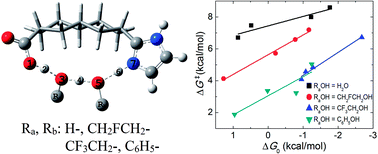
The long-range proton transfer dependence on the pKa of hydroxyl molecules in hydrogen (H)-bonded wires was investigated using quantum mechanical calculations. The triple proton transfer takes place in an asynchronous and concerted fashion between carboxylic and imidazole groups linked by two H-bonded chain molecules. Four hydroxyl molecules with different acidities, water, 2-fluoromethanol, 2,2,2-trifluoromethanol, and phenol, were used to construct sixteen H-bonded wires. The proton transfer rate increased with the acidity of the chain molecules. The rate was found to be more dependent on the particular chain molecule with relatively small structural changes in the wire, which can act as a solvent, rather than molecules with larger O–H bond cleavage in the TS. An inverse linear free energy relationship was recognized for the first time in the multiple proton transfer with a change in hydroxyl molecules. The activation and reaction free energies decreased and increased, respectively, with respect to the acidity of the chain molecules. This inverse LFER can be explained by the pKa slide rule, in which the pKa dependence of H-bond strength in a wire has an opposite trend for chain molecules that donate and accept a H-bond. Therefore, the pKa of wire molecules can have different roles, which leads to the very unusual relationship between the activation and reaction free energies.
Solvent structures near mediating water molecules must play an important role in the dynamics of direct proton relay. It has recently been shown that when the end groups have acidic or basic pKa values, proton transfer take place through protolytic or solvolytic pathways with H3O+ or OH− character in the TS, respectively; therefore, the rate constant becomes larger when the mediating water has H-bond accepting or donating solvent molecules, respectively.10 The dynamics of direct multiple proton relay will be much more complicated when non-identical hydroxyl molecules are components of a single H-bonded chain, as is found in many biological systems. Kwon et al.11 found that the rate constants of double proton transfer in 7-azaindole-alcohol complexes were dependent on the acidity of mediating alcohol molecules in the H-bonded wire. Recently, a triple proton transfer process through an H-bonded wire has been investigated with 7-hydroxyquinoline (7HQ) complexes and two different alcohol molecules in a non-polar solution.12,13 Very interestingly, the observed rate was relatively fast when a less acidic alcohol, rather than a more acidic one, was directly H-bonded to the base (imino-group) in the mixed 7HQ–RaOH–RbOH (Ra ≠ Rb) complex to start the proton transfer reaction. This observation was explained based on a hypothesis that proton transfer from RbOH to the base is promoted by a more acidic RaOH from the back along the asynchronous solvolytic pathway leading to accumulation of proton-donating abilities.14 The proton transfer of RbOH was stimulated by the so-called “push-ahead effect” of the RaOH in the H-bonded chain, and the strength of this effect increased with the gap between the proton-donating abilities of the two alcohols.14
The acidity of mediating alcohols would obviously affect the rates of direct long-range proton relay. However, the role of mediating molecules in direct proton relay has rarely been studied either experimentally or theoretically, and the accumulative role of chain molecules is not yet fully understood. If the so-called “push-ahead effect” of mediating alcohols plays an important role in direct multiple proton relay, it would not be limited to the excited-state 7HQ complex. We, therefore, developed a theoretical model to investigate the role of mediating hydroxyl molecules, in which carboxylic and imidazole moieties at the ends of trans-decalin were linked by an H-bonded chain made up of two hydroxyl molecules, as depicted in Fig. 1.
![]() | ||
| Fig. 1 The multiple proton transfer process via an H-bonded chain made up of two different alcohols. | ||
Carboxylic and imidazole groups are biologically important molecules, which are moderately acidic and basic, respectively, in aqueous solution. Therefore, this model could be used to mimic the long-range proton relay in biological systems. The distance between carboxylic group (donor) and imidazole (acceptor) in this model was about 7.5 Å, which was sufficient for two hydroxyl molecules to form a H-bonded chain. Among four hydroxyl molecules with different acidities (water, 2-fluoromethanol, 2,2,2-trifluoromethanol, and phenol), different pairs were selected as H-bonded chain components in this study.
The pKa value of the generic acid HA was calculated from the following equation:
| pKa = ΔG0(aq)/2.303RT |
From the thermochemical cycle, ΔG0(aq) can be calculated as
| ΔG0(aq) = G0(H+, aq) + G0(A−·nH2O, aq) − G0(HA·nH2O, aq) |
| = ΔG0(g) + ΔΔG0S |
The standard-state free energy of solvation maybe written as ΔG0S(X) = ΔG*S(X) + ΔG0C, where ΔG*S(X) corresponds to the solvation free energy in a process in which the concentration of solute X is the same in the gas phase and in a dilute liquid, and ΔG0C is the free energy required to bring the concentration to their standard-state values. The standard states of a 1 atm ideal gas and a 1 M ideal solution are approximately 1.89 kcal mol−1. In this work, we used the value of G0(H+, aq) is −6.28 kcal mol−1, which comes from the Sackur–Tetrode equation,20,21 and the value of ΔG0S(H+) is −264.0 kcal mol−1,22 which corresponds to ΔG*S(H+) is −265.9 kcal mol−1. All structures of protonated hydroxyl molecules were fully optimized in the gas phase and in solution at the M06-2X/6-311++G(2df,2pd) level.
While no H3O+ or OH− ions are generated as intermediates in the pathways, the transition state (TS) can have H3O+ or OH− character. In the protolytic TS of the direct proton relay (Scheme 1), RaOH has cationic character by accepting a proton partly dissociated from an acid while RbOH hardly changes. However, in the solvolytic TS, RbOH has anionic character by donating a proton partly to the base while RaOH hardly changes. We denote precedent alcohols as those that accept or donate proton early and have cationic or anionic character in the TS of the protolytic or solvolytic direct proton relay, respectively, and succedent alcohols as those that form an H-bond to the precedent alcohols without a significant structural change. The succedent alcohols can also be considered a solvent in the first solvation shell that stabilizes the solute by forming an H-bond.
The pKa values of the four hydroxyl molecules along with carboxylic group (which is approximate as pKa of acetic acid) and ImH+ are listed in Table 1. From these four molecules, sixteen different H-bonded chains could be derived. Structures of reactants, products, and TSs for the triple proton transfer were fully optimized at the M06-2X/6-31+G(d,p)/MIDIX level in aqueous solution.
Only one asynchronous and concerted solvolytic TS was found without any intermediate for these reactions. In the reactant, the H-bond distances between RbOH and imidazole (O5–H6⋯N7) were 1.85, 1.75, 1.66, and 1.64 Å for water, 2-fluoromethanol, 2,2,2-trifluoromethanol, and phenol, respectively. Note that for a given RbOH, four H-bonded chains could be constructed because four hydroxyl molecules were used for RaOH; therefore, each distance listed above is an average value of these four H-bonded chains. As the H-bond length becomes shorter, the H-bond energy becomes larger. This is true in general for a single H-bond. However, because it is not easy to estimate the energy of a specific H-bond in a relay chain, it is necessary to investigate whether the general relation between H-bond length and energy works equally well in the H-bonded relay chain. We used the natural bond order (NBO) analysis of H-bond,29–31 where the charge transfer interaction between the lone pair electron of oxygen (or nitrogen) and anti-bonding orbital of O–H bond is an important component of the H-bond, which therefore can be used to estimate the strength of H-bond; the larger the charge transfer interaction, the stronger the H-bond becomes. A good correlation was found between the charge transfer energies of each H-bond in the H-bonded chain and its lengths (Table S1 and Fig. S1†), which suggests that in general the H-bond becomes stronger as its length becomes smaller in the H-bonded wire.
The H-bond energies with phenol and water would be the largest and smallest, respectively. These trends are in good agreement with the pKa slide rule, in which the strength of the A–H⋯B bond increases with decreasing value of ΔpKa = pKa(A–H) − pKa(B+–H).32 In the product, the H-bond distances of N7–H6⋯O5 were 1.90, 1.92, 1.99, and 2.08 Å for water, 2-fluoromethanol, 2,2,2-trifluoromethanol, and phenol, respectively. The H-bonds of ImH+ with water and phenol were the strongest and weakest, respectively. To apply the pKa slide rule in this case, we need the pKa values of the protonated hydroxyl molecules. The pKa value of H3O+ is −1.74 in water;33 however, there are no experimental data for the other molecules. We calculated the pKa values at the M06-2X/6-311++G(2df,2pd) level based on the thermodynamic cycle described previously,19 which were −0.81, −2.70, −5.59, and −8.32, respectively, for H3O+, CH2FCH2OH2+, CF3CH2OH2+, and C6H5OH2+. These results indicate that the H-bond strength of the product also satisfies the pKa slide rule. The Löwdin partial charges34 of OH groups are also listed in Table 1. The strength of the H-bond depends on the magnitude of the partial charge. An alcohol with a large negative charge on oxygen can act as a good H-bond acceptor. Therefore, among the four tested molecules, H2O and C6H5OH were the best and worst H-bond acceptors, respectively.
The distance between the O1 and N7 atoms (donor–acceptor distance) decreased from 7.20 Å in the reactant to 6.75 Å at the TS and was restored to its original value in the product. The two end groups move closer with a minimum distance at the TS, a phenomenon that has also been observed in previous studies.35,36 Several distances of selected bonds at the TS with two identical molecules in the chain are listed in Table 2. The O1–H2 and N7–H6 distances were quite small (averaging approximately 1.05 Å) whereas the O3–H2 and O5–H6 distances were quite long (averaging approximately 1.55 Å). Additionally, the H4 proton was closer to the O3 atom than the O5 atom; the O3–H4 and O5–H4 distances were approximately 1.17 Å and 1.24 Å, respectively. These results indicate that, in the TS, RbOH has a larger structural change than RaOH and an RbO−-like moiety with a partial negative charge was generated. This structure would be the typical TS for the solvolytic proton relay mechanism (Scheme 1). This result is in agreement with experimental data that the direct triple proton transfer in 7-HQ along an H-bonded alcohol chain proceeds via a solvolytic pathway in an asymmetrically concerted fashion.13
| ROH | RbO− charge | Bond distance | |||||
|---|---|---|---|---|---|---|---|
| O1–H2 | H2–O3 | O3–H4 | H4–O5 | O5–H6 | H6–N7 | ||
| H2O | −0.54 | 1.08 | 1.39 | 1.17 | 1.24 | 1.49 | 1.11 |
| CH2FCH2OH | −0.59 | 1.06 | 1.44 | 1.17 | 1.24 | 1.51 | 1.09 |
| CF3CH2OH | −0.63 | 1.02 | 1.56 | 1.17 | 1.25 | 1.64 | 1.06 |
| C6H5OH | −0.68 | 1.00 | 1.69 | 1.19 | 1.22 | 1.81 | 1.04 |
Large negative partial charges were predicted for the RbO−-like moiety in the TS of the direct triple proton relay (Table 2), which confirms the asynchronous solvolytic mechanism. In this solvolytic pathway, RbOH and RaOH can be denoted precedent and succedent hydroxyl molecules, respectively, because the former donates proton early and becomes an RbO−-like moiety and the latter seems to stabilize the RbO−-like moiety by forming a strong H-bond in the highly asynchronous TS.
The property of the TS can be visualized with a correlation plot of H-bond distances. In A–H⋯B complexes, the rAH and rBH distances correlate with each other; the rAH and rBH values satisfy the Pauling equation under the assumption that the sum of bond orders is conserved during the H-transfer reaction. Limbach et al.37,38 have suggested that both proton transfer and hydrogen-bonding coordinates could be combined into the same correlation and defined the natural hydrogen bond coordinates q1 = (rAH – rBH)/2 and q2 = rAH + rBH to represent the correlation between rAH and rBH for A–H⋯B reactions. For a linear H-bond, q1 and q2 represent the dislocation of H from the H-bond center and the distance between the two heavy atoms, respectively. These coordinates can be used to study the characteristics of the TS, such as earliness or lateness, bond order, and asynchronicity. A negative or positive q1 value represents an early or late TS, respectively, and a small or large q2 value represents a tight or loose TS, respectively. Additionally, at the TS of the direct multiple proton relay, the q1 values of each hydrogen in flight would be very similar or different in the synchronous or asynchronous mechanisms, respectively.
The correlation between O1–H2 and O3–H2 distances (H2 transfer), O3–H4 and O5–H4 distances (H4 transfer), and O5–H6 and N7–H6 distances (H6 transfer) in the TS are depicted in Fig. 2. For simplicity, the q2 and q1 values of the H transfer are denoted as “the H correlation points”.
![]() | ||
| Fig. 2 Correlation for the H-bond distances of TS, q2 = r1 + r2 vs. q1 = 1/2 (r1 – r2). The solid lines designate the correlation that satisfies the conservation of bond order, where parameters for Pauling equations were from the literature.38 | ||
All correlation points of the TS were at or near the solid lines satisfying the Pauling equation of bond order,37,38 which implies the bond order is conserved during the multiple proton relay. When phenol is used for RaOH, the H2 correlation points appeared in the upper-left side of the correlation plot along the solid line, and when phenol is used for RbOH, the H6 points appeared in the upper-right side of the plot. In general, all H2 and H6 points appeared in the upper-left side and the upper-right side, respectively, and the H4 points appeared in the middle of the correlation plot, which indicates that H2 and H6 are closer to O1 and N7, respectively, while H4 is centered between O3 and O4. These results indicate that the multiple proton relay takes place by a highly asynchronous pathway and a [RaO–H–ORb]−-like moiety would be generated as part of the TS.
Free energies of activation (ΔG‡) and reaction (ΔG0) for the triple proton relay through an H-bonded chain made up of different pairs of hydroxyl molecules are listed in Table 3.
| Pair | Ordera | ΔG‡ | ΔG0 |
|---|---|---|---|
| a S and W denote hydroxyl molecules with relatively strong and weak acidities, respectively. | |||
| H2O and CF3CH2OH | S–S | 4.57 | −1.08 |
| S–W | 6.72 | −2.68 | |
| W–S | 7.47 | 0.48 | |
| W–W | 8.59 | −1.77 | |
| CH2FCH2OH and CF3CH2OH | S–S | 4.57 | −1.08 |
| S–W | 4.84 | −1.28 | |
| W–S | 5.72 | −0.21 | |
| W–W | 6.58 | −0.77 | |
| H2O and C6H5OH | S–S | 1.88 | 0.96 |
| S–W | 5.04 | −1.24 | |
| W–S | 6.70 | 0.86 | |
| W–W | 8.59 | −1.77 | |
| H2O and CH2FCH2OH | S–S | 6.58 | −0.77 |
| S–W | 7.19 | −1.17 | |
| W–S | 8.00 | −1.23 | |
| W–W | 8.59 | −1.77 | |
| CF3CH2OH and C6H5OH | S–S | 1.88 | 0.96 |
| S–W | 3.37 | 0.02 | |
| W–S | 4.08 | −0.95 | |
| W–W | 4.57 | −1.08 | |
| CH2FCH2OH and C6H5OH | S–S | 1.88 | 0.96 |
| S–W | 3.23 | −0.80 | |
| W–S | 4.13 | 1.27 | |
| W–W | 6.58 | −0.77 | |
When the same molecule was used for both RaOH and RbOH, the activation energies were 1.88, 4.57, 6.58, and 8.59 kcal mol−1 for C6H5OH, CF3CH2OH, CH2FCH2OH, and H2O, respectively. The smaller the pKa of the H-bonded chain molecule, the lower the activation energy. Similarly, when only one chain molecule is varied while the other remains unchanged, the smaller the pKa of the molecule, the lower the activation energy (Table S2†). This result probably occurs because the proton relay becomes easier as the O–H bonds of the chain become weaker. It is very interesting that the change in activation energy was larger when RaOH rather than RbOH was changed as depicted in Fig. S2† (the slope of ΔG‡ vs. pKa is larger with the change of RaOH).
The correlation between activation energy and pKa of the H-bonded wire is plotted in Fig. 3. The acidity of the H-bonded wire is represented by a × pKa1 + (1 − a) × pKa2, where 0 ≤ a ≤ 1, and pKa1 and pKa2 are acidity constants for RaOH and RbOH, respectively. The activation energy increased with the sum of the pKa's of the H-bonded wire. A good correlation was found with a = 0.62, which indicates that RaOH, the succedent alcohol, has a larger influence than RbOH, the precedent one, on the activation energy. These results suggest that the acidity of the wire cumulatively increases proton transfer rates, but each molecule contributes differently to the rate. The solvent effect of the succedent alcohol (RaOH) stabilizing the solute (precedent alcohol losing a proton) in the wire is more important in reducing the activation free energy than the acidity of the solute itself. All proton transfer reactions between acids and bases will give a Brönsted relation, log
kA = α
log
KA + constants, which is a linear free energy relationship (LFER) that can be expressed as δ(ΔG‡) = α δ(ΔG0), where ΔG‡ is the free energy of activation and ΔG0 is the standard free energy change for the proton transfer reaction. The α value is normally about 0.5 for a symmetric single proton transfer reaction, which suggests that the activation energy is changed by about half of the reaction energy resulting from the pKa change of the acid (a precedent molecule in our case). However, with the same change in pKa for the solvent molecule in the first solvation shell, the solvation energy for the solvolytic TS with a large anionic character can be larger than the activation energy resulting from the Brönsted relation.
![]() | ||
| Fig. 3 Correlation between activation energy and acidity of an H-bonded wire made up of two hydroxyl molecules. | ||
For two hydroxyl molecules in an H-bonded chain, S or W denote molecules with relatively stronger or weaker acidities, respectively, and the first and second letters represent RaOH and RbOH, respectively. The activation energies in this study were always smaller with S–W chains than with W–S chains, which implies that the direct multiple proton relay is always faster when the succedent hydroxyl molecule (RaOH) is more acidic than the precedent hydroxyl molecule (RbOH) rather than the alternative arrangement. Fig. 4 shows the correlation between the pKa gap of the two hydroxyl molecules in the chain and the ratio of activation energies with S–W and W–S chains, ΔG‡(W–S)/ΔG‡(S–W). The ΔG‡(W–S)/ΔG‡(S–W) ratio is always larger than unity and increases with the pKa gap. These results are consistent with the experimental rate constants for the excited-state triple proton transfer in mixed 7HQ–RaOH–RbOH (Ra ≠ Rb) complexes, which are larger when RaOH is more acidic than RbOH.14 It was postulated that proton donation is pushed by another hydroxyl group from the backside along the proton-replay pathway, the so-called “push-ahead effect”.14,39 This experimental observation, however, may be attributed to the fact that the succedent hydroxyl molecule in the wire has a larger influence on the activation energy. This stabilizing effect of RaOH will eventually help proton donation by RbOH to the acceptor; therefore, the so-called “push-ahead effect” seems to be operable.
![]() | ||
| Fig. 4 Correlation between the pKa difference of two hydroxyl molecules in the wire and the ratio of activation energies, ΔG‡(W–S)/ΔG‡(S–W). | ||
The activation energy of the long-range proton relay was monitored when only precedent hydroxyl molecule RbOH was changed in the wire, and the relationship between the free energies of activation and reaction are depicted in Fig. 5A. It is very interesting that as the reaction free energy becomes smaller (more negative), the activation energy becomes larger (Fig. 5A), which indicates an inverse LFER. To the best of our knowledge, an inverse LFER has never been reported for any proton transfer reaction. Most LFERs for proton transfer reactions have been studied with structural variations in the proton donor or acceptor. In this study, hydroxyl molecules in the wire were not the final proton donor or acceptor in the multiple proton relay, but they participated in the proton transfer process and changed the energetics of the reaction. As described previously, acidic hydroxyl molecules in the wire reduced the free energy of activation. However, Fig. 5B shows that an acidic RbOH increased the reaction free energy because the H-bond between ImH+ and RbOH in the product becomes weaker as a more acidic molecule was used for RbOH, due to the pKa slide rule. The smaller the pKa of RbOH becomes (more acidic), the lower the activation energy and at the same time the higher the reaction free energy, which will give an inverse LFER. This study shows that the pKa of the wire can have different roles in the activation energy and reaction free energy, which leads to the very unusual inverse LFER.
![]() | ||
| Fig. 5 (A) LFERs for the direct proton relay with the change of RbOH in the wire and (B) the free energy of reaction with respect to the pKa difference between RbOH and ImH+. | ||
In this study we investigated the role of pKa of hydroxyl molecules on the multiple proton transfer through H-bonded wire in aqueous solution. Since the proton relay is very important in biological systems, it would be useful to consider our results in comparison with the proton relay in non-aqueous medium (protein) with a low dielectric constant. The concept of pKa values breaks down in proteins and therefore the H-bond length may not be predicted by the pKa values of both groups in water. This means that pKa slide rule cannot be used to predict the H-bond energy and length in protein. It was shown that the proton transfer in the active site of protein is better modeled using the proton transfer in polar aprotic solvents and the polarity inside enzymes is induced mostly by polar side chains and bound water molecules,40,41 which can be mimicked as that of organic solvent with a dielectric constant of about 30. We calculated the activation and reaction free energies in a medium with the dielectric constant of 10, and the results are listed in Table S3† and Fig. 6, which show a good inverse LFER too. This is probably because the relative acidity and basicity of our hydroxyl molecules are maintained in a nonpolar environment. This result suggests that, although the pKa slide rule cannot be used to predict the proton transfer in protein, the general concept between acid–base property and the H-bond strength (and the free energy of activation) would work well to predict the proton relay through well-defined chain molecules.
![]() | ||
| Fig. 6 LFERs for the direct proton relay with the change of RbOH in the wire in a medium with a dielectric constant of 10. | ||
Footnote |
| † Electronic supplementary information (ESI) available. See DOI: 10.1039/c4ra15076g |
| This journal is © The Royal Society of Chemistry 2015 |