One-pot cascade synthesis of 2,3-disubstituted 2,3-dihydrobenzofurans via ortho-quinone methide intermediates generated in situ

Abdul kadar Shaikh and George Varvounis*
Section of Organic Chemistry and Biochemistry, Department of Chemistry, University of Ioannina, 45110 Ioannina, Greece. E-mail: gvarvoun@cc.uoi.gr

Received 21st November 2014 , Accepted 26th January 2015

First published on 26th January 2015


Abstract

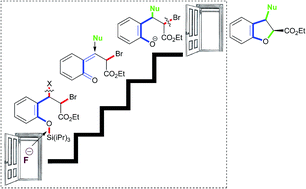
A simple and efficient one-pot cascade reaction for the regioselective synthesis of trans or cis/trans 2,3-disubstituted 2,3-dihydrobenzofurans is reported. The method involves fluoride-induced desilylation, generation of o-quinone methide (o-QM) by chloride or nitrate anion elimination, Michael addition and intramolecular 5-exo-tet elimination of a bromide anion. Nitrate, acetoxy and chloride anions are compared as leaving groups in the formation of the in situ generated o-QM.

Introduction

2,3-Disubstituted 2,3-dihydrobenzofurans are found in an increasing number of biologically active molecules and natural products. For example, cis 2-ethoxy-3-hydroxyethyl derivative 1 and trans acetic acid 2-aryl-3-ylmethyl ester derivative 2 were isolated from Rhododendron mariae Hance species,1 aminophenethylethanol derivatives 3 have demonstrated anti-multi drug resistance (MDR) properties2 while (+)-lithospermic acid is a potent and nontoxic anti-HIV agent that inhibits HIV-1 integrase (Fig. 1).3

The synthesis of 2,3-dihydrobenzofurans has been reviewed recently.4 The best developments in the past 10 years towards the synthesis of 2,3-disubstituted 2,3-dihydrobenzofurans were by cyclodehydration of 2-(2-hydroxyethyl)phenols,5 asymmetric formal [4 + 1] cycloaddition of camphor-derived sulfonium salts with aldimines,6 tandem Claisen rearrangement and intramolecular hydroaryloxylation of allyl aryl ethers,7 intramolecular CH–insertion reactions,8 palladium-catalyzed acyloxyarylation of benzofurans via dearomatization with arylboronic and carboxylic acids,9 intramolecular aza-spiroannulation onto benzofurans using chiral rhodium catalysis,10 intramolecular Michael addition-lactonization of [2-(α,β-unsaturated carbonyl)phenoxy]acetic acids by organic and organometallic catalysts,11 cerium ammonium nitrate-mediated oxidative dimerization of p-alkenylphenols12 and through reactions of 2-hydroxyaryl-α,β-unsaturated ketones with dimethylsulfonium carbonylmethylides.13 The first report of a 2,3-dihydrobenzofuran synthesis via an o-quinone methide (o-QM) intermediate was the C–H insertion reaction on the o-QM derived from (2-hydroxybenzyl)trimethylammonium iodide by dimethyl sulfoxonium methylide in base, followed by intramolecular substitution of trimethylamine, that gave the parent compound.14 After forty-four years, o-QM intermediates have been used again to synthesise 2,3-dihydrobenzofurans. This time, (2-hydroxybenzyl)trimethylammonium iodides were heated to reflux in acetonitrile and in the presence of DBU to generate the corresponding o-QMs in situ that reacted with pyridinium acylmethylides to give 2-substituted 2,3-dihydrobenzofurans.15 A different concept involved the generation of o-QMs in situ from 2-(1-tosylmethyl)phenols using caesium carbonate as base while reaction with sulfur ylides led to the synthesis of trans-2,3-disubstituted-2,3-dihydrobenzofurans.16 Subsequently, an oxidative method for the generation of o-QMs was reported. 2-Alkylsubstituted phenols were oxidised by silver oxide to generate o-QMs in situ that were reacted with sulfur ylides to afford 2,3-disubstituted 2,3-dihydrobenzofurans in excellent diastereoselectivity.17


image file: c4ra15024d-f1.tif
Fig. 1 Natural and biologically active 2,3-disubstituted 2,3-dihydrobenzofurans.

In our previous work we have reported a new method for generating o-QM in situ that involves fluoride-induced desilylation of 2-(tert-butyldimethylsilyloxy)benzyl nitrate and elimination of a nitrate anion. An important feature of this method is the ease of elimination of the nitrate group which is the key to rapid o-QM formation. Michael addition to the o-QM formed in situ by different C, N, O, and S nucleophiles led to a variety of 2-(substituted methyl)phenols.18a Subsequently, this method was applied toward the regioselective synthesis of 3-substituted 2,3-dihydrobenzofurans. This was accomplished by fluoride anion cleavage of the Si–O bond of 2-bromo-1-{2-[(triisopropylsilyl)oxy]phenyl}ethyl nitrate followed by conjugate elimination of nitrate anion from the resulting phenoxide anion intermediate to produce o-QM in situ. Michael addition of different C, N, O and S nucleophiles to the transient o-QM species gave a higher substituted phenoxide anion intermediate which cyclised to the final product by intramolecular 5-exo-tet elimination of bromide anion.18b

In view of our continuing interest in 2,3-dihydrobenzofurans as pharmacologically active substances and due to the lack of a versatile and efficient method of introducing variable substitution at position 3 of the 2-substituted 2,3-dihydrobenzofurans, we now present an application of our novel method for generating an o-QM and trapping with N, O, and S nucleophiles by using 8, 14 and 18 as precursors and incorporating into the one-pot reaction an intramolecular 5-exo-tet elimination process, to afford 2,3-disubstituted 2,3-dihydrobenzofurans.

Results and discussion

Herein, we report a simple synthesis of 2,3-disubstituted 2,3-dihydrobenzofurans from commercially available starting materials via the generation of an appropriate o-QM in situ. To accomplish this goal we planned the synthesis of o-QM precursor 8 from 2-hydroxybenzaldehyde 4. Compound 8 was designed so that after fluoride-induced cleavage of the TIPS protecting group, elimination of acetoxy anion and o-QM generation, nucleophilic addition of a nucleophile (RH) to the o-QM 11a (Path b, Scheme 2) would lead to phenoxide anion 12a that could cyclise by bromo anion elimination to afford 2,3-disubstituted 2,3-dihydrobenzofurans 13a. For the synthesis of compound 8 (Scheme 1), compound 4 was converted to the acrylate 5 by a Wittig condensation19 that is, treating 4 with triphenyl phosphine and ethyl bromoacetate in water. Acrylate 5 was obtained in 84% yield. The hydroxy group of 5 was then protected by introducing a triisopropylsilyl group using TIPSCl, DMAP, and (i-Pr)2NH in dichloromethane, to afford 6 in 90% yield. The latter was then reacted with N-bromosuccinimide20 and water to give bromohydrin derivative 7, in 78% yield. Acetylation of alcohol 7 with acetic anhydride and a catalytic amount of DMAP in dichloromethane afforded acetoxy derivative 8, in 97% yield. This reaction was similar to that used for the acetylation of mesitol.21 In order to verify the feasibility of transforming acetate 8 into dihydrobenzofuran 9 (Scheme 1), acetate 8 was treated with pyrrolidine in THF at −78 °C followed by dropwise addition of TBAF at −78 °C. The reaction did not afford dihydrobenzofuran 9 but instead benzofuran 10 was isolated in 89% yield.
image file: c4ra15024d-s1.tif
Scheme 1 Attempted synthesis of ethyl 3-pyrrolidin-1-yl-2,3-dihydro-1-benzofuran-2-carboxylate 9.

When the reaction of compound 8 was repeated with pyrrolidine in THF but this time dropwise addition of TBAF at either 0 °C or at room temperature, compound 10 was obtained in 85% and 72% yield, respectively. Also, reaction of compound 8 with methyl thioglycolate in THF at −78 °C followed by dropwise addition of TBAF gave compound 10 in 84% yield. Furthermore, by using methanol both as nucleophile and solvent the reaction at −78 °C with dropwise addition of TBAF afforded compound 10 in 92% yield (Table 1). From the yields of compound 10 obtained in these reactions, it is reasonable to conclude that at −78 °C the o-QM intermediate 11 formed (Scheme 2) is more stable than at higher temperatures. On the other hand, the acetoxy anion has been proved to serve as a good leaving group during the generation of o-QMs, as described from precursors such as acetic acid 4-acetoxy-2-hydroxy-6-methylbenzyl ester and acetic acid 5-benzyl-2-(tert- butyldimethylsilanyloxy)benzyl ester, during the synthesis of natural product Alboatrin22 and bioactive Puupehedione,23 respectively. In these precursors, hydrogen bonding such as that proposed between the carbonyl oxygen and the α-hydrogen atom of the ester group of compound 8 (Scheme 2) and its role in abstracting this proton, are not feasible.

Table 1 Synthesis of ethyl 1-benzofuran-2-carboxylate 10 using a N, O or S nucleophile
Entry RH Product Yielda
a Isolated yields.b Instead of using THF as a solvent, methanol was used.
1 image file: c4ra15024d-u1.tif image file: c4ra15024d-u2.tif 89% at −78 °C
85% at 0 °C
72% at rt
2 image file: c4ra15024d-u3.tif image file: c4ra15024d-u4.tif 84% at −78 °C
3 image file: c4ra15024d-u5.tif image file: c4ra15024d-u6.tif 92% at −78 °C


image file: c4ra15024d-s2.tif
Scheme 2 Proposed mechanism for the synthesis of ethyl 1-benzofuran-2-carboxylate 10.

The outcome of this reaction can be explained on the basis of the proposed mechanism depicted in Scheme 2. The first step of the reaction involves cleavage of the Si–O σ-bond of compound 8 by fluoride ion followed by conjugation by a lone-pair of the negatively charged oxygen atom into the aromatic ring and elimination of acetic acid (Path a). The prerequisite for elimination of acetic acid is a strong hydrogen bond between the carbonyl oxygen of the acetoxy group and the acidic proton of the tertiary carbon atom bonded to a bromine atom and an ester group. The carbanion of the resulting intermediate 11 is stabilised by the aforementioned electron-withdrawing groups but more stability is provided to the molecule when it aromatises by conjugation to give intermediate phenoxide 12. The alkene π-electrons of the styrene moiety of 12 are displaced by conjugation into the aromatic benzene ring as the charged oxygen atom of the molecule approaches the carbon atom bearing the bromine atom and ester group. The resulting intermediate carbanion 13 is stabilized by conjugation but further stabilization is delivered by the exo-tet elimination of bromine ion and the formation of the fully aromatic benzofuran 10. A similar type of cyclisation has been described by Mérour and co-workers.24

The failure of obtaining compound 9 from compound 8 led us to change the acetoxy group on compound 8 to a chloro atom, as on benzyl chloride derivative 14 (Scheme 3), in the hope that after treating the latter with TBAF cleavage of the Si–O σ-bond would occur leading to chloride anion elimination and o-QM generation. Compound 14, obtained in 90% yield by heating benzyl alcohol derivative 7 in neat thionyl chloride at 65 °C, was then treated with pyrrolidine in THF at −78 °C followed by dropwise addition of TBAF at −78 °C, to afford trans dihydrobenzofuran 9 in 54% yield. In this reaction (Scheme 3), it is proposed that cleavage of the Si–O σ-bond of compound 14 by fluoride ion and conjugation of the oxygen atom lone-pair into the aromatic ring with concomitant elimination of chloride anion, generates o-QM 11a. The latter undergoes Michael addition by pyrrolidine and the resulting phenoxide intermediate 15 cyclises via an exo-tet elimination of a bromide anion to afford the trans isomer of dihydrobenzofuran 9, as the only product and in 54% yield.


image file: c4ra15024d-s3.tif
Scheme 3 Synthesis of ethyl 3-pyrrolidin-1-yl-2,3-dihydrobenzofuran-2-carboxylate 9.

In order to test the applicability of this reaction it was repeated using methyl thioglycolate instead of pyrrolidine. The only product isolated was the trans isomer of the dihydrobenzofuran 16, obtained in 59% yield (Scheme 4). A third nucleophile, methanol, was used also as solvent. By dissolving compound 14 in methanol lowering the temperature to −78 °C and then adding TBAF dropwise at −78 °C, two products were obtained after separation by column chromatography, the trans dihydrobenzofuran 17a and the cis dihydrobenzofuran 17b in 16% and 19% yield, respectively. The formation of the trans 17a and cis 17b isomers in the case of methanol being used as nucleophile in contrast to the formation of trans 9 and trans 16 isomers in the case of pyrrolidine and methyl thioglycolate being used as nucleophiles, respectively, is probably due to the smaller size of methanol relative to pyrrolidine and methyl thioglycolate, allowing nucleophilic attack by methanol on both planes of the methide β-carbon atom of the planar o-QM intermediate.


image file: c4ra15024d-s4.tif
Scheme 4 Synthesis of dihydrobenzofurans 16 and 17 from propanoate 14 using methyl thioglycolate and methanol as nucleophiles.

In order to compare the efficiency of the nitrate anion, compared to the chloride anion, as leaving group during the generation of the o-QM, the nitrate ester 18 was prepared from the dihalo compound 14 using a method reported by Lehmann and co-workers.25 Compound 14 was stirred overnight with 2 equivalents of silver nitrate in acetonitrile to afford regioselectively nitrate ester 18, in 96% yield. This reaction occurred most probably via an SN1 mechanism involving elimination of chloride anion and formation of a stabilized benzylic carbocation prior to addition by the nitrate anion. The nitrate ester 18 in THF at −78 °C in the presence of pyrrolidine or methyl thioglycolate and the nitrate ester 18 in methanol at −78 °C were then subjected to dropwise addition of TBAF. These reactions led to the isolation of the corresponding 2,3-disubstituted 2,3-dihydrobenzofurans 9, 16, 17a and 17b, in 76, 84, 37 and 43% yields, respectively (Scheme 5). The yields of dihydrobenzofurans 9, 16, 17a and 17b using propanoate 18 as starting material are much higher than the corresponding yields using propanoate 14. This confirms the higher efficiency of the nitrate anion, compared to the chloride anion, as leaving group during the generation of the o-QMs in the aforementioned reactions.


image file: c4ra15024d-s5.tif
Scheme 5 Synthesis of dihydrobenzofurans 9, 16 and 17 from ethyl 2-bromo-3-(nitrooxy)-3-{2-[(triisopropylsilyl)oxy]phenyl}propanoate 18 using pyrrolidine, methyl thioglycolate and methanol as nucleophiles.

The novelty of this method resides in the cascade reaction that involves Si–O and C–ONO2 (or less efficiently C–Cl) bond cleavage leading to o-QM generation, followed by C–N/C–O/C–S bond formation, C–Br bond cleavage and C–O bond formation that leads to ring closure. The advantage of one-pot cascade reactions over stepwise reactions is their economy in solvents, reagents, adsorbents and energy.26

Conclusions

In conclusion, we have presented a new one-pot cascade regioselective synthesis of trans or cis/trans 2,3-disubstituted 2,3-dihydrobenzofurans from either ethyl 2-bromo-3-chloro-3-{2-[(tri-isopropylsilyl)oxy]phenyl}propanoate or ethyl 2-bromo-3-(nitrooxy)-3-{2-[(triisopropylsilyl)oxy]phenyl}propanoate, the latter providing higher yields of products. The reaction takes place by fluoride-induced Si–O σ-bond cleavage from n-tetrabutylammonium fluoride followed by chloride anion or nitrate anion elimination to generate the corresponding o-QM intermediate. Michael addition of a N, O or S nucleophile to the o-QM gives a phenoxide anion intermediate which undergoes intramolecular 5-exo-tet elimination of a bromide anion to afford the respective trans or cis/trans 2,3-disubstituted 2,3-dihydrobenzofuran. Similar reactions using ethyl 3-(acetyloxy)-2-bromo-3-{2-[(triisopropylsilyl)oxy]phenyl}propanoate as starting material gives only the fully aromatic parent benzofuran. The methodology described will be useful in the synthesis of natural products and pharmacologically active compounds.

Acknowledgements

We thank the State Scholarship Foundation (I. K. Y.) of Greece (for a studentship to A. K. S., Grant no. 1210) for support. We appreciate the use of NMR and mass spectrometry facilities funded by the Network of Research Supporting Laboratories of the University of Ioannina and thank Dr K. Tsiafoulis, and Dr A. Karkabounas, of the University of Ioannina, for NMR and mass spectra, respectively.

Notes and references

  1. Q. Guo, Y. Li, Y.-B. Liu, H.-S. Gu, Y.-D. Wang, Q. Hou and S.-S. Yu, J. Asian Nat. Prod. Res., 2014, 16, 1 CrossRef PubMed.
  2. S. Rebitzer, D. Annibali, S. Kopp, M. Eder, T. Langer, P. Chiba, G. F. Ecker and C. R. Noe, Farmaco, 2003, 58, 185 CrossRef CAS.
  3. (a) Y. L. Lin, C. N. Wang, Y. J. Shiao, T. Y. Liu and W. Y. Want, J. Chin. Chem. Soc., 2003, 50, 1079 CAS; (b) I. S. Abd-Elazem, H. S. Chen, R. B. Bates and R. C. C. Huang, Antiviral Res., 2002, 55, 91 CrossRef CAS.
  4. F. Bertolini and M. Pineschi, Org. Prep. Proced. Int., 2009, 41, 385 CrossRef CAS.
  5. F. Bertolini, P. Crotti, V. Di Bussolo, F. Macchia and M. Pineschi, J. Org. Chem., 2007, 72, 7761 CrossRef CAS PubMed.
  6. Y. Cheng, X.-Q. Hu, S. Gao, L.-Q. Lu, J.-R. Chen and W.-J. Xiao, Tetrahedron, 2013, 69, 3810 CrossRef CAS PubMed.
  7. V. H. Grant and B. Liu, Tetrahedron Lett., 2005, 46, 1237 CrossRef CAS PubMed.
  8. M. Ito, R. Namie, J. Krishnamurthi, H. Miyamae, K. Takeda, H. Nambu and S. Hashimoto, Synlett, 2014, 25, 288 CAS.
  9. K. Hata, Z. He, C. G Daniliuc, K. Itami and A. Studer, Chem. Commun., 2014, 50, 463 RSC.
  10. T. Shibuta, S. Sato, M. Shibuya, N. Kanoh, T. Taniguchi, K. Monde and Y. Iwabuchi, Heterocycles, 2014, 89, 631 CrossRef CAS PubMed.
  11. (a) D. Belmessieri, A. de la Houpliere, E. D. D. Calder, J. E. Taylor and A. D. Smith, Chem.–Eur. J., 2014, 20, 9762 CrossRef CAS PubMed; (b) S. Jiang, B. Hu, X. Yu and W. Deng, Chin. J. Chem., 2014, 32, 694 CrossRef CAS.
  12. P.-Y. Chen, Y.-H. Wu, M.-H. Hsu, T.-P. Wang and E.-C. Wang, Tetrahedron, 2013, 69, 653 CrossRef CAS PubMed.
  13. S. Malik, U. K. Nadir and P. S. Pandey, Tetrahedron, 2009, 65, 3918 CrossRef CAS PubMed.
  14. E. Breuer and D. Melumad, Tetrahedron Lett., 1969, 10, 1875 CrossRef.
  15. V. A. Osyanin, D. V. Osipov and Y. N. Klimochkin, J. Org. Chem., 2013, 78, 5505 CrossRef CAS PubMed.
  16. M.-W. Chen, L.-L. Cao, Z.-S. Ye, G.-F. Jiang and Y.-G. Zhou, Chem. Commun., 2013, 49, 1660 RSC.
  17. B. Wu, M.-W. Chen, Z.-S. Ye, C.-B. Yu and Y.-G. Zhou, Adv. Synth. Catal., 2014, 356, 383 CrossRef CAS.
  18. (a) A. K. Shaikh, A. J. A. Cobb and G. Varvounis, Org. Lett., 2012, 14, 584 CrossRef CAS PubMed; (b) A. K. Shaikh and G. Varvounis, Org. Lett., 2014, 16, 1478 CrossRef CAS PubMed.
  19. J. Wu and C. Yue, Synth. Commun., 2006, 36, 2939 CrossRef CAS.
  20. S. Bar, Can. J. Chem., 2010, 88, 605 CrossRef CAS PubMed.
  21. D. J. Berry, C. V. DiGiovanna, S. S. Metrick and R. Murugan, ARKIVOC, 2001, i, 201 Search PubMed.
  22. R. Rodriguez, R. M. Adlington, J. E. Moses, A. Cowley and J. E. Baldwin, Org. Lett., 2004, 6, 3617 CrossRef CAS PubMed.
  23. A. F. Barrero, J. F. Quıĺez del Moral, M. M. Herrador, P. Arteaga, M. Cortés, J. Benites and A. Rosellón, Tetrahedron, 2006, 62, 6012 CrossRef CAS PubMed.
  24. A. Arrault, J.-Y. Merour, J.-M. Leger, C. Jarry and G. Guillaumet, Helv. Chim. Acta, 2001, 84, 2198 CrossRef CAS.
  25. C. Webler, A. Homann, U. Fricke and J. Lehmann, Eur. J. Med. Chem., 2003, 38, 581 CrossRef.
  26. K. C. Nicolaou, D. J. Edmonds and P. G. Bulger, Angew. Chem., Int. Ed., 2006, 45, 7134 CrossRef CAS PubMed.

Footnote

Electronic supplementary information (ESI) available: Experimental details, characterization data, 1H and 13C NMR spectra for all new compounds. See DOI: 10.1039/c4ra15024d

This journal is © The Royal Society of Chemistry 2015
Click here to see how this site uses Cookies. View our privacy policy here.