Jing Guo,
Zhaoyin Wen*,
Guoqiang Ma,
Jun Jin,
Weiqi Wang and
Yu Liu
CAS Key Laboratory of Materials for Energy Conversion, Shanghai Institute of Ceramics, Chinese Academy of Sciences, Shanghai 200050, P. R. China. E-mail: zywen@mail.sic.ac.cn; Fax: +86-21-52413903; Tel: +86-21-52411704
First published on 3rd February 2015
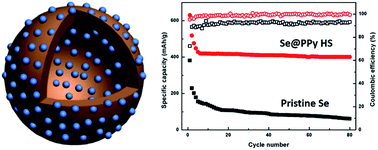
A selenium@polypyrrole hollow sphere composite cathode delivers a reversible specific discharge capacity of 400 mA h g−1 after 80 cycles and a 60% reduction in impedance of the cycled cells is obtained. The soluble polyselenide species are demonstrated to be confined by PPy hollow spheres, thus inhibiting the shuttle effect to a large extent.
Selenium, belonging to the same group as sulfur, with a high specific theoretical capacity of 675 mA h g−1 or 3253 mA h cm−3, was first demonstrated as a candidate cathode material for lithium and sodium rechargeable batteries by Abouimrane et al.11 They investigated the structural mechanisms for Li insertion in selenium-based electrodes and their results show that the trigonal structural Se finally transforms into an antifluorite-type Li2Se phase during discharge. They also found that the redox shuttle effect in the Se cathode was less severe than that in a S cathode. Li–Se batteries are supposed to possess a large volumetric energy density, which is of greater importance than gravimetric energy density in terms of the low weight and portability of batteries. Moreover, selenium exhibits a quite high intrinsic electronic conductivity (1 × 10⁻³ S m−1) that is about 20 orders of magnitude greater than that of sulfur,11,12 indicating better electrochemical activity and better rate capability. Nevertheless, the shuttle effect in the Li–Se system that deteriorates the cycle performance due to the dissolution of polyselenide species in electrolytes remains a problem.13 Some of the strategies used to address the similar issue in Li–S batteries can be applied to Li–Se batteries, such as carbon coating,14–16 use of microstructures with various morphologies,17,18 exploration of appropriate electrolyte systems19–21 and other methods of modification.22 Zhang et al. presented a simple way to improve the specific capacity of Li–Se batteries by inserting a conductive, porous carbon interlayer between the cathode and the separator.23 Wu et al. prepared a Se–C cathode via low temperature treatment that delivered a capacity of 187 mA h g−1, even at a current density of 500 mA g−1.24
Conductive polymer compounds have been repeatedly used in Li secondary batteries due to their good electrochemical activities and better accommodation of volume expansion than carbon.25 Polypyrrole was reported to be beneficial in improving the performance of Li–S batteries26–28 and was also adopted for the Se cathode. Kundu et al.29 studied the performance of nano-fibrous selenium (20–50 nm) with a polypyrrole coating, synthesized by a surfactant-free solution method, as a cathode material and demonstrated that polypyrrole wrapping enhanced the capacity by withstanding the large magnitude of shrinkage and expansion in volume. Considering that polypyrrole has both electronic and ionic conductivity, which can diminish electrochemical polarization, we employed polypyrrole hollow spheres in the cathode for a Li–Se battery system in order to confine Se and polyselenides. The loss of active material and capacity fading were effectively suppressed.
:
4 weight ratio was mixed uniformly by grinding for 30 minutes. Then the mixture was sealed in an evacuated glass tube and heated at 250 °C for 12 h. After that the composite was washed with CS2 solvent 3 times to remove the unconfined Se.
The cycled Li anode samples for SEM measurements were prepared in an argon-filled glove box. The cells were disassembled after cycling and the cycled Li foils were washed with pure 1,2-dimethoxyethane (DME, anhydrous, Sigma) and then dried for 2 h. A special transfer system31 was employed to transfer the cycled lithium samples from the glove box to a SEM system without exposing them to air.
:
1 was employed as the electrolyte. A glass fiber disc and lithium foil were used as the separator and the anode, respectively.
Galvanostatic discharge/charge tests were performed on a LAND CT2001A battery test system (Wuhan, China) in a voltage range of 1.6–2.6 V (vs. Li/Li+). AC impedance spectroscopy data were collected over a frequency range from 0.01 Hz to 1 MHz, with a potential amplitude of 10 mV, on an Autolab Electrochemical Workstation (ECO CHEMIE B.V, Netherlands). Cyclic voltammetry (CV) measurements were also conducted on the Autolab Electrochemical Workstation at 0.1 mV s−1 in the potential range of 1.0–3.0 V. All the electrochemical measurements were carried out at room temperature. The value of Coulombic efficiency is determined by dividing the discharge capacity by the charge capacity of each cycle.
![]() | ||
| Fig. 1 (a) SEM image of PPy hollow spheres; (b) TEM images of PPy hollow spheres; (c) Se@PPy HS and corresponding C and Se elemental mapping. | ||
Fig. 2a shows the XRD patterns of pristine Se, PPy HS and the Se@PPy HS composite. All the diffraction peaks of pristine Se, of extreme sharpness and high intensity, can be indexed as those of the trigonal phase of selenium. By comparison, the identical diffraction peaks of Se in the Se@PPy HS composite become much weaker and broader, which indicates that some of the crystalline Se has become amorphous and most of the Se has diffused into the hollow spheres.
![]() | ||
| Fig. 2 (a) XRD patterns of Se, PPy HS and Se@PPy HS; (b) Raman spectra of Se, PPy HS and Se@PPy HS; (c) schematic illustration of the Se@PPy HS composite and a possible spatial structure for it. | ||
The structural features of the Se in the composite were further probed using Raman Spectroscopy (Fig. 2b). Compared with the pristine Se, the intensity of the characteristic peak of Se greatly decreases in the Se@PPy HS composite but the spectrum of the composite still shows a small peak at 236 cm−1 which corresponds to the chain-structured Sen molecule,32 thus indicating the impregnation of Se into the PPy hollow spheres.13 Chain-like Sen molecules are likely to exhibit superior electrochemical properties because of their strong interaction with the host matrix.33 In the spectrum of PPy, a major broad band at 1348 cm−1 is assigned to a hybrid mode of intra-ring C–C bond stretching and mainly inter-ring C–C bond stretching, antisymmetrical C–N stretching, or ring stretching.34 The other band at 1571 cm−1 is assigned to the C
C backbone stretch contributed by the cation species.35 However, after encapsulation of Se into the PPy hollow spheres, the band at 1348 cm−1 red shifts to 1343 cm−1 while the C
C band shifts to 1555 cm−1, which is attributed to neutral species.35 The shift of bands reveals certain interactions between the Se and PPy matrix.
The schematic illustration of the Se@PPy HS composite and a possible spatial structure of it are shown in Fig. 2c. The thin wall of the PPy hollow sphere, which is favorable for both electron conduction and Li ion transport, can physically hinder the dissolution of polyselenides. The volume expansion during cycling can be well-buffered by the hollow space. Furthermore, the interaction force between chain-like Sen and PPy generated during the heat treatment can also play a part in inhibiting the shuttle effect. According to the above Raman analysis, the C
C backbone stretch in PPy changes a little after the infiltration of Se. Therefore, we can speculate that part of the chain-like Sen in the composite has certain interactions with the C atom in the C
C bonds, as indicated by the black dotted lines in Fig. 2c. Thus, a cross-linked Se–PPy network is developed. A similar phenomenon is observed in S@PPy composite.30
The CV curves of Li–Se and Li–Se@PPy HS cells are shown in Fig. 3. The curves of the pristine Se cathode vary a lot with the increase of scanning laps, while those of the Se@PPy HS cathode almost overlap, thus confirming that the composite cathode displays high reversibility and stability. The cathodic peak current of the composite electrode is 4 times higher than that of pristine Se, implying higher electrochemical activity of the Se@PPy HS cathode. During the initial discharge process of the Li–Se@PPy HS cell, two cathodic peaks at 2.04 V and 1.60 V are noted, corresponding to the conversion of elemental Se to polyselenides, and polyselenides to Li2Se, respectively. Only one anodic peak (Li-extraction) is observed at 2.37 V in the subsequent anodic sweep to 3.0 V. In the second and third cycles, the reduction peaks shift by 0.03 V to a higher potential while the oxidation peaks shift to a lower potential by 0.04 V. The slight shift in the peak potentials indicates a decrease in electrochemical polarization and the good reversibility of the Se@PPy HS composite. Furthermore, the oxidation peak current becomes greater as the scanning continues, which is related to the activation of the electrochemical process.
![]() | ||
| Fig. 3 Cyclovoltammetric behavior of pristine Se (a) and Se@PPy HS electrode (b) performed at a scan rate of 0.1 mV s−1 between 1.0 and 3.0 V against Li+/Li. | ||
Fig. 4a displays the galvanostatic discharge/charge voltage profiles of the Se@PPy HS cathode at 0.2 C between 1.6 V and 2.6 V. Consistent with the cyclic voltammetry curves, two discharge plateaus are shown in the discharge curves, which can be attributed to the two classical step reactions of elemental selenium with lithium during the discharge process.36 The composite cathode delivers an initial discharge capacity of 630 mA h g−1. Fig. 4b compares the specific discharge capacity and Coulombic efficiency of Se@PPy HS and pristine Se at a rate of 0.2 C. The pristine Se cathode presents rather poor cycling stability with a low reversible capacity of less than 45 mA h g−1 after 80 cycles. The severe capacity fading is ascribed to the shuttle effect with dissolution of polyselenide species generated during the discharging process, which also results in a lower Coulombic efficiency. By contrast, a specific discharge capacity of 400 mA h g−1 is obtained for the Se@PPy HS electrode after 80 cycles. Moreover, the Coulombic efficiency almost reaches 100%, indicating that the shuttle effect is effectively inhibited by the hollow structure of PPy matrix (the Coulombic efficiency displayed over a smaller scale range is shown in Fig. S2†). The large capacity loss during the first five cycles can be interpreted as follows. Some of the Se in the composite cathode is free and dissociative instead of being restricted inside the hollow spheres or connected with PPy. The polyselenide species generated by this dissociative Se during the discharge process dissolve in the electrolyte and migrate to the anode, thus resulting in the loss of active mass. It is the rest of the Se inside the hollow spheres or interacting with PPy that contributes to the stable discharge capacity in subsequent cycles.
The Se@PPy HS cathode also shows an excellent rate capability (Fig. 4c). The discharge capacity gradually decreases as the current rate increases from 0.1 C to 2 C (1 C is 675 mA h g−1). A capacity of 238 mA h g−1 is retained at 2 C and it recovers to 402 mA h g−1 when the current rate is reduced back to 0.1 C, indicating the high reversibility of the composite cathode. Even after 100 cycles, a capacity of 399 mA h g−1 is retained. The good rate capability of the composite cathode can be attributed to the facile electronic/ionic transport and fast reaction kinetics in Se@PPy HS.
Electrochemical impedance spectroscopy (EIS) provides further evidence for the superior cyclability of the Se@PPy HS composite, as Fig. 4d indicates. The data show that the charge transfer resistance (Rct) obviously decreases when pristine Se is substituted by Se@PPy HS as the cathode, demonstrating higher electrochemical activity of the composite cathode. The improved electrochemical activity can be ascribed to the reduced corrosion of the Li surface, which results from the suppression of shuttle effect during cycling.
After 50 cycles, the two kinds of cells were disassembled. The Li anodes were observed using photography on the macroscopic scale, as shown in the insets of Fig. 5. The displayed Li surface is the side close to the separator. It can be clearly seen that the Li anode from the Li–Se cell appears partially black and dark on the surface, indicating severe corrosion by the reaction with polyselenides. On the contrary, the cycled Li anode from the Li–Se@PPy HS cell presents a metallic lustre with little distinction from the fresh Li foil. The Li surface was further observed from the micro perspective. The Li anode from the Li–Se cell shows an uneven and coarse morphology (Fig. 5a) while a smooth and flat surface is shown in Fig. 5b, demonstrating that only a small amount of polyselenide migrates from the Se@PPy HS cathode to the anode side and thus the shuttle effect is greatly restrained.
The SEM images of the cycled Li cross-section provide further strong evidence for the shuttle effect suppression of the Se@PPy HS cathode. The corrosion of the Li anode by polyselenides in the Li–Se cell is so severe that both the upper surface and the internal mass are eroded as presented in Fig. 5c and d. By comparison, the cross-section of Li in the cycled Li–Se@PPy HS cell shows a little bit of corrosion (Fig. 5e and f). These results convincingly prove that the Se@PPy HS cathode successfully inhibits the shuttle effect and improves the electrochemical performance of the Li–Se battery by accommodating the soluble polyselenides into the hollow spheres and adsorbing them via certain interactions by PPy.
Footnote |
| † Electronic supplementary information (ESI) available. See DOI: 10.1039/c4ra14945a |
| This journal is © The Royal Society of Chemistry 2015 |