Special nanostructure control of ethanol sensing characteristics based on Au@In2O3 sensor with good selectivity and rapid response

Ying Wanga, Ying Linb, Dingsheng Jianga, Feng Lia, Chao Lib, Linghui Zhua, Shanpeng Wen*b and Shengping Ruan*a
aState Key Laboratory on Integrated Optoelectronics, Jilin University, Changchun 130012, P. R. China. E-mail: ruansp@jlu.edu.cn
bCollege of Electronic Science and Engineering, Jilin University, Changchun 130012, P. R. China. E-mail: sp_wen@jlu.edu.cn

Received 19th November 2014 , Accepted 6th January 2015

First published on 6th January 2015


Abstract

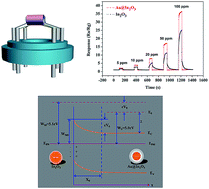
A unique Au@In2O3 core–shell nanostructure was firstly prepared through a simple sol–gel method, the structure and morphology were characterized by X-ray diffraction (XRD), scanning electron microscopy (SEM), transmission electron microscopy (TEM) and energy-dispersive X-ray spectroscopy (EDX). The results showed that unique architectures were core–shell nanostructure assembled from an Au core and an In2O3 shell. The gas sensing properties of the as-prepared pure In2O3 and Au@In2O3 core–shell samples were tested toward various gases. The sensor based on a Au@In2O3 core–shell nanostructure showed excellent selectivity toward ethanol at the operating temperature of 160 °C, giving a response of about 36.14 to 100 ppm, which was about 1.5 times higher than that of the sensor based on pure In2O3. The τres and the τrec values of the Au@In2O3 sensor to 100 ppm ethanol were 4 s and 2 s respectively, while those of the pure In2O3 sensor were relatively long. The enhancement might be attributed to the unique core–shell structure and existence of a Schottky junction between Au/In2O3.

Introduction

Various metal oxide semiconductors, such as In2O3,1,2 Co3O4,3 Cr2O3,4–6 and NiO7–12 have been widely used as gas sensors. Indium oxide (In2O3), one of the most important n-type semiconductors with a bandgap of 3.55–3.75 eV,13 has been widely used in UV irradiation14 and gas sensors15 due to its excellent electronic and optical properties. It is known that pure In2O3 has been used to detect gas for a long time,1 but in practical application there are still some performance problems that need to be solved, such as selectivity, response and recovery time.

It is well known that the morphology and microstructure play important roles on the gas sensing performance of metal oxide semiconductors. Recently, many efforts have been made to the synthesis of metal oxide semiconductor with different morphologies, including nanofiber,1 nanoparticle,16 core–shell nanostructure3 and so on, which expand practical applications of In2O3 to a large extend. For the most fabrications of core–shell nanostructure, materials are usually synthesized by chemical vapor deposition,17 pulsed-laser deposition,18 hydrothermal method,3 which are usually complex and expensive.

Based on our summary to the current manufacture process of core–shell structure, sol–gel is a method rarely encountered used to perform synthesis of core–shell structure and is much more simple, practical and economical than other approaches with large scale equipment and sophisticated detection demanding, but Feng Chao Chung, Ren-Jang Wu, Fu-Chou Cheng prepared the Au@SnO2 sensor by sol–gel method in 2014. Therefore, we are considering sol–gel to be a feasible and effective process to the preparation of unique structure.

Many studies shown that noble metals (like Au, Ag, Pt, Cu)19–22 worked a lot to improve the catalytic activity of metal oxide. It is also found that the gas sensing performances are related to core–shell nanostructure. Thus, synthesizing hierarchical Au@In2O3 core–shell nanostructure has vitally scientific and practical significance. In general, noble metal was made to decorate surface of various as-prepared precursor to enhance optical properties, electrical properties and so on. However, our group firstly synthesized unique nanostructure of Au@In2O3 core–shell structure with In2O3 shell formed on the Au core firstly through a simple sol–gel method successfully, the preparation process of which is more environmental friendly and less costly. Aiming to demonstrate the potential applications, the as-prepared materials were used to fabricate gas sensor. The results revealed that the Au@In2O3 core–shell nanostructure sensor exhibited a rapid response to ethanol at optimum operating temperature of 160 °C, which was superior to pure In2O3.

Experimental section

Preparation of In2O3 nanoparticle

All the used materials for this synthesization of Au@In2O3 core–shell are analytical grade and without further purification. Certain amounts of In(NO3)3·4.5H2O were dissolved in ethanol (20 mL) to form a clear solution (0.15 M), and dodecylamine was added in ethanol (20 mL) to form another clear solution (0.1 M). The above two solutions were mixed and stirred vigorously for 5 h to form the precursor solution, then maintained at 80 °C for 24 h. The obtained products were calcined at 600 °C for 4 h in air.

Preparation of Au@In2O3 core–shell structure

HAuCl4 solution (0.15 mL, 0.01 M) and sodium citrate solution (0.4 mL, 0.01 M) were added into 10 mL deionized water. The mixture was heated until the solution turned purplish red. Immediately the same dose of indium nitric acid ethanol solution and dodecylamine ethanol solution (10 mL, 0.0015 M) were added to the above mixture. The obtained precursor solution was stirred vigorously for 5 h and dried at 80 °C for 24 h. Then collected precursors were calcined at 600 °C for 4 h in air, and the Au@In2O3 core–shell nanostructures were obtained.

Characterization

X-Ray diffraction (XRD) analysis was conducted on a Scintag XDS-2000 X-ray diffractometer with Cu Kα radiation (λ = 1.5418 Å). Scanning electron microscopy (SEM) images were performed on a SHIMADZU SSX-550 (Japan) instrument. Transmission electron microscope (TEM) images and energy-dispersive X-ray spectroscopy (EDX) were obtained on a JEM-ARM200F microscope.

Fabrication and measurement of gas sensor

The as-prepared material was mixed with deionized water in a weight ratio of 100[thin space (1/6-em)]:[thin space (1/6-em)]25 and ground in a mortar for 3 h to form a paste. The paste was then coated on an Al2O3 ceramic tube to form a sensing film (a thickness of about 300 μm) on which a couple of parallel Au electrodes was previously printed. Pt lead wires attached to these Au electrodes were used as electrical contacts. After the ceramic tube was calcined at 300 °C for 2 h, a Ni–Cr heating wire was inserted into the ceramic tube as a heater for controlling the operating temperature. The structure of the sensor is shown in Fig. 1. The details of the sensor fabrication were similar to our previous works.13,23
image file: c4ra14879g-f1.tif
Fig. 1 Schematic structure of the gas sensor.

Gas sensing properties were measured by CGS-8 intelligent gas sensing analysis system (Beijing Elite Tech Co., Ltd., China) under laboratory condition (25 °C, 40 RH%). The test gases were injected into a test chamber with a microinjector. The response value (S) was defined as S = Ra/Rg, where Ra and Rg denoted the sensor's resistance in the air and presence of the target gases. The time taken by the sensor to achieve 90% of the total resistance change was defined as response time when the target gas was introduced to the sensor (target gas adsorption) or the recovery time when the chamber was full of air replacing target gas (target gas desorption).24

Results and discussion

Structural and morphological characteristics

The XRD patterns of pure In2O3 and Au@In2O3 products are shown in Fig. 2. It can be observed that all of the diffraction peaks of pure In2O3 can be indexed to In2O3, and no other peaks corresponding to impurities were observed, which was consistent with the Joint Committee on Powder Diffraction Standards card (JCPDS, 06-0416). While the crystal phase of the Au@In2O3 product was the mixture of Au and In2O3. Most of the diffraction peaks can be indexed to In2O3, which was well agreed with the reported values from the standard data file (JCPDS, 06-0416). The residual peaks were indexed to Au, which was consistent with the standard card file 04-0784. We can infer that the peaks of Au@In2O3 cover Au and In2O3. Combined with SEM, TEM and EDX analysis of the Au@In2O3 product, it can be deduced the successful synthesis of Au@In2O3 core–shell nanostructure.
image file: c4ra14879g-f2.tif
Fig. 2 XRD patterns of pure In2O3 and Au@In2O3 core–shell nanostructure obtained after calcination at 600 °C for 4 h.

The morphologies of the as-prepared Au@In2O3 core–shell nanostructure were investigated by SEM and TEM. Fig. 3(a) and (b) showed the high magnification SEM images of pure In2O3 and Au@In2O3 core–shell, respectively. The resulting images of Fig. 3 showed that the Au@In2O3 core–shell nanostructure was formed spheres with diameter about 20 nm, which was similar to the values determined by TEM.


image file: c4ra14879g-f3.tif
Fig. 3 High magnification SEM images of pure In2O3 and Au@In2O3 nanostructure.

Fig. 4 showed the In2O3 shells formed on Au core nanoparticles. The high-magnification TEM images in Fig. 4 showed a portion of the Au and In2O3 crystal lattices. In Fig. 4, the fringe patterns indicated by d = 0.204 nm spaces corresponding to the Au (2 0 0) nm planes, and the fringe patterns indicated by d = 0.185 nm, d = 0.217 nm and d = 0.238 nm spaces corresponding to the (5 2 1), (3 3 2) and (4 1 1) planes of In2O3, respectively. Fig. 4 showed that the Au core diameter (within the green dotted line) was about 15 nm, and the In2O3 shell thickness was about 8 nm. These results demonstrated that the (5 2 1), (3 3 2) and (4 1 1) In2O3 planes corresponded to the (2 0 0) plane of Au.25,26


image file: c4ra14879g-f4.tif
Fig. 4 High magnification TEM image of Au@In2O3 core–shell nanostructure and its crystal lattice.

EDX revealed that the core–shell structures contained In, O and Au, as shown in Fig. 5. The energy diagram indicates that the green circle outside the shell contained In2O3, and the green circle inside the core comprised gold, thereby confirming the successful preparation of Au@In2O3 core–shell nanostructure.


image file: c4ra14879g-f5.tif
Fig. 5 EDX image of Au@In2O3 core–shell nanostructure.

Gas sensor performance and sensing mechanism

We all know that the gas response of a semiconductor sensor is usually dependent on the sensor operating temperature.13,27 The responses of the sensors based on pure In2O3 and Au@In2O3 core–shell nanostructure to ethanol (C2H5OH) were tested to determine the optimum operating temperature, as shown in Fig. 6. It can be observed that the responses of the tested sensor varied with operating temperature. According to Fig. 6, 185 and 160 °C were suggested to be the optimum operating temperature for ethanol detection based on pure In2O3 and Au@In2O3 core–shell sensors, respectively, because these sensors showed the maximum response of 36.1 and 24.5 at the corresponding temperature. It is apparently that the optimum operating temperature of Au@In2O3 core–shell sensor is lower than that of pure In2O3 sensor.
image file: c4ra14879g-f6.tif
Fig. 6 Responses of sensors based on pure In2O3 and Au@In2O3 core–shell nanoarchitecture to 100 ppm ethanol as a function of operating temperature.

The sensing transients of pure In2O3 and Au@In2O3 sensors to the sensing transients of pure In2O3 and Au@In2O3 sensors to 5–100 ppm ethanol were given in Fig. 7. It clearly showed that with the increase of ethanol increase concentration, the value of real-time response of both sensors increases obviously. The existence of Au core makes the response amplitude changing extremely huge and far more evidence. Corresponding to Table 3, introduction of Au nanoparticle as a core in In2O3 system improved its sensing performance in terms of response and recovery time. The τres values of the Au@In2O3 sensor were very short (4 s to 100 ppm ethanol) while those of the pure In2O3 sensor were relatively long. The τrec values of the Au@In2O3 sensor were also shorter (2 s to 100 ppm ethanol) than pure In2O3 sensor in the entire ethanol concentration, which was much more rapid than most In2O3-based sensor.28,29 Table 1 presents comparisons between the gas sensing performances of the Au@In2O3 core–shell nanostructure and other reported results. The quick response and recovery in Au@In2O3 core–shell sensor maybe caused by fast in-diffusion and out-diffusion of reducing gas occurred in the sensor surface.30 In addition, it may be attributed to that the noble nanoparticles could improve the modulation of nano-Schottky barriers during the oxidation of ethanol due to the electron mechanism.31 The improved sensing performances maybe caused by formation of Au/In2O3 Schottky barriers, making it modulating for the electrons to travel between Au/In2O3 with the direction of the electron transfer depending on desorbing gas molecule.


image file: c4ra14879g-f7.tif
Fig. 7 Responses to different concentrations of ethanol for pure In2O3 sensor at 185 °C and Au@In2O3 sensor at 160 °C.
Table 1 Performance comparison of various In2O3-based gas sensors toward ethanol
  Operating temperature (°C) Ethanol (ppm) Response (Ra/Rg) Response time (s) Recovery time (s)
0.2 wt% Au/In2O3 nanofibers28 140 500 13.8 12 24
Porous In2O3 nanospheres29 275 100 ∼22 16 24
In2O3–Ag composite nanoparticle layers32 200 1000 22 70
Co-doped In2O3 nanofibers33 300 100 16.5 2 3
Au@In2O3 in this paper 160 100 36.14 4 2


Table 2 Response and Sethanol/Sgas comparisons of In2O3 & Au@In2O3 gas sensors toward various gases
Gas Ra/Rg In2O3 Sethanol/Sgas In2O3 Ra/Rg Au@In2O3 Sethanol/Sgas Au@In2O3
H2 3 8.17 1.21 29.87
CO 1.05 23.34 1 36.14
NH3 1.13 21.69 1.34 26.97
Toluene 1.21 20.26 1.39 26
Benzene 1.51 16.23 3.24 11.15
Ethylene glycol 2.69 9.11 1.1 32.85
Acetone 15.3 1.6 11.1 3.25
Formaldehyde 6.34 3.86 1.01 35.78
Ethanol 24.16 1 36.14 1


Table 3 Response and recovery times comparisons of In2O3 & Au@In2O3 gas sensors toward different ethanol concentrations
Ethanol (ppm) In2O3 τres (s)/τrec (s) Au@In2O3 τres (s)/τrec (s)
5 12/2 5/4
10 10/8 4/3
20 38/84 4/2
50 23/47 4/2
100 23/24 4/2


The response, τres and τrec were calculated from sensing transients (Fig. 7) and the results were summarized in Fig. 8. It was seen that the response increased with the increasing of ethanol concentration from 5 to 100 ppm. As the concentration of ethanol rose, the responses increased. The responses of pure In2O3 sensor to 5–100 ppm ethanol ranged from 2.01 to 24.51, which increased from 2.1 to 36.14 in Au@In2O3 core–shell sensor (Fig. 8).


image file: c4ra14879g-f8.tif
Fig. 8 Responses of sensors based on pure In2O3 at 185 °C and Au@In2O3 core–shell nanostructure at 160 °C versus ethanol concentrations.

Fig. 9 shows the bar graph of the response of sensors based on pure In2O3 and Au@In2O3 core–shell sensor to a variety of gases with a concentration of 100 ppm, which were tested at their optimum operating temperatures. It can be observed that the response of the pure In2O3 sensor to 100 ppm ethanol at 185 °C was 24.16, which was higher than the response to 100 ppm H2, CO, NH3, toluene, benzene, ethylene glycol, acetone, formaldehyde (3–15.3) (Table 2). In the Au@In2O3 core–shell sensor, the Ra/Rg value to 100 ppm ethanol at 160 °C increased to 36.1, while those to most of other gases decreased (3–15.3) (Table 2). The selectivity to target gases was defined as the response ratio between gas response to 100 ppm target gases and that to other gases Sethanol/Sgas.30 Sethanol/Sgas values of interference gases were 1.6–23.34 in pure In2O3 sensor (Table 2). These values increased to 3.25–36.14 in Au@In2O3 core–shell sensor. These results clearly demonstrated that Au@In2O3 core–shell nanostructure was effective for enhancing response to ethanol as well as selectivity. Thus, the Au@In2O3 core–shell sensor had good selectivity to ethanol over other gases at 160 °C.


image file: c4ra14879g-f9.tif
Fig. 9 Responses of sensors based on pure In2O3 at 185 °C and Au@In2O3 core–shell nanostructure at 160 °C to 100 ppm various gases.

Gas sensing mechanism

In typically, In2O3 is an n-type metal oxide semiconductor, and its sensing mechanism could be explained through the change in resistance of the sensor caused by the adsorption and desorption process of gas molecules on the surface of the oxide.34–36 When In2O3 sensor is exposed to air, oxygen molecules adsorb on the surface of the material. These adsorbed oxygen molecules will capture electrons from the conductance band of In2O3 to become oxygen ions (O2, O, O2−),28 which results in the increase of resistance of the sensors. In ethanol environments, ethanol reacts with chemisorbed anions. This reaction can be expressed as follows:37
 
C2H5OH + O2− → CH3CHO + H2O + 2e (1)
 
CH3CHO + 5O2− → 2CO2 + 2H2O + 10e (2)

Ethanol molecules react with absorbed surface oxygen and release electrons back to the conduction band of In2O3, thus decreasing the width of electron depletion layer, and leading to decrease in the sensor resistance.

For Au@In2O3 core–shell nanostructure, Au as a noble metal and In2O3 which is a metal oxide semiconductor would joint together to form a Schottky junction between Au/In2O3. Thus, Au/In2O3 Schottky junction will generate an electron depletion layer and a decrease in conductivity of Au@In2O3 core–shell material. The Au work function (WM = 5.1 eV) is larger than that of In2O3 (WS = 5.0 eV),32 electrons in conduction band of In2O3 shell will transfer to Au core, which will make In2O3 energy band around the Au/In2O3 interface bend up. The values of (ECEFN) enlarged, while the values of (EFNEV) diminished (EC, EV, EFN correspond to the conduction band minimum, the valence band maximum and the Fermi level position of n-type semiconductor oxide, respectively, as is shown in Fig. 10), As a result, a decrease in electron concentration and an electron depletion layer inside In2O3 around Au/In2O3 interface come out. It means a decrease in conductivity and an increase in resistance of Au@In2O3 core–shell material. Thus, compared to pristine In2O3, the ethanol enhancement of can be due to presence of Au/In2O3 Schottky barriers in Au@In2O3.


image file: c4ra14879g-f10.tif
Fig. 10 Schematic illustration of energy band in Au/In2O3 system.

The excellent gas sensing performance of Au@In2O3 core–shell nanostructure sensor can be attributed to the Au/In2O3 metal–semiconductor junction: when Au@In2O3 material is exposed to ethanol gas, reactions (1) and (2) will take place on the surface and the generated electrons transfer from ethanol molecule into In2O3, leading to increase of the charge carrier density and a diminish of electron depletion layer showing as a marked change in resistance of Au@In2O3 material. Thus, Au@In2O3 core–shell nanostructure shows an enhanced response to ethanol.

Another reason for the enhanced ethanol sensing properties may be attributed to Au catalysis. Au nanoparticles can lower the operating temperature as a catalyst by decreasing activity energy, and accelerated the sensing reaction (1) and (2) resulting in the improvement of response and fast response–recovery speed to ethanol.

Stability test

Fig. 11(a) shows that short term reproducibility of the In2O3 and Au@In2O3 sensor response data is maintained at a constant value. Fig. 11(b) shows that long term reproducibility of the In2O3 and Au@In2O3 sensor response data were with no change over 21 days, indicating that both sensors displayed a stable response to ethanol gas. Therefore, Au@In2O3 is a potential nanomaterial with long-term service to ethanol gas.
image file: c4ra14879g-f11.tif
Fig. 11 Reproducibility of the In2O3 and Au@In2O3 sensor.

Conclusions

In summary, the pure In2O3 and Au@In2O3 architectures had been successfully synthesized through a sol–gel process and their gas sensing properties were investigated. Comparison with pure In2O3, the sensing performance: selectivity, response–recovery speed of the sensors based on Au@In2O3 exhibited enhanced a lot to ethanol due to introduction of Au core. The excellent gas performance of Au@In2O3 sensor may be contributed to their properties, such as unique structure, synergistic effect of Au core and In2O3 shell and the presence of Au/In2O3 Schottky junction. The results certified that the core–shell nanostructure sensor is a potential candidate for high performance gas sensors.

Acknowledgements

The authors are grateful to National Natural Science Foundation of China (Grant no. 61274068, 51303061), the National High Technology Research and Development Program of China (Grant no. 2013AA030902), Project of Science and Technology Plan of Changchun City (Grant no. 13KG49), and Project of Science and Technology Development Plan of Jilin Province (Grant nos 20120324, 20130206021GX, 20140204056GX), and Project of Science and Technology Plan of Changchun City (Grant no. 13KG49).

Notes and references

  1. J. Liu, W. Guo, F. Qu, C. Feng, C. Li, L. Zhu, J. Zhou, S. Ruan and W. Chen, Ceram. Int., 2014, 40, 6685–6689 CrossRef CAS PubMed.
  2. Y. Chen, L. Zhu, C. Feng, J. Liu, C. Li, S. Wen and S. Ruan, J. Alloys Compd., 2013, 581, 653–658 CrossRef CAS PubMed.
  3. F. Qu, J. Liu, Y. Wang, S. Wen, Y. Chen, X. Li and S. Ruan, Sens. Actuators, B, 2014, 199, 346–353 CrossRef CAS PubMed.
  4. D. N. Suryawanshi, D. R. Patil and L. A. Patil, Sens. Actuators, B, 2008, 134, 579–584 CrossRef CAS PubMed.
  5. H. Liu, X. Du, X. Xing, G. Wang and S. Z. Qiao, Chem. Commun., 2012, 48, 865–867 RSC.
  6. R. C. Singh, N. Kohli, M. P. Singh and O. Singh, Bull. Mater. Sci., 2010, 33, 575–579 CrossRef CAS PubMed.
  7. H.-J. Kim and J.-H. Lee, Sens. Actuators, B, 2014, 192, 607–627 CrossRef CAS PubMed.
  8. P. Wu, J. H. Sun, Y. Y. Huang, G. F. Gu and D. G. Tong, Mater. Lett., 2012, 82, 191–194 CrossRef CAS PubMed.
  9. N. G. Cho, I.-S. Hwang, H.-G. Kim, J.-H. Lee and I.-D. Kim, Sens. Actuators, B, 2011, 155, 366–371 CrossRef CAS PubMed.
  10. N. G. Cho, H. S. Woo, J. H. Lee and I. D. Kim, Chem. Commun., 2011, 47, 11300–11302 RSC.
  11. B. Liu, H. Yang, H. Zhao, L. An, L. Zhang, R. Shi, L. Wang, L. Bao and Y. Chen, Sens. Actuators, B, 2011, 156, 251–262 CrossRef CAS PubMed.
  12. X. Song, L. Gao and S. Mathur, J. Phys. Chem. C, 2011, 115, 21730–21735 CAS.
  13. C. Feng, W. Li, C. Li, L. Zhu, H. Zhang, Y. Zhang, S. Ruan, W. Chen and L. Yu, Sens. Actuators, B, 2012, 166–167, 83–88 CrossRef CAS PubMed.
  14. I. A. Tambasov, V. G. Maygkov, A. S. Tarasov, A. A. Ivanenko, L. E. Bykova, I. V. Nemtsev, E. V. Eremin and E. V. Yozhikova, Semicond. Sci. Technol., 2014, 29, 082001 CrossRef.
  15. X. Zou, J. Wang, X. Liu, C. Wang, Y. Jiang, Y. Wang, X. Xiao, J. C. Ho, J. Li, C. Jiang, Y. Fang, W. Liu and L. Liao, Nano Lett., 2013, 13, 3287–3292 CrossRef CAS PubMed.
  16. W. S. Seo, H. H. Jo, K. Lee and J. T. Park, Adv. Mater., 2003, 15, 795–797 CrossRef CAS.
  17. H.-M. Lin, Y. L. Chen, J. Yang, Y.-C. Liu, K.-M. Yin, J.-J. Kai, F.-R. Chen, L.-C. Chen, Y.-F. Chen and C.-C. Chen, Nano Lett., 2003, 3, 537–541 CrossRef CAS.
  18. A. B. G. Oliver Hayden and D. C. Bell, Adv. Mater., 2005, 17, 701–704 CrossRef.
  19. L. H. Qian, K. Wang, Y. Li, H. T. Fang, Q. H. Lu and X. L. Ma, Mater. Chem. Phys., 2006, 100, 82–84 CrossRef CAS PubMed.
  20. E. H. Espinosa, R. Ionescu, C. Bittencourt, A. Felten, R. Erni, G. Van Tendeloo, J. J. Pireaux and E. Llobet, Thin Solid Films, 2007, 515, 8322–8327 CrossRef CAS PubMed.
  21. A. Kaniyoor, R. Imran Jafri, T. Arockiadoss and S. Ramaprabhu, Nanoscale, 2009, 1, 382–386 RSC.
  22. J. Luo, S. Jiang, H. Zhang, J. Jiang and X. Liu, Anal. Chim. Acta, 2012, 709, 47–53 CrossRef CAS PubMed.
  23. W. Li, C. Li, L. Zhu, C. Feng, W. Chen, W. Guo and S. Ruan, Integr. Ferroelectr., 2012, 138, 71–76 CrossRef CAS.
  24. Y. Hu, O. K. Tan, W. Cao and W. Zhu, Ceram. Int., 2004, 30, 1819–1822 CrossRef CAS PubMed.
  25. R. Giovannetti, V. Bartocci, F. Pucciarelli and L. Petetta, Polyhedron, 2008, 27, 1047–1053 CrossRef CAS PubMed.
  26. B. Slater, C. R. A. Catlow, D. H. Gay, D. E. Williams and V. Dusastre, J. Phys. Chem. B, 1999, 103, 10644–10650 CrossRef CAS.
  27. H. Gong, J. Q. Hu, J. H. Wang, C. H. Ong and F. R. Zhu, Sens. Actuators, B, 2006, 115, 247–251 CrossRef CAS PubMed.
  28. X. Xu, H. Fan, Y. Liu, L. Wang and T. Zhang, Sens. Actuators, B, 2011, 160, 713–719 CrossRef CAS PubMed.
  29. P. Song, D. Han, H. Zhang, J. Li, Z. Yang and Q. Wang, Sens. Actuators, B, 2014, 196, 434–439 CrossRef CAS PubMed.
  30. I. S. Hwang, J. K. Choi, H. S. Woo, S. J. Kim, S. Y. Jung, T. Y. Seong, I. D. Kim and J. H. Lee, ACS Appl. Mater. Interfaces, 2011, 3, 3140–3145 CAS.
  31. A. Kolmakov, D. O. Klenov, Y. Lilach, S. Stemmer and M. Moskovits, Nano Lett., 2005, 5, 667–673 CrossRef CAS PubMed.
  32. V. N. Singh, B. R. Mehta, R. K. Joshi, F. E. Kruis and S. M. Shivaprasad, Sens. Actuators, B, 2007, 125, 482–488 CrossRef CAS PubMed.
  33. Z. Li and Y. Dzenis, Talanta, 2011, 85, 82–85 CrossRef CAS PubMed.
  34. B. Varghese, C. H. Teo, Y. Zhu, M. V. Reddy, B. V. R. Chowdari, A. T. S. Wee, V. B. C. Tan, C. T. Lim and C. H. Sow, Adv. Funct. Mater., 2007, 17, 1932–1939 CrossRef CAS.
  35. J. Park, X. Shen and G. Wang, Sens. Actuators, B, 2009, 136, 494–498 CrossRef CAS PubMed.
  36. G. S. Noboru Yamazoe and K. Shimanoe, Catal. Surv. Asia, 2003, 7, 63–75 CrossRef.
  37. M. Ivanovskaya, D. Kotsikau, G. Faglia and P. Nelli, Sens. Actuators, B, 2003, 96, 498–503 CrossRef CAS.

This journal is © The Royal Society of Chemistry 2015
Click here to see how this site uses Cookies. View our privacy policy here.