
Controllable fabrication of nanostructured copper compound on a Cu substrate by a one-step route

Yongqian Wang*a, Tingting Jianga, Dawei Menga, Junhan Konga, Hanxiang Jiaa and Meihua Yu*b
aFaculty of Material Science and Chemistry, China University of Geoscience, Wuhan 430074, China. E-mail: cugwyq@126.com; Tel: +86 138 7137 9285
bSchool of Materials Science and Engineering, Guangxi University, Nanning 530004, China. E-mail: 18140666868@163.com; Tel: +86 189 7888 0610

Received 14th November 2014 , Accepted 20th January 2015

First published on 20th January 2015


Abstract

We report a one-step corrosion process to synthesize nanostructured CuO thin films at room temperature. The reaction time has great effect on the composition and microstructure of products to control the size and shape of the copper compound. X-ray diffraction studies showed the transformation of nanograins from Cu(OH)2 nanowires to flower-like CuO and to dispersed CuO nanosheets. The optical properties of CuO nanosheets were investigated by using UV-vis spectroscopy with considerable blue-shift in the optical band gap (Eg = 1.8 eV) due to the quantum confinement effect. Additionally, the photocatalytic activities of as-prepared copper compound films were determined by measuring the degradation of methyl blue (MB) to find out their potential application in waste water treatment. The photoluminescence (PL) spectrum showed both UV as well as visible emission peaks, indicating their good optical properties. Moreover, a reasonable growth mechanism for the formation of the CuO nanostructure is proposed by means of a scanning electron microscope (FESEM).

1. Introduction

Considerable attention has been paid to various nanomaterials of transition-metal (iron, nickel, cobalt, zinc, titanium and copper) oxides with different morphologies due to their prominent structural flexibility combined with a variety of properties with a wide range of potential applications.1–4 Among them, cupric oxide (CuO) as a charge transfer/Mott insulator (Egap = 1.2–1.9 eV, p-type) has attracted much interest due to its unique and predictable properties with highly anisotropic geometry and size confinement from both the fundamental and technological point of view. CuO has been widely used in many important applications, such as solar cells,5 lithium-ion batteries,6 gas sensors,7 capacitors,8 diodes,9 antimicrobials,10 field transistors,11 magnetic storage media12 and so forth. Especially, as a heterogeneous catalyst, CuO makes a great contribution to multifarious chemical processes including selective catalytic reduction of nitric oxide with ammonia, the degradation of nitrous oxide, and the oxidation of carbon monoxide, hydrocarbon, and phenol in supercritical water.13–16 To date, many technologies have been developed to prepare CuO nanostructured films such as CVD,17 ultrasonic spray pyrolysis,18 chemical vapor deposition,19 molecular-beam epitaxy,20 pulsed laser deposition,21 electrodeposition22 and thermal oxidation.23

In this work, we achieved controllable fabrication of nanostructured Cu(OH)2/CuO films composed of wires, sheets and string ball-like structure by in situ growth on Cu foils without using any template and surfactants. This method has its own advantages of fast reaction rate, controllability, non-toxicity and simplicity. We specifically analyzed how reaction time affected the growth of nanostructured CuO and illustrated a plausible growth mechanism for their formation. Moreover, because it is a promising candidate for wastewater treatment, the photocatalytic activity of CuO films was evaluated by examining the degradation of methyl blue (MB).

2. Experiment

Typically, CuO nanostructure was carried out at room temperature. All the reagents used in this experiment were of analytical grade without further purification. High-purity Cu foil (99.9 wt%) with a dimension of 20 × 20 × 0.2 mm3 was polished to remove oxide on its surface. Then, the substrate was ultrasonically cleaned with ethanol and deionized water in sequence for 10 min, respectively. Then, the Cu foil was dipped into 100 mL mixed solutions with 1.245 mol L−1 NaOH and 0.05 mol L−1 (NH4)2S2O8 at 25 °C for a while. The pH value of the prepared solution was 13.24. Eventually, CuO film was obtained and rinsed by deionized water, followed by drying at 80° in air.

X-ray diffraction (XRD) was carried out by using an X-ray diffractometer model D8 Advance (Bruker) with Cu Kα radiation (λ = 1.54178 Å) at a scanning rate of 0.02° s−1 in the 2θ range from 5° to 70°. Field emission scanning electron microscopy (FESEM) experiments were performed on a Hitachi SU8010 electron microscope. The absorbance of prepared CuO film was measured by a UV-vis spectrophotometer (UV-2550, Shimadzu, Japan). Photoluminescence (PL) was measured at room temperature to study the optical properties of the Cu(OH)2/CuO films by using an F-4500 PL spectrophotometer equipped with Xe lamp (excitation wavelength = 280 nm). The roughness analysis of the films was studied by atomic force microscopy (AFM) in the tapping mode with an AJ-III scanning probe microscope (SPM) from AIJIAN Nano Science and Technology with 1.507 scanning rate.

The photocatalytic activity of the nanostructured CuO films with different morphologies was evaluated by the degradation of a model pollutant MB. In this test, 12 mg L−1 MB was poured into four beakers. One was used as a reference, and the others were mixed with CuO films. All of them were illuminated by a high pressure mercury lamp (160 W) at 15 cm vertical distance. The adsorption spectrum of the solution was then recorded with the UV-vis spectrometer.

3. Results and discussion

3.1 Control of the product composition and nanostructure

Fig. 1 shows the crystal structure and phase purity of as-prepared Cu(OH)2/CuO films covered on copper foil. In order to understand the formation and evolution of nanostructured Cu(OH)2/CuO, the effect of reaction time on phase was investigated from 1 min to 90 min. When reaction time was 1 min as shown in Fig. 1(a), except for the diffraction peaks of Cu substrate, all diffraction peaks are indexed to the orthorhombic Cu(OH)2 (space group: Cmc21) with the lattice constants a = 2.949 Å, b = 10.59 Å, and c = 5.256 Å, which are consistent with the values in the standard card (JCPDS 72-0140). No other peaks were detected by XRD analysis, indicating the phase purity of Cu(OH)2 nanostructures. Only the major peaks located at 2θ = 16.69° and 23.84° are obvious, which can be indexed as (020) and (021) crystal planes, respectively. With an increase in the reaction time to 5 min, the diffraction peaks of Cu(OH)2 become higher and narrower. Notably, a broadening peak at 2θ = 38.90° indicates the presence of a small amount of monoclinic CuO because of the dehydration of Cu(OH)2. That is to say, there is the coexistence of CuO and Cu(OH)2 on the copper substrate. Over time, the intensities of (002) and (111) crystal planes of CuO are significantly enhanced. As the reaction time is prolonged to 60 min, the two major diffraction peaks of CuO become the sharpest and highest, which are located at 2θ = 35.74° and 38.90°. All the peaks of CuO match well with the standard diffraction pattern of monoclinic CuO (JCPDS 65-2309) whose cell parameters are a = 4.662 Å, b = 3.416 Å, c = 5.118 Å and β = 99.49°. At the same time, intensities of peaks of Cu(OH)2 gradually decrease. At 90 min, it is clear that all the characteristics peaks could be indexed and specified as CuO as shown in Fig. 1(h), demonstrating that the crystal structure transforms from Cu(OH)2 to CuO and pure CuO nanostructures can be obtained.
image file: c4ra14523b-f1.tif
Fig. 1 XRD patterns of nanostructured CuO films at different reaction times. (a) 1 min, (b) 2 min, (c) 5 min, (d) 10 min, (e) 15 min, (f) 30 min, (g) 60 min, (h) 90 min.

The morphology of as-synthesized copper compound films at different reaction times was observed by using FESEM analysis and is shown in Fig. 2. Changing the time only can bring about significant dimensional, morphological, and structural changes. The trace of the growth mechanism of Cu(OH)2/CuO could be grasped from snapshots taken at an intermediate stage of evolution process. In the beginning, the copper foil just loses its metallic luster and Cu(OH)2 nanowires can be observed in Fig. 2(a). Each individual nanowire is about 30 nm in diameter and 1–3 μm in length. At 2 min, there is blue perceptible solid deposit on the Cu substrate. Fig. 2(b) shows that the nanowires get longer and mutually crisscross, resulting in a three-dimensional net structure, and small pieces of CuO sheets could be seen. When the reaction time is 5 min, more lines can cover the whole substrate but their length is obviously shorter. As the reaction continues, the blue film on the copper substrate becomes increasingly black, and more and more sheets come into being from small and single layers to large flowers caused by the layered structure, as demonstrated in Fig. 2(c)–(e). Extending this reaction to 30 min, crystal particles of CuO grow along (002) and (111) planes and form regular string ball-like structures. Besides, nanowires of Cu(OH)2 visibly become fewer. Then after 30 min, the balls become more uniform in size and compact in structure, with an average diameter of about 40 nm. It is obvious that string balls are composed of nanosheets generating in two directions in Fig. 2(g). For a reaction time longer than 90 min, the blue film on the copper substrate become entirely black due to the complete transformation of Cu(OH)2 to CuO nanosheets. As shown in Fig. 2(h), all structures are 300 nm long lamellar monoclinic CuO.


image file: c4ra14523b-f2.tif
Fig. 2 The FESEM images of nanostructured CuO films at different reaction times. (a) 1 min, (b) 2 min, (c) 5 min, (d) 10 min, (e) 15 min, (f) 30 min, (g) 60 min, (h) 90 min.

Fig. 3(a) presents 14.7 μm × 14.7 μm AFM images of Cu substrate. The morphology parameters, root mean square (Rq) roughness and average length on selected places were evaluated. The surface is relatively smooth with Rq of 32.479 nm and mean roughness (Ra) of 24.703 nm. Fig. 3(b) shows the 2D AFM image of film under reaction of 1 min. The result shows that the average surface roughness is 256.93 nm and the value of Rq is 322.22 nm. The increase in surface roughness is attributable to staggered growth of nanowires, which indicates the possibility of anti-reflection coatings. On the other hand, all prepared films were well adhered to the Cu substrate. Any macroscopic defects like voids, pinholes or peeling could not be observed.


image file: c4ra14523b-f3.tif
Fig. 3 (a) 14.7 μm × 14.7 μm AFM images of Cu substrate, (b) 5 μm × 5 μm AFM images of the film prepared under reaction of 1 min.

3.2 Growth mechanism of copper compound

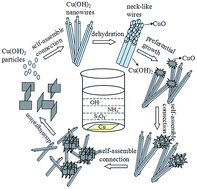
According to the above results and the reported references, the formation mechanism of CuO nanosheets can be schematically illustrated in Fig. 4. The whole process can be expressed as follows:
Cu + 4NaOH + (NH4)S2O8 → CuO + 2Na2SO4 + 2NH3↑ + 3H2O

image file: c4ra14523b-f4.tif
Fig. 4 Schematic representation of the synthesis and growth process of nanostructured CuO.

It includes two reactions:

Cu + 4NaOH + (NH4)S2O8 → Cu(OH)2 + 2Na2SO4 + 2NH3↑ + 2H2O

Cu(OH)2 → CuO + H2O

In fact, inorganic polymerization reactions under alkaline and oxidative conditions are the main processes to form nanostructured Cu(OH)2/CuO. In the initial stage of the procedure, the Cu2+ ions resulting from copper oxidation react with OH ions, forming the nucleation process of Cu(OH)2. As reported previously, orthorhombic Cu(OH)2 is composed of chains in (001) crystal faces, which is caused by being oriented along [100] and whose feature is square-planar coordination of the Cu2+ ions by σx2y2 bonds. Fig. 5 shows the corrugated sheet of Cu(OH)2 parallel to (010) plane. By means of stacking with hydrogen bonds, one-dimensional Cu(OH)2 crystal could be formed. There are μ4-OH bridges generated by the condensation of Cu2+ and OH in this process. OH ligand, as a nucleophile, would transform itself from a terminal ligand in a monomer into a bridging ligand in a condensed species. Because the interplanar distance of (100) is the shortest (2.952 Å), Cu(OH)2 crystals choose [100] as their preferred growth direction and eventually form the structure of nanowires. The longest interplane distance in orthorhombic Cu(OH)2 is about 10.60 Å, located between (100) planes. Due to the relatively loose hydrogen bond linkages, this unstable layer structure cannot resist oxidation because oxygen atoms are either pentacoordinated or tricoordinated. In the structure of monoclinic CuO, it is characterized by chains of copper with the square-planar coordination of μ4-O bridges.24 As time goes on, interplanar hydrogen bonds break gradually and form monoclinic CuO. At the same time, the dehydration could disrupt Cu(OH)2 nanowires, and pieces of CuO nanosheets come into being. Cu(OH)2 nanowires from self-assembled connection of adjacent nanoparticles at their energetically favorable crystal planes would gradually shrink to form neck-like connections and finally break. Dispersed CuO particles collide with each other followed by accumulating and growing along (002) and (111) as optimal growth planes. At first, self-assembled “string balls” composed by CuO sheets are more likely to conform to a thermodynamically driven spontaneous process. With reaction continuing, irregular, scattered and smaller CuO pieces come into being to decrease surface energy.


image file: c4ra14523b-f5.tif
Fig. 5 Projection of the (010) plane of orthorhombic Cu(OH)2 on (a–c) surface.24

3.3 Photoluminescence studies

The emission properties of the copper compound films have been studied at room temperature by using a PL spectrum excited with 280 nm as shown in Fig. 6. The four main broad emission bands centered at 341 nm (3.64 eV), 390 nm (3.18 eV), 423 nm (2.93 eV), 460 nm (2.70 eV) and 489 nm (2.54 eV) are observed in both samples with different compositions of pure CuO and Cu(OH)2/CuO, which indicated CuO emission.25–28 The recombination of electron–hole pairs in free-excitons results in the UV emission peak at 341 nm.29 A dominant emission peak at 390 nm that is a visible emission peak in the violet region is attributed to the near band-edge emission of CuO nanostructures, which is consistent with its absorption measurement (Fig. 8(c)). The blue-shift behavior of the peak position is apparent in comparison with the CuO bulk because of the Burstein–Moss effect resulting from nanosized particles, which are provided with the enhanced quantum confinement effect.30 In the PL spectrum of pure CuO, a small hump of luminescence blue band at 489 nm is caused by transition vacancy of oxygen and interstitial oxygen.25 The luminescence properties of CuO are strongly dependent on sizes and shapes of nanocrystals. In addition, transformation of mixed phase crystal structure to pure CuO crystalline structure, where it could produce defects or surface impurities might be one of the reasons.
image file: c4ra14523b-f6.tif
Fig. 6 PL spectra of copper compound film on Cu substrate with different compositions. (a) CuO obtained at 90 min, (b) Cu(OH)2/CuO obtained at 60 min.

3.4 Photocatalytic studies

It is reported that nanostructured copper compound could be used to decompose the organic pollutant. The photocatalytic activity of copper compound films can be evaluated by the degradation rate of MB. Fig. 7 shows the photocatalytic efficiency of copper compound films with different compositions (Cu(OH)2, Cu(OH)2/CuO and CuO). Obviously, pure CuO nanostructure has the best photocatalytic activity compared with the mixture of Cu(OH)2/CuO and pure Cu(OH)2 nanowires because of the formation of excess superoxides and/or hydroxyl radicals at their interface in the CuO structure.31 By UV-vis irradiation for 210 min, the degradation of MB attains the highest values, −90%, 91.7% and 92.8%, respectively. For comparison, degradation rates of MB with bulk CuO particles was given as well according to our previous report under the same conditions.32 It can be seen that after the irradiation time of 180 min, 91.4% MB is completely decolorized, whereas only about 56.2% of MB was degraded on CuO particles, which is significantly less efficient than the CuO nanosheets. The reason is due to the large surface area of the nanostructures.
image file: c4ra14523b-f7.tif
Fig. 7 MB degradation efficiency of copper compound film with different compositions. (a) Cu(OH)2 obtained at 1 min, (b) Cu(OH)2/CuO obtained at 60 min, (c) CuO obtained at 90 min.

Fig. 8 shows the UV-vis spectra of copper compound films with different compositions. Typical optical absorption spectra for nanostructured CuO can be observed in the left figure with a clear absorption edge obviously at the visible region to UV region covering the entire visible spectrum. As shown in Fig. 8(a), there is a significant absorption edge at about 613 nm, revealing light absorption in the visible range, indicating that the CuO nanosheets may process good photocatalytic activity under natural light. For the Cu(OH)2 film (Fig. 8(c)), although there are three weak absorption edges at 325 nm, 550 nm and 670 nm, respectively, its overall trend of absorbance keeps declining from UV region to visible spectrum. When the sample is the mixture of Cu(OH)2 and CuO, its result is a superimposition of the two outcomes above. An obvious absorption edge at about 650 nm can be seen from Fig. 8(b).


image file: c4ra14523b-f8.tif
Fig. 8 Optical absorption spectra (left figure) and the band gap determination (right figure) of copper compound film with different compositions. (a)CuO obtained at 90 min, (b) Cu(OH)2/CuO obtained at 60 min, (c) Cu(OH)2 obtained at 1 min.

The band gaps can be calculated according to the equation given below:

(αhv)1/r = B(hvEg),
where Eg is the band gap energy, B is a constant related to the material and matrix element of the transition, ν is the frequency of the incident radiation, h is Planck's constant, α is the absorption coefficient in cm−1 and r depends on the nature of the transition (1/2 for direct allowed transitions, 2 for indirect allowed transitions, 3/2 for direct forbidden transitions and 3 for indirect forbidden transitions).33,34 To obtain the band gap, (αhν)2 was plotted against energy . Extrapolation of the linear part until its intersection with the axis provides the values of Eg (the right part of Fig. 8). The values are approximately 1.8 eV and 3.2 eV for the CuO film and Cu(OH)2/CuO for the composite film. Compared with bulk CuO whose band gap is 1.2 eV,35 the bandgap of nanostructured CuO is blueshifted because of quantum size effect. A smaller size particle with a larger surface/volume ratio leads to a lower coordination number and atomic interaction of the surface atom. In the event, decrease of the lowest unoccupied conduction band energy and the increase of the highest valance band energy result in higher band gap energy.32

4. Conclusion

In summary, we have developed a facile approach without any template and additive for the synthesis of nanostructured copper compound on Cu substrate with the advantages of low cost, non-toxicity and simplicity, in which Cu(OH)2 nanowires have been recognized as seeding sites for the growth of CuO nanosheets. The optical band-gap energy of CuO nanosheets at room temperature was 1.8 eV due to the blue shift resulting from the quantum size effect. A dominant emission peak at about 390 nm in the violet region of the PL spectrum for CuO nanoparticles and Cu(OH)2/CuO composite was observed. The dispersed CuO nanosheets exhibit the best performance on MB photodecomposition. Moreover, a reasonable growth mechanism was proposed to explain the formation of CuO nanoplates through tracing the evolution process by FESEM observations.

References

  1. F. Bayansal, S. Kahraman, G. Cankaya, H. A. Cetinkara, H. S. Güder and H. M. Cakmak, Growth of homogenous CuO nano-structured thin films by a simple solution method, J. Alloys Compd., 2011, 509, 2094 CrossRef CAS PubMed .
  2. X. B. Chen and S. S. Mao, Titanium Dioxide Nanomaterials: Synthesis, Properties, Modifications, and Applications, Chem. Rev., 2007, 107, 2891 CrossRef CAS PubMed .
  3. Y. F. Sun, S. B. Liu, F. L. Meng, J. Y. Liu, Z. Jin, L. T. Kong and J. H. Liu, Metal Oxide Nanostructures and Their Gas Sensing Properties: A Review, Sensors, 2012, 12, 2610 CrossRef CAS PubMed .
  4. J. Zhang, L. S. Qian, W. Fu, J. H. Xi and Z. G. Ji, Alkaline-earth metal Ca and N codoped TiO2 with exposed {001} facets for enhancing visible light photocatalytic activity, J. Am. Ceram. Soc., 2014, 97, 2615 CrossRef CAS PubMed .
  5. J. Xu and D. Xue, Fabrication of Malachite with a Hierarchical Sphere-like Architecture, J. Phys. Chem. B, 2005, 109, 17157 CrossRef CAS PubMed .
  6. J. C. Park, J. Kim, H. Kwan and H. Song, Gram-scale synthesis of Cu2O nanocubes and subsequent oxidation to CuO hollow nanostructures for lithium-ion battery anode materials, Adv. Mater., 2009, 21, 803 CrossRef CAS .
  7. X. Gou, G. Wang, J. Yang, J. Park and D. Wexler, Chemical synthesis, characterization and gas sensing performance of copper oxide nanoribbons, J. Mater. Chem., 2008, 18, 965 RSC .
  8. H. Zhang and M. Zhang, Synthesis of CuO nanocrystalline and their application as electrode materials for capacitors, Mater. Chem. Phys., 2008, 108, 184 CrossRef CAS PubMed .
  9. I. Y. Erdogan and O. Gullu, Optical and structural properties of CuO nanofilm: Its diode application, J. Alloys Compd., 2010, 492, 378 CrossRef CAS PubMed .
  10. G. Ren, D. Hu, E. W. C. Cheng, M. A. Vargas-Reus, P. Reip and R. P. Allaker, Characterisation of copper oxide nanoparticles for antimicrobial applications, Int. J. Antimicrob. Agents, 2009, 33, 587 CrossRef CAS PubMed .
  11. W. Jia, E. Reitz, P. Shimpi, E. G. Rodriguez, P. X. Gao and Y. Lei, Spherical CuO synthesized by a simple hydrothermal reaction: concentration-dependent size and its electrocatalytic application, Mater. Res. Bull., 2009, 44, 1681 CrossRef CAS PubMed .
  12. R. V. Kumar, Y. Diamant and A. Gedanken, Sonochemical synthesis and characterization of nanometer-size transition metal oxides from metal acetates, Chem. Mater., 2000, 12, 2301 CrossRef CAS .
  13. J. Liu, J. Jin, Z. Deng, S. Z. Huang, Z. Y. Hu, L. Wang, C. Wang, L. H. Chen, Y. Li, G. Van Tendeloo and B. L. Su, Tailoring CuO nanostructures for enhanced photocatalytic property, J. Colloid Interface Sci., 2012, 384, 1 CrossRef CAS PubMed .
  14. H. Wang, J. Z. Xu, J. J. Zhu and H. Y. Chen, Preparation of CuO nanoparticles by microwave irradiation, J. Cryst. Growth, 2002, 244, 88 CrossRef CAS .
  15. W. Wang, Y. Zhan, X. Wang, Y. Liu, C. Zheng and G. Wang, Synthesis and characterization of CuO nanowhiskers by a novel one-step, solid-state reaction in the presence of a nonionic surfactant, Mater. Res. Bull., 2002, 37, 1093 CrossRef CAS .
  16. J. Bandara, I. Guasaquillo, P. Bowen, L. Soare, W. F. Jardim and J. Kiwi, Photocatalytic Storing of O2 as H2O2 Mediated by High Surface Area CuO, Evidence for a Reductive-Oxidative Interfacial Mechanism, Langmuir, 2005, 21, 8554 CrossRef CAS PubMed .
  17. D. Barreca, G. Carraro, A. Gasparotto, C. Maccato, O. I. Lebedev, A. Parfenova, S. Turner, E. Tondello and G. Van Tendeloo, Tailored vapor-phase growth of CuxO–TiO2 (x = 1, 2) nanomaterials decorated with Au particles, Langmuir, 2011, 27, 6409 CrossRef CAS PubMed .
  18. S. Kose, F. Atay, V. Bilgin and I. Akyuza, Some physical properties of copper oxide films: The effect of substrate temperature, Mater. Chem. Phys., 2008, 111, 351 CrossRef CAS PubMed .
  19. T. Koh, E. O'Hara and M. J. Gordon, Growth of nanostructured CuO thin films via microplasma-assisted, reactive chemical vapor deposition at high pressures, J. Cryst. Growth, 2013, 363, 69 CrossRef CAS PubMed .
  20. K. P. Muthe, J. C. Vyas, S. N. Narang, D. K. Aswal, S. K. Gupta, D. Bhattacharya, R. Pinto, G. P. Kothiyal and S. C. Sabharwal, A study of the CuO phase formation during thin film deposition by molecular beam epitaxy, Thin Solid Films, 1998, 324, 37 CrossRef CAS .
  21. A. P. Chen, H. Long, X. C. Li, Y. H. Li, G. Yang and P. X. Lu, Controlled growth and characteristics of single-phase Cu2O and CuO films by pulsed laser deposition, Vacuum, 2009, 83, 927 CrossRef CAS PubMed .
  22. Y. Q. Wang, T. T. Jiang, D. W. Meng, J. Yang, Y. C. Li, Q. Ma and J. Han, Fabrication of nanostructured CuO films by electrodeposition and their photocatalytic properties, Appl. Surf. Sci., 2014, 317, 414 CrossRef CAS PubMed .
  23. C. H. Xu, C. H. Woo and S. Q. Shi, Formation of CuO nanowires on Cu foil, Chem. Phys. Lett., 2004, 399, 62 CrossRef CAS PubMed .
  24. W. X. Zhang, X. G. Wen and S. H. Yang, Controlled Reactions on a Copper Surface: Synthesis and Characterization of Nanostructured Copper Compound Films, Inorg. Chem., 2003, 42, 2005 Search PubMed .
  25. P. Chand, A. Gaur and A. Kumar, Structural, optical and ferroelectric behavior of CuO nanostructures synthesized at different pH values, Superlattices Microstruct., 2013, 60, 129 CrossRef CAS PubMed .
  26. S. S. Changa, H. J. Leea and H. J. Park, Photoluminescence properties of spark-processed CuO, Ceram. Int., 2005, 31, 411 CrossRef PubMed .
  27. K. Mageshwari and R. Sathyamoorthy, Flower-shaped CuO Nanostructures: Synthesis, Characterization and Antimicrobial Activity, J. Mater. Sci. Technol., 2013, 29, 909 CAS .
  28. B. Toboonsunga and P. Singjaia, Formation of CuO nanorods and their bundles by an electrochemical dissolution and deposition process, J. Alloys Compd., 2011, 509, 4132 CrossRef PubMed .
  29. H. Siddiqui, M. S. Qureshi and F. Z. Haque, One-step, template-free hydrothermal synthesis of CuO tetrapods, Optik, 2014, 125, 4663 CrossRef CAS PubMed .
  30. İ. Y. Erdoğana and Ö. Güllü, Optical and structural properties of CuO nanofilm: Its diode application, J. Alloys Compd., 2010, 492, 378 CrossRef PubMed .
  31. J. Bandara, I. Guasaquillo, P. Bowen, L. Soare, W. F. Jardim and J. Kiwi, Photocatalytic Storing of O2 as H2O2 Mediated by High Surface Area CuO, Evidence for a Reductive-Oxidative Interfacial Mechanism, Langmuir, 2005, 21, 8554 CrossRef CAS PubMed .
  32. T. T. Jiang, Y. Q. Wang, D. W. Meng, X. L. Wu, J. X. Wang and J. Y. Chen, Controllable fabrication of CuO nanostructure by hydrothermal method and its properties, Appl. Surf. Sci., 2014, 311, 602 CrossRef CAS PubMed .
  33. J. Tauc, R. Grigorovici and A. Vancu, Optical Properties and Electronic Structure of Amorphous Germanium, Phys. Status Solidi B, 1966, 15, 627 CrossRef CAS .
  34. J. Zhang, W. Fu, J. H. Xi, H. He, S. C. Zhao, H. W. Lu and Z. G. Ji, N-doped rutile TiO2 nano-rods show tunable photocatalytic selectivity, J. Alloys Compd., 2013, 575, 40 CrossRef CAS PubMed .
  35. N. Mukherjeea, B. Showb, S. K. Majia, U. Madhua, S. K. Bharc, B. C. Mitrad, G. G. Khane and A. Mondal, CuO nano-whiskers: Electrodeposition, Raman analysis, photoluminescence study and photocatalytic activity, Mater. Lett., 2011, 65, 3248 CrossRef PubMed .

This journal is © The Royal Society of Chemistry 2015
Click here to see how this site uses Cookies. View our privacy policy here.