
C. Perréardabcd,
Y. Ladnerabcd,
F. d'Orlyéabcd,
S. Descroixe,
V. Tanigae,
A. Varenneabcd,
F. Kanoufif,
C. Slimabcd,
S. Griveauabcd and
F. Bedioui*abcd
aPSL Research University, Chimie ParisTech, Unité de Technologies Chimiques et Biologiques pour la Santé, Paris, France. E-mail: fethi.bedioui@chimie-paristech.fr
bCNRS, UMR 8258, Paris, France
cUniversité Paris Descartes, Paris, France
dINSERM, U 1022, Paris, France
ePSL Research University, Institut Curie, Physico-Chimie Curie, UMR 168, CNRS 16, Paris, France
fCNRS, ITODYS UMR 7086, Paris, France
First published on 9th January 2015
The surface modification of the bottom of a microchannel of a new family of microfluidic chip materials, fluorinated thermoplastic polymer (Dyneon THV), was performed for the first time through the local electrochemical carbonization of the polymer followed by the adsorption of azide-bearing diazonium moieties and the covalent linkage of alkyne-bearing aptamers through the click chemistry reaction.
CF2), hexafluoro propylene (F2C
CF–CF3) and vinylidene difluoride (H2C
CF2). It has a very low surface energy, a hydrophobic character and a high resistance to chemicals. Furthermore, its low melting temperature (TM ≈ 165 °C) makes its use in microchip fabrication processes simple and fast. However, as most perfluorinated materials, this emerging substrate lacks chemical reactivity. Indeed, the aliphatic carbon and fluorine atoms that constitute the THV backbone make difficult its derivatization by conventional chemical methods. Nevertheless, the surface functionalization of microsystem materials is of prime importance to control the interfacial chemical properties (hydrophilic/hydrophobic character) of the microchannel. In addition to create patterns, surface chemistry control allows monitoring the flow of the solvent for the design of nonmechanical passive valves,4 avoids potential physical adsorption of undesired species etc.
The introduction of chemical functionalities on fluoropolymers can be achieved by different processes.5 Chemical6 or electrochemical7 activations yield either an irreversible aggressive transformation (reduction of carbone–fluorine bonds or strong base-promoted dehydrohalogenation) or a reversible supramolecular self-organisation on the surface.8 Irradiation or plasma processes have also been used.5,9–12 Only one study related to the plasma-based surface modification of THV is referenced so far in the literature.12 Such an activation process allowed the formation of a thin brominated polymeric film on the THV surface under the influence of plasma, i.e. generation of brominated surface functionalities, in order to successfully achieve further chemical activation through click chemistry reaction. This unique example allowed the successful functionalization of the entire surface of the flat material but it is not adequate for the local micro functionalization and micro patterning of restricted areas in the material, such as along or within microchannels of a microsystem. Indeed, the local micro patterning within microchannels of a microsystem combined with the use of specific ligands such as antibodies or aptamers is now highly desired to create specific capture zones in microfluidic channels for analytical or diagnosis purposes. The ability to create “islands” of a chosen molecule on the surface of a substrate and especially within microchannels, without masking or elaborated physical constrains patterning, fits well with the use of scanning electrochemical microscopy SECM designing.13 Within the last ten years, it was shown that polymers might be functionalized locally by SECM by generating reactive species at the tip that are prone to react with the material surface.14–18 For example, it was demonstrated that SECM permits the localized reduction of fluoropolymers by the electrogenerated radical anion of a redox mediator. Reduction of polytetrafluoroethylene by an electrogenerated radical anion had been reported and results in its carbonization allowing further selective post-decoration of the carbonized patterns with metals,19 organic20 and polymeric entities.21
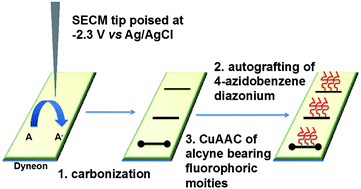
In the present paper, we provide a general route to built-in functional areas patterning within a perfluorinated microfluidic system. We first present the unprecedented local patterning of a Dyneon THV flat substrate by reductive carbonization assisted by SECM and extend this process to the patterning within an engraved microchannel. To this end, we adopt a three-steps approach: (1) SECM-assisted carbonization of the Dyneon THV, (2) introduction of azide groups by auto grafting of 4-azidobenzenediazonium on the carbonized area, (3) covalent linkage of alkyne-bearing molecules on the particular spot, through the Copper-Catalyzed Azide–Alkyne Cycloaddition (CuAAC) reaction (see Scheme 1).
![]() | ||
| Scheme 1 Strategy developed for the local modification of Dyneon THV surface by chemical functions and/or biomolecules. | ||
In a first step, the surface of a flat plate of Dyneon THV was carbonized using a 25 μm diameter SECM tip to reduce 2,2′ dipyridyl in DMF solution into its radical anion at a close distance. Preliminary experiments confirmed that the reduction of 2,2′ dipyridyl starts at −2.2 V vs. Ag/AgCl, and thus a potential of −2.3 V vs. Ag/AgCl was used for the mass-transfer controlled local patterning process. The tip was positioned at a desired close distance from the substrate surface using conventional approach curve in the feedback mode in 0.1 M KCl + 5 mM hexaammineruthenium (III) chloride aqueous solution (see approach curves in ESI†). The tip electrode was positioned by recording the microelectrode current, iT, as a function of the substrate-microelectrode distance d. It is positioned at a normalized current value equal to iT/iT,∝ ∼ 0.5, where iT,∝ is the current at infinite distance.
After through rinsing of the substrate, the aqueous solution is then replaced by DMF containing 2,2′ dipyridyl (50 mM) and Bu4NBF4 (0.1 M). The system was kept under nitrogen in a polyethylene bag during the experiment. The humidity in the plastic bag was maintained at less than 30%. The tip was biased at −2.3 V vs. Ag/AgCl while moving the electrode at scan rates of 1, 2 or 3 μm s−1. As for other fluoropolymers, the local reduction performed at the SECM tip yields the material carbonization. Fig. 1A shows the traces of the carbonization of the Dyneon THV surface observed by optical microscopy. Then, the freshly carbonized surface was immersed in 4-azidobenzenediazonium (5 mM) in acetonitrile for 1 h to allow its spontaneous grafting, leading to an azide functionalization of the carbonized areas20,22 (see ESI†). In a final step, the fluorescent dye acetylene-Fluor 488 was clicked through CuAAC reaction.23 Fig. 1B & C show that the specific immobilization of the fluorescent dye was carried out successfully and provides a visual means to evaluate CuAAC reaction yield on N3-modified THV substrate following its carbonization. It should be noticed that the same experiment conducted without copper catalyst led to adsorption of the dye in the carbonized zone with lower fluorescence intensity that disappears with ethanol rinsing.
The same procedure was carried out within a microchannel of 950 μm width and 150 μm height engraved in the Dyneon THV substrate. To do so, the SECM tip was placed at the bottom of the channel through control over the negative feedback current in 0.1 M KCl + 5 mM hexaammineruthenium (III) chloride aqueous solution (currents such that iT/iT,∝ = 0.25 and 0.5 were chosen). The solution was then replaced by DMF solution containing 2,2′ dipyridyl (100 mM) and Bu4NBF4 (0.1 M). The carbonization of the surface of the microchannel through the electrochemical reduction of 2,2' dipyridyl was performed at two different positions of the tip and at two different scan rates.
Fig. 2A shows the fluorescent images of the carbonized areas after reaction with 4-azidobenzenediazonium and Fig. 2B after the click reaction with acetylene-Fluor 488. As expected, for a given normalized distance, the decrease of the scan rate during the reduction of 2,2′ dipyridyl leads to larger carbonized patterns on Dyneon thus producing larger modified zones with acetylene-Fluor 488 after click reaction (≈30 μm width at 1 μm s−1 and ≈14 μm width at 3 μm s−1). For a given scan rate during carbonization, lower working distance (between the tip and Dyneon surface) leads to narrower carbonized zone (≈65 μm at a distance corresponding to iT/iT,∝ = 0.5 and ≈30 μm at iT/iT,∝ = 0.25) due to the slowness of the surface reaction. Whatever the carbonization conditions used, these data allow confirming the successful specific micro immobilization of the fluorescent dye within the microchannel on the N3-modified Dyneon THV substrate following its carbonization.
Finally, the patterning of an aptamer of 75 bases with sequence 5′-ATA CCA GCT TAT TCA ATT GCA ACG TGG CGG TCA GTC AGC GGG TGG TGG GTT CGG TCC AGA TAG TAA GTG CAA TCT-3′ modified with 6-carboxyfluorescein (6-FAM) at the 5′ end and 5-Octadiynyl at the 3′ end (see ESI†) was successfully performed following a click procedure similar to that of the anchoring of acetylene-Fluor 488. Fig. 3 shows an example of the fluorescent image of the pattern obtained with a tip of 10 μm diameter positioned at iT/iT,∝ = 0.5 a within the channel and moved at 1 μm s−1 and further derivatized with the fluorescently-tagged aptamer. The grafted oligonucleotide was stable through several rinsings with water and ethanol and upon ultra sonication. Further experiments are in progress to clearly show that the grafted oligonucteotide retains its affinity to bind the specific target molecule (i.e. diclofenac).
Footnote |
| † Electronic supplementary information (ESI) available. See DOI: 10.1039/c4ra14413a |
| This journal is © The Royal Society of Chemistry 2015 |