Enhanced electroactivity and substrate affinity of microperoxidase-11 attached to pyrene-linkers π–π stacked on carbon nanostructure electrodes

K. Sudhakara Prasad, Charuksha Walgama and Sadagopan Krishnan*
Department of Chemistry, Oklahoma State University, Stillwater, OK, USA 74078. E-mail: gopan.krishnan@okstate.edu

Received 12th November 2014 , Accepted 9th January 2015

First published on 13th January 2015


Abstract

An exceptionally large electroactively connected microperoxidase-11 (MP-11) with strong affinity for organic peroxide and offering a high electrocatalytic reduction current density of 7.5 mA cm−2 is achieved for the first time. For this, MP-11 was attached via pyrene linkers on the surface of multiwalled carbon nanotube-modified graphite electrodes.

The nature of protein arrangement on the surface of electrodes plays an important role in controlling the direct electron transfer and catalytic properties.1–4 Due to this reason, the specific immobilization of metalloenzymes on various functionalized “nano” surfaces has gained enormous attention recently. Both the covalent and non-covalent attachment methods have been reported for attaching enzymes to carbon nanostructures for electrocatalytic applications.5–12

Among several redox-active proteins attached to nanotube-modified electrodes, MP-11 (an 11-amino acid heme–iron peptide of cytochrome c) has gained enormous interests due to its small size with hydroxylation and peroxidase activities, similar to heme peroxidases and drug-metabolizing cytochrome P450 enzymes.9,13 Microperoxidases are obtained from the proteolytic digestion of cytochrome c and retain the proximal histidine (His-18) ligand of heme with the proximal imidazole coordinated to the heme–iron tightly at neutral pH.14 The axial coordination of histidine to the ferric-heme has been shown to have a crucial role in the activity of peroxidases.15,16 Prior studies reported the immobilization of MP-11 on gold surface by self-assembly techniques, simple adsorption and covalent attachment onto carbon nanotubes, and adsorption to nonporous films of indium tin oxide or silica cavity arrays.9,13–25

Katz and Willner studied the direct electrochemistry of MP-11 as a self-assembled monolayer on a cystamine-modified gold electrode.18 Gooding et al. examined the MP-11 film bound to the free ends of aligned –COOH functionalized, shortened single-walled carbon nanotubes (SWNT) on the surface of cystamine-layered gold electrodes.9 Dong et al. used an adsorption approach involving the immersion of MWNT-modified glassy carbon electrodes in MP-11 solution for 10 h.22 Another study utilized the covalent immobilization of MP-11 onto carbon nanotube structures by ion soft-landing method.17 However, to our knowledge, the electrocatalytic properties of MP-11 films covalently linked onto pyrenyl carbon-nanostructures have not been investigated yet.

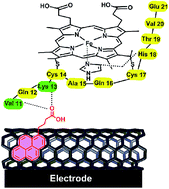
The MP-11 used in this study was the sodium salt of microperoxidase prepared from equine heart cytochrome c by peptic digestion. The direct electrochemistry of MP-11 films on high purity graphite (HPG) electrodes modified with multiwalled carbon nanotubes (MWNT) and π–π stacked with 1-pyrenebutyric acid (MWNT/Py) was investigated by cyclic voltammetry. The covalent attachment of the two MP-11 amine groups (N-terminus Val-11 and Lys-13) to the terminal carboxylic acid groups of Py in MWNT/Py surface was through the amine–carboxylic acid coupling chemistry, similar to that reported previously (denoted as MP11-aminecov film, Scheme 1).4


image file: c4ra14361b-s1.tif
Scheme 1 Representation of the covalent immobilization of MP-11 on MWNT/Py modified HPG electrodes.

Fig. S1 shows that the characteristic D and G bands of MWNT in the Raman spectrum were shifted to lower frequencies as a result of π–π interaction with Py molecules.26,27 Thus, Raman spectroscopy confirmed the π–π stacking of Py with surface MWNT coated on HPG electrodes. The formation of MP-11 films on the surface of MWNT/Py electrodes was confirmed by Fourier transform infrared spectroscopy operated in the attenuated total reflection mode (FTIR-ATR, Fig. S2 and S3). The attachment of MP-11 to MWNT/Py units was also confirmed by surface morphological characterization using scanning electron microscopy (SEM, Fig. 1), transmission electron microscopy (TEM, Fig. S4), and energy dispersive spectroscopy (EDS, Fig. S5).


image file: c4ra14361b-f1.tif
Fig. 1 SEM images for (A) HPG/MWNT/Py and (B) MP11-aminecov films. (C) The image of a bare HPG surface displaying the texture of graphite flakes is shown for comparison.

For the SEM imaging, polished HPG surface was only partially modified with MWNT/Py assembly to allow the comparison of bare HPG surface and that coated with MWNT. As can be seen from Fig. 1, the HPG surface showing platelet like features is covered by bundles of MWNT (Fig. 1A and C). After the covalent attachment of MP-11 via amine groups, the MWNT/Py features were buried under the peptide film and resulted in a fiber-like texture (Fig. 1B). The TEM images additionally supported the inferences obtained from SEM (Fig. S4).28 The presence of Fe and S (possibly from the MP-11 heme and cysteinyl sulfur, respectively) identified in the EDS analysis further confirmed the immobilization of MP-11 on the MWNT/Py modified electrodes (Fig. S5).29

Electrochemical studies were carried out to investigate the effect of MP-11 immobilization onto the pyrene linkers of MWNT/Py modified electrodes with respect to the electroactive MP-11 amount, direct electron transfer (ET) rates, and organic peroxide reduction currents. The cyclic voltammograms of the designed MP11-aminecov film in 0.1 M phosphate buffer saline (PBS), pH 7.4 displayed well-defined quasi-reversible redox peaks, and indicated the direct electron transfer between the heme cofactor of MP-11 and the MWNT/Py modified electrode surface (Fig. 2A(a)). Similarly, the control MP-11 films coated on only HPG or HPG/Py or HPG/MWNT electrodes showed reversible voltammograms, however, at more positive Eo′ values due to the differences among the electrode surfaces that can possibly influence the MP-11 arrangements (Fig. 2A(b–d), Table 1). In the absence of immobilized MP-11, the MWNT/Py modified electrode alone or only the HPG electrode did not show any redox peaks (Fig. 2B). This confirmed that the observed votlammetry in Fig. 2A was of MP-11.

Table 1 Contribution of pyrene linker in enhancing the catalytic reduction currents of MP11-aminecov film over control films
Enzyme film type Eo′ (in V) vs. Ag/AgCl Catalytic current density (mA cm−2) (at −0.5 V vs. Ag/AgCl)
MP11-aminecov −0.36 (±0.01) 7.5 ± 0.4
HPG/MP11 (no MWNT and Py-linker) −0.28 (±0.01) 3.4 ± 0.2
HPG/Py-MP11 (no MWNT) −0.33 (±0.01) 3.6 ± 0.1
HPG/MWNT-MP11 (no Py-linker) −0.32 (±0.03) 4.8 ± 0.2
Myoglobin-aminecov (ref. 4) −0.35 (±0.02) 4.1 ± 0.3


image file: c4ra14361b-f2.tif
Fig. 2 (A) Background subtracted cyclic voltammograms of (a) MP11-aminecov, (b) MWNT-MP11 (EDC/NHS activated MWNT, but no pyrene linker), (c) HPG/Py-MP11 with no MWNT, and (d) HPG/MP11 with no Py and MWNT at 0.7 V s−1 in pH 7.4, PBS. (B) Cyclic voltammograms of (a) MWNT/Py modified electrode and (b) only HPG electrode with no MP-11 film.

In fact, the large double layer capacitance of MWNT/Py modified HPG electrode indicates the feature of high surface area [Fig. 2B(a)] and also suggests a supercapacitor property that has been shown for MWNT electrodes.30 By plotting the charging current densities with scan rates for the HPG/MWNT/Py and bare HPG electrodes, we obtained the capacitance values of each electrode from the slopes of the resulting plots (Fig. S6).31 By this procedure, we determined that the capacitance of HPG/MWNT/Py was 1066 μF cm−2 and that of the polished HPG surface was 367 μF cm−2. This indicates that the MWNT/Py modification on HPG electrode offered an ∼3-fold greater electroactive surface area than the unmodified HPG electrode.

The cathodic (Epc) and anodic (Epa) peak separation (ΔEp) with increasing scan rate of the MP11-aminecov film was used to calculate the standard ET rate constant (ks) by the Laviron's method (Fig. S7 and details in the ESI).32,33 A ks value of 4.6 ± 0.2 s−1 was obtained for the designed MP11-aminecov film. The electroactive surface concentration (Γ) of MP11-aminecov film was calculated by integrating the area of the reduction or oxidation peak (since the peak current ratio was close to unity).4,33,34 The MP11-aminecov film exhibited an ∼2-fold higher electroactive coverage than the MWNT-MP11 film (EDC/NHS activated MWNT) without the pyrene linker [Fig. 2A(b)], and ∼3 to 4-fold enhancement in Γ than the films of HPG/Py-MP11 with no MWNT [Fig. 2A(c)] and HPG/MP11 with no Py and MWNT [Fig. 2A(d)] (Table S1). This property confirms the unique role of the pyrene linkers in facilitating higher density covalent immobilization of MP-11 and the associated large electroactive enzyme coverage in the MP11-aminecov film over other control films.

Furthermore, an 8-fold enhancement in Γ was obtained for the MP11-aminecov film when compared to a myoglobin film (−0.35 V vs. Ag/AgCl, Table 1) attached similarly via surface amino groups on MWNT/Py modified electrodes (denoted as myoglobin-aminecov, Table S1).4 The electroactive coverage of MP-11 films on the modified electrodes suggests the formation of multilayer films, with a highly possible electron self-exchange phenomenon occurring between adjacent MP-11 heme centers.21,23,33

The electrocatalytic property of the MP11-aminecov film and other control films was investigated by monitoring the reduction of tert-butyl hydroperoxide (t-BuOOH) to tert-butanol (t-BuOH). The larger electroactive MP-11 in the MP11-aminecov film led to a 1.5 to 2-fold greater catalytic reduction current density of this film over control MP-11 films (Fig. 3, Table 1). Thus, the enhancement effect of pyrene linkers on both the electroactive coverage and the electrocatalytic currents of immobilized MP-11 in the MP11-aminecov film can be understood. The currents were measured at the plateau region at −0.5 V vs. Ag/AgCl, which is a high enough over potential region, where the interfacial ET-rate is presumed to be not rate limiting.10,11,33 The reduction currents were subtracted for the small background currents (≤5% of the catalytic current) from the respective electrodes with no immobilized MP-11 films (i.e., MWNT/Py, MWNT, HPG/Py, and only HPG; Fig. 4b illustrates the background reduction currents from the HPG/MWNT/Py electrode).


image file: c4ra14361b-f3.tif
Fig. 3 Electrocatalytic t-BuOOH (4.8 mM) reduction currents at 1000 rpm in PBS (pH 7.4), 25 °C, catalyzed by (a) MP11-aminecov, (b) MWNT-MP11 (EDC/NHS activated MWNT, but no pyrene linker), (c) HPG/Py-MP11 with no MWNT, and (d) HPG/MP11 with no Py and MWNT.

image file: c4ra14361b-f4.tif
Fig. 4 Catalytic current densities with t-BuOOH concentration at 1000 rpm for the designed (a) MP11-aminecov film and (b) MWNT/Py electrode in the absence of attached MP-11 in pH 7.4, PBS, 25 °C.

The t-BuOOH reduction currents catalyzed by the MP11-aminecov film versus the applied potential for increasing t-BuOOH concentrations are shown in Fig. S8. The catalytic reduction current density (current divided by the electrode geometric area) versus the concentration of t-BuOOH present in solution is shown in Fig. 4a. The small background reduction currents from the MWNT/Py electrodes with no MP-11 film are shown in Fig. 4b.

The designed MP11-aminecov film exhibited a high electrocatalytic activity with a current density of 7.5 mA cm−2 towards an organic peroxide reduction. The current density is greater by about 2-fold than the myoglobin-aminecov films (Table 1).4 This feature can be attributed to the small size of MP-11 heme peptide favoring high density surface concentration compared to the relatively large myoglobin protein. More interestingly, the apparent Michaelis–Menten constant (Kappm) obtained from the Michaelis–Menten fit of reduction current density plot (Fig. 4a) of the designed MP11-aminecov film (Kappm = 1 mM) is 12-fold smaller than that observed by us for the myoglobin-aminecov film (Kappm = 12 mM).4 This suggests the stronger affinity of short MP-11 peptide by the designed covalent strategy over the similarly prepared large myoglobin protein film towards an organic peroxide substrate.

Conclusions

The results presented demonstrate that the π–π stacking of pyrene linkers with carbon nanotubes offers enhanced electroactive redox protein molecules and catalytic currents probably by retaining the innate electronic properties of MWNT and additionally by the presence of a large number of stacked pyrene units for high density, stable covalent enzyme immobilization. Furthermore, the findings above suggest a new potential direction in achieving high electrocatalytic activities of large, fragile, redox-center buried, or otherwise difficult to study metalloenzymes by mutating them into small catalytically active redox domains to effectively connect with electrodes.

Experimental

Materials

Equine heart microperoxidase-11 (MP-11) sodium salt, multiwalled carbon nanotubes (carbon >90% trace metal basis, outer diameter 10–15 nm, inner diameter 2–6 nm, length 0.1–10 μm, average wall thickness 5–15 graphene layers), 1-ethyl-3-[3-dimethylaminopropyl]carbodiimide hydrochloride (EDC), tert-butyl hydroperoxide (t-BuOOH), 1-pyrenebutyric acid (Py), and N-hydroxysuccinimide (NHS) were purchased from Sigma and used as received. High purity graphite electrode disks (grade: POCO EDM-4, average particle size: <4 microns) were purchased from EDM Inc., MN, USA. All other chemicals used were high purity analytical grade.

Voltammetry

Voltammetric studies were carried out with a CHI 6017E workstation (Austin, TX, USA) at room temperature (25 °C) under a nitrogen atmosphere. A 3-electrode system consisting of a HPG electrode modified with MWNT/Py surface and attached with MP-11 as the working electrode, an Ag/AgCl (3 M KCl) reference electrode, and a platinum wire auxiliary electrode was used. Prior to surface modification, the HPG electrodes were sanded to expose a fresh surface by polishing on a SiC paper (P320 grit) followed by sonication in ethanol–water mixture and drying under nitrogen. The rotating disk voltammetry (RDV) was performed at a rotation rate of 1000 rpm using an Eco Chemie Auto lab rotator system equipped with a motor controller unit (Metrohm Inc., USA).

Preparation of MP-11 films on MWNT/Py modified electrodes

The procedure to prepare MWNT/Py modified electrodes and covalent MP-11 immobilization is similar to our prior report.4 In brief, to the polished and cleaned surface of HPG electrodes (geometric area 0.2 cm2), a 15 μL suspension of 1 mg mL−1 MWNT in dimethylformamide (DMF) was added and allowed to dry at room temperature. Following this, a 10 μL aliquot of 1-pyrenebutyric acid (Py, 10 mM) in DMF was added to each electrode. The electrodes were covered with a moisturized beaker (to avoid the Py solution from drying) and allowed for 1 hour to form the strong π–π stacked MWNT/Py assemblies. Then the electrodes were rinsed well in water.

For the selective covalent attachment of MP-11 through the free amine groups (Lys-13 and N-terminus Val-11), MWNT/Py electrodes were treated with a freshly prepared mixture of 0.35 M 3-[3-dimethylaminopropyl]carbodiimide hydrochloride (EDC) and 0.1 M N-hydroxysuccinimide (NHS) to activate the carboxylic acid surface groups of Py by reacting for 10 min. The electrodes were rinsed in deionized water and subsequently 20 μL of MP-11 (1 mM in 0.1 M PBS) were added and incubated for 1 hour at 4 °C to obtain MP11-aminecov films.

Characterization of MP11-aminecov films

The characterization and surface morphological studies of the designed MWNT/Py modified electrodes and those attached with MP-11 films were carried out by Raman spectroscopy (Nicolet NXR FT-Raman module, Nd:YVO4 laser, 0.2 W, resolution 4 cm−1), Fourier transform infrared spectroscopy in the attenuated total reflection mode (Varian 800 FTIR, Scimitar Series), scanning electron microscopy (SEM), energy dispersive spectroscopy (EDS, FEI Quanta 600 field emission gun ESEM with Evex EDS and HKL EBSD) and transmission electron microscopy (TEM, JEOL JEM-2100).

Acknowledgements

Financial support by Oklahoma State University is greatly acknowledged. We thank Dr Smita Mohanty and Dr Jose Soulages for helpful discussions. We thank Evangeline Rukundo for helping with Raman spectroscopy measurements.

Notes and references

  1. C. Leger and P. Bertrand, Chem. Rev., 2008, 108, 2379–2438 CrossRef CAS PubMed.
  2. A. Walcarius, S. D. Minteer, J. Wang, Y. Lin and A. Merkoci, J. Mater. Chem. B, 2013, 1, 4878–4908 RSC.
  3. E. S. Redeker, D. T. Ta, D. Cortens, B. Billen, W. Guedens and P. Adriaensens, Bioconjugate Chem., 2013, 24, 1761–1777 CrossRef PubMed.
  4. C. Walgama and S. Krishnan, J. Electrochem. Soc., 2014, 161, H47–H52 CrossRef CAS PubMed.
  5. I. Willner and E. Katz, Angew. Chem., Int. Ed., 2000, 39, 1180–1218 CrossRef.
  6. E. Lojou, Electrochim. Acta, 2011, 56, 10385–10397 CrossRef CAS PubMed.
  7. M. Calvaresi and F. Zerbetto, Acc. Chem. Res., 2013, 46, 2454–2463 CrossRef CAS PubMed.
  8. R. J. Chen, Y. Zhang, D. Wang and H. Dai, J. Am. Chem. Soc., 2001, 123, 3838–3839 CrossRef CAS.
  9. J. J. Gooding, R. Wibowo, J. Q. Liu, W. R. Yang, D. Losic, S. Orbons, F. J. Mearns, J. G. Shapter and D. B. Hibbert, J. Am. Chem. Soc., 2003, 125, 9006–9007 CrossRef CAS PubMed.
  10. G. Göbel and F. Lisdat, Electrochem. Commun., 2008, 10, 1691–1694 CrossRef PubMed.
  11. S. Krishnan and F. A. Armstrong, Chem. Sci., 2012, 3, 1015–1023 RSC.
  12. L. Halamkova, J. Halamek, V. Bocharova, A. Szczupak, L. Alfonta and E. Katz, J. Am. Chem. Soc., 2012, 134, 5040–5043 CrossRef CAS PubMed.
  13. M. Wang, F. Zhao, Y. Liu and S. Dong, Biosens. Bioelectron., 2005, 21, 159–166 CrossRef CAS PubMed.
  14. T. Mashino, S. Nakamura and M. Hirobe, Tetrahedron Lett., 1990, 31, 3163–3169 CrossRef CAS.
  15. E. Ryabova and E. Nordlander, Dalton Trans., 2005, 7, 1228–1233 RSC.
  16. T. L. Poulos, J. Biol. Inorg. Chem., 1996, 1, 356–359 CrossRef CAS.
  17. F. Mazzei, G. Favero, F. Frasconi, A. Tata and F. Pepi, Chem.–Eur. J., 2009, 15, 7359–7367 CrossRef CAS PubMed.
  18. E. Katz and I. Willner, Langmuir, 1997, 13, 3364–3373 CrossRef CAS.
  19. T. Lotzbeyer, W. Schuhmann, E. Katz, J. Falter and H.-L. Schmidt, J. Electroanal. Chem., 1994, 377, 291–294 CrossRef.
  20. T. Lotzbeyer, W. Schuhmann and H.-L. Schmidt, J. Electroanal. Chem., 1995, 395, 341–344 CrossRef.
  21. T. Ruzgas, A. Gaigalas and L. Gorton, J. Electroanal. Chem., 1999, 469, 123–131 CrossRef CAS.
  22. Y. Liu, M. Wang, F. Zhao, Z. Guo, H. Chen and S. Dong, J. Electroanal. Chem., 2005, 581, 1–10 CrossRef CAS PubMed.
  23. A. Yarman, T. Nagel, N. Gajovic-Eichelmann, A. Fischer, U. Wollenberger and F. W. Scheller, Electroanalysis, 2011, 23, 611–618 CAS.
  24. C. Renault, C. P. Andrieux, R. T. Tucker, M. J. Brett, V. Balland and B. Limoges, J. Am. Chem. Soc., 2012, 134, 6834–6845 CrossRef CAS PubMed.
  25. S. Tian, Q. Zhou, Z. Gu, X. Gu, L. Zhao, Y. Li and J. Zheng, Talanta, 2013, 107, 324–331 CrossRef CAS PubMed.
  26. Y. Zhang, S. Yuan, W. Zhou, J. Xu and Y. Li, J. Nanosci. Nanotechnol., 2007, 7, 2366 CrossRef CAS PubMed.
  27. Q. Yang, L. Shuai, J. Zhou, F. Lu and X. Pan, J. Phys. Chem. B, 2008, 112, 12934 CrossRef CAS PubMed.
  28. D. Zhang, L. Zhang, L. Shi, C. Fang, H. Li, R. Gao, L. Huang and J. Zhang, Nanoscale, 2013, 5, 1127 RSC.
  29. D. Zhang, L. Zhang, C. Fang, R. Gao, Y. Qian, L. Shi and J. Zhang, RSC Adv., 2013, 3, 8811 RSC.
  30. E. Frackowiak, K. Metenier, V. Bertagna and F. Beguin, Appl. Phys. Lett., 2000, 77, 2421 CrossRef CAS PubMed.
  31. D. Svedruzic, J. L. Blackburn, R. C. Tenent, J.-D. R. Rocha, T. B. Vinzant, M. J. Heben and P. W. King, J. Am. Chem. Soc., 2011, 133, 4299 CrossRef CAS PubMed.
  32. E. Laviron, J. Electroanal. Chem., 1979, 101, 19–28 CrossRef CAS.
  33. S. Krishnan, A. Abeykoon, J. B. Schenkman and J. F. Rusling, J. Am. Chem. Soc., 2009, 131, 16215 CrossRef CAS PubMed.
  34. S. Krishnan and C. Walgama, Anal. Chem., 2013, 85, 11420 CrossRef CAS PubMed.

Footnote

Electronic supplementary information (ESI) available: Fig. S1–S8 detailing the spectroscopic and microscopic characterization, capacitive current versus scan rate plots of HPG/MWNT/Py and only HPG, potential versus logarithmic scan rate, and electrocatalytic voltammograms. See DOI: 10.1039/c4ra14361b

This journal is © The Royal Society of Chemistry 2015
Click here to see how this site uses Cookies. View our privacy policy here.