
NHC macrometallocycles of mercury(II) and silver(I): synthesis, structural studies and recognition of Hg(II) complex 4 for silver ion

Qing-Xiang Liu*, Qing Wei, Rui Liu, Xiao-Jun Zhao and Zhi-Xiang Zhao
Tianjin Key Laboratory of Structure and Performance for Functional Molecules, Key Laboratory of Inorganic–Organic Hybrid Functional Material Chemistry, Ministry of Education, College of Chemistry, Tianjin Normal University, Tianjin 300387, China. E-mail: tjnulqx@163.com

Received 12th November 2014 , Accepted 11th March 2015

First published on 16th March 2015


Abstract

A series of bis-benzimidazolium (or bis-imidazolium) salts, and their seven N-heterocyclic carbene mercury(II) and silver(I) complexes 2–8, as well as one anionic complex 1 have been synthesized and characterized. In complex 1, two benzimidazole rings point in opposite directions, and π–π interactions between these two benzimidazole rings are observed. In complex 2, two 13-membered macrometallocycles are linked together by one bridging chlorine atom, in which each macrometallocycle is formed by one bidentate carbene ligand (L2) and one Hg(II) ion. In complexes 3–6, each molecule contains one 13-membered macrometallocycle formed by one bidentate carbene ligand and one metal ion. In the crystal packings of 1–8, 1D polymeric chains, 2D supramolecular layers and 3D supramolecular frameworks are formed via intermolecular weak interactions, including hydrogen bonds, π–π interactions and C–H⋯π contacts. Particularly, the selective recognition of Ag+ using 4 as a host compound was studied on the basis of fluorescent and UV/vis spectroscopic titrations.

Introduction

Fluorescent recognition is one of the significant tools to detect and measure metal ions in chemistry, biology and environmental science.1 So far, a number of host compounds for recognition of metal ions have been reported,2 but the development of practical host compounds is still important work for researchers. The compounds containing silver(I) ion is widely used in the electrical, photography imaging and pharmaceutical industry.3 It is known that silver oxide can destroy the environmental benign bacteria by inhibiting their growth or disturbing their reproductive ability. Also silver(I) ion can inactivate sulfhydryl enzymes and destroy organic tissues to lead to cell death.3b,4 Therefore, the detecting and monitoring content of silver(I) ion in soil, food and water have great importance for the environment and human health. There are many methods toward Ag+ detection, such as fluorescence spectrophotometry,5 inductively coupled plasma mass spectrometry (ICP-MS)6 and atomic absorption spectrometry.7 Among these methods, the fluorescence spectrophotometry has received more attention due to high sensitivity and easy-operation. In reported fluorescence host compounds for Ag+ detection, the main binding sites are N, O, S and π system,8 and the using I-donor of organic compound as binding site was not found although iodine has strong affinity toward Ag+. Therefore, the design and synthesis of host compounds bearing I-donor may be a promising method for Ag+ detection.

During the course of searching for appropriate host compounds, we become interested in N-heterocyclic carbene (NHC) metal complexes. N-heterocyclic carbene can form stable metal complexes with many transition metals due to its strong σ-donating property.9 Among these metal complexes, NHC metal complexes based on chelating bis-NHC ligands with different linkages (such as aromatic ring and ether chain) can be used as receptors to capture selectively guests (ions or molecules),10 and they may be a type of host compound with the value of potential application in host–guest chemistry.

In this paper, we report the preparation of bis-benzimidazolium salts 2,3-bis[2′-(N-R-benzimidazoliumyl)ethoxy]naphthalene 2X (L1H2·(PF6)2: R = ethyl, X = PF6; L2H2·I2: R = picolyl, X = I; L2H2·(PF6)2: R = picolyl, X = PF6; L3H2·I2: R = npropyl, X = I; L4H2·(PF6)2: R = nbutyl, X = PF6), and bis-imidazolium salts 2,3-bis[2′-(N-R-imidazoliumyl)ethoxy]naphthalene hexafluorophosphate (L5H2·(PF6)2: R = nbutyl; L6H2·(PF6)2: R = ethyl), as well as preparation and structures of one anionic complex [L1H2](Pd2Cl6) (1) and seven N-heterocyclic carbene metal complexes, [(L2HgI)2Cl]I (2), [L3Hg(HgCl2I2)] (3), [L4HgI2] (4), [L5HgI2] (5), [L6Hg(HgI4)(DMSO)] (6), [L2Ag](PF6) (7) and [L4Ag](PF6) (8). Particularly, the selective recognition of Ag+ using organometallic complex containing I-donor (4) as a host compound was investigated on the basis of fluorescent and UV/vis spectroscopic titrations.

Results and discussion

Synthesis and general characterization of precursors L1H2·(PF6)2, L2H2·(PF6)2, L4H2·(PF6)2–L6H2·(PF6)2, L2H2·I2 and L3H2·I2

As shown in Schemes 1 and 2,3-dihydroxynaphthalene as starting material was reacted with 2-chloroethanol to afford 2,3-bis(2′-hydroxyethoxy)naphthalene, followed by chlorination of hydroxyl groups with thionyl chloride to give 2,3-bis(2′-chloroethoxy)naphthalene. The reaction of 2,3-bis(2′-chloroethoxy)naphthalene with N-R-benzimidazole (R = ethyl, npropyl, nbutyl or picolyl) or N-R-imidazole (R = ethyl or nbutyl) in the presence of NaI to afford bis-benzimidazolium (or imidazolium) salts L1H2·I2–L6H2·I2, and subsequent anion exchange with ammonium hexafluorophosphate for L1H2·I2, L2H2·I2 and L4H2·I2–L6H2·I2 were carried out in methanol to give L1H2·(PF6)2, L2H2·(PF6)2 and L4H2·(PF6)2–L6H2·(PF6)2, respectively. These bis-benzimidazolium (or imidazolium) salts are stable to air, heat and moisture. They are soluble in DMSO, CH3CN or CH2Cl2, but insoluble in benzene, diethyl ether and petroleum ether. In the 1H NMR spectra of the precursors, the imidazole proton signals (NCHN) appear at δ = 9.23–9.99 ppm, which are consistent with the chemical shifts of reported benzimidazolium (or imidazolium) salts.11
image file: c4ra14340j-s1.tif
Scheme 1 Preparation of precursors.

image file: c4ra14340j-s2.tif
Scheme 2 Preparation of complexes 1–8.

Synthesis and general characterization of anionic complex 1 and NHC metal complexes 2–8

As shown in Scheme 2, the anionic complex [L1H2](Pd2Cl6) (1) was obtained via the reaction of L1H2·(PF6)2 with PdCl2 in CH3NO2. The precursors L2H2·I2, L3H2·I2, L4H2·(PF6)2, L5H2·(PF6)2 or L6H2·(PF6)2 were reacted with HgCl2 or HgI2 in the presence of KOtBu in CH3CN/DMSO to afford complexes [(L2HgI)2Cl]I (2), [L3Hg(HgCl2I2)] (3), [L4HgI2] (4), [L5HgI2] (5) and [L6Hg(HgI4)(DMSO)] (6), respectively. The reaction of L2H2·(PF6)2 or L4H2·(PF6)2 with Ag2O in ClCH2CH2Cl/DMSO afforded complexes [L2Ag](PF6) (7) and [L4Ag](PF6) (8), respectively. Complexes 1–8 are stable toward air and moisture, soluble in acetonitrile and DMSO, and insoluble in diethyl ether and hydrocarbon solvents. The structures of complexes 1–8 were confirmed by 1H NMR and 13C NMR spectroscopy and X-ray crystallography. The 1H NMR and 13C NMR spectra of anionic complex 1 are similar to that of corresponding precursor L1H2·(PF6)2. In the 1H NMR spectra of 2–8, the resonances for the benzimidazolium (or imidazolium) protons (NCHN) have disappeared, which shows the formation of the expected metal carbene complexes. The chemical shifts of other protons are similar to those of the corresponding precursors. In 13C NMR spectra, the signals for the carbene carbons of complexes 2–6 appear at 175.7–185.6 ppm, which are similar to known carbene metal complexes.12 The signals of the carbene carbons for silver(I) complexes 7 and 8 were not observed. The absence of the carbene carbon resonance is not usual, and this phenomenon has been reported for some silver(I)–carbene complexes, which may result from the fluxional behaviour of the NHC complexes.9

Structure of complexes 1–8

In the cationic unit of complex 1 (Fig. 1), two benzimidazole rings point to opposite directions, and π–π interactions between these two benzimidazole rings are observed (the inter-planar separation being 3.483(8) Å and the center-to-center separation being 3.594(1) Å).13 Two ethyl groups point to the same direction. The dihedral angles between naphthalene ring and two benzimidazole rings are 40.0(3)° and 38.3(2)°, respectively. The bond angles of N(1)–C(9)–N(2) is 110.6(3)°. In the anionic unit of 1, the coplanar [Pd2Cl6]2− unit is formed by two palladium(II) ions and six chlorine atoms (two bridging chlorine atoms Cl(3) and Cl(4), and four terminal chlorine atoms Cl(1), Cl(2), Cl(5) and Cl(6)). Four atoms Pd(1), Cl(3), Pd(2) and Cl(4) form a parallelogram, in which the bond angles of Cl(3)–Pd(1)–Cl(4) and Pd(1)–Cl(3)–Pd(2) are 85.9(3)° and 94.5(3)°, respectively. The distance of Pd–Clterminal (2.270(8) Å) is slightly shorter than that of Pd–Clbridging (2.351(8) Å). These values are similar to those of known complexes.14
image file: c4ra14340j-f1.tif
Fig. 1 Perspective view of 1 and anisotropic displacement parameters depicting 30% probability. All hydrogen atoms were omitted for clarity. Selected bond lengths (Å) and angles (°): Pd(1)–Cl(3) 2.318(8), Pd(1)–Cl(4) 2.351(8), Pd(1)–Cl(5) 2.280(8), Pd(1)–Cl(6) 2.277(9), Pd(2)–Cl(1) 2.277(8), Pd(2)–Cl(2) 2.270(8), Pd(2)–Cl(3) 2.328(9), Pd(2)–Cl(4) 2.345(8); Cl(1)–Pd(2)–Cl(2) 90.8(3), Cl(3)–Pd(1)–Cl(4) 85.9(3), Pd(1)–Cl(3)–Pd(2) 94.5(3), N(1)–C(9)–N(2) 110.6(3), N(3)–C(30)–N(4) 110.9(3).

In complexes 2–8 (Fig. 2–8), the internal ring angles (N–C–N) at the carbene center are from 105.3(4)° to 107.6(6)°, which are similar to those of known NHC metal complexes,15,16 but less than corresponding value in 1 (110.6(3)°). In the same ligand of complexes 2–8, the dihedral angles between two benzimidazole (or imidazole) rings are from 50.6(4)° to 59.0(9)°, and the naphthalene ring and two benzimidazole (or imidazole) rings formed the dihedral angles of 68.9(6)–87.4(5)° (Table S4 in ESI).


image file: c4ra14340j-f2.tif
Fig. 2 Perspective view of 2 and anisotropic displacement parameters depicting 30% probability. All hydrogen atoms were omitted for clarity. Selected bond lengths (Å) and angles (°): C(13)–Hg(1) 2.103(4), C(28)–Hg(1) 2.103(4), Hg(1)–I(1) 3.103(6), Hg(1)–Cl(1) 2.878(8); C(13)–Hg(1)–C(28) 160.2(1), C(13)–Hg(1)–I(1) 86.8(1), C(28)–Hg(1)–I(1) 108.1(1), I(1)–Hg(1)–Cl(1) 96.3(1), Hg(1)–Cl(1)–Hg(1A) 136.4(6), N(2)–C(13)–N(3) 107.0(3), N(4)–C(28)–N(5) 107.5(4). Symm. code: (i): 1 − x, y, 1.5 − z.

In complexes 3–8, each molecule contains a 13-membered macrometallocycle formed via one bidentate carbene ligand (L3 for 3, L4 for 4 and 8, L5 for 5, L6 for 6, L2 for 7) and one metal ion (Hg(II) ion for 3–6 and Ag(I) for 7 and 8). In complexes 2–6, each Hg(1) ion was tetra-coordinated with two carbene carbon atoms and two heteroatoms (one iodine atom and one chlorine atom for 2, two chlorine atoms for 3, two iodine atoms for 4 and 5, and one iodine atom and one oxygen atom from DMSO for 6) to adopt a slightly distorted tetrahedral geometry. In each NHC–Hg–NHC unit of 2–6, two benzimidazole rings form the dihedral angles of 50.6(4)–59.0(9)°. In complexes 2–6, the bond angles of C–Hg–C are from 146.6(3)° to 170.5(3)° and the bond distances of Hg–C are from 2.067(6) Å to 2.146(7) Å. In dinuclear mercury complexes 2, 3 and 6, the Hg(1)⋯Hg(2) separations are 5.344(1) Å, 4.082(6) Å and 4.997(4) Å, respectively, which indicates no interactions between two mercury ions17 (van der Waals radii of mercury = 1.70 Å). In complexes 2, 3, 5 and 8, an inversion center in each molecule is observed.

Interestingly, two 13-membered macrometallocycles in 2 (Fig. 2) are connected together via one bridging chlorine atom, in which each macrometallocycle is formed by one bidentate carbene ligand (L2) and one Hg(II) ion. The bond distances of Hg(1)–I(1) and Hg(1)–Cl(1) are 3.103(6) Å and 2.878(8) Å, respectively. The bond angles of Hg(1)–Cl(1)–Hg(1A) and I(1)–Hg(1)–Cl(1) are 136.4(6)° and 96.3(1)°, respectively.15 The dihedral angles between benzimidazole rings and adjacent pyridine rings are from 79.2(7)° to 82.6(1)°.

In 3 (Fig. 3), a coplanar quadrangle [Hg2Cl2]2− was formed by Hg(1), Cl(1), Hg(2) and Cl(1A). The bond angles of Cl(1)–Hg(1)–Cl(1A), I(1)–Hg(2)–I(1A) and Hg(1)–Cl(1)–Hg(2) are 79.9(9)°, 125.2(5)° and 95.5(6)°, respectively. The Hg(2) is tetra-coordinated with two iodine atoms and two chlorine atoms. The bond distance of Hg(2)–Cl(1) (2.635(2) Å) is slightly shorter than that of Hg(1)–Cl(1) (2.876(2) Å). The bond distance of Hg(2)–I(1) (2.670(9) Å) is fall within the normal range.15 The bond angles of Cl–Hg(2)–I are from 104.3(6)° to 114.1(5)°.


image file: c4ra14340j-f3.tif
Fig. 3 Perspective view of 3 and anisotropic displacement parameters depicting 30% probability. All hydrogen atoms were omitted for clarity. Selected bond lengths (Å) and angles (°): Hg(1)–C(4) 2.095(8), Hg(1)–Cl(1) 2.876(2), Hg(2)–I(1) 2.679(9), Hg(2)–Cl(1) 2.635(2); C(4)–Hg(1)–C(4A) 160.8(5), C(4)–Hg(1)–Cl(1) 86.9(2), C(4)–Hg(1)–Cl(1A) 108.1(2), Cl(1)–Hg(2)–I(1) 104.3(6), Cl(1)–Hg(2)–I(1A) 114.1(5), Cl(1)–Hg(1)–Cl(1A) 79.9(9), I(1)–Hg(2)–I(1A) 125.2(5), Hg(1)–Cl(1)–Hg(2) 95.5(6), N(1)–C(4)–N(2) 107.0(7). Symm. code: (i): 1 − x, y, 1.5 − z.

In complexes 4 and 5 (Fig. 4 and 5), the bond distances of Hg–I are from 3.047(5) Å to 3.179(9) Å, and these values are longer than normal values of 2.7–2.8 Å.12 The bond angles of I–Hg–I are for 4 101.7(3)° and 94.6(2)° for 5. The bond angles of C–Hg–I are from 83.5(1)° to 111.5(1)°. These values are similar to those of known NHC–mercury(II) complexes.15


image file: c4ra14340j-f4.tif
Fig. 4 Perspective view of 4 and anisotropic displacement parameters depicting 30% probability. All hydrogen atoms were omitted for clarity. Selected bond lengths (Å) and angles (°): Hg(1)–C(11) 2.138(7), Hg(1)–C(26) 2.146(7) Hg(1)–I(1) 3.179(9), Hg(1)–I(2) 3.167(9); C(11)–Hg(1)–C(26) 157.8(3), C(11)–Hg(1)–I(1) 110.4(2), C(11)–Hg(1)–I(2) 83.5(1), C(26)–Hg(1)–I(1) 84.9(2), I(1)–Hg(1)–I(2) 101.7(3), N(1)–C(11)–N(2) 107.3(6), N(3)–C(26)–N(4) 107.6(6).

image file: c4ra14340j-f5.tif
Fig. 5 Perspective view of 5 and anisotropic displacement parameters depicting 30% probability. All hydrogen atoms were omitted for clarity. Selected bond lengths (Å) and angles (°): Hg(1)–C(5) 2.133(5), Hg(1)–I(1) 3.047(5); C(5)–Hg(1)–C(5A) 146.6(3), C(5)–Hg(1)–I(1) 91.2(1), C(5)–Hg(1)–I(1A) 111.5(1), I(1)–Hg(1)–I(1A) 94.6(2), N(1)–C(5)–N(2) 105.3(4). Symm. code: (i): − x, y, 0.5 − z.

image file: c4ra14340j-f6.tif
Fig. 6 Perspective view of 6 and anisotropic displacement parameters depicting 30% probability. All hydrogen atoms were omitted for clarity. Selected bond lengths (Å) and angles (°): Hg(1)–C(5) 2.067(6), Hg(1)–C(22) 2.068(7), Hg(1)–O(3) 2.745(7), Hg(2)–I(2) 2.752(6), Hg(2)–I(3) 2.774(6), Hg(2)–I(4) 2.790(5), Hg(2)–I(1) 2.841(5), Hg(1)–I(1) 3.363(5); C(5)–Hg(1)–C(22) 170.5(3), C(5)–Hg(1)–I(1) 107.5(1), C(22)–Hg(1)–I(1) 81.0(1), C(5)–Hg(1)–O(3) 80.8(4), C(22)–Hg(1)–O(3) 105.0(4) Hg(1)–I(1)–Hg(2) 106.9(1), Hg(1)–O(3)–S(1) 119.8(6), N(1)–C(5)–N(2) 106.0(5), N(3)–C(22)–N(4) 106.1(6).

In 6, Hg(2) is surrounded by four iodine atoms to adopt a tetrahedral geometry, in which the bond distances of Hg–I range from 2.752(6) Å to 2.841(5) Å, and the bond angles of I–Hg–I range from 105.0(1)° to 115.9(2)°. These values fall within the normal range.16 The bond distance of Hg(1)–I(1) (3.363(5) Å) is longer than above mentioned normal values. The bond angles of Hg(1)–I(1)–Hg(2) and Hg(1)–O(3)–S(1) are 106.9(1)° and 119.8(6)°, respectively.

Complexes 7 and 8 have similar structures (Fig. 7 and Fig. 8), in which each silver(I) ion is di-coordinated with two carbene carbon atoms to adopt an approximately linear geometry. The bond angles of C–Ag–C are 171.5(1)° for 7 and 172.1(1)° for 8, and the bond distances of Ag–C are from 2.086(4) Å to 2.097(3) Å. These values are similar to those of known NHC–silver(I) complexes.16 In each NHC–Ag–NHC unit of 7 and 8, two benzimidazole rings form the dihedral angles of 52.1(2)° for 7 and 56.9(1)° for 8. In complex 7, the dihedral angles between benzimidazole rings and the adjacent pyridine rings are 79.6(1)° and 83.5(5)°, respectively, and two pyridine rings form the dihedral angle of 33.4(4)°.


image file: c4ra14340j-f7.tif
Fig. 7 Perspective view of 7 and anisotropic displacement parameters depicting 30% probability. All hydrogen atoms were omitted for clarity. Selected bond lengths (Å) and angles (°): C(13)–Ag(1) 2.086(4), C(28)–Ag(1) 2.094(4); C(13)–Ag(1)–C(28) 171.5(1), N(2)–C(13)–N(3) 105.7(3), N(4)–C(28)–N(5) 106.3(3).

image file: c4ra14340j-f8.tif
Fig. 8 Perspective view of 8 and anisotropic displacement parameters depicting 30% probability. All hydrogen atoms were omitted for clarity. Selected bond lengths (Å) and angles (°): C(11)–Ag(1) 2.097(3); C(11)–Ag(1)–C(11A) 172.1(1), N(1)–C(11)–N(2) 106.0(3). Symm. code: (i): 1 − x, y, 0.5 − z.

The crystal packings of complexes 1–8

2D supramolecular layer of 1 is formed via C–H⋯Cl hydrogen bonds18 and π–π stacking interactions15 from benzimidazole rings and naphthalene rings (Fig. S1 in ESI). In the C–H⋯Cl hydrogen bonds, the hydrogen atoms are from benzimidazole rings. The data of π–π stacking interactions and hydrogen bonds are given in Tables S5 and S6 in ESI, respectively.

In the crystal packing of 2, 2D supramolecular layer (Fig. S2(a)) is formed through π–π stacking interactions from benzimidazole rings and C–H⋯π contacts19 (the data of C–H⋯π contacts being given in Table S5). In the C–H⋯π contacts, the hydrogen atoms are from benzimidazole rings and π systems are from naphthalene rings. Additionally, 3D supramolecular architecture (Fig. S2(b)) is formed through new C–H⋯π contacts. In new C–H⋯π contacts, the hydrogen atoms are from pyridine rings and π systems are from benzimidazole rings.

1D chain of 3 is formed via π⋯π stacking interactions from benzimidazole rings (Fig. S3). 2D supramolecular layer of 4 is formed through π–π stacking interactions from benzimidazole rings and C–H⋯π contacts (Fig. S4). In the C–H⋯π contacts, the hydrogen atoms are from CH3 and π systems are from benzimidazole rings.

In the crystal packing of 5, 2D supramolecular layer (Fig. S5(a)) is formed through π–π stacking interactions from imidazole rings and C–H⋯π contacts. In C–H⋯π contacts, the hydrogen atoms are from CH2 of nbutyl and π systems are from naphthalene rings. Additionally, 2D layers are further extended 3D supramolecular architecture (Fig. S5(b)) via the same C–H⋯π contacts.

1D polymeric chain of 6 is formed via C–H⋯π contacts (Fig. S6). In C–H⋯π contacts, the hydrogen atoms are from CH3 and π systems are from imidazole rings.

In the crystal packing of 7, 2D supramolecular layer (Fig. S7(a)) is formed via π–π stacking interactions from benzimidazole rings and C–H⋯π contacts. In the C–H⋯π contacts, the hydrogen atoms are from CH2 and π systems are from naphthalene rings. 2D supramolecular layers are further extended into 3D supramolecular architecture via another π–π interactions from benzimidazole rings (Fig. S7(b)).

As shown in Fig. S8(a), 2D supramolecular layer of 8 is formed through C–H⋯π contacts and π–π stacking interactions from benzimidazole rings. In the C–H⋯π contacts, the hydrogen atoms are from CH3 and π systems are from benzimidazole rings. Besides, 3D supramolecular architecture (Fig. S8(b)) is formed through the same C–H⋯π contacts and π–π interactions.

Recognition of Ag+ using 4 as a host compound

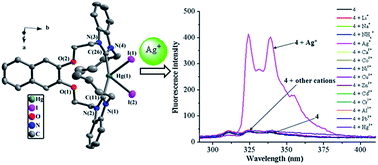
The selective recognition of some cations (Li+, Na+, NH4+, Ag+, Ca2+, Co2+, Ni2+, Cu2+, Zn2+, Cd2+, Cr3+, Al3+, Pb2+ and Hg2+, and use of their nitrate salts) using 4 as a host compound was investigated by fluorescent and UV/vis titrations in CH3OH at 25 °C. The host compound 4 showed a weak fluorescence emission band at 300 nm to 365 nm (λex = 283 nm, the excitation and emission slit: 3 nm and 3 nm), and its fluorescence was not influenced obviously by the addition of 30 equiv. of Li+, Na+, NH4+, Ca2+, Co2+, Ni2+, Cu2+, Zn2+, Cd2+, Cr3+, Al3+, Pb2+ and Hg2+, respectively (Fig. 9). Upon addition of Ag+, the host 4 exhibited a prominent fluorescence enhancement (free 4 of 10 fold) accompanied by a red shift of 14 nm, and these changes are attributed to the internal charge transfer (ICT) process induced by Ag+.2d,20
image file: c4ra14340j-f9.tif
Fig. 9 Fluorescence spectra of 4 (1 × 10⁻⁵ mol L−1) and upon the addition of salts (30 equiv.) of Li+, Na+, NH4+, Ag+, Ca2+, Co2+, Ni2+, Cu2+, Zn2+, Cd2+, Cr3+, Al3+, Pb2+ and Hg2+ in CH3OH at 25 °C.

In UV/vis experiments (Fig. S9), upon addition of Ag+ to the solution of 4, the absorption around 247 nm to 500 nm increased obviously, but other cations had not obvious effect on the absorption of 4. Therefore, complex 4 can be functioned as a highly selective host compound for recognition of Ag+.

In the fluorescent titration experiments (Fig. 10), upon the titration of Ag+ into solution of 4, the fluorescence intensity of 4 at 316–394 nm increases gradually with the concentration of Ag+ increases. In the insets of Fig. 10, the fluorescence intensity at 338 nm shows zigzag enhancement with the increase of concentration of Ag+ (for more information see Fig. S13 in ESI). In the range of low concentration of Ag+ (the ratio of CAg+ with C4 being below 0.11), the fluorescence intensity increases slowly. Following gradual increase of concentration of Ag+, the fluorescence intensity of 4 is sharply enhanced. When the ratio of CAg+ with C4 exceeded 50, higher concentrations of Ag+ do not lead to further enhancement of fluorescence intensity. The stability constant is calculated as 5.75 × 10⁴ (R = 0.999) for 4·Ag+ by using the eqn (1) in CH3OH at 25 °C.10b

 
image file: c4ra14340j-t1.tif(1)
where F and F0 are the fluorescence intensity of 4 in the presence and absence of Ag+, Fmax is final fluorescence intensity in titration experiment, X means lnCAg+, and KS is the stability constant.


image file: c4ra14340j-f10.tif
Fig. 10 Fluorescence titration spectra of 4 (1.0 × 10⁻⁵ mol L−1) in the presence of different concentrations of Ag+ in CH3OH at 25 °C. CAg+ for curves 1–34 (from bottom to top) are 0, 0.01, 0.02, 0.03, 0.05, 0.07, 0.09, 0.11, 0.17, 0.25, 0.43, 0.67, 1, 1.5, 2, 3, 5, 7, 9, 13, 17, 21, 25, 30, 35, 40, 45, 50, 55, 60, 65, 70, 75, 80 × 10−5 mol L−1 (λex = 283 nm). Inset: the fluorescence at 338 nm of 4 as a function of Ag+ concentration.

In UV/vis titration experiments (Fig. 11), the UV/vis absorption spectra of 4 decreased gradually with the increase of the molar fraction of Ag+. It is notable that a 1[thin space (1/6-em)]:[thin space (1/6-em)]1 complexation stoichiometry for 4·Ag+ was established by Job's plot analysis at 275 nm (inset of Fig. 11),21 where the products (χΔA) between molar fractions and the discrepancy of the absorption bands were plotted against molar fractions (χ) of 4 under the conditions of a constant total concentration. When the molar fractions of 4 was 0.5, the χΔA values for 4·Ag+ reach maximum.22 The stability constant K for 4·Ag+ calculated from the plot of A0A versus 4·Ag+ based on the standard Benesi–Hildebrand eqn (2) is 1.02 × 10⁴ (R = 0.999) in CH3OH at 25 °C (Fig. S10).

 
A0/(A0 − A) = {εr/(εrεc)}(1/KCAg+ + 1) (2)
where A0 is the absorption of host 4 in the absence of Ag+, and A0A is the discrepancy of absorption between the absence and presence of Ag+; εr and εc are the molar extinction coefficients of 4 and 4·Ag+, respectively; CAg+ is the concentration of Ag+. The stability constant K is given by the ratio of intercept/slope.23


image file: c4ra14340j-f11.tif
Fig. 11 UV/vis absorption spectra of 4 (2.0 × 10⁻⁵ mol L−1) in CH3OH at 25 °C. The concentrations of Ag+ for curves 1–11 (from top to bottom) are: 0, 0.2, 0.4, 0.6, 0.8, 1.0, 1.2, 1.4, 1.6, 1.8, 2 × 10⁻⁵ mol L−1. Inset: The Job plot for 4·Ag+ complex at 275 nm.

From the changes in Ag+-dependent fluorescence intensity (Fig. S11), the detection limit was estimated to be 1.7 × 10⁻⁸ mol L−1 for 4. In reported host compounds for the recognition of Ag+, their detection limits are in the range of 10−5 to 10−8 M−1.2c,5n,24 Our result is similar to the best of them (5.2 × 10⁻⁸).

In order to further explore the special selective ability of 4 as a host compound for Ag+, the competition experiments were conducted. The host 4 (1 × 10⁻⁵ mol L−1) is firstly mixed with 30 equiv. of various cations (Li+, Na+, NH4+, Ca2+, Co2+, Ni2+, Cu2+, Zn2+, Cd2+, Cr3+, Al3+, Pb2+ and Hg2+), and then 30 equiv. of Ag+ was added. The fluorescent spectra are exploited to monitor the competition events. As displayed in Fig. S12, only Pb2+, Hg2+ and Cu2+ cause the fluorescence intensity decreased about 16–25% compared with that in the presence of Ag+ alone. The fluorescence intensities of other cations are almost identical with that in the presence of Ag+ alone. The results show that host 4 can discriminate between Ag+ and other cations.

Interactions of Ag+ with 4

From the structure of 4 (Fig. 4), we can see that the iodine atoms, oxygen atoms and π system are the most likely binding sites for Ag+. The possible interactions of Ag+ with 4 include Ag⋯I interactions, Ag⋯O interactions and Ag⋯π interactions. To obtain detailed information on the binding mode of 4 with Ag+, 1H NMR titration experiments were carried out in DMSO-d6. The spectral differences are depicted in Fig. 12. Hg was downfield shifted by only 0.04 ppm upon addition of 2 equiv. of Ag+ (Scheme 3). This result suggests that Ag⋯O interactions have small possibility, otherwise Hg should have a larger shift. Additionally, the capture of Ag+ by 4 via Ag⋯π interactions has also a small possibility. If Ag+ is captured via Ag⋯π interactions, Ag+ should have still second binding group (e.g. another π moiety or L (L = N, O or S)) because Ag⋯π interactions are generally sandwich π⋯Ag⋯π mode8a,25 or L–Ag⋯π mode.26 According to the structure of 4 and the results of UV/vis titration experiments (4 and Ag+ being 1[thin space (1/6-em)]:[thin space (1/6-em)]1 complexation in insets of Fig. 11), the capture of Ag+ by 4 is not likely to form these both modes. Besides, in 1H NMR titration experiments, the signal of protons in benzimidazole and naphthalene were downfield shifted by only 0.03–0.04 ppm upon addition of 2 equiv. of Ag+, which indicates also that the capture of Ag+ by 4 is not via Ag⋯π interactions, otherwise the signal of protons in aromatic ring should have a larger shift. Thus, the capture of Ag+ by 4 should be attributed to Ag⋯I interactions, and 1H NMR titration experiments support the conclusion. Hf and Ha have relatively large shifts following the addition of Ag+ (Hf was downfield shifted by 0.10 ppm and Ha was upfield shifted by 0.11 ppm upon addition of 2 equiv. of Ag+), which are attributed to the electron-withdrawing effect of Ag+.
image file: c4ra14340j-f12.tif
Fig. 12 Partial 1H NMR spectra in DMSO-d6. (a) L4H2·(PF6)2; (b) complex 4 only; (c) 4 and 0.25 equiv. of AgNO3; (d) 4 and 0.5 equiv. of AgNO3; (e) 4 and 1 equiv. of AgNO3; (f) 4 and 1.5 equiv. of AgNO3; (g) 4 and 2 equiv. of AgNO3.

image file: c4ra14340j-s3.tif
Scheme 3 The interactions of Ag+ with 4.

To further understand the complexation behavior of 4 and Ag+, the infrared spectra (IR) of 4 and 4·AgNO3 were measured. In the infrared spectra (Fig. S14), we observed that the ν(C–N) absorption bands move from 1168 cm−1 in free 4 to 1173 cm−1 in 4·Ag+.

By comprehensive analysis of the structure of 4, 1H NMR spectra and infrared spectra, we can see that the binding force of 4 and Ag+ originates mainly from Ag⋯I interactions due to strong affinity of iodine toward Ag+. When Ag+ is bound by iodine, the electron-withdrawing effect of Ag+ leads to the internal charge transfer (ICT). As a result, the fluorescence intensity of 4 enhances remarkably and has a red shift of 14 nm. Similar the internal charge transfer (ICT) process has been reported by Kim.20a,b

Conclusions

In summary, a series of bis-benzimidazolium (or bis-imidazolium) salts and their seven N-heterocyclic carbene mercury(II) and silver(I) complexes, as well as one anionic complex have been prepared and characterized. In complex 1, two benzimidazole rings point to opposite directions, and π–π interactions between these two benzimidazole rings are observed. In complex 2, two 13-membered macrometallocycles are linked together by one bridging chlorine atom. In complexes 2–8, each 13-membered macrometallocycle is formed via one bidentate carbene ligand and one metal ion (Hg(II) for 2–6 and Ag(I) for 7 and 8). In the crystal packings of 1–8, 1D chains, 2D supramolecular layers and 3D supramolecular frameworks are formed via intermolecular weak interactions, including C–H⋯Cl hydrogen bonds, π–π interactions and C–H⋯π contacts. Interestingly, complex 4 was turned out to be high selectivity and sensitivity for Ag+ detection, and this means 4 can distinguish Ag+ with other cations by using the methods of fluorescent and UV/vis spectroscopic titrations. Even if the detection limit is down to 1.7 × 10⁻⁸ mol L−1, the host 4 for Ag+ detection is also sensitive. The host 4 may have potential applications in environmental science and life science. Further studies on the synthesis and recognition of organometallic complexes from these precursors, as well as analogous precursors are underway.

Experimental section

General procedures

N-nEthylbenzimidazole and N-nbutylbenzimidazole were prepared according to the methods of literature reported.17a,19a All manipulations were performed using Schlenk techniques, and solvents were purified by standard procedures. All the reagents for synthesis and analyses were of analytical grade and used without further purification. Melting points were determined with a Boetius Block apparatus. 1H and 13C NMR spectra were recorded on a Varian Mercury Vx 400 spectrometer at 400 MHz and 100 MHz, respectively. Chemical shifts, δ, are reported in ppm relative to the internal standard TMS for both 1H and 13C NMR. J values are given in Hz. Elemental analyses were measured using a Perkin-Elmer 2400C Elemental Analyzer. The fluorescence spectra were performed using a Cary Eclipse fluorescence spectrophotometer. UV-vis spectra were recorded on a JASCO-V570 spectrometer. IR spectra (KBr) were taken on a Bruker Equinox 55 spectrometer.

Synthesis of 2,3-bis(2′-chloroethoxy)naphthalene

Anhydrous K2CO3 (34.552 g, 250.0 mmol) was added to a DMF (150 mL) solution of 2,3-dihydroxynaphthalene (10.000 g, 62.5 mmol), and the suspension was stirred for 0.5 h at 60 °C in the N2 atmosphere. Then 2-chloroethanol (20.000 g, 250.0 mmol) was dropped to the above mixture and stirred continually for 24 h at 110 °C. The mixture was poured into 500 mL of water and a white powder of 2,3-bis(2′-hydroxyethoxy)naphthalene was obtained by filtration. Yield: 13.965 g (90%). M.p.: 132–134 °C. 1H NMR (400 MHz, DMSO-d6): δ 3.82 (t, J = 5.0 Hz, 4H, CH2), 4.13 (t, J = 5.2 Hz, 4H, CH2), 4.97 (d, J = 2.0 Hz, 2H, OH), 7.32 (m, 4H, PhH), 7.73 (q, J = 4.0 Hz, 2H, PhH). 13C NMR (100 MHz, DMSO-d6): δ 148.7 (PhC), 128.8 (PhC), 126.1 (PhC), 123.8 (PhC), 107.7 (PhC), 70.0 (OCH2CH2), 59.3 (OCH2CH2).

Thionyl chloride (23.972 g, 201.5 mmol) was added dropwise to the chloroform solution (100 mL) of 2,3-bis(2′-hydroxyethoxy)naphthalene (10.000 g, 40.3 mmol) and pyridine (15.938 g, 201.5 mmol) within 1 h at ambient temperature. The mixture solution was stirred for 12 h at 60 °C. The resulting mixture was poured into 300 mL of water, and the water layer was extracted with chloroform (30 mL × 3). The organic layer was combined and dried over anhydrous MgSO4. After removing chloroform, 2,3-bis(2′-chloroethoxy)naphthalene was obtained as a pale yellow powder. Yield: 6.442 g (56%). M.p.: 72–74 °C. 1H NMR (400 MHz, CDCl3): δ 3.92 (t, J = 6.0 Hz, 4H, CH2), 4.40 (t, J = 18.4 Hz, 4H, CH2), 7.20 (s, 2H, PhH), 7.37 (m, 2H, PhH), 7.69 (m, 2H, PhH). 13C NMR (100 MHz, CDCl3): δ 148.4 (PhC), 129.6 (PhC), 126.4 (PhC), 124.7 (PhC), 110.2 (PhC), 69.3 (OCH2CH2), 41.7 (OCH2CH2).

Preparation of 2,3-bis[2′-(N-ethylbenzimidazoliumyl)ethoxy]naphthalene hexafluorophosphate (L1H2·(PF6)2)

A THF (100 mL) solution of 2,3-bis(2-chloroethoxy)naphthalene (2.000 g, 7.0 mmol), N-ethylbenzimidazole (3.084 g, 21.1 mmol) and NaI (3.164 g, 21.1 mmol) was stirred for 7 days under refluxing, and a yellow oil of 2,3-bis[2′-(N-ethylbenzimidazoliumyl)ethoxy]naphthalene iodide was formed.

NH4PF6 (3.000 g, 18.4 mmol) was added to a methanol solution (150 mL) of 2,3-bis[2′-(N-ethylbenzimidazoliumyl)ethoxy]naphthalene iodide (4.638 g, 6.1 mmol) with stirring for 3 days, and a white precipitate was formed. The precipitate was collected by filtration and washed with a small portion of methanol to give 2,3-bis[2-(N′-ethylbenzimidazoliumyl)ethoxy]naphthalene hexafluorophosphate (L1H2·(PF6)2) as a white powder. Yield: 3.790 g (78%). M.p.: 198–200 °C. Anal. calcd for C32H34N4O2P2F12: C, 48.24; H, 4.30; N, 7.03%. Found: C, 48.33; H, 4.54; N, 7.28%. 1H NMR (400 MHz, DMSO-d6): δ 1.51 (t, J = 7.2 Hz, 6H, CH3), 4.51 (m, 4H, CH2), 4.60 (m, 4H, CH2), 5.03 (m, 4H, CH2), 7.35 (m, 4H, PhH), 7.62 (m, 2H, PhH), 7.73 (m, 4H, PhH), 8.05 (m, 4H, PhH), 9.77 (s, 2H, 2-bimiH). 13C NMR (100 MHz, DMSO-d6): δ 147.1 (bimi-NCN), 142.3 (PhC), 131.4 (PhC), 130.6 (PhC), 128.8 (PhC), 126.4 (PhC), 126.3 (PhC), 126.2 (PhC), 124.5 (PhC), 114.0 (PhC), 113.4 (PhC), 108.5 (PhC), 66.2 (OCH2CH2), 46.2 (OCH2CH2), 42.0 (CH2CH3), 14.1 (CH2CH3) (bimi = benzimidazole).

Preparation of 2,3-bis[2′-(N-picolylbenzimidazoliumyl)ethoxy]naphthalene iodide (L2H2·I2)

A THF (100 mL) solution of 2,3-bis(2-chloroethoxy)naphthalene (2.000 g, 7.0 mmol), N-picolybenzimidazole (4.414 g, 21.1 mmol) and NaI (3.164 g, 21.1 mmol) was stirred for 7 days under refluxing, and a white precipitate was formed. The precipitate was collected by filtration and washed with THF to give 2,3-bis[2′-(N-picolylbenzimidazoliumyl)ethoxy]naphthalene iodide (L2H2·I2) as a white powder. Yield: 3.667 g (60%). M.p.: 202–204 °C. Anal. calcd for C40H36N6O2I2: C, 54.19; H, 4.09; N, 9.47%. Found: C, 54.44; H, 4.38; N, 9.18%. 1H NMR (400 MHz, DMSO-d6): δ 4.60 (t, J = 4.6 Hz, 4H, CH2), 5.03 (t, J = 4.8 Hz, 4H, CH2), 5.94 (s, 4H, CH2), 7.36 (q, J = 3.9 Hz, 6H, ArH), 7.58 (m, 4H, ArH), 7.70 (m, 4H, ArH), 7.91 (m, 4H, ArH), 8.06 (q, J = 3.1 Hz, 2H, ArH), 8.41 (d, J = 4.8 Hz, 2H, ArH), 9.99 (s, 2H, 2-bimiH). 13C NMR (100 MHz, DMSO-d6): δ 153.3 (bimi-NCN), 150.0 (ArC), 147.7 (ArC), 138.0 (ArC), 131.8 (ArC), 131.5 (ArC), 129.3 (ArC), 127.2 (ArC), 126.7 (ArC), 125.0 (ArC), 124.2 (ArC), 123.2 (ArC), 114.6 (ArC), 114.2 (ArC), 109.2 (ArC), 67.4 (OCH2CH2), 51.3 (OCH2CH2), 49.0 (NCH2).

Preparation of 2,3-bis[2′-(N-picolylbenzimidazoliumyl)ethoxy]naphthalene hexafluorophosphate (L1H2·(PF6)2)

This compound was prepared in a manner analogous to that for L1H2·(PF6)2, only N-picolylbenzimidazole (4.414 g, 21.1 mmol) was used instead of N-ethylbenzimidazole. Yield: 5.554 g (86%). M.p.: 134–136 °C. Anal. calcd for C40H36N6O2P2F12: C, 52.06; H, 3.93; N, 9.10%. Found: C, 52.32; H, 3.77; N, 9.41%. 1H NMR (400 MHz, DMSO-d6): δ 4.60 (d, J = 4.4 Hz, 4H, CH2), 5.02 (s, 4H, CH2), 5.94 (s, 4H, CH2), 7.36 (m, 6H, ArH), 7.58 (m, 4H, ArH), 7.70 (m, 4H, ArH), 7.91 (m, 4H, ArH), 8.06 (q, J = 3.1 Hz, 2H, ArH), 8.41 (d, J = 4.4 Hz, 2H, ArH), 9.99 (s, 2H, 2-bimiH). 13C NMR (100 MHz, DMSO-d6): δ 152.8 (bimi-NCN), 149.5 (ArC), 147.2 (ArC), 143.4 (ArC), 137.5 (ArC), 131.3 (ArC), 131.0 (ArC), 128.9 (ArC), 126.7 (ArC), 126.4 (ArC), 126.2 (ArC), 124.5 (ArC), 123.7 (ArC), 122.7 (ArC), 114.1 (ArC), 113.7 (ArC), 108.7 (ArC), 66.3 (OCH2CH2), 50.8 (OCH2CH2), 46.4 (NCH2).

Preparation of 2,3-bis[2′-(N-npropylbenzimidazoliumyl)ethoxy]naphthalene iodide (L3H2·I2)

This compound was prepared in a manner analogous to that for L2H2·I2, only N-npropylbenzimidazole (3.380 g, 21.1 mmol) was used instead of N-picolybenzimidazole. Yield: 4.193 g (76%). M.p.: 98–100 °C. Anal. calcd for C34H38N4O2I2: C, 51.78; H, 4.85; N, 7.10%. Found: C, 51.48; H, 4.57; N, 7.32%. 1H NMR (400 MHz, DMSO-d6): δ 0.90 (t, J = 7.4 Hz, 6H, CH3), 1.91 (q, J = 7.0 Hz, 4H, CH2), 4.49 (t, J = 4.6 Hz, 4H, CH2), 4.61 (t, J = 4.6 Hz, 4H, CH2), 4.99 (t, J = 4.6 Hz, 4H, CH2), 7.34 (m, 4H, PhH), 7.69 (m, 6H, PhH), 8.09 (t, J = 4.8 Hz, 4H, PhH), 9.92 (s, 2H, 2-bimiH). 13C NMR (100 MHz, DMSO-d6): δ 147.1 (bimi-NCN), 142.6 (PhC), 131.3 (PhC), 130.9 (PhC), 128.8 (PhC), 126.5 (PhC), 126.4 (PhC), 126.2 (PhC), 124.4 (PhC), 114.1 (PhC), 113.5 (PhC), 108.5 (PhC), 66.1 (OCH2CH2), 48.0 (OCH2CH2), 46.3 (CH2CH2CH3), 22.0 (CH2CH2CH3), 10.5 (CH2CH2CH3).

Preparation of 2,3-bis[2′-(N-nbutylbenzimidazoliumyl)ethoxy]naphthalene hexafluorophosphate (L4H2·(PF6)2)

This compound was prepared in a manner analogous to that for L1H2·(PF6)2, only N-nbutylbenzimidazole (3.676 g, 21.1 mmol) was used instead of N-ethylbenzimidazole. Yield: 4.760 g (80%). M.p.: 88–90 °C. Anal. calcd for C36H42N4O2P2F12: C, 50.70; H, 4.96; N, 6.57%. Found: C, 50.43; H, 4.72; N, 6.65%. 1H NMR (400 MHz, DMSO-d6): δ 0.89 (t, J = 7.4 Hz, 6H, CH3), 1.33 (q, J = 7.6 Hz, 4H, CH2), 1.86 (m, 4H, CH2), 4.49 (t, J = 7.2 Hz, 4H, CH2), 4.60 (t, J = 5.2 Hz, 4H, CH2), 4.96 (t, J = 4.4 Hz, 4H, CH2), 7.34 (t, J = 4.0 Hz, 4H, PhH), 7.67 (m, 6H, PhH), 8.06 (t, J = 7.6 Hz, 4H, PhH), 9.78 (s, 2H, 2-bimiH). 13C NMR (100 MHz, DMSO-d6): δ 147.1 (bimi-NCN), 142.5 (PhC), 131.3 (PhC), 130.8 (PhC), 128.8 (PhC), 126.5 (PhC), 126.3 (PhC), 126.2 (PhC), 124.5 (PhC), 114.0 (PhC), 113.5 (PhC), 108.5 (PhC), 66.2 (OCH2CH2), 46.4 (OCH2CH2), 46.3 (CH2CH2CH2CH3), 30.5 (CH2CH2CH2CH3), 19.0 (CH2CH2CH2CH3), 13.3 (CH2CH2CH2CH3).

Preparation of 2,3-bis[2′-(N-nbutylimidazoliumyl)ethoxy]naphthalene hexafluorophosphate (L5H2·(PF6)2)

This compound was prepared in a manner analogous to that for L1H2·(PF6)2, only N-nbutylimidazole (2.619 g, 21.1 mmol) was used instead of N-ethylbenzimidazole. Yield: 4.212 g (80%). M.p.: 112–114 °C. Anal. calcd for C28H38N4O2P2F12: C, 44.68; H, 5.08; N, 7.44%. Found: C, 44.78; H, 5.35; N, 7.63%. 1H NMR (400 MHz, DMSO-d6): δ 0.88 (t, J = 7.4 Hz, 6H, CH3), 1.27 (m, 4H, CH2), 1.78 (m, 4H, CH2), 4.21 (t, J = 7.0 Hz, 4H, CH2), 4.50 (t, J = 5 Hz, 4H, CH2), 4.69 (t, J = 4.6 Hz, 4H, CH2), 7.36 (t, J = 3.6 Hz, 4H, PhH), 7.74 (q, J = 3.2 Hz, 2H, PhH), 7.80 (d, J = 1.6 Hz, 2H, imiH), 7.81 (d, J = 1.6 Hz, 2H, imiH), 9.25 (s, 2H, 2-imiH). 13C NMR (100 MHz, DMSO-d6): δ 147.3 (imi-NCN), 136.4 (PhC), 128.9 (PhC), 126.3 (PhC), 124.5 (PhC), 123.0 (PhC), 122.3 (PhC), 108.8 (PhC), 66.6 (OCH2CH2), 48.6 (OCH2CH2), 48.4 (CH2CH2CH2CH3), 31.3 (CH2CH2CH2CH3), 18.7 (CH2CH2CH2CH3), 13.2 (CH2CH2CH2CH3) (imi = imidazole).

Preparation of 2,3-bis[2′-(N-ethylimidazoliumyl)ethoxy]naphthalene hexafluorophosphate (L6H2·(PF6)2)

This compound was prepared in a manner analogous to that for L1H2·(PF6)2, only N-ethylimidazole (2.028 g, 21.1 mmol) was used instead of N-ethylbenzimidazole. Yield: 3.508 g (72%). M.p.: 122–124 °C. Anal. calcd for C24H30N4O2P2F12: C, 41.38; H, 4.34; N, 8.04%. Found: C, 41.47; H, 4.58; N, 8.31%. 1H NMR (400 MHz, DMSO-d6): δ 1.43 (t, J = 7.2 Hz, 6H, CH3), 4.25 (q, J = 7.2 Hz, 4H, CH2), 4.50 (t, J = 4.8 Hz, 4H, CH2), 4.68 (t, J = 4.6 Hz, 4H, CH2), 7.37 (q, J = 10.1 Hz, 4H, PhH), 7.75 (q, J = 3.2 Hz, 2H, PhH), 7.77 (s, 2H, imiH), 7.82 (s, 2H, imiH), 9.23 (s, 2H, 2-imiH). 13C NMR (100 MHz, DMSO-d6): δ 147.3 (imi-NCN), 136.1 (PhC), 128.9 (PhC), 126.3 (PhC), 124.5 (PhC), 122.9 (PhC), 122.0 (PhC), 108.8 (PhC), 66.6 (OCH2CH2), 48.4 (OCH2CH2), 44.3 (CH2CH3), 15.0 (CH3).

Preparation of complexes 1–8

Preparation of [L1H2](Pd2Cl6) (1). A CH3NO2 (15 mL) suspension of L1H2·(PF6)2 (0.159 g, 0.2 mmol), PdCl2 (0.106 g, 0.6 mmol) and NaCl (0.034 g, 0.6 mmol) was stirred for 24 h under refluxing, and then a yellow solution was formed. The resulting solution was filtered and concentrated to 5 mL, and diethyl ether (5 mL) was added to precipitate a yellow powder. Yield: 0.050 g (27%). M.p.: 196–198 °C. Anal. calcd for C32H34Cl6N4O2Pd2: C, 41.22; H, 3.67; N, 6.01%. Found: C, 41.56; H, 3.41; N, 6.39%. 1H NMR (400 MHz, DMSO-d6): δ 1.50 (s, 6H, CH3), 4.97 (m, 8H, CH2), 4.98 (q, J = 1.2 Hz, 4H, CH2), 7.33 (s, 4H, PhH), 7.62 (t, J = 2.0 Hz, 4H, PhH), 7.68 (t, J = 0.8 Hz, 2H, PhH), 8.05 (m, 4H, PhH), 9.86 (s, 2H, 2-bimiH). 13C NMR (100 MHz, DMSO-d6): δ 147.1 (bimi-NCN), 142.5 (PhC), 130.6 (PhC), 128.8 (PhC), 126.4 (PhC), 126.3 (PhC), 126.2 (PhC), 124.4 (PhC), 114.0 (PhC), 113.4 (PhC), 111.0 (PhC), 108.5 (PhC), 66.3 (OCH2CH2), 48.5 (OCH2CH2), 42.0 (CH2CH3), 14.1 (CH2CH3).
Preparation of [(L2Hg)2I2Cl]I (2). An acetonitrile/DMSO (15 mL, v/v = 2[thin space (1/6-em)]:[thin space (1/6-em)]1) suspension of L2H2·I2 (0.177 g, 0.2 mmol), HgCl2 (0.065 g, 0.2 mmol) and KOtBu (0.056 g, 0.5 mmol) was stirred for 24 h under refluxing, and a yellow solution was formed. The solution was filtered and concentrated to 5 mL, and diethyl ether (5 mL) was added to precipitate a yellow powder. Yield: 0.216 g (26%). M.p.: 260–262 °C. Anal. calcd for C160H136Cl2Hg4I6N24O8: C, 46.22; H, 3.29; N, 8.08%. Found: C, 46.47; H, 3.58; N, 8.39%. 1H NMR (400 MHz, DMSO-d6): δ 4.41 (s, 4H, CH2), 5.33 (s, 4H, CH2), 6.55 (s, 4H, ArH), 7.32 (m, 6H, ArH), 7.69 (m, 8H, ArH), 7.82 (m, 2H, ArH), 7.92 (d, J = 8.0 Hz, 2H, ArH), 8.11 (d, J = 8.0 Hz, 2H, ArH), 8.32 (d, J = 8.0 Hz, 2H, ArH). 13C NMR (100 MHz, DMSO-d6): δ 185.6 (Ccarbene), 154.1 (ArC), 149.4 (ArC), 147.2 (ArC), 137.4 (ArC), 133.2 (ArC), 132.1 (ArC), 128.6 (ArC), 126.2 (ArC), 125.7 (ArC), 125.6 (ArC), 124.2 (ArC), 123.4 (ArC), 122.7 (ArC), 113.1 (ArC), 112.8 (ArC), 106.9 (ArC), 65.5 (OCH2CH2), 51.7 (OCH2CH2), 47.8 (CH2).
Preparation of [L3Hg(HgCl2I2)] (3). This complex was prepared in a manner analogous to that for 2, only L3H2·I2 (0.157 g, 0.2 mmol) and HgCl2 (0.130 g, 0.4 mmol) were used instead of L2H2·I2 and HgCl2 (0.065 g, 0.2 mmol). Yield: 0.075 g (30%). M.p.: 278–280 °C. Anal. calcd for C34H36Cl2Hg2I2N4O2: C, 32.44; H, 2.88; N, 4.45%. Found: C, 32.56; H, 2.57; N, 4.59%. 1H NMR (400 MHz, DMSO-d6): δ 1.11 (t, J = 7.2 Hz, 6H, CH3), 1.96 (q, J = 7.1 Hz, 4H, CH2), 4.41 (s, 4H, CH2), 5.00 (t, J = 6.8 Hz, 4H, CH2), 5.37 (s, 4H, CH2), 7.20 (s, 2H, PhH), 7.28 (q, J = 3.1 Hz, 2H, PhH), 7.71 (m, 6H, PhH), 8.07 (d, J = 7.6 Hz, 2H, PhH), 8.15 (d, J = 8.0 Hz, 2H, PhH). 13C NMR (100 MHz, DMSO-d6): δ 184.9 (Ccarbene), 146.9 (PhC), 132.8 (PhC), 132.2 (PhC), 128.5 (PhC), 126.1 (PhC), 125.78 (PhC), 125.70 (PhC), 124.3 (PhC), 113.3 (PhC), 112.8 (PhC), 106.9 (PhC), 65.3 (OCH2CH2), 48.5 (OCH2CH2), 47.6 (CH2CH2CH3), 23.2 (CH2CH2CH3), 15.1 (CH2CH2CH3).
Preparation of [L4HgI2] (4). This complex was prepared in a manner analogous to that for 2, only L4H2·(PF6)2 (0.170 g, 0.2 mmol) and HgI2 (0.227 g, 0.5 mmol) were used instead of L2H2·I2 and HgCl2. Yield: 0.077 g (38%). M.p.: 257–259 °C. Anal. calcd for C36H40HgI2N4O2: C, 42.59; H, 3.97; N, 5.51%. Found: C, 42.83; H, 3.65; N, 5.54%. 1H NMR (400 MHz, DMSO-d6): δ 0.87 (t, J = 7.4 Hz, 6H, CH3), 1.44 (q, J = 7.6 Hz, 4H, CH2), 1.89 (t, J = 7.4 Hz, 4H, CH2), 4.39 (s, 4H, CH2), 5.07 (d, J = 6.4 Hz, 4H, CH2), 5.35 (s, 4H, CH2), 7.18 (s, 2H, PhH), 7.27 (q, J = 3.1 Hz, 2H, PhH), 7.68 (m, 6H, PhH), 8.04 (d, J = 7.6 Hz, 2H, PhH), 8.13 (d, J = 7.6 Hz, 2H, PhH). 13C NMR (100 MHz, DMSO-d6): δ 185.2 (Ccarbene), 146.9 (PhC), 132.9 (PhC), 132.0 (PhC), 128.5 (PhC), 126.1 (PhC), 125.6 (PhC), 125.5 (PhC), 124.3 (PhC), 113.2 (PhC), 112.7 (PhC), 106.8 (PhC), 65.2 (OCH2CH2), 47.7 (OCH2CH2), 47.4 (CH2CH2CH2CH3), 32.0 (CH2CH2CH2CH3), 19.1 (CH2CH2CH2CH3), 13.7 (CH2CH2CH2CH3).
Preparation of [L5HgI2] (5). This complex was prepared in a manner analogous to that for 2, only L5H2·(PF6)2 (0.150 g, 0.2 mmol) and HgI2 (0.227 g, 0.5 mmol) were used instead of L2H2·I2 and HgCl2. Yield: 0.084 g (46%). M.p.: 186–188 °C. Anal. calcd for C28H36HgI2N4O2: C, 36.75; H, 3.96; N, 6.12%. Found: C, 36.93; H, 3.53; N, 6.47%. 1H NMR (400 MHz, DMSO-d6): δ 0.85 (t, J = 7.4 Hz, 6H, CH3), 1.32 (q, J = 7.6 Hz, 4H, CH2), 1.82 (m, 4H, CH2), 4.33 (t, J = 4.2 Hz, 4H, CH2), 4.61 (t, J = 7.2 Hz, 4H, CH2), 4.90 (s, 4H, CH2), 7.26 (s, 2H, PhH), 7.34 (q, J = 3.1 Hz, 2H, PhH), 7.73 (q, J = 3.2 Hz, 2H, PhH), 7.81 (d, J = 1.6 Hz, 2H, PhH), 7.86 (d, J = 1.6 Hz, 2H, PhH). 13C NMR (100 MHz, DMSO-d6): δ 176.6 (Ccarbene), 147.0 (PhC), 128.6 (PhC), 126.2 (PhC), 124.3 (PhC), 123.7 (PhC), 123.3 (PhC), 106.9 (PhC), 66.8 (OCH2CH2), 50.1 (OCH2CH2), 49.8 (CH2CH2CH2CH3), 32.8 (CH2CH2CH2CH3), 18.9 (CH2CH2CH2CH3), 13.6 (CH2CH2CH2CH3).
Preparation of [L6Hg(HgI4)(DMSO)] (6). This complex was prepared in a manner analogous to that for 2, only L6H2·(PF6)2 (0.139 g, 0.2 mmol) and HgI2 (0.227 g, 0.5 mmol) were used instead of L2H2·I2 and HgCl2. Yield: 0.097 g (35%). M.p.: 154–156 °C. Anal. calcd for C26H34Hg2I4N4O3S: C, 22.44; H, 2.46; N, 4.02%. Found: C, 22.63; H, 2.84; N, 4.42%. 1H NMR (400 MHz, DMSO-d6): δ 1.47 (t, J = 7.0 Hz, 6H, CH3), 4.37 (t, J = 3.8 Hz, 4H, CH2), 4.60 (q, J = 7.2 Hz, 4H, CH2), 4.93 (s, 4H, CH2), 7.29 (s, 2H, PhH), 7.35 (m, 2H, PhH), 7.75 (q, J = 6.4 Hz, 2H, PhH), 7.90 (d, 2H, J = 6.0 Hz, PhH), 7.91 (s, 2H, PhH). 13C NMR (100 MHz, DMSO-d6): δ 175.7 (Ccarbene), 146.9 (PhC), 128.6 (PhC), 126.3 (PhC), 124.4 (PhC), 123.8 (PhC), 123.4 (PhC), 107.0 (PhC), 66.8 (OCH2CH2), 50.2 (OCH2CH2), 45.6 (CH2CH3), 16.4 (CH3).
Preparation of [L2Ag](PF6) (7). Silver oxide (0.092 g, 0.4 mmol) was added to a 1,2-dichloroethane/DMSO (15 mL, v/v = 2[thin space (1/6-em)]:[thin space (1/6-em)]1) solution of L2H2·PF6 (0.184 g, 0.2 mmol). The suspension was stirred for 24 h at 40 °C. The resulting solution was filtered and concentrated to 5 mL, and diethyl ether (5 mL) was added to precipitate a pale yellow powder. Isolation by filtration yielded complex 7. Yield: 0.045 g (26%). M.p.: 252–254 °C. Anal. calcd for C40H34AgF6N6O2P: C, 54.37; H, 3.87; N, 9.51%. Found: C, 54.53; H, 3.62; N, 9.78%. 1H NMR (400 MHz, DMSO-d6): δ 4.39 (t, J = 4.2 Hz, 4H, CH2), 5.05 (d, J = 4.0 Hz, 4H, CH2), 5.92 (s, 4H, CH2), 7.22 (s, 2H, ArH), 7.34 (m, 5H, ArH), 7.52 (m, 7H, ArH), 7.67 (q, J = 3.2 Hz, 2H, ArH), 7.77 (m, 2H, ArH), 7.97 (m, 2H, ArH), 8.50 (d, J = 4.4 Hz, 2H, ArH). 13C NMR (100 MHz, DMSO-d6): δ 155.5 (ArC), 149.5 (ArC), 147.3 (ArC), 137.2 (ArC), 133.8 (ArC), 132.8 (ArC), 128.5 (ArC), 126.1 (ArC), 124.17 (ArC), 124.10 (ArC), 123.2 (ArC), 122.2 (ArC), 112.4 (ArC), 111.8 (ArC), 106.7 (ArC), 65.6 (OCH2CH2), 53.2 (OCH2CH2), 48.3 (NCH2).
Preparation of [L4Ag](PF6) (8). This complex was prepared in a manner analogous to that for 8, only L4H2·PF6 (0.170 g, 0.2 mmol) was used instead of L2H2·(PF6)2. Yield: 0.048 g (30%). M.p.: 248–250 °C. Anal. calcd for C36H40AgF6N4O2P: C, 53.14; H, 4.95; N, 6.88%. Found: C, 53.64; H, 4.78; N, 6.65%. 1H NMR (400 MHz, DMSO-d6): δ 0.92 (t, J = 11.4 Hz, 6H, CH3), 1.44 (m, 4H, CH2), 1.93 (m, 4H, CH2), 4.40 (t, J = 4.2 Hz, 4H, CH2), 4.64 (t, J = 6.8 Hz, 4H, CH2), 5.14 (t, J = 4.0 Hz, 4H, CH2), 7.23 (s, 2H, PhH), 7.30 (q, J = 3.2 Hz, 2H, PhH), 7.55 (m, 4H, PhH), 7.67 (q, J = 3.2 Hz, 2H, PhH), 7.90 (t, J = 4.4 Hz, 2H, PhH), 7.99 (t, J = 4.2 Hz, 2H, PhH). 13C NMR (100 MHz, DMSO-d6): δ 147.3 (PhC), 133.36 (PhC), 133.31 (PhC), 132.9 (PhC), 132.8 (PhC), 128.6 (PhC), 126.1 (PhC), 124.17 (PhC), 124.11 (PhC), 112.2 (PhC), 111.9 (PhC), 106.7 (PhC), 65.8 (OCH2CH2), 48.3 (OCH2CH2), 48.2 (CH2CH2CH2CH3), 31.9 (CH2CH2CH2CH3), 19.5 (CH2CH2CH2CH3), 13.5 (CH2CH2CH2CH3).

Fluorescence titrations

Fluorescence titrations were performed on a Cary Eclipse fluorescence spectrophotometer using a 1 cm path-length quartz fluorescence cell. The CH3OH used in the titrations was freshly distilled. Titrations were carried out by placing the receptor 4 (1 × 10⁻⁵ mol L−1) into the 4 mL cuvette and adding increasing amounts of the Ag+ (0–80.0 × 10⁻⁵ mol L−1) using a microsyringe. The solution of 4 was excited at 283 nm, and the emission spectra were recorded in the range of 316–394 nm. After each addition, an equilibration time of 8–10 min was allowed before the fluorescence intensity was recorded. Statistical analysis of the data was carried out using Origin 8.0.

UV titrations

UV titrations were performed on a JASCO-V570 spectrometer using a 1 cm path-length quartz cuvette. The CH3OH used in the titrations was freshly distilled. Keeping the fixed overall concentration is 2.0 × 10⁻⁵ mol L−1, and the molar fraction of Ag+ was changed from 0 to 1. The absorption spectra were recorded in the range of 240–320 nm. After each addition, an equilibration time of 8–10 min was allowed before the absorption spectra were recorded. Statistical analysis of the data was carried out using Origin 8.

X-ray data collection and structure determinations

X-ray single-crystal diffraction data for complexes 1–8 were collected using a Bruker Apex II CCD diffractometer at 173(2) K for 1, 3 and 7 and 296(2) K for 2, 4–6 and 8 with Mo-Kα radiation (λ = 0.71073 Å) using the ω scan mode. There was no evidence of crystal decay during the data collection in all cases. Semiempirical absorption corrections were applied using SADABS and the program SAINT was used for the integration of the diffraction profiles.27 All the structures were solved by direct methods using the SHELXS program of the SHELXTL package and refined with SHELXL28 by the full matrix least-squares method, with anisotropic thermal parameters for all non-hydrogen atoms on F2. Hydrogen atoms bonded to C atoms were placed geometrically and presumably solvent H atoms were first located in difference Fourier maps and then fixed in the calculated sites. Further details for the crystallographic data and structural analysis are listed in Tables S1–S3, generated using Crystal-Maker.29

Acknowledgements

This work was financially supported by the National Natural Science Foundation of China (no. 21172172), Tianjin Natural Science Foundation (no. 11JCZDJC22000) and The Program for Innovative Research Team in University of Tianjin (TD12-5038).

References

  1. (a) S. Lee, I. Choi, S. Hong, Y. I. Yang, J. Lee, T. Kang and J. Yi, Chem. Commun., 2009, 6171–6173 RSC; (b) E. M. Nolan and S. L. Lippard, Chem. Rev., 2008, 108, 3443–3480 CrossRef CAS PubMed.
  2. (a) R. D. Hancock, Chem. Soc. Rev., 2013, 42, 1500–1524 RSC; (b) M. Formica, V. Fusi, L. Giorgi and M. Micheloni, Coord. Chem. Rev., 2012, 256, 170–192 CrossRef CAS PubMed; (c) S. S. Huang, S. He, Y. Lu, F. F. Wei, X. S. Zeng and L. C. Zhao, Chem. Commun., 2011, 47, 2408–2410 RSC; (d) X. J. Peng, J. J. Du, J. L. Fan, J. Y. Wang, Y. K. Wu, J. Z. Zhao, S. G. Sun and T. Xu, J. Am. Chem. Soc., 2007, 129, 1500–1501 CrossRef CAS PubMed; (e) H. N. Kim, M. H. Lee, H. J. Kim, J. S. Kim and J. Yoon, Chem. Soc. Rev., 2008, 37, 1465–1472 RSC; (f) M. H. Lee, S. W. Lee, S. H. Kim, C. Kang and J. S. Kim, Org. Lett., 2009, 11, 2101–2104 CrossRef CAS PubMed.
  3. (a) J. L. Barriada, A. D. Tappin, E. H. Evans and E. P. Achterberg, TrAC, Trends Anal. Chem., 2007, 26, 809–817 CrossRef CAS PubMed; (b) H. T. Ratte, Environ. Toxicol. Chem., 1999, 18, 89–108 CrossRef CAS.
  4. C. M. Litwin, S. A. Boyko and S. B. Calderwood, J. Bacteriol., 1992, 174, 1897–1903 CAS.
  5. (a) I. T. Ho, K. C. Haung and W. S. Chung, Chem. Asian J., 2011, 6, 2738–2746 CrossRef CAS PubMed; (b) Z. Xu, S. Zheng, J. Yoon and D. R. Spring, Analyst, 2010, 135, 2554–2559 RSC; (c) C. Zhao, K. Qu, Y. Song, C. Xu, J. Ren and X. Qu, Chem. Asian J., 2010, 16, 8147–8154 CAS; (d) H. H. Wang, L. Xue, Y. Y. Qian and H. Jiang, Org. Lett., 2010, 12, 292–295 CrossRef CAS PubMed; (e) K. M. K. Swamy, H. N. Kim, J. H. Soh, Y. Kim, S. J. Kim and J. Yoon, Chem. Commun., 2009, 1234–1236 RSC; (f) A. Chatterjee, M. Santra, N. Won, S. Kim, J. K. Kim, S. B. Kim and K. H. Ahn, J. Am. Chem. Soc., 2009, 131, 2040–2041 CrossRef CAS PubMed; (g) R. Joseph, B. Ramanujam, A. Acharya and C. P. Rao, J. Org. Chem., 2009, 74, 8181–8190 CrossRef CAS PubMed; (h) L. Liu, D. Zhang, G. Zhang, J. Xiang and D. Zhu, Org. Lett., 2008, 10, 2271–2274 CrossRef CAS PubMed; (i) L. Liu, G. Zhang, J. Xiang, D. Zhang and D. Zhu, Org. Lett., 2008, 10, 4581–4584 CrossRef CAS PubMed; (j) S. Iyoshi, M. Taki and Y. Yamamoto, Inorg. Chem., 2008, 47, 3946–3948 CrossRef CAS PubMed; (k) X. Zhu, S. Fu, W. K. Wong and W. Y. Wong, Tetrahedron Lett., 2008, 49, 1843–1846 CrossRef CAS PubMed; (l) J. Y. Lee, J. Kwon, C. S. Park, J. E. Lee, W. Sim, J. S. Kim, J. Seo, I. Yoon, J. H. Jung and S. S. Lee, Org. Lett., 2007, 9, 493–496 CrossRef CAS PubMed; (m) A. Coskun and E. U. Akkaya, J. Am. Chem. Soc., 2005, 127, 10464–10465 CrossRef CAS PubMed; (n) M. Hu, J. Fan, J. Cao, K. Song, H. Zhang, S. Sun and X. Peng, Analyst, 2012, 137, 2107–2111 RSC.
  6. D. Karunasagar, J. Arunachalam and S. Gangadharan, J. Anal. At. Spectrom., 1998, 13, 679–682 RSC.
  7. Y. Li, C. Chen, B. Li, J. Sun, J. Wang, Y. Gao, Y. Zhao and Z. Chai, J. Anal. At. Spectrom., 2006, 21, 94–96 RSC.
  8. (a) R. Rathore, V. J. Chebny and S. H. Abdelwahed, J. Am. Chem. Soc., 2005, 127, 8012–8023 CrossRef CAS PubMed; (b) F. Wang, J. H. Moon, R. Nandhakumar, B. Kang, D. Kim, K. M. Kim, J. Y. Lee and J. Yoon, Chem. Commun., 2013, 49, 7228–7230 RSC; (c) T. Chen, W. Zhu, Y. Xu, S. Zhang, X. Zhang and X. Qian, Dalton Trans., 2010, 39, 1316–1320 RSC; (d) V. K. Bhardwaj, A. P. S. Pannu, N. Singh, M. S. Hundal and G. Hundal, Tetrahedron, 2008, 64, 5384–5391 CrossRef CAS PubMed; (e) K. M. K. Swamy, H. N. Kim, J. H. Soh, Y. Kim, S. J. Kim and J. Yoon, Chem. Commun., 2009, 1234–1236 RSC; (f) B. Zhang, J. Sun, C. Bi, G. Yin, L. Pu, Y. Shi and L. Sheng, New J. Chem., 2011, 35, 849–853 RSC.
  9. (a) O. Guerret, S. Sole, H. Gornitzka, M. L. Teichert, G. Teingnier and G. Berte, J. Am. Chem. Soc., 1997, 119, 6668–6669 CrossRef CAS; (b) C. K. Lee, K. M. Lee and I. J. B. Lin, Organometallics, 2002, 21, 10–12 CrossRef CAS; (c) A. J. Arduengo III, H. V. R. Dias, J. C. Calabrese and F. Davidson, Organometallics, 1993, 12, 3405–3409 CrossRef; (d) R. Z. Ku, J. C. Huang, J. Y. Cho, F. M. Kiang, K. R. Reddy, Y. C. Chen, K. J. Lee, J. H. Lee, G. H. Lee, S. M. Peng and S. T. Liu, Organometallics, 1999, 18, 2145–2154 CrossRef CAS.
  10. (a) Q. X. Liu, Z. Q. Yao, X. J. Zhao, A. H. Chen, X. Q. Yang, S. W. Liu and X. G. Wang, Organometallics, 2011, 30, 3732–3739 CrossRef CAS; (b) Q. X. Liu, Z. Q. Yao, X. J. Zhao, Z. X. Zhao and X. G. Wang, Organometallics, 2013, 32, 3493–3501 CrossRef CAS; (c) D. B. Qin, X. S. Zeng, Q. S. Li, F. B. Xu, H. B. Song and Z. Z. Zhang, Chem. Commun., 2007, 147–149 RSC; (d) C. X. Lin, X. F. Kong, Q. S. Li, Z. Z. Zhang, Y. F. Yuan and F. B. Xu, CrystEngComm, 2013, 15, 6948–6962 RSC.
  11. (a) F. E. Hahn, M. C. Jahnke and T. Pape, Organometallics, 2007, 26, 150–154 CrossRef CAS; (b) P. L. Arnold and I. J. Casely, Chem. Rev., 2009, 109, 3599–3611 CrossRef CAS PubMed; (c) F. E. Hahn and M. C. Jahnke, Angew. Chem., Int. Ed., 2008, 47, 3122–3172 CrossRef CAS PubMed; (d) X. L. Liu and W. Z. Chen, Organometallics, 2013, 31, 6614–6622 CrossRef; (e) Q. Li, X. Li, J. Yang, H. B. Song and L. F. Tang, Polyhedron, 2013, 59, 29–37 CrossRef CAS PubMed; (f) J. H. Chen, X. Q. Zhang, Q. Feng and M. M. Luo, J. Organomet. Chem., 2006, 691, 470–474 CrossRef CAS PubMed; (g) J. Qu and Y. Cheng, Tetrahedron, 2013, 69, 888–894 CrossRef CAS PubMed; (h) B. Liu, Q. Xia and W. Z. Chen, Angew. Chem., Int. Ed., 2009, 48, 5513–5516 CrossRef CAS PubMed.
  12. (a) J. J. Van Veldhuizen, J. E. Campbell, R. E. Giudici and A. H. Hoveyda, J. Am. Chem. Soc., 2005, 127, 6877–6882 CrossRef CAS PubMed; (b) J. C. Garrison and W. J. Youngs, Chem. Rev., 2005, 105, 3978–4008 CrossRef CAS PubMed; (c) J. C. Y. Lin, R. T. W. Huang, C. S. Lee, A. Bhattacharyya, W. S. Hwang and I. J. B. Lin, Chem. Rev., 2009, 109, 3561–3598 CrossRef CAS PubMed; (d) C. M. Crudden and D. P. Allen, Coord. Chem. Rev., 2004, 248, 2247–2273 CrossRef CAS PubMed; (e) C. V. Georgios and H. G. Robert, Chem. Rev., 2010, 110, 1746–1787 CrossRef PubMed; (f) A. A. D. Tulloch, A. A. Danopoulos, S. Winston, S. Kleinhenz and G. Eastham, Dalton Trans., 2000, 4499–4506 RSC; (g) X. Wang, S. Liu, L. H. Weng and G. X. Jin, Organometallics, 2006, 25, 3565–3569 CrossRef CAS; (h) L. H. Gade and S. Bellemin-Laponnaz, Coord. Chem. Rev., 2007, 251, 718–725 CrossRef CAS PubMed; (i) B. Liu, C. Y. Chen, Y. J. Zhang, X. L. Liu and W. Z. Chen, Organometallics, 2013, 32, 5451–5460 CrossRef CAS; (j) X. Q. Zhang, Y. P. Qiu, B. Rao and M. M. Luo, J. Organomet. Chem., 2009, 28, 3093–3099 CrossRef CAS; (k) J. W. Wang, Q. S. Li, F. B. Xu, H. B. Song and Z. Z. Zhang, Eur. J. Org. Chem., 2006, 1310–1316 CrossRef CAS; (l) Q. Li, Y. F. Xie, B. C. Sun, J. Yang, H. B. Song and L. F. Tang, Organometallics, 2013, 745, 106–114 CrossRef PubMed.
  13. A. L. Pickering, G. Seeber, D. L. Long and L. Cronin, CrystEngComm, 2005, 7, 504–510 RSC.
  14. (a) S. Ahrens, A. Zeller, M. Taige and T. Strassner, Organometallics, 2006, 25, 5409–5415 CrossRef CAS; (b) W. A. Herrmann, Angew. Chem., Int. Ed., 2002, 41, 1290–1309 CrossRef CAS; (c) J. P. Knowles and A. Whiting, Org. Biomol. Chem., 2007, 5, 31–44 RSC.
  15. Q. X. Liu, J. Yu, X. J. Zhao, S. W. Liu, Z. Q. Wang, A. H. Chen and X. G. Wang, CrystEngComm, 2011, 13, 4086–4096 RSC.
  16. (a) D. J. Nielsen, K. J. Cavell, B. W. Skelton and A. H. White, Organometallics, 2006, 25, 4850–4856 CrossRef CAS; (b) J. Huang, E. D. Stevens and S. P. Nolan, Organometallics, 2000, 19, 1194–1197 CrossRef CAS; (c) Q. X. Liu, S. J. Li, X. J. Zhao, Y. Zang, H. B. Song, J. H. Guo and X. G. Wang, Eur. J. Inorg. Chem., 2010, 2010, 983–988 CrossRef.
  17. (a) Q. X. Liu, L. N. Yin and J. C. Feng, J. Organomet. Chem., 2007, 692, 3655–3663 CrossRef CAS PubMed; (b) U. J. Scheele, S. Dechert and F. Meyer, Inorg. Chim. Acta, 2006, 359, 4891–4900 CrossRef CAS PubMed; (c) K. M. Lee, J. C. C. Chen, C. J. Huang and I. J. B. Lin, CrystEngComm, 2007, 9, 278–281 RSC.
  18. M. L. Cole and P. C. Junk, CrystEngComm, 2004, 6, 173–176 RSC.
  19. (a) Q. X. Liu, X. J. Zhao, X. M. Wu, L. N. Yin, J. H. Guo, X. G. Wang and J. C. Feng, Inorg. Chim. Acta, 2008, 361, 2616–2622 CrossRef CAS PubMed; (b) R. P. A. Bettens, D. Dakternieks, A. Duthie, F. S. Kuan and E. R. T. Tiekink, CrystEngComm, 2009, 11, 1362–1372 RSC.
  20. (a) H. J. Kim, S. H. Kim, H. Kim, L. N. Anh, J. H. Lee, C. H. Lee and J. S. Kim, Tetrahedron Lett., 2009, 50, 2782–2786 CrossRef CAS PubMed; (b) J. F. Zhang, Y. Zhou, J. Yoon, Y. Kim, S. J. Kim and J. S. Kim, Org. Lett., 2010, 12, 3852–3855 CrossRef CAS PubMed; (c) L. Xue, C. Liu and H. Jiang, Org. Lett., 2009, 11, 1655–1658 CrossRef CAS PubMed.
  21. (a) J. Polster and H. Lachmann, Spectrometric Titrations, VCH, Weinheim, 1989, pp. 256–259 Search PubMed; (b) J. Wang, S. G. Bodige, W. H. Watson and C. D. Gutsche, J. Org. Chem., 2000, 65, 8260–8263 CrossRef CAS PubMed.
  22. G. Shyamaprosad, H. Anita, C. Rinku and K. F. Hoong, Org. Lett., 2009, 11, 4350–4353 CrossRef PubMed.
  23. A. Easwaran, A. Ayyappanpillai and D. Jorg, J. Am. Chem. Soc., 2005, 127, 3156–3164 CrossRef PubMed.
  24. (a) J. Dessingou, A. Mitra, K. Tabbasum, G. S. Baghel and C. P. Rao, J. Org. Chem., 2012, 77, 371–378 CrossRef CAS PubMed; (b) K. Velmurugan, A. Raman, S. Easwaramoorthi and R. Nandhakumar, RSC Adv., 2014, 4, 35284–35289 RSC; (c) G. N. Lin, H. Xu, Y. J. Cui, Z. Y. Wang, Y. Yang and G. D. Qian, Mater. Chem. Phys., 2013, 141, 591–595 CrossRef CAS PubMed; (d) C. Y. Li, X. F. Kong, Y. F. Li, C. X. Zou, D. Liu and W. G. Zhu, Dyes Pigm., 2013, 99, 903–907 CrossRef CAS PubMed; (e) H. Zheng, M. Yan, X. X. Fan, D. Sun, S. Y. Yang, L. J. Yang, J. D. Li and Y. B. Jiang, Chem. Commun., 2012, 48, 2243–2245 RSC.
  25. (a) H. Ruffin, S. A. Baudron, D. Salazar-Mendoza and M. W. Hosseini, Chem.–Eur. J., 2014, 20, 2449–2453 CrossRef CAS PubMed; (b) S. V. Lindeman, R. Rathore and J. K. Kochi, Inorg. Chem., 2000, 39, 5707–5716 CrossRef CAS.
  26. Y. Habata, A. Taniguchi, M. Ikeda, T. Hiraoka, N. Matsuyama, S. Otsuka and S. Kuwahara, Inorg. Chem., 2013, 52, 2542–2549 CrossRef CAS PubMed.
  27. A. X. S. Bruker, SAINT Software Reference Manual, Madison, WI, 1998 Search PubMed.
  28. G. M. Sheldrick, SHELXTL NT (Version 5.1), Program for Solution and Refinement of Crystal Structures, University of Göttingen, Göttingen(Germany), 1997 Search PubMed.
  29. D. C. Palmer, Crystal Maker 7.1.5, CrystalMaker Software, Yarnton, UK, 2006 Search PubMed.

Footnote

Electronic supplementary information (ESI) available: Text, tables, figures and CIF files giving crystallographic data and the crystal packings for 1–8, fluorescence and UV spectra for 4, infrared 4 and 4·AgNO3, and general considerations, characterization data, and 1H NMR and 13C NMR spectra for all precursors and complexes with this article can be found in the online version. CCDC 1033244–1033251. For ESI and crystallographic data in CIF or other electronic format see DOI: 10.1039/c4ra14340j

This journal is © The Royal Society of Chemistry 2015
Click here to see how this site uses Cookies. View our privacy policy here.