Shao-Wei Bian*,
Si Liu,
Mei-Xia Guo,
Ling-Li Xu and
Lan Chang
College of Chemistry, Chemical Engineering and Biotechnology, Donghua University, Shanghai 201620, PR China. E-mail: swbian@dhu.edu.cn; Fax: +86-21-67792608; Tel: +86-21-67792049
First published on 12th January 2015
Pd@nitrogen-doped carbon nanoreactors (Pd@NC) were synthesized by partially embedding small Pd nanoparticles in the inner wall of the nitrogen-doped carbon shells. Such embedment is critical for improving catalytic activity and stability.
The small noble metal nanoparticles have high surface energy, which makes them unstable, and tend to aggregate.11 The loss of active surface area by the aggregation of noble metal nanoparticles is a major cause of deactivation for noble metal-based catalysts.1,8,12,13 The conventional synthesis methods including impregnation, ion exchange, and deposition–precipitation can effectively disperse noble metal nanoparticles on the surface of catalyst supporter. However, the interaction between them is too weak to keep the dispersion state of noble metal nanoparticles under reaction conditions.9 Therefore, it is a great challenge to synthesize noble metal-based catalyst with high stability using a facile synthesis route.
The catalytic performance of noble metal nanoparticles can vary strongly with particle size, support material and catalyst structure.6,10,14,15 Recently several methods have been reported for improving the stability of noble metal nanoparticles by encapsulating noble metal nanoparticles in hollow porous shells.15,16 Lee et al. prepared the Au@SiO2 yolk–shell structure through selective etching of metal cores from Au@SiO2 core/shell particles.17 By further coating Pd/C with porous silica shells, followed by removal of the carbon cores, Pd composites was reported by Chen et al.18 However, most reported noble metal-based nanoreactors with yolk–shell structure focused on the dispersion of noble metal nanoparticles in hollow porous silica shells. It is hard to realize a strong interaction between noble metal nanoparticles and silica shells. Further tune the interaction between the noble metal nanoparticles and hollow shells is of importance and still a great challenge.
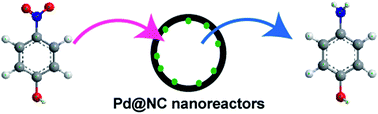
Herein, a novel design of Pd@NC nanoreactors by partially embedding mono-dispersed Pd nanoparticles in the inner wall of the nitrogen-doped carbon shells was successfully developed. The porous nitrogen-doped carbon shells prepared by dopamine effectively prevent the migration of Pd nanoparticles.4,19–23 Being on the inner wall of the hollow sphere also protected the Pd nanoparticles from direct physical impact under reaction conditions. These two structural features significantly enhanced the catalytic stability when used as a catalyst for the catalytic reduction of 4-nitrophenol (PNP). The dispersion state and catalytic activity of Pd nanoparticles remained unchanged after six cycles.
The preparation of Pd@NC nanoreactors follows the steps described in Fig. 1. Pd nanoparticles were first adsorbed on the –NH2 functionalized silica nanospheres by adding the above –NH2 terminated silica nanospheres into the solution containing Pd nanoparticles, forming Pd/silica–NH2 composite nanospheres. Then, dopamine was transformed to polydopamine on the surface of Pd/silica–NH2 composite nanospheres. Then, the polydopamine shells were successfully converted to nitrogen-doped carbon shells after being calcined at 600 °C in N2 atmosphere. Finally, the silica nanospheres were removed by washing with NaOH solution, resulting in the formation of Pd@NC nanoreactors.
Fig. S1a and b (ESI†) show the TEM image of Pd/silica–NH2 nanospheres. Many small Pd nanoparticles with a particle size of 5 ± 2 nm are randomly dispersed around the –NH2 functionalized silica nanospheres. After being coated with polydopamine and subsequently calcined at 600 °C in N2, the polydopamine shells on the Pd/silica–NH2 composite nanospheres were converted to nitrogen-doped carbon shells. The desired composite material was produced after the removal of silica spheres (see Fig. 1). Fig. 2a shows the SEM image of Pd@NC spheres with a diameter of 368 ± 23 nm. Some broken Pd@NC spheres clearly show the inner hollow cores. The high magnification SEM image in Fig. 2b shows some Pd nanoparticles highly dispersed on the hollow nitrogen-doped carbon shells. The TEM image of Pd@NC spheres in Fig. 2c shows some hollow spheres with a thin nitrogen-doped carbon shell. The thickness of the hollow shells was determined to be 14 ± 3 nm. The high-magnification TEM image of the Pd@NC nanoreactors and particle size distribution of Pd nanoparticles (Fig. 2d and f) show many small Pd nanoparticles with a particle size of 13 ± 5 nm highly dispersed on the inner wall of the hollow nitrogen-doped carbon shells. No Pd nanoparticles were observed on the outer wall of hollow nanospheres. In a high-resolution TEM image (inset in Fig. 2d), a Pd nanoparticle with a (111) lattice spacing of 0.225 nm was present. With close observation in the white rectangle region in Fig. 2d, it can be seen that small Pd nanoparticles are partially embedded in the inner wall of hollow nitrogen-doped carbon shells (see Fig. 2e). Such embedment is critical in this study for improving the catalytic stability, which effectively restrains the migration and aggregation of the Pd nanoparticles across the support surface under reaction conditions.13
![]() | ||
| Fig. 2 (a and b) SEM and (c, d and e) TEM images of Pd@NC nanoreactors. (f) Particle size distribution of Pd nanoparticles. The inset in (b) is the high-resolution TEM image of Pd/NC nanoreactors. | ||
Fig. S2 (ESI†) shows the XRD pattern of Pd@NC nanoreactors. It reveals the crystalline structure and nanoscale size of the Pd nanoparticles partially embedded in the nitrogen-doped carbon shells. It can be seen that there are five strong peaks in the range of 10–90°. The broad peak at around 22° is attributed to the nitrogen-doped carbon shells. Four sharp and strong peaks at around 40, 46, 68, and 82° are typical for metallic Pd with a face centered cubic crystalline structure (JCPDS card no. 46-1043).24 The particle size of Pd nanoparticles was calculated to be 15 nm according to the Scherrer formula, which is consistent with the result obtained from the TEM characterization.
The XPS survey spectrum of the Pd@NC nanoreactors (see Fig. S3a†) reveals the presence of C, N, O and Pd. The peaks at around 284, 335, 400, and 532 eV are assigned to C 1s, Pd 3d, N 1s and O 1s, respectively. From the high-resolution XPS spectra of N 1s (Fig. S3b†), the N 1s region shows three main contributions: the peak at 398.4 eV is assigned to pyridinic nitrogen, the peak at 399.4 eV belongs to pyrrolic nitrogen, and the peak at 400.6 eV indicates the presence of quaternary nitrogen.25–27 These findings demonstrate the presence of nitrogen in the structure of the hollow carbon shells. The loading of nitrogen was determined to be 8.6 wt%, according to the XPS analysis result. Fig. S3c† shows the high-resolution XPS spectra of C 1s. It can be deconvoluted into three peaks with binding energy of 284.8, 285.5, and 288.8 eV, respectively, assigning to sp2-hybridized graphite-like carbon (C–C sp2), sp3-hybridized diamond-like carbon (C–C sp3) and C–O bonds.28,29 The high-resolution XPS spectra of Pd 3d (Fig. S3d†) exhibits two peaks at 335.5 and 340.5 eV, respectively, which are in good agreement with the reported XPS data of Pd 3d5/2 and Pd 3d3/2 in metallic Pd. Based on the XPS analysis, the loading of Pd nanoparticles was determined to be 2.0 wt%.
The Pd-catalyzed reduction of 4-nitrophenol by NaBH4 to 4-aminophenol was chosen as a model reaction to evaluate the catalytic activity and stability of the synthesized Pd@NC nanoreactors. Fig. 3a shows the absorption peak at 400 nm quickly decreased with the increase of reaction time when in the presence of Pd@NC nanoreactors. Meanwhile, a new absorption peak at 300 nm appeared, which was attributed to 4-aminophenol.30 The conversion of 4-nitrophenol reached 90% after 4.2 min in the presence of Pd@NC nanoreactors, while during the same period of time, the experiment using a commercial Pd/C catalyst only reached 4% 4-nitrophenol conversion (see Fig 3b). In a control experiment, the hollow nitrogen-doped carbon spheres do not show any catalytic activity. The conversion of 2-amino-4-nitrophenol (NPNP) and 2-chloro-4-nitrophenol (ClPNP) is similar to that of 4-nitrophenol, indicating the functional groups have no significant effect on the catalytic activity of Pd@NC nanoreactors.
In this study, the concentration of NaBH4 is significantly higher than that of 4-nitrophenol, 2-amino-4-nitrophenol and 2-chloro-4-nitrophenol and can be considered as constant during the reaction period. So the pseudo first-order kinetics can be applied to evaluate the reaction rate constant.11,24,31 Fig. 3c shows the plot of ln(Ct/C0) as a function of reaction time for the catalytic reduction of 4-nitrophenol, 2-amino-4-nitrophenol and 2-chloro-4-nitrophenol, showing a linear relationship. The reaction rate constant of 4-nitrophenol, 2-amino-4-nitrophenol and 2-chloro-4-nitrophenol was calculated from the slope to be 6.4 × 10⁻³/s, 1.1 × 10⁻²/s and 7.8 × 10⁻³/s, which is similar to the reported values.24,28,31,32 It indicates the unique embedment has not obviously effect on the catalytic activity of Pd nanoparticles.
For the practical catalytic application, the catalyst with high stability for multiple recycles is highly desirable. The recycling test result (Fig. 3d) shows the Pd@NC nanoreactors could be recycled up to six times without loss of catalytic activity. After the sixth cycle, the Pd@NC nanoreactors were recovered for further TEM characterization. Fig. 3e shows the dispersion state of Pd nanoparticles in Pd@NC nanoreactors. All Pd nanoparticles partially embedded in the nitrogen-doped shells. No Pd nanoparticles detached from the nitrogen-doped carbon shells. Fig. 3f shows the particle size distribution of Pd nanoparticles. The Pd particle size was determined to be 12 ± 4 nm. Compared to the fresh Pd@NC nanoreactors, the morphology of Pd@NC nanoreactors and dispersion state of Pd nanoparticles are almost unchanged after the sixth cycle. Based on the recycling test and TEM characterization results, the high catalytic activity and stability of the Pd@NC nanoreactors are mainly attributed to the unique nanostructures between Pd nanoparticles and nitrogen-doped carbon shells. The presence of a nitrogen-dropped carbon shell facilitates preventing the migration and aggregation of Pd nanoparticles, resulting in the high catalytic stability.
In summary, this work presents an effective strategy for synthesizing Pd-based composite catalyst with high catalytic performances. The Pd nanoparticles partially embedded in the nitrogen-dropped carbon shells prevent the migration and aggregation of Pd nanoparticles. The partially embedment resulted in an enhanced stability of the highly dispersed Pd nanoparticles. The catalytic activity and dispersion state of the nanoreactors remained the same after six cycles.
Footnote |
| † Electronic supplementary information (ESI) available: Experimental section, TEM images of Pd/silica–NH2 composite nanopsheres, XRD pattern of Pd@NC nanoreactors, and XPS spectra of Pd@NC nanoreactors. See DOI: 10.1039/c4ra12950d |
| This journal is © The Royal Society of Chemistry 2015 |