Physicochemical characterizations for improving the slurryability of Philippine lignite upgraded through microwave irradiation

Jun Cheng*, Xin Wang, Fan Zhou, Rui Huang, Aiying Wang, Xungang Chen, Jianzhong Liu and Kefa Cen
State Key Laboratory of Clean Energy Utilization, Zhejiang University, Hangzhou 310027, China. E-mail: juncheng@zju.edu.cn; Fax: +86 571 87951616; Tel: +86 571 87952889

Received 17th October 2014 , Accepted 23rd January 2015

First published on 23rd January 2015


Abstract

Philippine lignite with high inherent moisture and oxygen was upgraded by improving the slurryability through microwave irradiation. The physicochemical properties of the upgraded lignite were characterized through Fourier transform infrared spectroscopy, N2 adsorption porosimetry, scanning electron microscopy, energy dispersive X-ray spectroscopy, and X-ray diffraction. The solid concentration of coal water slurry (CWS) that was prepared using the upgraded lignite increased from 51% to 53.4%, and the apparent CWS viscosity decreased from 862 mPa s to 687 mPa s at a shear rate of 100 s−1. These results can be attributed to several reasons. (1) The inherent moisture and hydrophilicity of the upgraded lignite was reduced after microwave irradiation. (2) Hydroxyl and carboxyl, which had the strongest hydrophilicity among the oxygen functional groups, decreased, whereas the carbonyl and ether, which only slightly affected the hydrophilicity, increased. (3) The specific surface area of the upgraded lignite initially decreased because of particle expansion, which was then augmented with increasing microwave time. (4) The aluminosilicate crystalline phase was generated through the mineral interactions in the upgraded lignite, and the soluble alkali ions, such as Ca2+, Mg2+, and Na+, increased on the particle surfaces. It is promising to continuously upgrade Philippine lignite in a tunnel-type microwave irradiation system to improve its slurribility for industrial-scale application.

1. Introduction

Coal water slurry (CWS) is not only a major topic in clean lignite technology but is also an important solution to the crude oil shortage in China. CWS is composed of 60 wt% to 70 wt% pulverized lignite (40 μm to 50 μm), and 30 wt% to 40 wt% water. CWS with <1 wt% chemical dispersant is a non-Newtonian fluid fuel with a high viscosity of 800 mPa s to 1200 mPa s (at a shear rate of 100 s−1). The parent coal properties, chemical additives, and particle size distribution significantly affect the CWS properties.1–3

A high-quality CWS fuel is a pseudoplastic fluid with high solid concentration, low apparent viscosity, and favorable rheological behavior. Lignite, as a low-rank coal, is highly abundant and accounts for 33% (ref. 4) of the lignite reserves worldwide. However, the high moisture and oxygen contents, volatile matter, and porosity of lignite have resulted in inferior slurryability.5–7 Upgrading the physicochemical properties of lignite is necessary to improve the CWS solid concentration and rheological behavior.

Microwave irradiation, as an internal heat type, selectively utilizes the thermal effect on polar molecules, such as the moisture in bulk lignite. In addition, microwave irradiation is regarded as a promising process for industrial-scale lignite improvement. For example, Shenhua group is building a tunnel-type microwave irradiation system, in which lignite was continuously transported by a conveyor belt through tens of microwave resonant cavities, to upgrade 150[thin space (1/6-em)]000 t/a lignite for moisture removal in Inner Mongolia of China. As an electromagnetic wave, microwave irradiates lignite, which causes polar molecules, such as moisture, quite to absorb microwave energy effortlessly, while non-polar molecules, such as organic carbon, hardly absorb microwave energy. Microwave power absorbed by a material from microwave radiation can be written as the equation8 P = 55.63 × 10⁻¹²|E0|2′′. Here P is the power absorbed per unit volume of the material (W m−3), E0 is the amplitude of microwave radiation, ε′′ is the loss factor of the material at microwave frequency f. At f = 2.45 GHz, ε′′ = 10 for moisture compared to ε′′ = 0.1 for coal, making P about 100 times more for water than that for coal. Moisture can be heated approximately 100 times faster than the bulk coal in microwave irradiation.

The cost effectiveness of microwave irradiation on lignite treatment has been investigated and verified in terms of dewatering,8 pyrite removal,9 increasing grindability,10,11 petrographic change,12 and combustion property.13 Meikap14,15 indicated that microwave irradiation on high-ash Indian lignite improved the CWS rheological characteristics and has abated the erosion problem in pipeline transport. Cheng16 improved the CWS concentration from 58.23% to 62.14% through microwave irradiation, where the unit energy consumptions for the CWS concentration promotion and inherent moisture removal of microwave irradiation account for 1/214 and 1/22, respectively, of those using thermal heat. Although many researchers studied the chemical composition, pore structure, and slurryability change in lignite upgraded through microwave irradiation, the microcosmic mechanism of lignite modification through microwave is still rarely reported. Thus, the effects of microwave irradiation on the oxygen functional groups, surface morphology of lignite particles, and surficial chemical and mineralogical compositions remain insufficiently investigated. This study employs microwave irradiation to upgrade the lignite property and to improve the high-concentration CWS property. Moreover, the microcosmic modification mechanism is comprehensively investigated.

2. Experimental

2.1 Materials

The raw Philippine lignite had high moisture content of 25.15%, oxygen content of 13.37%, and volatile content of 33.3%, thus, making high-quality CWS fuel production with high concentration and favorable rheological behavior difficult. Therefore, microwave irradiation was employed to improve the slurryability of the air-dried Philippine lignite. The air-dried lignite was obtained without further weight loss in an oven with an air flow at 60 °C for 4 h.

2.2 Apparatus and methods

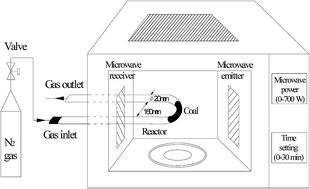
The microwave irradiation experiments were conducted in a horizontal U-tube glass reactor with an inner diameter of 20 mm, which were installed in a retrofitted commercial microwave oven with internal dimensions of 206 mm × 309 mm × 334 mm, and with magnetron tubes as 2.45 GHz microwave generators, as shown in Fig. 1. 5 g of air-dried Philippine lignite particles with an average size of 50 μm was placed in the reactor with a N2 flow of 1 L min−1. Subsequently, the microwave oven was operated at 700 W for a set time (0 s to 120 s) to upgrade the Philippine lignite. As a real control experiment, the air-dried Philippine lignite was further treated with hot air at 60 °C for 0–120 s, which was in parallel to the microwave upgrading procedures.
image file: c4ra12595a-f1.tif
Fig. 1 Experimental apparatus of microwave irradiation for lignite upgrading.

The CWS was produced from the pulverized lignite through a wet grinding process using sulfonate condensate as the chemical additive (0.8 wt% based on the air-dried pulverized lignite weight).

2.3 Analytical chemistry

The chemical compositions of the upgraded Philippine lignite were investigated through proximate and ultimate analyses. The oxygen functional groups were analyzed using a Nicolet NEXUS 670 Fourier transform infrared spectroscopy (FTIR). The pore structures were determined using a Quantachrome Autosorb-1-C N2 adsorption porosimetry. The surface morphology of the lignite particles were studied using a FEI SIRION-100 scanning electron microscope (SEM). The surficial chemical compositions of the lignite were investigated using an EDAX Genesis 4000 energy dispersive X-ray spectroscopy (EDS). The crystals of the mineral compositions were investigated using a Thermo Fisher ARL X'TRA X-ray diffraction (XRD). The CWS rheological behavior and apparent viscosity were measured using a Thermo Haake VT550 rotary viscometer. The CWS solid concentration was determined through oven-drying at 105 °C.

3. Results and discussion

3.1 Chemical compositions of the upgraded lignite

The proximate and ultimate analyses of Philippine lignite upgraded through microwave irradiation are shown in Table 1. The inherent moisture content reduced from 7.36 wt% (air-dried) to the minimum of 6.36 wt% after microwave irradiation. The inherent moisture in the capillaries, or when combined with organic compounds and mineral crystals, was much more difficult to remove than the exterior moisture on the lignite particle surfaces. Removing the inherent moisture from the lignite particles was difficult because breaking the chemical bonds of the crystal water and vapor diffused with considerable resistance in many pores needed much energy. The decrease in the inherent moisture adsorbed by the porous lignite particles improved the CWS rheological behavior and increased the CWS concentration, given the upsurge of the free water among the lignite particles as the flow media. Although the oxygen content was almost maintained post-treatment, the oxygen functional groups were reformed during the microwave irradiation. Thus, the hydrophilicity of the lignite surface changed and the CWS property improved.
Table 1 Microwave irradiation effects on the chemical compositions of Philippine lignite (air-dry basis)
Microwave time (s) Proximate analysis (wt%) Ultimate analysis (wt%)
Moisture Ash Volatile Fixed carbon Carbon Hydrogen Nitrogen Sulfur Oxygen
0 7.36 12.80 41.21 38.63 57.18 4.50 1.11 0.50 16.55
10 7.18 13.41 41.30 38.55 57.20 4.33 1.19 0.52 16.63
20 6.97 13.76 41.08 38.37 57.15 4.14 1.21 0.44 16.32
30 6.64 13.29 41.59 38.34 57.34 4.14 1.17 0.47 16.33
60 6.38 12.88 41.49 38.47 57.07 4.21 1.20 0.48 16.41
120 6.36 12.55 41.44 38.73 57.28 4.52 1.02 0.52 16.50


3.2 Oxygen functional groups of the upgraded lignite

The organic matrix of lignite was a three-dimensional macromolecular network that comprised stacked aromatic clusters, where the aromatic rings were linked by aliphatic and hetero-aliphatic bridges. Given the hydrophobic structures of lignite, water could hardly wet the lignite particles with strong polarities. However, some oxygen functional groups that had strong hydrophilicity such as hydroxyl (–OH) and carboxyl (–COOH) were unfavorable to the lignite slurryability. The FTIR spectra of the Philippine lignite upgraded through microwave irradiation are shown in Fig. 2. The oxygenic function groups of the upgraded lignite were analyzed according to the typical FTIR spectra of the different functional groups reported in literature.
image file: c4ra12595a-f2.tif
Fig. 2 Microwave irradiation effects on the oxygen functional groups of the Philippine lignite.

For most lignites, the band at the 3800 cm−1 to 3000 cm−1 zone was hydroxyl-related, as explained in the following: (1) hydroxyl groups with strong polarities were remarkably found in upgraded lignite at 3420 cm−1. These associated structures resulted in a universal distribution of the intermolecular and intramolecular hydrogen bonds in the lignite. The peak area of the associated hydroxyl, which indicated the content of the associated hydroxyl, decreased as the microwave time increased. (2) Based on the FTIR spectra, the free hydroxyl groups, which were attributed to the absorption peak at 3700 cm−1, also decreased gradually as the microwave time increased. This decline in both the associated and free hydroxyl groups after microwave irradiation reduced the hydrophilicity of the lignites.

The band at the 2500 cm−1 to 2250 cm−1 zone was carboxyl-related. As the microwave time increased, the absorption peak at 2360 cm−1 decreased constantly, which indicated a decrease in the carboxyl content. Hence, the hydrophilicity of the lignites decreased obviously.

The band at the 1700 cm−1 to 1500 cm−1 zone was carbonyl-related. The absorption peak at 1610 cm−1 increased as the microwave time increased, which indicated an increase in the carbonyl groups, which slightly affected hydrophilicity.

The band at the 1330 cm−1 to 1110 cm−1 zone was associated to the C–O of phenol, alcohol, ether, and ester. The absorption peak of ether at 1270 cm−1 increased as the microwave time increased, which indicated a rise in the ether content.

In summary, the hydroxyl and carboxyl which had the strongest hydrophilicity among the oxygen functional groups in the lignite decreased, whereas the carbonyl and ether which only slightly affected the hydrophilicity increased. This finding was consistent with that of the oxygen content, as shown in Table 1. Although the oxygen content was almost maintained, the oxygen functional groups were reformed during the microwave irradiation. Therefore, the hydrophilicity of the Philippine lignite decreased significantly and the CWS property improved.

3.3 Pore structures of the upgraded lignites

The specific surface area and pore volume initially decreased, and then increased during the microwave period, and the valley point appeared at the microwave time of 30 s, as shown in Fig. 3. On the one hand, the microwave treatment decreased the specific surface area of the lignite particles. The crystal water decomposed when microwave selectively heated the polar molecules, and the inherent moisture adsorbed in the micropores vaporized. The water vapor diffusion in the micropores was hindered because of considerable resistance. The thermal expansion of the remaining vapor in the micropores increased both the pore diameter (from the original 39.65 nm to 43.74 nm at the microwave time of 30 s) and the particle diameter (as verified in Fig. 4). On the other hand, the microwave treatment increased the specific surface area of the lignite particles. Compared with the water vapor close to the nucleus centers of the lignite particles, the water vapor near the external surfaces of the lignite particles had a lower diffusion resistance and escaped more easily. This escape of water vapor increased the amount of effective pores, which expanded the specific surface area. In summary, when the microwave time was less than 30 s, the former effect was dominant and the specific surface area of the lignite particles decreased, which improved the CWS property. However, when the microwave time was delayed to 60 s, the latter effect was dominant and the specific surface area of the lignite particles expanded, which degraded the CWS property.
image file: c4ra12595a-f3.tif
Fig. 3 Microwave irradiation effects on the pore structures of the Philippine lignite.

image file: c4ra12595a-f4.tif
Fig. 4 SEM patterns of the Philippine lignite upgraded through microwave irradiation.

3.4 Surface morphology of the upgraded lignite

The SEM micrograph of the lignite is shown in Fig. 4. When the microwave time increased from 0 s to 30 s, the particle size gradually increased from 2.5 μm to 10 μm to 5 μm to 18 μm. As the microwave time further increased to 60 and 120 s, the particle size increased to 7 μm to 24 μm and 13 μm to 40 μm, respectively. The reason behind this size increase is the gradual expansion of the water vapor in the pores as the microwave time increased, which then enlarged the particle sizes. This increase in particle sizes reduced the surface tension between the moisture and the particles, which lowered the CWS viscosity and improved the CWS property. Meanwhile, as the microwave time increased, the vaporization in the pores augmented the effective pores and CWS viscosity, which was unfavorable to the slurryability. These two opposing effects resulted in an optimum microwave time (about 30 s) to obtain the best rheological behavior and the highest concentration.

3.5 Elemental compositions of the upgraded lignite on the particle surfaces

As shown in Fig. 5, after microwave treatment for 30 s, the silicon, aluminum, magnesium, calcium, and sodium contents of the lignite surface increased from 1.75, 1.22, 0.17, 0, and 0 wt% to 1.92, 1.40, 0.25, 0.22, and 0.29 wt%, respectively. The silicon and aluminum primarily existed as aluminosilicates, whereas the calcium, magnesium, and sodium primarily existed as soluble cationic salts (as verified in Fig. 6). The increased contents of metal ions such as Ca2+, Mg2+, and Na+ on the surface of the microwave-upgraded lignite expanded the lignite surface polarity and electrostatic repelling force among the lignite particles. Meanwhile, the adsorption force between the hydrophobic dispersant groups and the lignite surface increased. Thus, a high-quality CWS fuel with low viscosity and favorable rheological behavior was obtained.
image file: c4ra12595a-f5.tif
Fig. 5 EDS patterns of the Philippine lignite upgraded through microwave irradiation.

image file: c4ra12595a-f6.tif
Fig. 6 XRD patterns of the Philippine lignite upgraded through microwave irradiation.

3.6 Mineralogical compositions of the upgraded lignites

The XRD patterns of the lignite upgraded through microwave are shown in Fig. 6. Numerous amorphous substances existed, which were mainly composed of fixed carbon, volatile matter and moisture, and some mineral crystals such as quartz (SiO2) and kaolinite (Al4OH8Si4O10). These mineral crystals mainly existed in ash, whereas some of the other mineral crystals with less than 0.5 wt% could hardly be detected through XRD. Given the decrease in the moisture content and the increase in the crystallinity degree, the amorphous substance content decreased after microwave irradiation. In addition, given that the decreased moisture content relatively increased the mineralogical composition contents, the characteristic peak area of the SiO2 crystal also increased. Moreover, the full width at half-maximum (fwhm = 0.216°) intensity of the SiO2 peak at 2θ of 26.6° of the lignite, which resulted from 30 s microwave irradiation, was less than that (fwhm = 0.432°) of the raw lignite. This result implied an increase in the SiO2 crystallite size after microwave irradiation. Meanwhile, some new mineralogical compositions such as anorthite (Ca, NaAl, Si2Si2O8) and offretite (K, Ca, Mg3Al5Si13O36·14H2O) were detected after the microwave irradiation because the mineralogical components were reformed through the microwave electromagnetism, and new crystals such as aluminosilicate were formed. The increased free metal ions such as Ca2+, Mg2+, and Na+ in the XRD spectrogram was consistent with the EDS test results. These results all improved the CWS property.

3.7 Upgraded CWS property

The rheological CWS behavior obtained from the Philippine lignite upgraded through microwave irradiation is shown in Fig. 7(a). According to the figure, the CWS with a constant concentration of 51% is a kind of pseudoplastic fluid. The viscosity of CWS prepared from Philippine lignite with air drying steady state as a control condition decreased from 4157 mPa s to 862 mPa s when the shear rate increased from 10 s−1 to 100 s−1. The CWS viscosity initially decreased, and then increased as the microwave time escalated, which is contrasting to the concentration trend. The minimum viscosity and the maximum concentration were simultaneously obtained at the microwave time of 30 s. The viscosity of CWS prepared from Philippine lignite with microwave upgrading for 30 s decreased from 2852 mPa s to 687 mPa s when the shear rate increased from 10 s−1 to 100 s−1. In addition, the CWS concentration with a constant viscosity of 900 mPa s at a shear rate of 100 s−1 is shown in Fig. 7(b). The solid concentration of CWS prepared from Philippine lignite with air drying steady state as a control condition was constant of 51% with a viscosity of 900 mPa s. The solid concentration of CWS prepared from Philippine lignite with microwave upgrading for 30 s increased to a peak of 53.4%.
image file: c4ra12595a-f7.tif
Fig. 7 Slurryability of the Philippine lignite upgraded through microwave irradiation.

Generally, 30 s microwave time was the most beneficial option in obtaining the best rheological behavior and the highest concentration during the CWS modification. This option can be explained by the following reasons: (1) the inherent moisture was reduced after the microwave treatment. (2) The hydrophilicity of the Philippine lignite decreased significantly. Although the oxygen content was almost maintained, the oxygen functional groups were reformed during the microwave irradiation. The hydroxyl and carboxyl which had the strongest hydrophilicity among the oxygen functional groups in the lignite decreased, whereas the carbonyl and ether which only slightly affected the hydrophilicity increased. (3) The expansion of the pulverized lignite particle after heating gradually increased the particle size. However, the specific surface area initially decreased, and then increased as the microwave time escalated; the valley point appeared when the microwave time was at 30 s. (4) The aluminosilicate crystalline phase was generated through the mineral interactions in the upgraded lignite, and the soluble alkali ions, such as Ca2+, Mg2+, and Na+, on the particle surfaces increased. It is promising to continuously upgrade Philippine lignite in an tunnel-type microwave irradiation system to improve its slurribility for industrial-scale application.

4. Conclusions

Microwave irradiation effectively decreased the hydrophilic oxygen functional groups (hydroxyl and carboxyl) and increased the soluble alkali ions on the particle surfaces, which improved the Philippine lignite slurryability. The inherent moisture and hydrophilicity of the upgraded lignite reduced after the microwave irradiation. The hydroxyl and carboxyl which had the strongest hydrophilicity among the oxygen functional groups in the lignite decreased. The specific surface area of the upgraded lignite initially decreased because of particle expansion, and then increased as the microwave time escalated. The aluminosilicate crystalline phase was generated through the mineral interactions in the upgraded lignite, and the soluble ions, such as Ca2+, Mg2+, and Na+, on the particle surface increased. Therefore, the CWS solid concentration that was prepared using the upgraded lignite increased, and the apparent CWS viscosity decreased. Although microwave irradiation effectively removed the inherent moisture and upgraded the air-dried lignite in this study, microwave irradiation was much more efficient in external moisture removal and as-received lignite upgrading in industrial applications. Microwave irradiation on as-received lignite can remarkably increase the CWS solid concentration and improve the CWS rheological behavior.

Acknowledgements

This study was supported by the Special Funds for Major State Basic Research Projects of China (2010CB227001), the National Natural Science Foundation of China (51176163, 51476141), the National High Technology R&D Program of China (2012AA050101), and Program of Introducing Talents of Discipline to University (B08026).

References

  1. R. M. Turian, J. F. Attal, D. J. Sung and L. E. Wedgewood, Fuel, 2002, 81, 2019–2033 CrossRef CAS.
  2. M. Zhou, Q. Kong, B. Pan, X. Qiu, D. Yang and H. Lou, Fuel, 2010, 89, 716–723 CrossRef CAS PubMed.
  3. S. C. Shukla, S. Kukade, S. K. Mandal and G. Kundu, Fuel, 2008, 87, 3428–3432 CrossRef CAS PubMed.
  4. T. Saeki, T. Tstsukawa and H. Usui, Int. J. Coal Prep. Util., 1999, 21, 161–176 CrossRef CAS.
  5. Z. Wang, H. Shui, Z. Pei and J. Gao, Fuel, 2008, 87, 527–533 CrossRef CAS PubMed.
  6. D. F. Umar, H. Usui, Y. Komoda and M. Alim, Fuel Process. Technol., 2009, 90, 611–615 CrossRef CAS PubMed.
  7. Z. Aktaa and E. T. Woodburn, Fuel Process. Technol., 2000, 62, 1–15 CrossRef.
  8. M. S. Seehra, A. Kalra and A. Manivannan, Fuel, 2007, 86, 829–834 CrossRef CAS PubMed.
  9. T. Uslu and U. Atalay, Fuel Process. Technol., 2003, 85, 21–29 CrossRef.
  10. E. Lester and S. Kingman, Energy Fuels, 2004, 18, 140–147 CrossRef CAS.
  11. E. Lester, S. Kingman and C. Dodds, Fuel, 2005, 84, 423–427 CrossRef CAS PubMed.
  12. E. Lester and S. Kingman, Fuel, 2004, 83, 1941–1947 CrossRef CAS PubMed.
  13. L. Ge, Y. Zhang, Z. Wang, Z. Wang, J. Zhou and K. Cen, Energy Convers. Manage., 2013, 71, 84–91 CrossRef CAS PubMed.
  14. B. K. Sahoo, S. De, M. Carsky and B. C. Meikap, Ind. Eng. Chem. Res., 2010, 49, 3015–3021 CrossRef CAS.
  15. B. C. Meikap, N. K. Purohit and V. Mahadevan, J. Colloid Interface Sci., 2005, 281, 225–235 CrossRef CAS PubMed.
  16. J. Cheng, J. Zhou, Y. Li, J. Liu and K. Cen, Energy Fuels, 2008, 22, 2422–2428 CrossRef CAS.

This journal is © The Royal Society of Chemistry 2015
Click here to see how this site uses Cookies. View our privacy policy here.