
Hong-Gyu Park,
Hae-Chang Jeong,
Tae-Kyu Park and
Dae-Shik Seo*
Department of Electrical and Electronic Engineering, Yonsei University, 50 Yonsei-ro, Seodaemun-gu, Seoul 120-749, Korea. E-mail: dsseo@yonsei.ac.kr; Fax: +82-2-2123-3147; Tel: +82-2-2123-4617
First published on 28th November 2014
We present the alignment characteristics of liquid crystal (LC) molecules on solution-derived tin(IV) oxide (SnO2) films. Solution processing was used in place of the sputtering method to deposit SnO2 films as LC alignment layers. The LC molecules on the SnO2 surfaces could be homogeneously and uniformly aligned by ion-beam (IB) irradiation. X-ray photoelectron spectroscopy (XPS) analysis indicated surface reformation of the SnO2 films resulting from annealing and that IB irradiation affects the uniform LC orientation. Fast response times of twisted nematic cells constructed with IB-irradiated SnO2 films were observed, which indicates that the proposed IB-irradiated solution-derived SnO2 films have considerable potential for use in the production of advanced LC displays.
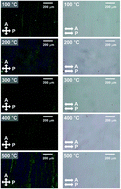
Many techniques may be used to deposit inorganic thin films, such as sputtering, spraying and chemical vapor deposition. Compared with these techniques, solution processing has some valuable characteristics: it allows the coating of large surfaces, it can be applied to complex shapes, and it is simpler than other techniques.19 Moreover, the possibility of obtaining coatings with various dopants at different concentrations is an interesting feature of this solution method. SnO2, which is considered to be one of the most promising inorganic materials as an LC alignment layer because of its high permittivity and high transparency,7 has already been well prepared and has shown excellent characteristics when fabricated through the solution process.
In this study, we demonstrate the use of a solution-derived SnO2 film treated by IB irradiation as an LC alignment layer. We achieved homogeneous LC alignment on the solution-derived SnO2 films by adjusting the annealing temperature. To elucidate the LC alignment mechanism, we conducted physicochemical analyses using atomic force microscopy (AFM) and X-ray photoelectron spectroscopy (XPS). In addition, we measured the properties of the alignment film and the electro-optical (EO) properties of twisted nematic (TN) LCDs using various techniques.
The SnO2 films were exposed to Ar+ IB plasma at an energy of 1800 eV for 2 min at an incident angle of 45° using a DuoPIGatron-type IB system. The dosages of Ar+ IB plasma were 1014 to 1015 ions per cm2. The current density in a beam of positively charged particles measured using a Faraday cup system was 3.7 mA cm−2. The plasma ion density measured using double Langmuir probe tips was approximately 1011 cm−3. To investigate the LC alignment properties, the SnO2-coated substrates were assembled in an antiparallel configuration with a cell gap of 60 μm. The TN cells were assembled with a cell gap of 5 μm to determine the EO properties of the TN cells. A nematic LC (MJ001929, ne = 1.5859, no = 1.4872, and Δε = 8.2; Merck) was injected into the cells. Images of the LC alignment states were obtained using a polarized optical microscope (POM, Olympus BXP51). The pretilt angle of the LC cells was measured using the crystal rotation method (TBA 107 tilt-bias angle evaluation device, Autronic). The morphologies of the solution-derived SnO2 films before and after IB irradiation were observed using AFM (Park Systems, XE-BIO). XPS (ES-CALAB 220i-XL, VG Scientific) was employed to investigate the molecular binding energy states on the IB-irradiated SnO2 films. Finally, the EO characteristics of the TN cells with IB-irradiated SnO2 films were measured using an LCD evaluation system.
An LC orientation with a regular pretilt angle is important for LC applications.6 The measurement of the pretilt angle not only showed the tilt angle of the LC molecules against the SnO2 surface but also indicated that a uniform LC orientation was achieved. The measured TBA 107 transmittance curves of each antiparallel LC cell with IB-irradiated SnO2 films are shown in Fig. 2(a–e). The transmittance of each antiparallel LC cell was measured with a latitudinal rotation of ±70°, and the oscillation of the transmittance was measured from the LC cell rotation. If the measured (blue line) and simulated (red line) curves are identical, then the LC alignment is uniform and it is possible to accurately estimate the pretilt angle of the LCs. The graphs of the measured pretilt angles indicated that the pretilt angles of the SnO2 films can be determined with high reliability and that uniform LC alignment was achieved. The pretilt angles of the LC molecules on the IB-irradiated SnO2 films ranged from 0.05° to 0.26°, indicating that the pretilt angles of the LC molecules were relatively constant with respect to the annealing temperature.
![]() | ||
| Fig. 2 (a–e) Transmittance versus incident angle of the LCs on IB-irradiated SnO2 films fabricated at various annealing temperatures, and (f) the measured pretilt angle. | ||
To determine the mechanism for the orientation of LC molecules, we used physicochemical analyses, including AFM and XPS, because it is well known that the alignment of LCs depends on both the chemical nature of the surface and on the surface topography. First, the morphology of the SnO2 films deposited by solution processing was observed using AFM. The bar graphs of the root-mean-square (RMS) values shown in Fig. 3, which were obtained from the AFM data before and after IB irradiation for 2 min, indicate that the IB irradiation does not strongly affect the roughness of the SnO2 films, even those fabricated with low annealing temperatures. This result also suggests that the LC orientation was not greatly affected by the morphologies of the IB-irradiated films.
The C1s, Sn3d, and O1s peaks in XPS spectra obtained from the surfaces of films produced using various annealing temperatures before and after IB irradiation were analyzed. All of the binding energies were referenced to the C1s signal at 284.6 eV. To follow the transformation of the solution-derived SnO2 films as a function of the annealing temperature, the change in the C1s spectra was monitored. Organic compounds were present in the prepared 0.1 M SnO2 solution. These compounds were vaporized during the annealing process to form the SnO2 films; however, these compounds remained in the films when the annealing temperature was less than 300 °C due to their high boiling points.20 As shown in Fig. 4, the intensity of the peak at 286.5 eV corresponding to C–O in the solvent decreased as the annealing temperature increased. These results indicate that the SnO2 films were not fully formed at annealing temperatures below 300 °C due to the presence of residual solvents. At annealing temperatures greater than 300 °C, the SnO2 films were fully oxidized. In addition, the C1s spectra of the IB-irradiated SnO2 films indicated that IB irradiation induces a chemical transformation in the solution-derived SnO2 films.
![]() | ||
| Fig. 4 XPS C1s core-level spectra of as-deposited and IB-irradiated SnO2 films annealed at temperatures of 100 °C, 300 °C, and 500 °C. | ||
Fig. 5(a) presents the Sn3d5/2 and Sn3d3/2 XPS spectra of the solution-derived SnO2 surfaces before and after IB irradiation. The binding energy of the Sn3d5/2 component for the as-deposited SnO2 film shifted from 487.3 eV to 486.7 eV compared to that of the SnO2 films annealed at 500 °C, and this shift was attributed to thermal oxidation.21 The upper binding energy of Sn3d5/2 at annealing temperatures of less than 300 °C was due to the coexistence of various Sn–O and Sn–Cl bonds in the SnCl2–SnO2 composite films because less oxidation occurred at these annealing temperatures. However, IB bombardment on the SnO2 surfaces strongly induced a surface transformation, irrespective of the initial state of the SnO2 film. The surfaces were reformed within nanoscale depths due to IB irradiation. The accelerated Ar+ ions of the IB system might have destroyed the bonding structure of the SnO2 surfaces and induced surface reformation to preserve the anisotropic characteristics. The uniform LC alignment on the IB-irradiated SnO2 films was attributed to van der Waals interactions between the LC molecules and the SnO2 films due to these anisotropic characteristics. The van der Waals interactions between the LC molecules and the SnO2 film increased to a level that was sufficient for maintaining a good balance in the LC molecule interactions, thereby leading to a homogeneous alignment of LC molecules. The chemical reformation was also observed in the O1s peak, as shown in Fig. 5(b). The SnO2 films were gradually oxidized as the annealing temperature increased and were reformed irrespective of the initial state of the SnO2 film. After IB irradiation, the SnO2 films had similar chemical compositions, regardless of the annealing temperature. Fig. 5(c) shows the changes in the atomic percentages of tin and oxygen before and after IB irradiation at various annealing temperatures. The atomic ratio of tin and oxygen in the SnO2 films increased proportionally to the formation of SnO2 films at annealing temperatures up to 300 °C. Then the ratios were saturated at annealing temperatures greater than 300 °C because the SnO2 films were fully oxidized. After IB irradiation, the atomic ratio of tin and oxygen in the IB-irradiated SnO2 films slightly decreased. This result indicates that the Sn–O bonds in the SnO2 surface were broken by IB irradiation.
The EO characteristics were confirmed to be appropriate for pragmatic LCD applications. Fig. 6 shows the EO characteristics of a TN cell with IB-irradiated SnO2 films that were annealed at 400 °C. The IB irradiation intensity, exposure time, and incident angle were 1800 eV, 2 min, and 45°, respectively. In addition, TN cells with layers of rubbed and IB-irradiated PI under the same conditions were used for comparison. The voltage–transmittance (V–T) characteristics of the TN cells are shown in Fig. 6(a). The threshold voltage at a transmittance of 90% for the TN cells with IB-irradiated SnO2 films and those of the rubbed and IB-irradiated PIs were 2.1 V, 2.3 V and 1.7 V, respectively. In addition, contrast ratios of all the TN cells were approximately 190
:
1. From the results, the TN cells with IB-irradiated SnO2 films were comparable to conventional TN cells with rubbed PI layers. Fig. 6(b) shows the response times of the TN cells. Superior performance was obtained from the IB-irradiated SnO2 film, as indicated by a rise time (R.T.) of 1.4 ms and a fall time (F.T.) of 4.7 ms, whereas the rubbed and IB-irradiated PI layers had R.T. of 2.6 ms and 2.0 ms and F.T. of 7.9 ms and 10.9 ms, respectively. The performance of the TN cells with IB-irradiated solution-derived SnO2 films was similar to that of TN cells with IB-irradiated SnO2 films deposited by sputtering. In addition, the reduced response time of the LC has potential for advanced LC applications, which are needed in industrial fields.
![]() | ||
| Fig. 6 (a) V–T curves and (b) response times of the TN cells with SnO2 films and PI layers via IB irradiation and rubbing. | ||
| This journal is © The Royal Society of Chemistry 2015 |