Peng Wang†
*a,
Shang-xing Chen†a,
Zhen-dong Zhaob,
Zongde Wanga and
Guorong Fana
aCollege of Forestry, Jiangxi Agricultural University, Nanchang, 330045, PR China. E-mail: pengwang1981@126.com
bInstitute of Chemical Industry of Forestry Products, CAF, National Engineering Lab. for Biomass Chemical Utilization, Key and Open Lab. on Forest Chemical Engineering, SFA, Key Lab. of Biomass Energy and Material, Nanjing, Jiangsu Province 210042, PR China
First published on 19th December 2014
A novel, sustainable, rosin-based quaternary ammonium salt, dehydroabietyltrimethyl ammonium bromine, has been applied for the synthesis of ordered hexagonal supermicroporous silica with nanosheet morphology. Unlike the conventional short chain surfactants, rosin-based surfactant possesses a rigid group of a three-ring phenanthrene skeleton. Such a hydrophobic group gives the surfactant a large total volume and small effective headgroup area, which are beneficial for the formation of 2D hexagonal phase. XRD, N2 adsorption–desorption, TEM, and SEM are used to characterize the samples. The results indicate that the molar ratios of mixture of silicate source, template agent and inorganic acid in the synthesis system have great effects on the regularity of the pore structure. The synthesized material possesses large surface area (1229 m2 g−1), high pore volume (0.59 cm3 g−1) and narrow pore size distribution (centered at about 2.03 nm), which is on the borderline between the micropore and mesopore regions. Such a material will be attractive for applications in separations and catalysis because of its potential shape and size selectivities.
Because the pore sizes of mesoporous materials (M41S) depend on the hydrophobic chain lengths of surfactants, short chain surfactants were applied as the templates to synthesize supermicroporous materials.19–21 However, the supermicroporous materials prepared with such methods possessed disordered worm-like structures. In order to fix this problem, the mixing templating system was adopted. A surfactant/cosurfactant system of decyltrimethylammonium bromide/butanol was used by Lin et al.22 to successfully synthesize well-ordered super-microporous aluminosilicate. Wang23 and Zhu et al.24 reported the synthesis of highly ordered supermicroporous silicas with a mixture of short chain cationic–anionic surfactants. Few types of amphiphilic compounds with unique structures were also synthesized and used as templates for the fabrication of supermicroporous materials. Bagshaw et al.16,25,26 described the synthesis of supermicroporous silica using ω-hydroxyalkylammonium bolaform surfactants. In contrast with the traditional alkylammonium surfactants, the introduction of ω-hydroxyl reduced the micellar radius, which was beneficial for the formation of supermicroporous materials. Ryoo27 and Wang28 successively reported the synthesis of supermicroporous materials using short chain gemini surfactants. The abilities of self-assembly of short chain gemini surfactants were stronger than that of corresponding monovalent surfactants; therefore, the highly ordered supermicroporous materials were synthesized. Zhou and coworkers29,30 investigated the preparation of supermicroporous lamellar silicas with a series of room-temperature ionic liquids (1-alkyl-3-methylimidazolium chloride) as templates via the nanocasting technique. The results indicated that the room-temperature ionic liquids could be excellent template agents, and the produced lamellar pore widths varied slightly with the chain lengths of the employed ionic liquids. Semifluorinated surfactants were used as templates by Di et al.31 for the synthesis of ordered hexagonal smaller supermicroporous silicas. Semifluorinated surfactants played a key role in the ultralow temperature synthesis of supermicroporous materials because the common templating (CTAB or P123) systems were completely frozen under such a temperature. Fukasawa et al.32 synthesized the supermicroporous silica using tri(quaternary ammonium) surfactant with a benzene core as the template. In contrast with the conventional surfactant of decyltrimethylammonium bromide, this surfactant was more effective for generating small and regularly arranged pores because of its strong tendency to form cylindrical assemblies. The abovementioned results indicate that the template agents are crucial for the synthesis of supermicroporous materials. Therefore, there is an urgent need for exploring new template agents for the synthesis of supermicroporous materials.
Rosin is a type of an abundant and renewable resource, which has a large variety of uses. The synthesis of surfactants using rosin as a raw material is an important way to the high-valued utilization of rosin. To date, the synthesis of highly ordered silicas using rosin-based surfactants as template agents has not been reported. Unlike traditional surfactants, the rosin-based surfactant possesses a big group of a three-ring phenanthrene skeleton, which is rigid and can be a good candidate for the synthesis of ordered silicas. Moreover, the rosin-based surfactant is derived from natural feedstocks. Low toxicity and renewable properties make it an environmentally friendly reagent for achieving sustainable processes. In this study, a novel self-synthesized rosin-based quaternary ammonium salt, dehydroabietyltrimethyl ammonium bromine (short for DTAB, Scheme 1), was applied as a directing agent to produce highly ordered silicas. The structures of the synthesized samples were characterized using X-ray diffraction, N2 adsorption and desorption, transmission electron microscopy and scanning electron microscopy.
:
formic acid
:
formaldehyde was 1
:
2
:
2. The obtained solution was stirred at room temperature for 1 h, and then heated under reflux at 353 K for 8 h. After the removal of excess formic acid and formaldehyde, aqueous sodium hydroxide solution (30 wt%) was added until the pH was 12, and the oily precipitate was extracted with dichloromethane. Note that the dichloromethane layer was separated, washed with water until pH = 7, and dried over sodium sulphate. Dichloromethane was removed through vacuum distillation, and N,N-dimethyl dehydroabietylamine was obtained. Then, N,N-dimethyl dehydroabietylamine was dissolved in acetone, and CH3Br was added quickly with stirring at room temperature with the mole ratio of N,N-dimethyl dehydroabietylamine
:
CH3Br = 1
:
2. After 4 h, the dehydroabietyltriethyl ammonium bromine precipitate was obtained and purified by recrystallization three times from a mixture of ethanol and ethyl acetate to give a white solid powder.
:
DTAB
:
HCl
:
H2O = 1.0
:
0.1–0.25
:
1.4–2.1
:
808.0. After further stirring for 24 h, the precipitated products were transferred into a Teflon-lined autoclave and heated at 373 K for 24 h. The products were washed with water and ethanol several times to remove sodium ions and unbound surfactants. After drying at 323 K, the template agent was removed by calcination at 823 K for 4 h at the rate of 1 K min−1.
:
DTAB ratio is 1.0
:
0.1, the sample presents only one diffraction peak (Fig. 1a), indicating that a short-range ordered pore structure is formed. With increase in DTAB dosage, the regularity of the pore structure is considerably enhanced. As the SiO2:DTAB ratio is 1.0:0.2, the sample (Fig. 1c) reveals three strong peaks at 2θ = 2.98°, 5.17°, 5.91° (d100 = 2.96 nm, d110 = 1.71 nm, d200 = 1.49 nm), which can be related to the (100), (110), and (200) reflections of a long-range ordered 2D hexagonal lattice symmetry (space group 2D-P6mm). The values of the interplanar spacing corresponding to the main XRD peak for this sample is 2.96 nm, which is much smaller than that of the normal MCM-41 silicas,1,2 demonstrating that a type of hexagonal ordered SiO2 with smaller pores is obtained. However, with further increase in DTAB dosage, the regularity of the pore structure decays. When the optimal regularity is obtained, the concentration of DTAB in the synthesis system is 0.56 wt%. This concentration is rather lower than that of conventional short chain surfactants,28 suggesting that the self-assembly ability of DTAB is much higher. Small-angle XRD patterns of the as-synthesized mesoporous samples prepared with different SiO2
:
HCl mole ratios are presented in Fig. 2. With decrease in HCl dosage, the pH of the system increases, and the regularity of the pore structure shows the trend of increase and then decrease, which demonstrates that only a suitable pH value (∼8.5) can enhance the regularity of the pore structures. Fig. 3 shows the small-angle XRD patterns of the as-synthesized and calcined samples prepared with mole ratio of SiO2
:
DTAB
:
HCl
:
H2O = 1.0
:
0.2
:
1.9
:
808.0. After calcination at 823 K, three peaks at 2θ = 3.11°, 5.33°, 6.14° (d100 = 2.84 nm, d110 = 1.66 nm, d200 = 1.44 nm) can be observed in Fig. 3b, indicating that the hexagonal pore structure is maintained after calcination. Due to the removal of surfactants, the peaks sharpen with stronger intensities. The small-angle peaks of the calcined sample shift to higher angles, which can be related to the shrinkage of unit cell upon calcination. The primary pore sizes (Wd) of materials with a hexagonally ordered array of uniform pores can be evaluated according the equation of Wd = cd100[ρVp/(1 + ρVp)]1/2 using the XRD (100) interplanar spacing, and primary pore volume results, where ρ is 2.2 g cm−3 (the pore wall density for amorphous silica), and c is 1.213 (a constant for cylindrical pores).27 For the calcined sample, the pore size calculated is 1.93 nm, suggesting that the supermicropores are obtained.
![]() | ||
Fig. 3 Small-angle XRD patterns of the as-synthesized (a) and calcined (b) supermicroporous silicas prepared with a mole ratio of SiO2 : DTAB : HCl : H2O = 1.0 : 0.2 : 1.9 : 808.0. | ||
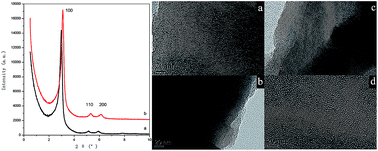
Fig. 4 presents the TEM images of the as-synthesized and calcined supermicroporous silicas prepared with the mole ratio of SiO2
:
DTAB
:
HCl
:
H2O = 1.0
:
0.2
:
1.9
:
808.0. Fig. 4a shows the pore structure along the [110] direction. The sample displays well-ordered curved pores with walls perfectly parallel to each other. The curved pores may be caused by the bending of the nanosheeted silicas (Fig. 5). It can be seen that Fig. 4b ([001] direction) displays uniform channels of 2D hexagonal structure and the regular arrays running along a large domain, suggesting that the structure is in a highly ordered arrangement. After calcination, the structure is still maintained (Fig. 4c and d). Note that the pore size of the calcined sample is about 2.0 nm, and the width of pore wall is about 1.0 nm. Particle morphology as determined by the SEM method is shown in Fig. 5. It can be seen that the sample is made of well-dispersed nanosheets without any agglomeration.
![]() | ||
Fig. 5 SEM image of calcined supermicroporous silica prepared with a mole ratio of SiO2 : DTAB : HCl : H2O = 1.0 : 0.2 : 1.9 : 808.0. | ||
Fig. 6a plots the N2 adsorption–desorption isotherm of the calcined sample synthesized with mole ratio of SiO2
:
DTAB
:
HCl
:
H2O = 1.0
:
0.2
:
1.9
:
808.0. The sample exhibits a transitional type between typical I and IV curves according to the IUPAC classification.33 A clear capillary condensation step occurs at a relative pressure (P/P0) of 0.15, which is rather lower than that obtained for any of the previously reported mesoporous materials, suggesting that supermicropores exist in the resulting sample. In Fig. 6a, a linear range for P/P0 can be observed between 0.04 and 0.15. When P/P0 is higher than 0.15, a deviation from linearity can be found. Thus, the P/P0 range of 0.04–0.15 should be selected to calculate the BET surface area. The BET surface area of the sample is 1229 m2 g−1, and the pore volume is 0.59 cm3 g−1. Since the precise determination of the pore size distributions for material in supermicroporous regions is still a matter of uncertainty,27 the pore size distributions of the sample are calculated from the adsorption branch of isotherm using the BJH (Fig. 6b), HK (Fig. 6c) and DFT models (Fig. 6d). The sample shows a narrow pore diameter distribution centered at about 1.47 nm for the BJH model, 1.13 nm for the HK model and 2.03 nm for the DFT model. Regardless of the models that are employed, the pore sizes obtained are obvious in the supermicroporous regions. However, according to the results evaluated by XRD (100) interplanar spacing and the TEM characterization, the result calculated by DFT model are more reliable. According to the formula a0 = 2d/30.5 (d100 = 2.84 nm), the size of the hexagonal unit cell is 3.28 nm, and the width of pore wall is 1.25 nm, which agrees with the TEM results. It is almost impossible to synthesize well-ordered supermicroporous materials using traditional short chain surfactants without any additive agents because their hydrophobic chains are too short to properly maintain good micellar structures in an aqueous environment,19–21 and their large effective headgroup areas prevent their formation of 2D hexagonal phases.9,27 Unlike the conventional short chain surfactants, rosin-based surfactant possesses a rigid group of a three-ring phenanthrene skeleton, which gives the surfactant a large total volume. Moreover, such a hydrophobic group has a strong steric effect by which the effective headgroup area of the surfactant is suppressed; therefore, the 2D hexagonal phase is easily formed.
Footnote |
| † These authors contributed equally to this work and should be considered as co-first authors. |
| This journal is © The Royal Society of Chemistry 2015 |