Investigations on the luminescence of emission-tunable Ca10K(PO4)7:Eu2+, Sr2+, Mg2+ phosphors for white LEDs

Yuchun Wanga, Hongyan Lia, Rongrong Zhanga, Maolin Zhana and Jia Zhang*ab
aSchool of Physics and Electronic Electrical Engineering, Huaiyin Normal University, 111 West Chang Jiang Road, Huai'an 223001, China. E-mail: zhangjia@hytc.edu.cn
bHuaian Key Laboratory of Functional Materials for Informatics, China

Received 25th September 2014 , Accepted 1st December 2014

First published on 2nd December 2014


Abstract

Ca10K(PO4)7:Eu2+, Sr2+, Mg2+ (CKP:Eu2+, Sr2+, Mg2+) phosphors were prepared by the solid-state reaction method, and their photoluminescence properties under near-ultraviolet excitation were studied. By measuring the diffuse reflection spectrum, the optical bandgap of the CKP host was determined to be about 5.39 eV. Eu2+-activated CKP shows an asymmetrical emission band in the range of 425–650 nm, derived from various Eu2+ emission centers. The corresponding excitation spectrum presents a broad excitation band which can match well with the emission wavelength of the near ultraviolet LED chip. By introducing Sr2+ and Mg2+ into CKP:Eu2+, tunable emission has been realized from light blue to greenish yellow including white, which is mainly owing to the effect of Sr2+ and Mg2+ on the structure of CKP. The above investigation results indicate the CKP:Eu2+, Sr2+, Mg2+ phosphors have potential applications in white LEDs.

1. Introduction

Since white light emitting diodes (LEDs) came into commercial use in 1997, they have been in increasing demand as a potential replacement for conventional light sources because of their low electric consumption, high brightness, long lifetime and environmentally friendly characteristics.1–3 Up to now, the most convenient way to generate white light from LEDs is using a blue chip and a yellow-emitting phosphor (YAG:Ce3+).3 However, this kind of white LED has a poor color rendering index (CRI, Ra ≈ 70–80) and high correlated color temperature (CCT ≈ 7750 K) due to a lack of a red component in the visible region.4 Therefore, another method by combination of an ultraviolet (UV) or near ultraviolet (NUV) chip with the red, green, and blue (RGB) phosphors has attracted much attention since they have excellent CRI, high color tolerance, and high conversion efficiency into visible light.5 As a result, recent research has focused on finding phosphors that can be excited by UV and NUV sources, such as CaAl2Si2O8:Eu2+,6 Na2−xAl2−xSixO4:Eu2+,7 and so on. On the other hand, the fabrication using NUV chip coupled with a blend of tunable green-to-yellow-emitting phosphors is also popular due to the surprisingly favorable properties including tunable CCT and CIE chromaticity coordinates.8 Since the performances of WLEDs strongly depend on the luminescence properties of phosphors used,9 it is important to develop new emission-tunable phosphors with strong and broad excitation band in UV and NUV region.

Phosphate-based phosphors can produce a variety of crystal field environments imposed on emission centers.10 Moreover, they have excellent physical and chemical stability, high luminescent efficiency, and a relatively low sintering temperature.11 The Ca10K(PO4)7 (CKP) compound is known to be iso-structural with β-Ca3(PO4)2, in which there are various Ca2+ sites. Accordingly, when Eu2+ is doped into this host, abundant spectral features could be expected since the luminescence of Eu2+ is strongly dependent on the surrounding crystal field. To the best of our knowledge, the luminescence properties of CKP:Eu2+, Mn2+ has been reported by Liu et al.,12 and the energy transfer mechanism from Eu2+ to Mn2+ was also studied. However, the effect on the spectral characteristics by doping Sr2+ and Mg2+ into CKP:Eu2+ has not been investigated.

In this paper, to develop new emission-tunable phosphors for NUV LEDs, a series of CKP:Eu2+, Sr2+, Mg2+ samples were synthesized by conventional solid-state reaction method, and their luminescence properties were studied in detail.

2. Experimental

Powder samples of Ca10(1−xyz)K(PO4)7:xEu2+, ySr2+, zMg2+ (CKP:xEu2+, ySr2+, zMg2+, 0 ≤ x ≤ 0.02, 0 ≤ y ≤ 0.5, 0 ≤ z ≤ 0.1) were prepared by solid-state reaction method. The starting materials included CaCO3 (AR), K2CO3 (AR), SrCO3 (AR), (MgCO3)4·Mg(OH)2·5H2O (AR), (NH4)2HPO4 (AR), and Eu2O3 (4N). Stoichiometric amounts of the starting reagents were thoroughly mixed and ground together by an agate mortar. The mixture was pre-fired in air at 600 °C for 3 h, reground, then calcined in a reduction atmosphere (N2[thin space (1/6-em)]:[thin space (1/6-em)]H2 = 95[thin space (1/6-em)]:[thin space (1/6-em)]5) at 1180 °C for 6 h. The phase purity was analyzed by using an ARL X'TRA powder X-ray diffractometer (XRD) with Cu Kα radiation (λ = 1.5418 Å) operating at 40 kV and 35 mA. Diffuse reflection spectra (DRS) were obtained by a UV/visible spectrophotometer (UV-3600, SHIMADZU) using BaSO4 as a reference in the range of 200–700 nm. The luminescence spectra and external quantum efficiency (QE) were measured with the HORIBA Jobin Yvon Fluorlog-3 spectrofluorometer system.

3. Results and discussion

Fig. 1 shows the XRD patterns of CKP:xEu2+ (0 ≤ x ≤ 0.02). All the diffraction peaks can be indexed to pure hexagonal-structured CKP (JCPDS no. 45-0138) regardless of the content of dopant, indicating that no obvious impurity phase is present.
image file: c4ra11198b-f1.tif
Fig. 1 XRD patterns of CKP:xEu2+ (0 ≤ x ≤ 0.02).

Fig. 2(a) shows the emission spectra of CKP:xEu2+ (0.001 ≤ x ≤ 0.02) upon 365 nm excitation. It can be seen the optimal Eu2+ doping concentration is for x = 0.007, and beyond this content, the Eu2+ emission intensity starts to decrease. The corresponding external QEs also demenstrate the CKP:0.007Eu2+ sample has the highest brightness (the QE values were measured to be 16.2%, 22.9%, 23.1%, and 13.3% for x = 0.001, 0.005, 0.007, and 0.010, respectively). The emission bands peaking at about 470 nm cover a broad range of 425–650 nm, attributed to the 4f65d1–4f7 transition of Eu2+.9 All the emission spectra exhibit similar profile however are asymmetric. It was reported that in the CKP compound, the Ca2+ ions have five different coordination numbers (CNs).13,14 Ca(1) is nine coordinated, Ca(2) and Ca(3) are both eight coordinated, and Ca(5) has a distorted octahedral coordination (CN = 6). CKP has only one symmetry element which is threefold parallel to the c axis. Ca(4) and K are sited at special positions which resided upon symmetry element, and all of the remaining Ca ions are sited at general positions which never reside upon any symmetry elements. And according to ref. 12, the emission band of CKP:Eu2+ has been deconvoluted into four Gaussian profiles which originate from different Eu2+ centers. Based on this, four deconvoluted Gaussian components are obtained for the typical CKP:0.007Eu2+ as shown in the inset of Fig. 2(a). The bands (a–d) of 461, 479, 511, and 574 nm correspond to Eu2+ centers in Ca1[9], Ca2[8], Ca3[8], and Ca4[6] sites, respectively.12 Fig. 2(b) presents the excitation spectrum of the typical CKP:0.007Eu2+ by monitoring 470 nm. Broad and intense excitation band is found, ascribed to the Eu2+ 4f7–4f65d1 transition.9 It is also obvious the excitation band covers the region of 350–410 nm, which could well match with the emission wavelength of the NUV LED chip.


image file: c4ra11198b-f2.tif
Fig. 2 (a) Emission spectra of CKP:xEu2+ (0.001 ≤ x ≤ 0.02), inset shows the emission spectrum of CKP:0.007Eu2+ decomposed by Gaussian components; (b) excitation spectrum of CKP:0.007Eu2+.

To realize the tunable emission for CKP:Eu2+, a series of Sr2+ and Mg2+ doped CKP:Eu2+ samples were designed. Fig. 3(a, b) and (c, d) present the XRD patterns of CKP:0.007Eu2+, ySr2+ (0 ≤ y ≤ 0.50) and CKP:0.07Eu2+, zMg2+ (0 ≤ z ≤ 0.10), respectively. With increasing Sr2+ concentration, the diffraction peaks of CKP:0.007Eu2+, ySr2+ shift towards the low angle direction due to that the ionic radius of Sr2+ is larger than that of Ca2+. On the contrary, the diffraction peaks of CKP:0.007Eu2+, zMg2+ show a slight shift towards high angle direction with the Mg2+ content increased. However, no obvious impurity phase is found, indicating the Sr2+ and Mg2+ ions can solubilize in the CKP host.


image file: c4ra11198b-f3.tif
Fig. 3 XRD patterns of (a and b) CKP:0.007Eu2+, ySr2+ (0 ≤ y ≤ 0.50) and (c and d) CKP:0.07Eu2+, zMg2+ (0 ≤ z ≤ 0.10).

Fig. 4(a) shows the normalized emission spectra of CKP:0.007Eu2+, ySr2+ (0 ≤ y ≤ 0.50) under 365 nm excitation. With increasing Sr2+ content, the emission spectra are broadened gradually. Accordingly, the luminescence color has been tuned facilely. In addition, the predominated emission intensities of these samples exhibit a continuous enhancement until y = 0.2, and beyond this concentration, the emission intensity starts to decay as can be seen from the inset of Fig. 4(a). This may be due to the decrease of the crystallinity for CKP:0.007Eu2+, 0.5Sr2+ when a high proportion of Sr2+ ions are doped. The external QEs of the typical CKP:0.007Eu2+, 0.07Sr2+ and CKP:0.007Eu2+, 0.2Sr2+ are measured to be 25.0% and 28.2%, respectively. As a result, the introduction of Sr2+ can not only tune the emission color but also enhance the luminescence of CKP:Eu2+. Fig. 4(b) presents the normalized excitation spectra of the typical CKP:0.007Eu2+, 0.20Sr2+ by monitoring 475 and 580 nm. With increasing monitoring wavelength, the excitation spectra demonstrate a red-shift, indicating the long-wavelength emission mainly corresponds to the long-wavelength excitation. This observation also reveals various Eu2+ emission centers exist in the CKP host. Generally, the introduction of Sr2+ into Ca2+ site could affect the surrounding crystal-field strength, and then shift the emission band position. However, the spectra characteristics in Fig. 4(a) show the predominated emission position does not shift much but the emission bands are broadened largely. Thus, the change of the crystal-field strength doesn't seem to be the main reason for the emission-spectral broadening although the crystal-field may shift the emission band edge (around 460 nm) obviously for high Sr2+ content (y = 0.2–0.5). To further verify this, a series of CKP:0.07Eu2+, zMg2+ (0 ≤ y ≤ 0.10) samples were synthesized, and their normalized emission spectra under 365 nm excitation are presented in Fig. 5(a). As expected, the predominated emission peak doesn't shift, but the long-wavelength emission from 500 to 750 nm is gradually enhanced with increasing Mg2+ concentration. The external QEs of the typical CKP:0.07Eu2+, 0.05Mg2+ and CKP:0.07Eu2+, 0.07Mg2+ samples are measured to be 27.5% and 26.6%, respectively. Additionally, the excitation spectra of the typical CKP:0.007Eu2+, 0.07Mg2+ monitored at 470 and 580 nm (see Fig. 5(b)) exhibit a similar red-shift to those in Fig. 4(b). Based on the above points, one can confirm that the broadening of the emission bands in both Fig. 4(a) and 5(a) should not be mainly connected with the change of the crystal-field strength, otherwise their emission band edge will show opposite shifts since the ionic radius of Ca2+ is between those of Mg2+ and Sr2+ which would increase or decrease the crystal-field strength.15 In this case, we predict that the broadening of the emission spectra could be related to the various Eu2+ emission centers. As mentioned above, four Eu2+ centers exist. So when Sr2+ or Mg2+ ions are introduced into the CKP host, the structure of CKP will be affected somewhat, and this structural adjustment is beneficial to the Eu2+ centers (501 and 553 nm) in Ca3[8] and Ca4[6] sites (see the inset of Fig. 2(a)), resulting in their emission enhancement finally.


image file: c4ra11198b-f4.tif
Fig. 4 (a) Normalized emission spectra of CKP:0.007Eu2+, ySr2+ (0 ≤ y ≤ 0.50), inset shows the dependence of the Eu2+ emission intensities on Sr2+ content; (b) normalized excitation spectra of CKP:0.007Eu2+, 0.20Sr2+.

image file: c4ra11198b-f5.tif
Fig. 5 (a) Normalized emission spectra of CKP:0.07Eu2+, zMg2+ (0 ≤ z ≤ 0.10); (b) normalized excitation spectra of CKP:0.007Eu2+, 0.07Mg2+.

Fig. 6 shows the DRS of CKP:xEu2+, ySr2+, zMg2+ (x = 0 and 0.007, y = 0 and 0.07, z = 0 and 0.1). The CKP host demonstrates two main absorptions in the UV region, starting at 352 and 250 nm. The drop in reflectance at 250 nm corresponds to the optical bandgap of CKP. To further determine the threshold for this transition, the corresponding absorption spectrum was obtained and shown in the inset (a) from its reflection spectrum by the Kubelka–Munk (K–M) function.

 
F(R) = (1 − R)2/2R = K/S (1)
where R, K, and S are the reflection, absorption and scattering coefficients, respectively.16 By extrapolating the K–M function to K/S = 0, the bandgap was calculated to be about 5.39 eV. In regard of the absorption from 250 to 352 nm, it may be associated with the defect energy levels in the CKP. And, the photoluminescence was found at room temperature as shown in the inset (b). Under 354 nm excitation, a broad emission band centred at 440 nm appears; by monitoring 440 nm, the excitation band between 250 to 400 nm is observed, which agrees with the absorption band from 250 to 352 nm in the reflection spectrum of CKP. Similar phenomenon was also reported in the SrY2O4:Eu phosphor.17 When Eu2+ ions are doped into CKP, the absorption in the UV to blue region is largely enhanced and extended. This is mainly owing to the Eu2+ 4f7–4f65d1 transition. The introduction of Sr2+ and Mg2+ further increases and stretches this absorption, which is in agreement with the corresponding excitation spectra in Fig. 4(b) and 5(b).


image file: c4ra11198b-f6.tif
Fig. 6 DRS of CKP:xEu2+, ySr2+, zMg2+, inset (a) shows the absorption spectrum of CKP, inset (b) shows the normalized excitation and emission spectra of CKP.

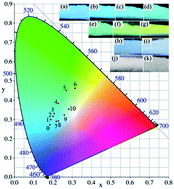
The Commission International del'Eclairage (CIE) chromaticity coordinates of CKP:0.007Eu2+, ySr2+, zMg2+ (0 ≤ y ≤ 0.5, 0 ≤ z ≤ 0.1) upon 365 nm excitation were calculated from the emission spectra using the 1931 CIE system, and the CIE chromaticity diagram is described in Fig. 7. The corresponding chromaticity coordinates values (points 0–10 in Fig. 7) are (0.185, 0.272), (0.188, 0.299), (0.200, 0.317), (0.207, 0.330), (0.229, 0.382), (0.269, 0.449), (0.315, 0.461), (0.218, 0.289), (0.228, 0.292), (0.259, 0.323), and (0.282, 0.353) for (y = 0, z = 0), (y = 0.03, z = 0), (y = 0.07, z = 0), (y = 0.1, z = 0), (y = 0.15, z = 0), (y = 0.2, z = 0), (y = 0.5, z = 0), (y = 0, z = 0.03), (y = 0, z = 0.05), (y = 0, z = 0.07), and (y = 0, z = 0.1), respectively. It can be seen the luminescence hue can be tuned from light blue to greenish yellow by doping Sr2+ of different concentrations, and from light blue to nearly white for different contents of Mg2+. To observe the emission colors visually, the insets (a)–(k) show the digital photographs of the above samples under 365 nm UV lamp irradiation, respectively. Thus, emission-tunable CKP:0.007Eu2+, ySr2+, zMg2+ phosphors are obtained finally.


image file: c4ra11198b-f7.tif
Fig. 7 CIE chromaticity diagram of CKP:0.007Eu2+, ySr2+, zMg2+, insets (a)–(k) show the corresponding digital photographs under 365 nm UV lamp irradiation.

4. Conclusions

In sum, a series of CKP:Eu2+, Sr2+, Mg2+ phosphors were developed by using solid-state reaction method. Under 365 nm excitation, the CKP:Eu2+ sample shows a broad emission band in the range of 425–700 nm, attributed to the 4f65d1–4f7 transition of Eu2+. When the Sr2+ and Mg2+ ions are introduced into CKP:Eu2+, the emission band of Eu2+ is broadened obviously and the emission color could be tuned from light blue to greenish yellow containing white. All the excitation spectra of the as-prepared samples show broad excitation bands from UV to blue, which can well match with the emission wavelength of the NUV LED chip. Therefore, the CKP:Eu2+, Sr2+, Mg2+ phosphors could be promising candidates for white LEDs.

Acknowledgements

This work was supported by the Natural Science Foundation of Jiangsu Province of China (no. BK20140456) and Natural Science Foundation of the Jiangsu Higher Education Institutions of China (no. 14KJD140002).

References

  1. S. Nakamura, MRS Bull., 1997, 22, 29 CAS.
  2. M. Krings, G. Montana, R. Dronskowski and C. Wickleder, Chem. Mater., 2011, 23, 1694 CrossRef CAS.
  3. M. Jiao, N. Guo, W. Lü, Y. Jia, W. Lv, Q. Zhao, B. Shao and H. You, Inorg. Chem., 2013, 52, 10340 CrossRef CAS PubMed.
  4. S. E. Brinkley, N. Pfaff, K. A. Denault, Z. Zhang, H. T. (Bert) Hintzen, R. Seshadri, S. Nakamura and S. P. Denbaars, Appl. Phys. Lett., 2011, 99, 241106 CrossRef PubMed.
  5. H.-S. Roh, S. Hur, H. J. Song, I. J. Park, D. K. Yim, D.-W. Kim and K. S. Hong, Mater. Lett., 2012, 70, 37 CrossRef CAS PubMed.
  6. X. Yu, X. Xu, P. Yang, Z. Yang, Z. Song, D. Zhou, Z. Yin, Q. Jiao and J. Qiu, Mater. Res. Bull., 2012, 47, 117 CrossRef CAS PubMed.
  7. J. Y. Han, W. B. Im, D. Kim, S. H. Cheong, G. Lee and D. Y. Jeon, J. Mater. Chem., 2012, 22, 5374 RSC.
  8. Y.-C. Wu, D.-Y. Wang, T.-M. Chen, C.-S. Lee, K.-J. Chen and H.-C. Kuo, ACS Appl. Mater. Interfaces, 2011, 3, 3195 CAS.
  9. G. Y. Lee, J. Y. Han, W. B. Im, S. H. Cheong and D. Y. Jeon, Inorg. Chem., 2012, 51, 10688 CrossRef CAS PubMed.
  10. H. J. Song, D. K. Yim, I.-S. Cho, H.-S. Roh, J. S. Kim, D.-W. Kim and K. S. Hong, Mater. Res. Bull., 2012, 47, 4522 CrossRef CAS PubMed.
  11. Z.-C. Wu, J. Liu, W.-G. Hou, J. Xu and M.-L. Gong, J. Alloys Compd., 2010, 498, 139 CrossRef CAS PubMed.
  12. W.-R. Liu, Y.-C. Chiu, Y.-T. Yeh, S.-M. Jang and T.-M. Chen, J. Electrochem. Soc., 2009, 156, J165 CrossRef CAS PubMed.
  13. V. A. Morozov, A. A. Belik, R. N. Kotov, I. A. Presnyakov, S. S. Khasanov and B. I. Lazoryak, Crystallogr. Rep., 2000, 45, 1 CrossRef.
  14. M. H. Sandström and D. Boström, Acta Crystallogr., Sect. E: Struct. Rep. Online, 2006, 62, i253 Search PubMed.
  15. W. B. Im, N. N. Fellows, S. P. DenBaars, R. Seshadri and Y. I. Kim, Chem. Mater., 2009, 21, 2957 CrossRef CAS.
  16. H. Yu, D. Deng, Y. Li, S. Xu, Y. Li, C. Yu, Y. Ding, H. Lu, H. Yin and Q. Nie, J. Lumin., 2013, 143, 132 CrossRef CAS PubMed.
  17. S. J. Park, C. H. Park, B. Y. Yu, H. S. Bae, C. H. Kim and C. H. Pyun, J. Electrochem. Soc., 1999, 146, 3903 CrossRef CAS PubMed.

This journal is © The Royal Society of Chemistry 2015
Click here to see how this site uses Cookies. View our privacy policy here.