DOI:
10.1039/C4RA09388G
(Paper)
RSC Adv., 2015,
5, 3552-3559
The highest connected pure inorganic 3D framework assembled by {P4Mo6} cluster and alkali metal potassium†
Received
28th August 2014
, Accepted 4th December 2014
First published on
4th December 2014
Abstract
A 3D high connected pure inorganic framework based on {P4Mo6} cluster, [{K(H2O)}12{CoMo12VO24(OH)6(HPO4)4(PO4)4}] (1) has been hydrothermally synthesized and characterized by elemental analysis, IR, TG, UV analysis and single crystal X-ray diffraction analyses. In compound 1, each basic unit {Co(P4Mo6)2} dimeric cluster uses its surface oxygen atoms (36) to attract 30 different-occupied potassium atoms at its periphery, which act as diverse bridge unit forming an centrosymmetric 18-connected open-framework with a (3343)2(364125664)(364845366213727869)(4)9 topology. Compound 1 represents the highest connection of the {P4Mo6}-based POMs up to now. Compound 1 shows bifunctional electrocatalytic activities toward not only reduction of nitrite and hydrogen peroxide, but also oxidation of biological molecules ascorbic acid (AA) ascribed to MoV-centers. In addition, compound 1 shows excellent photocatalytic activities for the degradation of methylene blue (MB).
Introduction
The design and synthesis of new polyoxometalate (POM)-based extended assemblies, such as chains, nets and open frameworks, have become a significant research area for POM chemists,1 due to their intriguing structural topologies and properties as well as their potential applications in catalysis,2 molecular adsorption,3 medicine,4 photochemistry,5 and electromagnetism6 et al. Generally, one effective approach for novel POM-based extended assemblies is the incorporation of POM building blocks and various linking units such as transition metal complexes (TMC), organic ligand and different metal ions. POMs possess a large number of surface oxygen atoms acting as potential active coordination sites, which tend to coordinate with various metal linkers via versatile coordination modes.7 In this subfamily, the {P4Mo6X31} (X = O or OH) units (abbr. {P4Mo6}) represent one of the ideal building blocks to construct novel extended assemblies:8–10 on the one hand, the reduced MoV centers and the relative small size of these POMs lead to the high negative charges of the whole clusters, which can induce more cationic linking units into the crystal structures and lead to plenty of structural topologies; on the other hand, the four extrude {PO4} fragments provide versatile coordination modes to various linking units;9 furthermore, the {P4Mo6} units are one of easy available clusters that can be in situ synthesized with simple starting materials in the hydrothermal environment or by routine synthesis.10 The N-donor ligands as structure-directing agents play important roles in the construction of {P4Mo6}-based assemblies. They can always act as reducing agents to reduce MoVI into MoV centers although sometimes organic ligands absent in the final hybrid materials. They can also induce the {P4Mo6}-based inorganic fragments to form different dimensions or various packing arrangements in the final extended materials.10 In addition, introduction of new linking units is an important factor to influence, adjust or even change the structural topologies, dimensions or packing arrangements of the {P4Mo6}-based extended assemblies. The transition metal and TMC have been widely used as bridging units due to their relatively strong coordination abilities with the four extrude {PO4} groups on the {P4Mo6} cluster.11 Such kind of modified not only dramatically enrich the inorganic backbone, but also improve their chemical properties. However, the highest covalent connecting number of {P4Mo6}-based assemblies is not more than eight in the face of the large number of oxygen atoms as the smart potential coordination sites.12 Recently, the alkali metal and alkaline-earth metal ions usually act as the other type of linkers to construct the {P4Mo6}-based assemblies for their more flexible coordination modes, low positive charge number and relatively high concentration in the starting materials.13–16 A large amount of new {P4Mo6}-based compounds with sodium,10,13 calcium,14 and strontium(II)15 cation as linker have been reported. However, {P4Mo6}-based compounds modified by potassium cation are relatively rare.16 Up to now, high-dimensional and highly-connected pure inorganic {P4Mo6}-based compounds modified by potassium cation have not been reported. Thus, it would be a challenging but attractive area to synthesize this kind of compounds. In fact, potassium cations not only contain less charge number than transitional metal ions have, but also possess the coordination mode and size of lanthanide ions. So they might be good template candidates to induce high-dimensional and highly-connected {P4Mo6}-based extended assemblies.
Based on aforementioned considerations, we attempt to introduce potassium cation as linkers into the {P4Mo6}-containing reaction systems in order to explore new {P4Mo6}-based high-dimensional and highly-connected assemblies with interesting physical and chemical properties. Herein, we report a novel 18-connected pure inorganic extended assembly based on {P4Mo6} clusters, [{K(H2O)}12{CoMo12VO24(OH)6(HPO4)4 (PO4)4}] (1). Their electrochemical properties and photocatalytic activities were also investigated.
Experimental
Materials and physical measurements
All reagents were purchased commercially and used without further purification. Elemental analyses Co, P, Mo, and K were performed on a PLASMA-SPEC (I) inductively coupled plasma atomic emission spectrometer. The IR spectra were obtained on an Alpha Centaurt FT/IR spectrometer with KBr pellet in the 400–4000 cm−1 region. The thermal gravimetric analyses (TGA) were carried out in N2 on a Perkin-Elmer DTA 1700 differential thermal analyzer with a rate of 10 °C min−1. Diffuse reflectance UV-vis spectra (BaSO4 pellets) were obtained with a Varian Cary 500 UV-vis NIR spectrometer. Electrochemical measurements were performed with a CHI660 electrochemical workstation. A conventional three-electrode system was used. The working electrode was a carbon paste electrode (CPE), a Pt wire as the counter electrode and Ag/AgCl (3 M KCl) electrode was used as a reference electrode.
Synthesis
[{K(H2O)}12{CoMo12VO24(OH)6(HPO4)4(PO4)4}] (1): the mixture of (NH4)6Mo7O24·H2O (0.7216 g, 0.584 mmol), Co(CH3COOH)2·2H2O (0.485 g, 1.95 mmol), CH3COOK·H2O (0.387 g, 2.10 mmol), 2,2′-bpy (0.421 g, 2.70 mmol), H3PO4(1 mL, 15 mmol), and H2O (27 mL, 1.5 mol) was stirred at room temperature for 30 minutes; then the pH value was adjusted to about 3.5 with 1 M NaOH, and it was sealed in a 50 mL Teflon-lined stainless steel reactor, which was heated at 160 °C for 4 days. The dark-blue crystals were isolated and collected by filtration, washed thoroughly with distilled water, and dried at room temperature (yield: 46% based on Mo). Anal. calcd for CoH24K12Mo12O74P8 (Mr = 3135.36): P, 7.91; K, 14.96; Co, 1.89; Mo, 36.72; found: P, 7.93; K, 14.92; Co, 1.90; Mo, 36.75%. IR (KBr pellet, cm−1): 3481 (br), 1062 (s), 981 (s), 929 (s), 817 (s), 750 (s).
X-ray crystallography
The crystal structure of compound 1 was determined from single-crystal X-ray diffraction data. Intensity data were collected on a Bruker SMART CCD diffractometer equipped with a graphite monochromatized Mo Kα radiation (λ = 0.71073 Å) at 293 K. The structure was solved by direct methods and difference Fourier map with SHELXL-97 program,17 and refined by full-matrix least-squares techniques on F2. For the compound, all the non-hydrogen atoms except solvent water molecules were refined anisotropically. The positions of hydrogen atoms of organic molecules were calculated theoretically, and refined using a riding model. Hydrogen atoms of water molecules were not treated. Graphics were obtained with diamond. The crystal parameters, data collection and refinement results for the compound were summarized in Table 1. Selected bond lengths and angles for 1 are listed in Table S1.†
Table 1 Crystal data and structure refinement for 1
| Compound |
1
|
|
R
1 = ∑||F0| − |FC||/∑|F0|.
wR2 = ∑[w(F02 − FC2)2]/∑[w(F02)2]1/2.
|
| Chemical formula |
CoH24K12Mo12O74P8 |
| Formula weight |
3135.36 |
|
T/K |
293(2) |
|
λ/Å |
0.71073 |
| Crystal system |
Trigonal |
| Space group |
R m |
|
a/Å |
13.3320(8) |
|
b/Å |
13.3320(8) |
|
c/Å |
35.988(4) |
|
α/° |
90.00 |
|
β/° |
90.00 |
|
γ/° |
120.00 |
|
V/Å3 |
5539.6(10) |
|
Z
|
3 |
|
D
calc/mg m−3 |
2.820 |
|
µ/mm−1 |
3.158 |
|
F(000) |
4485.0 |
| Crystal size/mm |
0.24 × 0.22 × 0.20 mm |
|
θ range/° |
1.70–27.54 |
| Reflections collected/unique |
10 844/1613 [Rint = 0.0371] |
| Data/restraints/parameters |
1613/24/97 |
| GOF on F2 |
1.057 |
| Final R indices [I > 2σ(I)]a |
R
1 = 0.0498, wR2 = 0.0995 |
|
R indices (all data)b |
R
1 = 0.0523, wR2 = 0.1097 |
The procedure for the TOPOS calculation
The disordered atoms K1A were omitted and K1, K2, K3, K4, and Co1 atoms were changed to Cu1, Cu2, Cu3, Cu4, and Cu5, respectively in Diamond software in order to facilitate topology calculation (because the topology program does not recognize the potassium atoms). The modified data was stored into a CIF file. The CIF file was opened in the TOPOS 4.0, and the bond lengths of Cu–Cu were restricted with the AutoCN program, then the topology symbols were calculated with ADS program.
Results and discussion
Synthesis
In our continuing research on the POM-based extended assemblies, we are trying to explore various new possible linkers to construct the extended materials. Recently, alkaline-earth metals strontium cation has been used to induce a series of new POM-based extended assemblies: (I) they might be good template candidates to fill in cavum18 or vacant position19a of POM inducing novel unclassical POM class such as basket-liked polyoxoanion [Sr⊂P6Mo4VMo14VIO73]10–18b and vacant position substituted Keggin-type [(CH3)4N]3.5H1.5[PW11O39Sr(H2O)2]·1.5H2O chain.19a (II) They are also a new kind of linking units to connect with surface oxygen atoms of POM resulting in POM-based extended assemblies, such as the first basket-liked 1-D chain (H2imi)6(Himi)4{[Sr(H2O)4]2[Sr⊂P6Mo4VMo14VIO73]2}·17H2O18c and 3-D high-connected sandwich compound [{Sr(H2O)5Sr(H2O)6Sr0.5(H2O)7}2Mn4(H2O)2(a-PW9O34)2]·6H2O.19b It is worth mentioning that a series of new {P4Mo6}-based extended assemblies with mixed metal connection units {SrxTM} (x = 2, 4) are obtained through introducing strontium cation into the {P4Mo6} reaction systems by our group.15 Inspired by the above work, we expect to introduce alkali metal potassium cation as linkers into the {P4Mo6} systems in order to explore new POM-based extended assemblies. Because potassium cations are analogous to strontium cations: they possess similar ionic radius, coordination mode, and strong coordination ability, which are testified by the fact that potassium cations also act as template reagent to induce basket-liked POM.20 In our initial hydrothermal syntheses, the strontium was substituted by potassium cation in the present of different ligands and transition metal centers under similar reaction conditions. But analogous {P4Mo6}-based extended assemblies with mixed metal connection units could not obtained, the reason for which may be that the lower charge number of potassium cation can't balance the negative charge of {P4Mo6} surface, and then decreases reaction activity of forming heterometallic linkers. Thus, we extend reaction time to 4 day and adjust reaction temperature to 160 °C after a series of combinatorial trials. The self-assembly reactions of (NH4)6Mo7O24·H2O (0.7216 g, 0.584 mmol), Co(CH3COOH)2·2H2O, (0.485 g, 1.95 mmol), CH3COOK·H2O (0.387 g, 2.10 mmol), 2,2′-bpy (0.421 g, 2.70 mmol), H3PO4(1 mL, 15 mmol), and H2O (27 mL, 1.5 mol) were carried out under lower pH (3.5). Then, 3-D high-connected frameworks based on {P4Mo6} cluster were successful synthesized. The crystals were found to be sensitive to the pH value and reaction temperature, which was controlled strictly at pH 3.5 and reaction temperature 160 °C. No crystals could be obtained outside the pH ranges and reaction temperature. It is noteworthy that the 2,2′-bpy was used as directing agents, but a pure inorganic 3D framework obtained in our experiments. Parallel experiments show that no crystal was obtained if 2,2′-bpy absence from raw materials. The fact further indicates that 2,2′-bpy plays an important role in the formation of compound 1. The reduction of MoVI to MoV may be attributed to the N-containing ligand (2,2′-bpy). Organic ligands acting as reducing agent under hydrothermal conditions often observed in the preparation of many POM-based hybrid materials.21 We summarized these experimental results related to potassium and strontium cation in Scheme 1.
 |
| | Scheme 1 A series of new POM-based extended assemblies induced by strontium(II) and potassium(I) cations. | |
Crystal structure
X-ray diffraction analysis reveals that the structure of compound 1 is based on the sandwich-type {Co{P4Mo6O31}2} cluster. As usually observed, the basic building unit [P4Mo6] is made up of six {Mo(1)O6} octahedral, one {P(1)O4} and three {P(2)O4} tetrahedral (Fig. S1 and S2†). The six oxygen-bridged molybdenum centers [Mo–O: 1.692(10)–2.274(7) Å] lie approximately in the same plane, which exhibits a ring of six edge-sharing [MoO6] octahedra with alternating Mo–Mo single bonds (2.584 Å) and nonbonding Mo⋯Mo contacts (3.528 Å). Four {PO4} tetrahedra are linked to the ring by sharing corners with three {PO4} groups around the periphery of the ring and the other one group located on its center. The P–O bond distances are in the range of 1.47(2)–1.552(12) Å and the angles of O–P–O are from 99.3(12) to 111.9(5)°. The central transitional metal cobalt ion connects two [P4Mo6] units via three bridging-oxygen atoms between Mo–Mo single bonds to form the sandwich-type moiety Co[P4Mo6]2 with a local symmetry of Ci. It is worth mentioning that the central phosphate groups and the Mo–Mo bonds on the two rings are staggered to each other. In addition, P1 and Co1 atoms in compound 1 lie on their inversion centres.
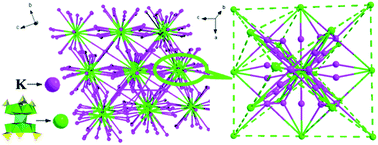
It is very interesting that compound 1 is modified by different-occupied K atoms, which could be viewed as µ2, µ4, and µ8-bridges to connect with adjacent sandwich-type polyanions forming 3D open-framework (Fig. 1). Each {Co(P4Mo6)2} cluster coordinates with 30 K ions via 12 terminal oxygen atoms of {Mo6} octahedron, 6 terminal oxygen atoms of {PO4} tetrahedron, and 18 µ-O atom shared by {Mo6} octahedron and {PO4} tetrahedron. Four crystallographically independent K atoms have different coordination environments (Fig. 2). The K1 atom is disordered in three positions with occupation ratios of 1/2 and 1/4 for K1 and two K1A position, respectively. K1 center is coordinated with two µ3-O atoms shared by P2, Mo1, and K1 atoms and two µ4-O atoms shared by two Mo1 and two K1 (Fig. 2a). In this way, K1 acts as a 2-connected node to link with two {Co(P4Mo6)2} dimeric clusters. K1A is coordinated with two terminal oxygen atom of {PO4} tetrahedral, two µ3-O atoms shared by two Mo1 and one µ3-O atom shared by P2 and Mo1. K1A are omitted for clarity and only linkage mode of K1 is discussed because K1 and K1A connect to the same four {Mo6} octahedra and four {PO4} tetrahedra by O2, O7 and O7, O9, respectively. K2 atom lies on intersection point of C2 and C3 axis with occupation ratios of 1/12 and exhibits eight-coordination geometry which is defined by six µ3-O atoms of {PO4} group from different {Co(P4Mo6)2} dimmers (Fig. 2b). Each K2 links with six {Co(P4Mo6)2} dimmers and two K3 through these µ3-O atoms. K3 center lies on C3 axis with occupation ratios of 1/6 and is coordinated with three µ3-O atoms of {PO4} units from three {Co(P4Mo6)2} dimmers and three coordinated water molecules, possessing six-coordination environment (Fig. 2c). K4 center lies on C2 axis and is divided by one of the crystal planes with occupation ratios of 1/4. K4 is tetra-coordinated and coordinates to four µ2-O atoms derived from four {MoO6} octahedra, which come from two {Co(P4Mo6)2} dimmers (Fig. 2d). The lengths of K–O are in the range of 2.48(3)–2.779(9) Å, and the angles of O–K–O are in the range of 72.6(10)–179.999(4).
 |
| | Fig. 1 Polyhedral and ball-and-stick representation of the sandwich-type {Co{P4Mo6O31}2} cluster modified by 30 different-occupied K atoms in 1. | |
 |
| | Fig. 2 The coordination environments of K1 (a), K2 (b), K3 (c), and K4 (d) of 1. Symmetry code: #1: 0.66667 − x, 0.3333 − y, 0.3333 − z; #2: 0.66667 − x, 0.3333 − x + y; #3: x, x − y, z; #4: −x + y, −x, z; #5: 0.66667 + x − y, 0.3333 − y, 0.3333 − z; #6: 0.66667 + x − y, 1.3333 − y, 0.3333 − z; #7: −x + y, 1 − x, z; #8: −0.3333 + y, 0.3333 + x, 0.3333 − z; #9: 1 − y, 1 + x − y, z; #10: 1 − y, 1 − x, z; #11: y, x, −z; #12: 1 − x, 1 − y, −z. | |
In summary, the coordination number and the coordination modes of K+ ions together lead to the formation of 18-connected 3D open-framework. The topological analysis by TOPOS 4.0 (ref. 22) reveals 5-nodal net with (3343)2(364125664)(364845366213727869)(4)9 topology (Fig. 3). In this simplification, {Co(P4Mo6)2} dimeric clusters as 30-connected nodes link with twelve K1, six K2, six K3, and six K4 atoms. K1, K2, K3, and K4 act as 2-, 8-, 4-, and 2-connected nodes, respectively. To the best of our knowledge, compound 1 represents the highest connection of {P4Mo6} POMs up to now.
 |
| | Fig. 3 Polyhedral/stick representation of the 3D structure of 1, view of the topology of compound 1, and the coordination environments of a {Co{P4Mo6O31}2} fragment. | |
Bond-valence sum (BVS) calculations23 show the values 5.17 for Mo1 and 4.94–4.98 for all phosphate atoms in compound 1, indicating that all Mo and P are in the +5 oxidation state. In addition, BVS calculations show that Co and K are in the +2 and +1 oxidation states, respectively in 1. BVS calculations present from 1.13 to 1.27 for O(1), O(6), and O(9) in 1, indicating that they are all hydroxyl groups. The terminal water ligands linked to the K centers (0.24–0.32) are also determined by the BVS calculations.
Spectroscopic and thermal analyses
IR spectrum of compound 1 was measured at room temperature (shown in Fig. S3†). The broad bands at 3481 cm−1 can be assigned to v(O–H) of isolated solvent water molecules. The peaks at 1062, 981, 929, 817, and 750 cm−1 are attributed to ν(P–O), ν(Mo
Od), ν(Mo–Ob–Mo), and ν(Mo–Oc–Mo) respectively of the {P4Mo6} polyanions.
The UV-vis absorption spectrum of compounds 1 is shown in the Fig. S4.† Two absorption bands at 217 nm and 298 nm are attributed to (LMCT) pπ (Oterminal) → dπ* (Mo) electronic transitions in the Mo
O bonds and dπ–pπ–dπ electronic transitions between the energetic levels of the Mo–O–Mo bonds.24 The broad band at 538 nm is assigned to the intervalence charge transfer (IVCT) in reduced polyoxoanions.24
The simulated and experimental the X-ray power diffraction (XRPD) patterns of the title compound are presented in diffraction peaks of both simulated and experimental patterns match in the key positions, indicating the phase purity of the compounds. The differences in intensity may be due to the preferred orientation of the powder samples.
In the TG curve of compound 1 (see Fig. S6†), the first weight loss of 7.21% in the temperature range 190–350 °C corresponds to the release of the water molecules, which is in accordance with the calculated value of 6.89% (∼12H2O). The second weight loss of 6.79% in the temperature range 680–900 °C is attributed to the loss of part of P2O5. The weight losses from the TG curves are accordant with the molecular formula of compound 1.
Electrochemical and electrocatalysis properties
The electrochemical behaviors of compound 1 were investigated with 1-modified carbon paste electrodes (1-CPE). The cyclic voltammetric (CV) behaviors for 1-CPE in 1.0 M H2SO4 aqueous solution at different scan rates were recorded (Fig. S7†). There exist two reversible redox peaks I–I′ and II–II′ with the half-wave potentials E1/2 = (Epa + Epc)/2 at −0.085, and 0.483 V for 1, which can be ascribed to three consecutive redox processes of MoV.25 Moreover, the cathodic peak potentials of compound 1 shift toward the negative direction and the corresponding anodic peak potentials shift to the positive direction with increasing scan rates, as shown in Fig. S7.† The peak potentials change gradually following the scan rate from 20 to 500 mV s−1. Furthermore, the peak-to-peak separations between the corresponding anodic and cathodic peaks increased, but the average peak potentials do not change on the whole. The plots of anodic peak current (II) vs. scan rates (see insert plots in Fig. S7b†) indicate that the redox process of 1-CPE are surface-controlled below the scan rate of 150 mV s−1, while at scan rates higher than 150 mV s−1, the peak currents were proportional to the square root of the scan rate, suggesting that redox processes are diffusion-controlled.26 It is also noteworthy that 1-CPE possesses the high stability. When the potential range is maintained between −1.0 and 1.0 V, the peak currents remains almost unchanged over 300 cycles at a scan rate of 120 mV s−1.
The electrocatalytic properties of 1-CPEs have also been investigated. As shown in Fig. S8† and 4a, in the potential range of +1.0 to −1.0 V, with addition of H2O2 and NO2−, the reduction peak currents of 1-CPE increase gradually while the corresponding oxidation peak currents decrease, which indicates that 1-CPE displays a good electrocatalytic activity toward the reduction of hydrogen peroxide and nitrite. However, with addition of ClO3−, the reduction peaks and oxidation peaks of 1-CPE are almost unaffected, which indicates that 1-CPE doesn't have obvious catalytic activity toward the reduction of ClO3−.
 |
| | Fig. 4 Reduction of NO2− (a) and oxidation of AA (b) for 1-CPE in 1 M H2SO4 solution containing nitrite or ascorbic acid. Scan rate: 50 mV s−1. Potentials vs. Ag/AgCl. | |
Ascorbic acid (AA) as a vital component in the diet of human being is known to take part in several biological reactions and be used clinically in the treatment and prevention of scurvy. Thus it is significant to detect the AA by electrochemical method. In our experiments, 1-CPE exhibits the catalytic oxidation ability toward the AA. As shown in Fig. 4b, the oxidation and reduction peak currents of the third Mo-wave both increase accompanying the addition of increasing amounts of AA, however, the extent of enhancement of oxidation peak currents are far bigger than the reduction peak currents. This fact suggests that III–III′ couple of 1-CPE is efficient toward the oxidation of AA. All these results indicate that 1-CPE has bifunctional electrocatalytic activities toward not only reduction of normal inorganic molecules (H2O2 and NO2−), but also oxidation of biological molecules AA ascribed to MoV centers.
The electrocatalytic efficiency (CAT) of 1-CPEs can be calculated by using the CAT formula:
| CAT = 100% × [Ip(POM, substrate) − Ip(POM)]/Ip(POM)27a |
where
Ip(POM, substrate) and
Ip(POM) are the peak currents for the reduction of the POM with and without the presence of substrate (NO
2−, AA,
etc.), respectively.
1-CPE shows a higher CAT value towards the reduction of nitrite than the reduction of ClO
3− and H
2O
2. As shown in
Fig. 5, the CAT of
1-CPE towards 20 mM NO
2− was calculated to be 350%. And CAT value towards the oxidation of AA was calculated to be 733%. To make a comparison between the
1-CPE in this study and V-based POM hybrids from another study,
27b catalytic efficiency for the
1-CPE is higher than vanadium-based modified electrodes, at least for the oxidation of AA.
 |
| | Fig. 5 Chart of the CAT vs. concentration of ClO3−, H2O2, NO2− and AA for 1-CPEs. Ip values of wave I for ClO3−, H2O2, NO2− and Ip values of wave II for AA at a scan rate of 50 mV s−1. | |
Photocatalytic activity
POM-based extended assemblies have been regarded as a kind of photocatalyst to degrade organic dyes.28 So the photocatalytic activities of the title compounds were investigated by the degradation of MB solution under UV irradiation in this work. In the process of photocatalysis, 100 mg of compound 1 were suspended in 0.02 mmol L−1 MB aqueous solutions (250 mL) and magnetically stirred for about 10 min to ensure the equilibrium in the dark. Then, 5.0 mL samples were taken out every 20 min for analysis by UV-visible spectroscopy. It can be clearly observed that the absorption peaks of MB decreased obviously with increasing reaction time (Fig. 6a). As shown in Fig. 6b, after irradiation with compound 1 for 180 min, the photocatalytic decomposition rate, defined as 1 − C/C0, is 96.52%. In comparison, the absorption peaks of MB without any catalyst show no obvious change. The results indicate that compound 1 show excellent photocatalytic activities for the degradation of MB. For POM catalysts, the photocatalytic reaction usually occurs on the surface of the POM. The catalysts are activated by exciting the POM with light energy, which leads to an intermolecular O–M charge transfer and the formation of the excited-state species (POM).29 In this work, UV-irradiation of the compound 1 leads to an O–Mo charge transfer and the excited state P4Mo6-based species, which produce considerable holes and electrons and can oxidize the MB.
 |
| | Fig. 6 (a) Absorption spectra of the MB solution during the decomposition reaction under UV irradiation in the presence of compound 1; (b) photocatalytic decomposition rate of the MB solution under UV irradiation with the use of the title compound 1 and only MB. | |
Conclusions
In summary, alkali metal potassium cations were introduced into the {P4Mo6} reaction systems as linking elements to assemble the highest connected pure inorganic extended POM based on sandwich-type building units {Co(P4Mo6)2}. The compound shows bifunctional electrocatalytic activities toward not only reduction of nitrite and hydrogen peroxide but also oxidation of biological molecules such as AA ascribed to MoV-centers. In addition, compound 1 shows excellent photocatalytic activities for the degradation of MB.
Acknowledgements
This work was supported the National Natural Science Foundation of China (Grants nos 21271056 and 21371042), the Ministry of Education and Specialised Research Fund for the Doctoral Program of Higher Education (20122329110001), Key Laboratory of Functional Inorganic Material Chemistry (Heilongjiang University), Ministry of Education, Doctoral initiation Foundation of Harbin Normal University (no. KGB201214). Program for Scientific and Technological Innovation Team Construction in Universities of Heilongjiang Province (no. 2011TD010).
Notes and references
- H. N. Miras, L. Vilà-Nadal and L. Cronin, Chem. Soc. Rev., 2014, 43, 5679 RSC
.
-
(a) P. Gouzerh and A. Proust, Chem. Rev., 1998, 98, 77 CrossRef CAS PubMed
;
(b) X. H. Yan, P. L. Zhu, J. B. Fei and J. B. Li, Adv. Mater., 2010, 22, 1283 CrossRef CAS PubMed
.
-
(a) R. B. Getman, Y. S. Bae, C. E. Wilmer and R. Q. Snurr, Chem. Rev., 2012, 112, 703 CrossRef CAS PubMed
;
(b) M. P. Suh, H. J. Park, T. K. Prasad and D. W. Lim, Chem. Rev., 2012, 112, 782 CrossRef CAS PubMed
;
(c) J. R. Li, Y. Tao, Q. Yu, X. H. Bu, H. Sakamoto and S. Kitagawa, Chem.–Eur. J., 2008, 14, 2771 CrossRef CAS PubMed
.
-
(a) D. L. Long, E. Burkholder and L. Cronin, Chem. Soc. Rev., 2007, 36, 105 RSC
;
(b) C. Lydon, C. Busche, H. N. Miras, A. Delf, D. L. Long, L. Yellowlees and L. Cronin, Angew. Chem., Int. Ed., 2012, 51, 2115 CrossRef CAS PubMed
;
(c) Y. F. Zeng, X. Hu, F. C. Liu and X. H. Bu, Chem. Soc. Rev., 2009, 38, 469 RSC
.
- P. Horcajada, R. Gref, T. Baati, P. K. Allan, G. Maurin, P. Couvreur, G. Férey, R. E. Morris and C. Serre, Chem. Rev., 2012, 112, 1232 CrossRef CAS PubMed
.
- J. M. Clemente-Juan, E. Coronado and A. Gaita-Arino, Chem. Soc. Rev., 2012, 41, 7464 RSC
.
-
(a) A. Dolbecq, E. Dumas, C. R. Mayer and P. Mialane, Chem. Rev., 2010, 110, 6009 CrossRef CAS PubMed
;
(b) Z. Peng, Angew. Chem., Int. Ed., 2004, 43, 930 CrossRef CAS PubMed
;
(c) P. J. Hagrman, D. Hagrman and J. Zubieta, Angew. Chem., Int. Ed., 1999, 38, 2638 CrossRef
;
(d) C. L. Hill and J. W. Han, J. Am. Chem. Soc., 2007, 129, 15094 CrossRef PubMed
.
-
(a) A. Guesdon, M. M. Borel, A. Leclaire and B. Raveau, Chem.–Eur. J., 1997, 3, 1797 CrossRef CAS
;
(b) L. A. Meyer and R. C. Haushalter, Inorg. Chem., 1993, 32, 1579 CrossRef CAS
;
(c) R. C. Haushalter and F. W. Lai, Inorg. Chem., 1989, 28, 2904 CrossRef CAS
;
(d) W. J. Chang, Y. C. Jiang, S. L. Wang and K. H. Lii, Inorg. Chem., 2006, 45, 6586 CrossRef CAS PubMed
;
(e) Z. Hao, Q. Dong, L. Zhang, Y. Zhang and F. Luo, CrystEngComm, 2010, 12, 977 RSC
.
-
(a) Y. S. Zhou, L. J. Zhang, X. Z. You and S. Natarajan, Inorg. Chem. Commun., 2001, 4, 699 CrossRef CAS
;
(b) Y. Ma, Y. G. Li, E. B. Wang, Y. Lu, X. L. Wang and X. X. Xu, J. Solid State Chem., 2006, 179, 2367 CrossRef CAS PubMed
;
(c) X. Zhang, J. Q. Xu, J. H. Yu, J. Lu, Y. Xu, Y. Chen, T. G. Wang, X. Y. Yu, Q. F. Yang and Q. Hou, J. Solid State Chem., 2007, 180, 1949 CrossRef CAS PubMed
;
(d) F. N. Shi, F. A. Almeida Paz, P. I. Girginova, H. I. S. Nogueira, J. Rocha, V. S. Amaral, J. Klinowski and T. Trindade, J. Solid State Chem., 2006, 179, 1497 CrossRef CAS PubMed
.
-
(a) C. Streb, D. L. Long and L. Cronin, Chem. Commun., 2007, 471 RSC
;
(b) C. Streb, D. L. Long and L. Cronin, CrystEngComm, 2006, 8, 629 RSC
.
-
(a) B.-Z. Lin, X.-Z. Liu, B.-H. Xu, Q.-Q. Wang and Z.-J. Xiao, Solid State Sci., 2008, 10, 1517 CrossRef CAS PubMed
;
(b) Y. Ma, Y. G. Li, E. B. Wang, Y. Lu, X. Wang and X. X. Xu, J. Coord. Chem., 2007, 60, 719 CrossRef CAS
;
(c) X. He, P. Zhang, T. Y. Song, Z. C. Mu, J. H. Yu, Y. Wang and J. N. Xu, Polyhedron, 2004, 23, 2153 CrossRef CAS PubMed
;
(d) H. X. Guo and S. X. Liu, J. Mol. Struct., 2005, 741, 229 CrossRef CAS PubMed
;
(e) Y. Ma, Y. G. Li, E. B. Wang, Y. Lu, C. Qin and X. X. Xu, J. Cluster Sci., 2006, 17, 167 CrossRef CAS PubMed
.
- Y. N. Zhang, B. B. Zhou, Q. Q. Sha, Z. H. Su and H. Liu, Inorg. Chem. Commun., 2010, 13, 550 CrossRef CAS PubMed
.
-
(a) R. D. Huang, F. C. Liu, Y. G. Li, M. Yuan, E. B. Wang, G. J. H. De, C. W. Hu, N. H. Hu and H. Q. Jia, Inorg. Chim. Acta, 2003, 349, 85 CrossRef CAS
;
(b) L. Zhang, Y. Zhou, X. Li and Y. Li, J. Cluster Sci., 2007, 18, 921 CrossRef CAS PubMed
;
(c) X. Q. Chen, S. Lin, L. J. Chen, X. H. Chen, C. L. Liu, J. B. Chen and L. Y. Yang, Inorg. Chem. Commun., 2007, 10, 1285 CrossRef CAS PubMed
.
-
(a) J. P. Wang, J. W. Zhao, P. T. Ma, J. C. Ma, L. P. Yang, Y. Bai, M. X. Li and J. Y. Niu, Chem. Commun., 2009, 2362 RSC
;
(b) B. Z. Lin, X. Z. Liu, B. H. Xu, Q. Q. Wang and Z. Xiao, Solid State Sci., 2008, 10, 1517 CrossRef CAS PubMed
.
-
(a) K. Yu, W. L. Chen, B. B. Zhou, Y. G. Li, Y. Yu, Z. H. Su, S. Gao and Y. Chen, CrystEngComm, 2011, 13, 3417 RSC
;
(b) K. Yu, B. B. Zhou, Y. Yu, Z. H. Su, C. M. Wang, C. X. Wang, S. Gao and Y. Chen, Inorg. Chim. Acta, 2012, 384, 8 CrossRef CAS PubMed
.
- X. Z. Liu, B. Z. Lin, L. W. He, X. F. Huang and Y. L. Chen, J. Mol. Struct., 2008, 877, 72 CrossRef CAS PubMed
.
-
(a)
G. M. Sheldrick, SHELXL 97, Program for Crystal Structure Refinement, University of Gőttingen, Germany, 1997 Search PubMed
;
(b)
G. M. Sheldrick, SHELXL 97, Program for Crystal Structure Solution, University of Gőttingen, Germany, 1997 Search PubMed
.
-
(a) K. Yu, B. Wan, Y. Yu, L. Wang, Z. H. Su, C. M. Wang, C. X. Wang and B. B. Zhou, Inorg. Chem., 2013, 52, 485 CrossRef CAS PubMed
;
(b) K. Yu, Y. G. Li, B. B. Zhou, Z. H. Su, Z. F. Zhao and Y. N. Zhang, Eur. J. Inorg. Chem., 2007, 5662 CrossRef CAS
;
(c) K. Yu, B. B. Zhou, Y. Yu, Z. H. Su, H. Y. Wang, C. M. Wang and C. X. Wang, Dalton Trans., 2012, 10014 RSC
.
-
(a) J. P. Wang, K. H. Wang and J. Y. Niu, J. Mol. Struct., 2008, 886, 183 CrossRef CAS PubMed
;
(b) Y. Yu, B. B. Zhou, K. Yu and Y. N. Zhang, J. Solid State Chem., 2010, 183, 1841 CrossRef CAS PubMed
.
-
(a) X. M. Zhang, H. S. Wu, F. Q. Zhang, A. Prikhod'ko, S. Kuwata and P. Comba, Chem. Commun., 2004, 2046 RSC
;
(b) F. Q. Zhang, X. M. Zhang, R. Q. Fang and H. S. Wu, Dalton Trans., 2010, 8256 RSC
.
-
(a) C. M. Liu, D. Q. Zhang and D. B. Zhu, Cryst. Growth Des., 2005, 5, 1639 CrossRef CAS
;
(b) C. J. Zhang, H. J. Pang, Q. Tang, H. Y. Wang and Y. G. Chen, New J. Chem., 2011, 35, 190 RSC
.
-
V. A. Blatov and D. M. Proserpio, TOPOS 4.0, A program package for multipurpose crystallochemical analysis Search PubMed
.
-
(a) I. D. Brown and D. Altermatt, Acta Crystallogr., Sect. B: Struct. Sci., 1985, 41, 244 CrossRef
;
(b) W. Liu and H. H. Thorp, Inorg. Chem., 1993, 32, 4102 CrossRef CAS
.
-
M. T. Pope, Heteropoly and Isopoly Oxometalates, Springer, Berlin, 1983 Search PubMed
.
-
(a) K. Unoura and N. Tanaka, Inorg. Chem., 1983, 22, 2963 CrossRef CAS
;
(b) H. Fu, W. L. Chen, E. B. Wang, J. Liu and S. Chang, Inorg. Chim. Acta, 2009, 362, 1412 CrossRef CAS PubMed
.
-
(a) S. Don, X. Xi and M. Tian, J. Electroanal. Chem., 1995, 385, 227 CrossRef
;
(b) X. L. Wang, Z. H. Kang, E. B. Wang and C. W. Hu, J. Electroanal. Chem., 2002, 523, 142 CrossRef CAS
.
-
(a) B. Keita, A. Belhouari, L. Nadjo and R. Contant, J. Electroanal. Chem., 1995, 381, 243 CrossRef
;
(b) Y. Yu, H. Y. Ma, H. J. Pang, S. B. Li, T. T. Yu, H. Liu, C. Y. Zhao and Z. F. Zhang, New J. Chem., 2014, 38, 1271 RSC
.
-
(a) Y. Hu, F. Luo and F. F. Dong, Chem. Commun., 2011, 47, 761 RSC
;
(b) Y. Q. Chen, S. J. Liu, Y. W. Li, G. R. Li, K. H. He, Y. K. Qu, T. L. Hu and X. H. Bu, Cryst. Growth Des., 2012, 12, 5426 CrossRef CAS
.
-
(a) Y. H. Guo, Y. H. Wang, C. W. Hu, Y. H. Wang and E. B. Wang, Chem. Mater., 2000, 12, 3501 CrossRef CAS PubMed
;
(b) H. Fu, Y. G. Li, Y. Lu, W. L. Chen, Q. Wu, J. X. Meng, X. L. Wang, Z. M. Zhang and E. B. Wang, Cryst. Growth Des., 2011, 11, 458 CrossRef CAS
.
Footnote |
| † Electronic supplementary information (ESI) available: Summary of selected bond lengths and angles; IR, UV-vis, XRD, TG and CV, ORTEP plots, and CIF files of 1. CCDC 1016375. For ESI and crystallographic data in CIF or other electronic format see DOI: 10.1039/c4ra09388g |
|
| This journal is © The Royal Society of Chemistry 2015 |
Click here to see how this site uses Cookies. View our privacy policy here.