
P. V. R. K. Ramacharyulu*a,
Dipak Bapurao Nimbalkara,
J. Praveen Kumarb,
G. K. Prasad*b and
Shyue-Chu Ke*a
aDepartment of Physics, National Dong Hwa University, Hualien 974-01, Taiwan. E-mail: ramamsc2007@gmail.com; ke@mail.ndhu.edu.tw
bDefence Research & Development Establishment, Jhansi Road, Gwalior 474 002, MP, India. E-mail: gkprasad2001@gmail.com
First published on 16th April 2015
N doped and S doped nano TiO2 catalysts were synthesized by a sol–gel process followed by hydrothermal treatment at low temperature and tested for catalytic activity by natural sunlight photocatalytic degradation of a toxic chemical warfare agent. It is observed that sulfate groups were anchored on the surface of titania upon doping, and also create active surface oxygen vacancies, both of which are responsible for sunlight absorption and the promotion of electrons to the conduction band. The formation of a superoxide radical (O2˙−) and hydroxyl radicals may be mainly responsible for the photodegradation of sulfur mustard under sunlight.
It was reported that narrowing of band gap of TiO2 could be achieved by using non-metal species instead of metal ions. Sulfur or nitrogen substitutional doping on TiO2 was found to be effective for reducing the band gap values. The S or N atoms occupy the vacant sites of either titanium ion or oxygen in the titania lattice. Subsequently, the mixing of S3p states with valance band was found to contribute to band gap narrowing.5 The large electronegativity differences between S, N, and O atoms were found to assist the formation of TiO1−xSx or TiO1−xNx structure which led to the shift of threshold wave length to visible light region.6,7 Asahi et al. reported theoretical calculations of the band structure of nitrogen doped TiO2 and studied photocatalytic degradation of acetaldehyde and methylene blue with irradiation of visible light.8 They found that nitrogen atoms substituted the lattice oxygen sites and narrowed the band gap due to mixing of N2p and O2p states. Similarly, several other groups investigated the photocatalytic properties of nitrogen doped TiO2 powders and thin films prepared by different methods.9–13 Hashimoto et al. reported the photocatalytic decomposition of 2-propanol. They found that decomposition of propanol decreased with increased N dopant content on TiO2 when irradiated with visible light. This was attributed to an increase of oxygen vacancies, which promoted the recombination of electrons and holes with increased dopant concentration.6
Umebayashi et al. synthesized S doped TiO2, and used it for the studies on photocatalytic degradation of methylene blue under visible light irradiation.14–16 They observed that sulphur was doped as an anion and replaced the lattice oxygen in TiO2. On the other hand, Ohno et al. found that S atoms were incorporated as cations and replaced Ti ions in the S doped TiO2.17–19 It is interesting that S atoms unlike other non metal dopants could exist in more than one oxidation state such as S2−, S4+ or S6+ on TiO2 depending on the conditions of synthesis or the type of sulfur precursors. Irrespective of sulfur oxidation state, the photocatalytic activity was found to be enhanced.18,20
Sulfur mustard (C4H8SCl2, 2,2′-dichloro diethyl sulfide, HD) is a vesicant, acts as a blister agent, alkylates DNA, and causes fatality to cells. Degradation of HD is a difficult process from the mechanism point of view.21 Its photochemical decomposition in the presence of visible light suggests the possibility of the use of sunlight for degrading HD.
Recently, Prasad and co-workers have studied photocatalytic degradation of sulfur mustard using various catalysts like TiO2, ZnO, MnO2, V-TiO2.22a–d Each has its own disadvantages TiO2 is visible inactive, it absorbs only UVA light in solar spectrum. ZnO absorbs some of the visible light but it takes more time for degradation. V-TiO2 absorbs both UVA & visible light in solar spectrum but metal ions can act as recombination centres. However, Cojocaru et al. studied photocatalytic degradation of CWA like soman, VX, and yperite on activated carbon supported with N doped and undoped TiO2 of large particle size.23 However, there are no reports available in literature on photocatalytic degradation of HD using S or N doped nano TiO2 in the presence of sunlight. The present paper reports the synthesis of N doped TiO2 (NT), S doped TiO2 (ST) nanocatalysts by sol–gel method followed by hydrothermal treatment. This synthesis is eco-friendly as use of toxic precursors are avoided. The synthesized materials were characterized by using X-ray diffraction (XRD), transmission electron microscopy (TEM), X-ray photoelectron spectroscopy (XPS), nitrogen adsorption (BET), UV-vis absorbance spectroscopy, and electron paramagnetic resonance spectroscopy (EPR) techniques. The photocatalytic degradation reactions of HD were studied in sunlight using gas chromatography (GC) and the resulting products were analysed using gas chromatography mass spectrometry (GC-MS). The obtained data on doped materials was compared with that of undoped (HT) and commercial TiO2 (CT) nanocatalysts of anatase phase.
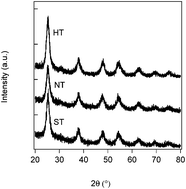
The crystallite sizes of synthesized nanocatalyst materials were calculated by Scherrer equation. Crystallite size of NT and HT nanocatalysts varied in between 6 to 10 nm. ST nanocatalyst showed a crystallite size of 4.8 nm. CT nanocatalyst showed crystallite size of 35 nm. XRD data shows similar peak patterns for ST, HT, and NT nanocatalysts. The S substituted for Ti4+ hinders the growth of TiO2, therefore, the particle size of S-doped TiO2 photocatalysts get smaller with the increasing sulfur doping.
TEM images of HT, ST, and NT nanocatalysts are presented in Fig. 2(a–c). TEM images indicate the particles of spherical shape that have been embedded in the agglomerates with sizes varying around 4.8 to 10 nm.
XPS spectra of ST nanocatalyst are shown in Fig. 3(a). ST nanocatalyst shows a peak at 167 eV (S2p) depicting the presence of S4+ ion in its bulk. In addition to this, a shoulder peak at 168 eV (S2p) and a broad peak at 169 eV (S2p) indicate the presence of S6+ ion in the same and the data is consistent with previously reported data.18 G. Yang et al.24 demonstrated that there are two possible coordination models between SO42− and TiO2 as shown in ESI.† The formation of cationic S-doped TiO2 could create a charge imbalance in the lattice of catalyst, and the extra positive charge is probably neutralized by the hydroxide ions.
XPS spectra of NT nanocatalyst are shown in Fig. 3(b). NT nanocatalyst shows peaks at 398.3 (N1s), 399.7 (N1s), and 401.3 eV (N1s) indicating the presence of O–Ti–N, N–O–Ti, and O–N–Ti–O structures in the bulk of same. It also shows peaks at 459.6 (Ti 2p3/2), 464.9 (Ti 2p1/2), 531, 532 eV (O1s), 284.6 eV (C1s) in the same (Fig. 3(b)) and the data is consistent with previously reported data.8,9 Where, HT nanocatalyst shows peaks 459.6, 464.9, 531, 532, 284.6 eV depicting Ti2p3/2, Ti 2p1/2, O1s, C1s respectively.17–19 The unmarked peaks in the spectra belong to Ti 2s, OKLL & Ti LMM respectively as reported in the literature.
Fig. 4 shows the nitrogen adsorption data of HT, ST, NT and CT nanocatalysts. All the nanocatalysts exhibit type IV adsorption isotherm typical of mesoporous materials with H3 type hysteresis. Isotherms also indicate the presence of slit type of pores formed due to aggregation of TiO2 nanocatalysts either doped or undoped. When compared to HT (230 m2 g−1), ST nanocatalyst exhibited slightly greater surface area (290 m2 g−1) which can be ascribed to the presence of relatively more number of mesopores in ST nanocatalyst. S atom was found to have controlled the nucleation and growth of titania particles and facilitated the formation of some new mesopores which increased the surface area and mesopore volume and the same can be seen in Table 1 and Fig. 4. Compared with undoped TiO2, the particle size of the S-doped TiO2 samples is much smaller, resulting in larger specific surface area. Small particle size can shorten the route for an electron migration from the interior of TiO2 to surface, which can reduce the recombination of h+ and e−. Moreover, the larger the surface area, the more SO42− it has. The SO42− adsorbed on the surface of TiO2 can trap photo-induced electrons (e−), improving the quantum yield.
| Type of nanocatalyst | BET surface area (m2 g−1) | Total pore volume (mL g−1) | Meso pore volume (mL g−1) |
|---|---|---|---|
| HT | 230.4 | 0.50 | 0.07 |
| ST | 290.3 | 0.54 | 0.09 |
| NT | 243.3 | 0.54 | 0.08 |
| CT | 75.3 | 0.29 | 0.09 |
Fig. 5 shows the UV-vis spectra of the undoped, N-doped and S-doped TiO2 powders. Very minute shifts of the absorbance shoulder from 400 nm to the visible light region are observed for the N and S-doped TiO2. These results reveal that the nitrogen and sulfur dopants are on the surface of TiO2 but not in the lattice of TiO2. It might have happened due to formation of N− atoms could have occupied interstitial sites in oxygen vacancies in N-TiO2. In S-TiO2 either S4+ or S6+ ions (SO42−) could have anchored on TiO2. To understand the dopant localised state, the samples were annealed at 450 °C in Ar atmosphere, noticable shifts in the visible region were observed (ESI†). Dopants exists as localised states above the valence band thus altering its crystal and electronic structures.
Electron paramagnetic resonance spectra were recorded under full-light illumination at 77 K. EPR signals assigned photogenerated electrons trapped in anatase lattice Ti3+ (g⊥ = 1.990 and g‖ = 1.960) and hole on the anatase surface O˙− (g1 = 2.016, g2 = 2.012 and g3 = 2.003) can be seen in Fig. 6. Excited electrons get trapped by conduction band defect site to produce Ti3+ signal and the remained hole in the valence band which can react with O2, H2O and hydroxide ion to from hydroxyl radical.25
The trapped electrons and holes is as given below.
| h+ + OH− → ˙OH | (1) |
| 2˙OH → H2O2 | (2) |
| H2O2 + h+ → O2− + 2H+ | (3) |
| O2− + h+ → O2 | (4) |
As the samples were prepared at low temperature and less percentage of N and S doping sources in TiO2, N˙–hole signal was not observed in N-TiO2. This infers that N and sulfur were on the surface but not inside the lattice.
ST nanocatalyst showed greater activity towards the photocatalytic degradation of HD when compared with NT or HT or CT nanocatalysts. It could be seen that NT and ST nanocatalysts showed much higher photocatalytic activities under sunlight than HT nanocatalyst. Under sunlight irradiation, ST nanocatalyst, NT nanocatalyst, and undoped nano TiO2 degraded 100% of HD in 120 min, 180 min, 240 min respectively. CT nanocatalyst took 420 min for 100% degradation of HD as observed from Fig. 7. Irrespective of catalyst, similar products were observed on doped (NT, ST) and undoped (HT, CT) nanocatalysts. On the whole, higher sunlight assisted photocatalytic degradation activity of S or N doped TiO2 nanocatalyst could be attributed to the synergetic effects of strong absorption in the visible light region due to red shift of adsorption edge; and enhanced separation of charge carriers. Size of crystallites, large surface area of the S doped nano TiO2 also facilitated this sunlight assisted photocatalytic degradation of HD. Relatively higher activity of ST nanocatalyst can be attributed to the highest absorption efficiency. The sulfur dopant was found to exist as either S4+ or S6+ (SO42−) and substituted titanium ion as observed from XPS data. The dopant sites seemed to have facilitated enhanced trapping of electrons. The size difference of nitrogen and oxygen atoms is very less and hence the nitrogen dopants seemed to have occupied oxygen interstitial sites. This could also be a reason for enhanced activity of ST catalyst relative to NT nanocatalyst. ST and NT nanocatalysts were observed to be deactivated after 3rd use due to poisoning of nanocatalysts through formation of alkoxy species, H2SO4 and HCl on the surface of catalyst. Initially they exhibited 98, 100% of HD degradation efficiency, then decreased to 95.0, 92.1% when it was reused after washing with acetonitrile. However, it decreased to 85, 81.6% after 3rd use and then to 65, 60% after 5th use. On the other hand, ∼95% of HD degradation was observed continuously for fifth time when the titania was thoroughly washed with 30% hydrogen peroxide solution followed by washing with copious amount of water, ethanol and dichloromethane. It could be ascribed to regeneration of active sites poisoned due to formation of surface bound alkoxy species (1100 cm−1) as well as sulfonate species (1126 cm−1, 1200 cm−1) and the conclusion is supported by IR data as previously reported.22
Photocatalytic degradation of HD resulted in the formation of several products like HD sulfoxide, HD disulfide, chloro ethyl vinyl sulfide, chloro ethyl vinyl sulfoxide, bis(2-hydroxy ethyl sulphide) and other products like CH3CHO, CO2 and H2O. GC-MS data was found to be similar to that which was already reported.22
:
1%, w/w) and exposed to sunlight. After exposure, products were extracted with ethanol, concentrated and subjected to GC-MS analysis. The GC-MS data indicated the formation of methane sulfonic acid ethyl ester and methane sulfonic acid as depicted by m/z values at 124, 109, 97, 79, 65, 45 and 96, 79, 65, 48, 31. Hydroxyl radical reacts with DMSO and converts it to methane sulfonic acid.
The reactions in absence of light lead to hydrolysis products. In presence of light, the decomposition of HD over titania systems leads to oxidation, elimination, rearranged products in addition to hydrolysis products. The products were consistent with earlier reports. GC-MS spectra of HD disulfide, HD sulfoxide, chloro ethyl vinyl sulfide, chloro ethyl vinyl sulfoxide were given in ESI.†
Decontamination of HD is also supported by FT-IR data as reported earlier. In the case of HD adsorbed on TiO2, a band at 2930 cm−1 indicates C–H vibration of CH2S, bands at around 1220 cm−1 and 1270 cm−1 correspond to CH2 vibration of the CH2–S group which are characteristics of adsorbed HD on nano TiO2. Band at 700 cm−1 disappeared due to hydrolysis of HD on TiO2 without irradiation. With irradiation of sunlight the band pattern observed to have changed. Weak band at around 1410 cm−1 indicates the formation of –COOH group typical of acetic acid formed during photocatalytic decontamination of HD on above said catalysts.
Footnote |
| † Electronic supplementary information available. See DOI: 10.1039/c5ra08858a |
| This journal is © The Royal Society of Chemistry 2015 |