
Nanoscale functionalization of surfaces by graft-through Sonogashira polymerization

P. Murugana, Soundaran Jeevarathinam Ananthakrishnana, Narayanasastri Somanathanac, Debasis Samanta*a and Asit Baran Mandal*bc
aPolymer Division, Council of Scientific and Industrial Research (CSIR)-Central Leather Research Institute (CLRI), Adyar, Chennai-600020, India. E-mail: debasis@clri.res.in; Fax: +91-44-24911589; Tel: +91-44-24422059
bChemical Lab, CSIR-CLRI, Adyar, Chennai-600020, India. E-mail: abmandal@clri.res.in; Fax: +91-44-24912150; Tel: +91-44-24910846
cNetwork Institute of Solar Energy, India

Received 13th July 2014 , Accepted 3rd December 2014

First published on 4th December 2014


Abstract

Graft through Sonogashira polymerization was used to functionalize various surfaces with conjugate polymers in a dimension of less than 100 nm. Atomic force microscopy measurement revealed a dense surface coverage with several closely packed islands. UV-vis spectroscopy and cyclic voltammetry measurements suggested a moderate band gap, which is important for various applications in material science. A device was fabricated using polymer functionalized ITO and deposited aluminium as cathode to determine the current–voltage (IV) characteristics and charge carrier mobility. Space charge limited current method indicated moderate charge carrier mobility while IV characteristic data indicated a behaviour as semiconducting material.

Functionalization of surfaces in the nanoscale is important for applications ranging from material science1,2 to chemical biology.3,4 In this context, utilization of self-assembled monolayer5 (SAM) formation technique affords a good control and defined orientation of functional groups – a prerequisite for the improved performance of devices and sensors.6 Since a desired, reactive ‘head-group’ may not always be compatible with the functional group necessary for SAM formation on a given surface, post-assembly chemical modification is often unavoidable.7,8 The chemical method9 to be employed must ensure a quantitative functional group conversion while the reaction condition must be mild enough to retain the structural integrity of the SAM10 and its bonding to the surface.11 Reactivity issues of different functional groups on self-assembled monolayer and applications have been highlighted in a recent review.12 Very recently we reported graft-through click polymerization to decorate the surface monolayer with polytriazole.13 However, due to the “broken” conjugation because of the presence of triazole14 moiety between thiophene rings result in higher band gap than the usual requirement for solar cell or molecular electronic devise fabrication. Hence we aimed to device new strategy to immobilize molecules of interest with continuous conjugation using graft-through approach.15,16 We were specifically interested in thiophene-based polymers because of its widespread use for various applications.17,18

It was recognized that various coupling reactions such as Suzuki coupling, Heck coupling, Sonogashira coupling and Negeshi coupling reactions produce thiophene-based conjugated molecules and polymers.19 Among them, Sonogashira coupling reactions yield carbon–carbon triple bond between aromatic rings, which provide several unique features.20 For example, the presence of internal triple bonds in the structure results in rigid structure and extended conjugation along with intermolecular cores. Moreover, polyacetylenes have high Q band absorption and higher power conversion efficiency than conjugated polymers with C[double bond, length as m-dash]C linkage.21,22 Recently several researchers described the importance of Sonogashira cross coupling reaction for different applications.23–25 Solution processed conjugated Sonogashira polymers were found to give wide range of absorption and unique structural features.26

In this paper, we report that “graft-through” Sonogashira polymerization can be used to form a conjugated thiophene-based polymers linked by C–C triple bond. Here, we used amenable starting materials like 2-ethynyl-5-(5-ethynylthiophen-2-yl)thiophene27 and 1,4-dibromo-2,5-bis (hexyloxy)benzene monomers.28 This strategy is superior to our previously reported click polymerization, since this Sonogashira polymerization on SAM yielded polymers with continuous conjugation, resulting in reduced band gap.

Scheme 1 depicts the polymerization reaction on an end alkyne functionalized silicon surface using 2-ethynyl-5-(5-ethynylthiophen-2-yl)thiophene and 1,4-dibromo-2,5-bis(hexyloxy)benzene followed by a quenching with ethynyl trimethylsilane. Polymerization reactions were first studied and standardized on self-assembled monolayer (SAM) on Si surface using FT-IR technique and extended the above approach to SAM on ITO surface.


image file: c4ra07053d-s1.tif
Scheme 1 “Sonogashira” polymerization reaction on a functionalized silicon surface using a “graft-through” approach. Inset: picture of water droplets on surfaces to measure contact angle: left side (A): end alkyne functionalized surface, right side (B): quenched polymer functionalized surface.

Azide and alkyne-functionalized self-assembled monolayer on different surfaces were prepared according to literature procedure.29 In brief, the plasma cleaned silicon wafer was treated with 3-azidopropyltrimethoxysilane in anhydrous toluene at 90 °C for 2 hours to form azide functionalized SAM and further click reaction was carried out with 2-ethynyl-5-(5-ethynylthiophen-2-yl)thiophene monomers and CuI/diisopropyl amine/DMF as a catalyst. The untreated and physisorbed monomers and catalysts were removed from the surface by repeated ultrasonication in fresh toluene, CHCl3, H2O, acetone and methanol. The contact angle measurement revealed the hydrophobic nature of the end alkyne-functionalized SAM of the surface (contact angle = 71.10°).

The polymerization was performed on the end alkyne functionalized silicon surface using 2-ethynyl-5-(5-ethynylthiophen-2-yl)thiophene and 1,4-dibromo-2,5-bis(hexyloxy)benzene in the presence of Pd(0) catalyst system. We added ethynyltrimethylsilane for quenching the reaction. During the surface polymerization, an appreciable amount of polymers also formed in solution phase. This type of competitive polymerization in solution is common for graft-through approach of polymerization on surfaces.16 After completion of surface polymerization the unreacted and physisorbed monomers, solution polymers, and catalyst were removed from the surface by repeated ultrasonication in fresh toluene, CHCl3, H2O, acetone, and ethanol and dried under N2 gas. The polymer functionalized surface was characterized by ellipsometry, contact angle, FT-IR, X-ray photoelectron spectroscopy, atomic force microscopy and current–voltage (IV) characterization. Increase in hydrophobicity after polymerization was observed by contact angle measurement. An appreciable amount of change from 71.1° to 89.7° was clearly observed. This may be attributed to the presence of hydrophobic silicon moiety at the termini of the polymer.30

Fig. 1(A) shows the IR spectra of the silicon surface after the azide functionalization (magenta curve) and polymerization (red curve), respectively. In IR spectra, complete disappearance of peak at 2100 cm−1 was observed indicating the consumption of most of the azide groups.31,32 Appearance of strong peaks at 2850–3000 cm−1 due to the C–H stretching frequency further confirms the successful implementation of “graft-through” Sonogashira polymerization on the surface.


image file: c4ra07053d-f1.tif
Fig. 1 (A) IR spectra of azide-functionalized (magenta) and polymer functionalized surfaces (red curve) (B) XPS spectra of alkyne-functionalized (black curve) and polymer functionalized (red curve) ITO surfaces. (C) and (D) AFM pictures of alkyne functionalized and polymer grafted (polymerization reaction is 12 h) silicon surface respectively.

Fig. 1(B) shows the XPS spectra of alkyne functionalized surface (black curve) and polymer functionalized ITO surface (red curve). The peak for S (2p), C (1s), N (1s) and O (1s) was observed at 165 eV, 285 eV, 400 eV and 532.5 eV respectively.33 Peak for S (2s) appeared as weak signal at 228 eV. However, a clear attenuation of peak for N (1s) and improvement of peak area for S (2p) was observed after polymerization. This may be attributed to the incorporation of more amounts of sulphur and other elements via polymerization. Peak for Si (2s) and (2p) was observed at 152.5 eV and 102 eV respectively. Those peaks may be attributed to both binding silicon on surface before and after reaction as well as silicon from end trimethoxy silane after reaction. Appearance of peaks at 445 eV and 452 eV for In (3d) elements after reaction for the ITO surface confirmed the low value of thickness of the grafted polymer. Attenuation of those peakes after polymerization is indicative of anchoring of several groups after polymerization. Fig. S6, ESI depicts the XPS spectra of alkyne functionalized silicon surface (black curve) and polymer functionalized silicon surface respectively. In those cases peaks were observed at 164 eV, 285 eV, 400 eV and 531 eV respectively for S (2p), C (1s), N (1s) and O (1s).

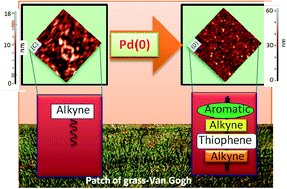
Fig. 1(C) and (D) show the atomic force microscope (AFM) pictures of the end alkyne functionalized silicon surface and the silicon surface after polymerization reaction respectively. In this case, the height of the monolayers is more than calculated value. The higher values were observed by other authors also for siloxane terminated monolayer and was attributed to several uncontrolled aggregation of siloxanes in solution.34 After polymerization, a dense pack of islands on surfaces were observed throughout the surfaces indicating a longitudinal grow of polymers typical for “graft-from” or “graft-through” polymerization techniques.35 This differs from a typical “graft-to” methods of immobilization of polymers where polymers collapse to coiled structures.36 Moreover, the resulting surface after polymerization had higher thickness than that of end alkyne monolayer and it showed approximately uniform coverage of an underlying substrate. However, thickness and roughness value increased with increase of polymerization reaction time. For example, as observed in Fig. S4, ESI the AFM image of polymer grafted silicon surface after performing the polymerization reaction for 24 h clearly showed a rougher surface with bigger islands of polymers and length scale of heights. In this case, a high value of root mean squire roughness of 33.4 nm with an amount of sampling of 25[thin space (1/6-em)]872 was observed. Similar effect of influence of time over the distribution of polymer was observed by others also.29 Fig. S5, ESI showed the distribution profiles of grafted polymer across the polymer functionalized silicon surface when the polymerization reaction was performed for 24 h. The curves further showed the rough surface with uniform nature of surface topography. The large value of surface height indicates a high value of chain length of the polymers. Further, even a more roughness and lack of uniformity was observed when reaction was performed on ITO surface. This may be attributed to the inherent rough nature of pristine ITO surface compared to silicon surface. Similar observation of roughness was observed for “click” polymerization on ITO surface also.13 However, in this case, an improvement of surface coverage was clearly observed by performing the polymerization reaction for longer time of 24 h (Fig. S1, B and C).

The success of polymerization was also evident from the characterization of the residual polymers in solution by NMR spectroscopy (Fig. 2 and S2, ESI). In this case, the disappearance of end alkyne proton peaks in 1H NMR (3.41 ppm) and the shift of thiophene protons to 7.70 ppm was observed. Further the peak at 82.6 ppm corresponding to 13C alkyne carbon of the reactant disappeared to generate two signals at 87.9 and 85.9 ppm.37 This may be attributed to the unsymmetrical nature of alkynes in the resulting polymer. As a control experiment, polymerization was attempted at cleaned empty surface (not functionalized), in a similar condition which did not yield the polymer functionalized surface as confirmed by ellipsometry, FT-IR, AFM and other studies.


image file: c4ra07053d-f2.tif
Fig. 2 1H (top) and 13C (bottom) NMR spectra of polymer. Inset: respective NMR of the reactants.

The polymerization method was extended on other surfaces such as ITO which are more useful for device fabrications.38 In a similar fashion, the self-assembled monolayers of azide followed by click reaction and further “graft-through” Sonogashira polymerization was performed using 2-ethynyl-5-(5-ethynylthiophen-2-yl)thiophene and 1,4-dibromo-2,5-bis(hexyloxy)benzene in the presence of Pd(0) catalyst system.

Fig. 3(A) shows the UV-vis spectra of the ITO surface after end alkyne functionalization (black curve) and polymerization (red curve), respectively. Absorption maxima (λmax) appeared at 414 nm for the polymer functionalized surfaces. This value is typical for a conjugated aromatic system. The band gap was 1.78 eV calculated from the Tauc plot from absorption data (Fig S7 ESI). This low band gap should be important for the designing of solar cell or molecular electronics materials. Similar UV-vis spectra were shown in reflection mode for polymer functionalized ITO surface (Fig. 3(B)).


image file: c4ra07053d-f3.tif
Fig. 3 (A) UV-vis absorbance spectra of ITO surfaces: alkyne functionalized (black) and polymer functionalized (red curve). (B) UV-vis spectra (reflection mode) on polymer functionalized ITO surfaces. (C) Current–voltage characteristics of the polymer grafted ITO surface in the fabricated device using aluminium as cathode in a sandwich structure. Inset: typical fabricated device using aluminium as cathode for this study (D) cyclic voltammogram of polymer functionalized ITO surface.

The devices were fabricated by using above mentioned polymer functionalized Indium Tin oxide (ITO) substrate (thickness 110 nm, 10 Ω square−1) followed by the deposition of aluminum as cathode at 10−5 torr (Fig. 3(C), inset) for charge carrier mobility study and IV characteristics. The current–voltage (IV) characteristics were measured using Keithley 2400 source meter respectively. Current–voltage (IV) characteristic curve (Fig. 3(C)) showed that the polymer had characteristics of a semiconducting polymer which is a clear indication of the surface functionalization by “graft-through” approach. Similar IV characteristic was observed when the ITO surface was spin coated with the similar polymer obtained in solution (Fig. S8, ESI). However, when control experiment was performed on ITO surface (polymerization in presence of pristine ITO without grafted alkyne) similar sandwich structure did not produce characteristic IV curve for semi conductive material (Fig. S9, ESI). Further the surface functionalized ITO substrates were studied for charge carrier mobility by Space Charge Limited Current (SCLC) method.39,40 The charge carrier mobilities of quenched polymer functionalized self assembled mono layer on ITO was found to be 1.23 × 10⁻⁶ cm2 V−1 S−1. The band structure of the device (Fig S3, ESI) indicated that the hole and electron injection barriers are 0.52 and 0.56 eV respectively. Hence, the mobility value corresponds to ambipolar mobility.

The surface bound conjugated polymers on ITO surface were also characterized via cyclic voltammetry (CV) (Fig. 3(D)) using Ag/AgCl as reference electrode to find the band gap, HOMO − LUMO energy levels. The equations:41 HOMO = −(jox + 4.71) and LUMO = −(jred + 4.71) was used to calculate the band gap. The oxidation process was observed at 1.07 V and onset of the reduction process was observed at −0.67 eV. Hence the corresponding HOMO and LUMO level was determined as −5.78 eV and −4.04 eV respectively. Thus the band gap (HOMO − LUMO gap) was calculated to be 1.74 eV, much lower than our previously reported polytriazole system.13

In conclusion, we demonstrated that “graft-through” Sonogashira polymerization can be used to functionalize various surfaces with conjugated thiophene-based polymers. The process is mild, requires only three-steps for getting an appreciable thickness of the polymer anchored on the surface. It is also superior to our previously reported click polymerization method in terms of continuous conjugation and lower band gap, determined from cyclic voltammeter studies and UV-vis spectroscopic studies. The fabricated device with functionalized ITO as anode and deposited aluminium as cathode showed an IV characteristic typical of a semiconducting material with moderate charge carrier mobility. The material further indicated that the methodology should be useful for the fabrication of conjugated polythiophene-based devices. We plan to pursue some of our research efforts in that direction.

Acknowledgements

We thank Dr A. Dhathathreyan of CLRI for assisting with AFM and contact angle data acquisition; Dr Chakravarty of IACS, Kolkata for assisting with XPS. Financial support from CSIR network project NWP54 is gratefully acknowledged. CSIR-CLRI communication no. 1101.

Notes and references

  1. G. Zotti, B. Vercelli and A. Berlin, Acc. Chem. Res., 2008, 41, 1098 CrossRef CAS PubMed.
  2. E. Hwang, K. M. N. de Silva, C. B. Seevers, J. R. Li, J. C. Garno and E. E. Nesterov, Langmuir, 2008, 24, 9700 CrossRef CAS PubMed.
  3. L. Yuan, Y. Wu, H. Shi and S. Liu, Chem.–Eur. J., 2011, 17, 976 CrossRef CAS PubMed.
  4. E. M. Benetti, C. Acikgoz, X. Sui, B. Vratzov, M. A. Hempenius, J. Huskens and G. J. Vancso, Adv. Funct. Mater., 2011, 21, 2088 CrossRef CAS.
  5. A. Ulman, Chem. Rev., 1996, 96, 1533 CrossRef CAS PubMed.
  6. L. Newton, T. Slater, N. Clark and A. Vijayaraghavan, J. Mater. Chem. C, 2013, 1, 376 RSC.
  7. G. E. Fryxell, P. C. Rieke, L. L. Wood, M. H. Engelhard, R. E. Williford, G. L. Graff, A. A. Campbell, R. J. Wiacek, L. Lee and A. Halverson, Langmuir, 1996, 12, 5064 CrossRef CAS.
  8. S. Herrwerth, T. Rosendahl, C. Feng, J. Fick, W. Eck, M. Himmelhaus, R. Dahint and M. Grunze, Langmuir, 2003, 19, 1880 CrossRef CAS.
  9. S. Srivastava, P. R. Solanki, A. Kaushik, M. A. Ali, A. Srivastava and B. D. Malhotra, Nanoscale, 2011, 3, 2971 RSC.
  10. M. I. Muglali, A. Bashir, A. Terfort and M. Rohwerder, Phys. Chem. Chem. Phys., 2011, 13, 15530 RSC.
  11. V. Chechik, R. M. Crooks and C. J. M. Stirling, Adv. Mater., 2000, 12, 1161 CrossRef CAS.
  12. D. Samanta and A. Sarkar, Chem. Soc. Rev., 2011, 40, 2567 RSC.
  13. D. Samanta, P. Murugan, S. J. Ananthakrishnan, N. Somanathan, S. K. Das, S. N. Jaisankar and A. B. Mandal, Chem. Commun., 2012, 48, 12068 RSC.
  14. J. P. Collman, N. K. Devaraj and C. E. D. Chidsey, Langmuir, 2004, 20, 1051 CrossRef CAS PubMed.
  15. C. D. Grande, M. C. Tria, M. J. Felipe, F. Zuluaga and R. Advincula, Eur. Phys. J. E, 2011, 34, 15 CrossRef PubMed.
  16. M. Beinhoff, A. T. Appapillai, L. D. Underwood, J. E. Frommer and K. R. Carter, Langmuir, 2006, 22, 2411 CrossRef CAS PubMed.
  17. T. Higashihara and M. Ueda, Macromol. Res., 2013, 21, 257 CrossRef CAS.
  18. C. Li and G. Shi, ACS Appl. Mater. Interfaces, 2013, 5, 4503 CAS.
  19. A. Mishra, C. Q. Ma and P. Baeuerle, Chem. Rev., 2009, 109, 1141 CrossRef CAS PubMed.
  20. R. Chinchilla and C. Najera, Chem. Rev., 2007, 107, 874 CrossRef CAS PubMed.
  21. Y. J. Cheng, S. H. Yang and C. S. Hsu, Chem. Rev., 2009, 109, 5868 CrossRef CAS PubMed.
  22. X. Zhan and D. Zhu, Polym. Chem., 2010, 1, 409 RSC.
  23. W. Y. Wong and C. L. Ho, Acc. Chem. Res., 2010, 43, 1246 CrossRef CAS PubMed.
  24. X. Huang, C. Zhu, S. Zhang, W. Li, Y. Guo, X. Zhan, Y. Liu and Z. Bo, Macromolecules, 2008, 41, 6895 CrossRef CAS.
  25. A. Marrocchi, F. Silvestri, M. Seri, A. Facchetti, A. Taticchia and T. J. Marks, Chem. Commun., 2009, 1380 RSC.
  26. R. Chinchilla and C. Najera, Chem. Soc. Rev., 2011, 40, 5084 RSC.
  27. J. Lewis, N. J. Long, P. R. Raithby, G. P. Shields, W. Y. Wong and M. Younus, J. Chem. Soc., Dalton Trans., 1997, 4283 RSC.
  28. B. Liu, Y. Bao, F. Du, H. Wang, J. Tian and R. Bai, Chem. Commun., 2011, 47, 1731 RSC.
  29. P. Paoprasert, J. W. Spalenka, D. L. Peterson, R. E. Ruther, R. J. Hamers, P. G. Evans and P. Gopalan, J. Mater. Chem., 2010, 20, 2651 RSC.
  30. C. Haensch, S. Hoeppener and U. S. Schubert, Chem. Soc. Rev., 2010, 39, 2323 RSC.
  31. M. Juricek, P. H. J. Kouwer and A. E. Rowan, Chem. Commun., 2011, 47, 8740 RSC.
  32. J. Terao, K. Kimura, S. Seki, T. Fujihara and Y. Tsuji, Chem. Commun., 2012, 48, 1577 RSC.
  33. NIST X-ray Photoelectron Spectroscopy Database, srdata.nist.gov/xps, (Accessed July 2014).
  34. S. B. Jhaveri, J. J. Peterson and K. R. Carter, Langmuir, 2009, 25, 9552 CrossRef CAS PubMed.
  35. E. Hwang, K. L. Lusker, J. C. Garno, Y. Losovyj and E. E. Nesterov, Chem. Commun., 2011, 47, 11990 RSC.
  36. J. Rahe, in Polymer Brushes, Wiley-VCH Verlag GmbH & Co, KGaA, 2005, p. 1 Search PubMed.
  37. S. Reimann, K. Wittler, S. Schmode, M. Sharif, T. Fahrenwaldt, R. Ludwig, A. Spannenberg and P. Langer, Eur. J. Org. Chem., 2013, 2013, 8115 CrossRef CAS.
  38. C. M. Bowers, A. A. Shestopalov, R. L. Clark and E. J. Toone, ACS Appl. Mater. Interfaces, 2012, 4, 3932 CAS.
  39. G. Schwartz, M. Pfeiffer, S. Reineke, K. Walzer and K. Leo, Adv. Mater., 2007, 19, 3672 CrossRef CAS.
  40. C. Goh, R. J. Kline, M. D. McGehee, E. N. Kadnikova and J. M. J. Frechet, Appl. Phys. Lett., 2005, 86 Search PubMed.
  41. J. H. Hou, Z. A. Tan, Y. Yan, Y. J. He, C. H. Yang and Y. F. Li, J. Am. Chem. Soc., 2006, 128, 4911 CrossRef CAS PubMed.

Footnotes

Electronic supplementary information (ESI) available: Experimental procedure and instrument details and various characterization data. See DOI: 10.1039/c4ra07053d
Typical procedure for Sonogashira polymerization: we took hot and cleaned 10 ml 2 neck round bottom flask, degassed with N2 gas and added alkyne-functionalized ITO surface, freshly distilled 10 ml diisopropylamine. After that, we added 2-ethynyl-5-(5-ethynylthiophen-2-yl)thiophene [25 mg, 0.116 mmol], 1,4-dibromo-2,5-bis(hexyloxy)benzene [43 mg, 0.10 mmol], CuI [5 mg, 0.026 mmol], palladium(II) acetate [5 mg, 0.022 mmol] and triphenylphosphine [15 mg, 0.057 mmol]. After that the reaction mixture was heated at 75 °C for 12 or 24 h. Then, we added 0.1 ml of ethynyltrimethylsilane, and refluxed for another 12 h. The ITO plate was taken out and washed with CHCl3, toluene, H2O, acetone, ethanol [each one 15 minutes] in a sonicator, dried over by N2 atm.

This journal is © The Royal Society of Chemistry 2015
Click here to see how this site uses Cookies. View our privacy policy here.