DOI:
10.1039/C4RA13342K
(Paper)
RSC Adv., 2014,
4, 63137-63142
Thermoelectric properties for AA- and AB-stacking of a carbon nitride polymorph (C3N4)
Received
28th October 2014
, Accepted 6th November 2014
First published on 7th November 2014
Abstract
The transport properties, and electronic structure, for C3N4 were investigated, and it was found that the valence band maximum (VBM) and the conduction band minimum (CBM) of AA-stacking of C3N4 are located at the A point of the Brillouin zone (BZ), resulting in a direct band gap of approximately 0.69 eV (LDA), 0.870 eV (GGA), 1.237 eV (EV-GGA), and 2.589 eV (mBJ). For AB-stacking, the VBM and the CBM are situated at the Γ point of the BZ, maintaining a direct band gap of approximately 1.204 eV (LDA), 1.357 eV (GGA), 1.680 eV (EV-GGA), and 2.990 eV (mBJ). The calculated electronic band structure was used to determine the thermoelectric properties such as electrical conductivity (σ/τ), electronic thermal conductivity (κe/τ), Seebeck coefficient (S), power factor (P), and figure of merit (ZT) using the semi-classical Boltzmann theory as incorporated in the BoltzTraP code. The maximum values of σ for AA-stacking are 3.4 × 10²⁰ (Ω m s)−1 and 1.05 × 10²⁰ (Ω m s)−1, which are achieved at ±0.17 μ(eV) for p-type and n-type materials at 300 and 600 K, respectively. For AB-stacking, the maximum values are 3.8 × 10²⁰ and 3.7 × 10²⁰ (Ω m s)−1 at 300 and 600 K for p-type, whereas they are 2.8 × 10²⁰ (Ω m s)−1 at 300 and 600 K for n-type; these values are achieved at ±0.2 μ(eV) for p-type and n-type. One can see that AA-stacking exhibits the highest S values of approximately 99.0 (μV K−1) for p-type and 98.0 (μV K−1) for n-type, while AB-stacking exhibits the maximum S values of approximately 270 (μV K−1) for p-type and 280 (μV K−1) for n-type. The critical points of S for p-type and n-type are ±0.03 μ(eV) and ±0.08 μ(eV) for AA- and AB-stacking of C3N4, respectively. The values of the critical points are the range where AA- and AB-stacking of C3N4 is expected to exhibit good thermoelectric properties, and beyond these critical points, S is zero. AA-stacking shows the minimum values of the κe between ±0.03 μ(eV), while they are ±0.08 μ(eV) for AB-stacking. Therefore, in these regions, AA- and AB-stacking are expected to exhibit maximum efficiency. The highest peaks of ZT (equal to unity) are confined between ±0.05 μ(eV) for AA-stacking and ±0.1 μ(eV) for AB-stacking.
1. Introduction
Carbon nitride is a promising candidate for various technological applications.1–7 It is chemically stable with good thermal hardness and astonishing optical characteristics that make it suitable for solar cells, fuel cell electrodes,8,9 chemical sensors,10–12 LED materials, and photocatalysts under visible light.13,14 Due to the exceptional physical properties of carbon nitride, research is currently ongoing to investigate its synthesis, electronic structure, elastic hardness, and linear and nonlinear optical properties.15–21 A first principles pseudopotential calculation for the structure and physical properties predicts a cubic form of C3N4 with a zero pressure bulk modulus exceeding that of diamond.4 The calculated bulk modulus (189 GPa) of α-C3N4 shows that the hardness is approximately half that of diamond, and the negative Poisson ratio leads to novel applications.20
Wang et al.17 reported that g-C3N4 is a metal-free photocatalyst that can absorb light in the visible spectrum. Holst and Gillan19 confirmed that C3N4 can be used as a novel photoactive material. Another study confirmed that β-C3N4 possesses hardness greater than diamond.5 Due to the large surface area of g-C3N4, which includes more active sites for reactions, the electrochemical properties confirm that it is highly suitable as a photocatalyst and supercapacitor for energy storage purposes and environmental protection applications.18 The electronic band structure of β-C3N4 was calculated by Corkill and Cohen21 and was found to be in good agreement with previous theoretical calculations.5 The energy band gap of β-C3N4 linearly increases with pressure,22 and anharmonic phonons play a principal role near the Fermi level.23
We recently investigated the electronic structure and linear and nonlinear optical properties of C3N4 (ref. 15 and 16) by performing comprehensive experimental and theoretical work. Our current study investigates the transport properties of C3N4 by means of Boltztrap theory based on electronic band structure calculations to elucidate the electronic structure and optical properties of this important material.
2. Crystal structure and computational detail
AA- and AB-stacking of C3N4 is arranged so that crystallization occurs in the hexagonal space group P
m2 (ref. 4) (Fig. 1a and b). We have employed the state-of-the-art full-potential augmented plane wave plus local orbitals (FP-APW + lo) based on density functional theory (DFT) within the framework of WIEN2k code24 to calculate the electron structure of AA- and AB-stacking of C3N4. The exchange correlation potential was treated within the Ceperley–Alder local density approximation (LDA-CA),25 the Perdew Burke and Ernzerhof generalized gradient approximation (GGA-PBE),26 the Engle–Vosko generalized gradient approximation (EV-GGA),27 and the modified Becke–Johnson (mBJ) approximation.28 The mBJ allows the calculation of band gaps with accuracy similar to very expensive GW calculations.28 To achieve accurate self consistency, the wave function in the interstitial regions was expanded in plane waves with cutoff RMTKmax = 7.0, where RMT and Kmax denote the muffin-tin sphere radius and magnitude of the largest k vector in-plane wave expansion, respectively. The RMT of C and N for AA- and AB-stacking was chosen to be 1.24 atomic units (a.u.). The wave function inside the sphere was expanded up to lmax = 10, and the Fourier expansion of the charge density up to Gmax = 12 (a.u.)−1. The self-consistent calculations were converged, and the difference in total energy of the crystal did not exceed 10−5 Ryd for successive steps. Self-consistency was obtained using 700 k points in the irreducible Brillouin zone (IBZ). Based on the calculated electronic structure we have used, the semi-classical Boltzmann theory as incorporated in BoltzTraP code29 was used to calculate the thermoelectric properties such as electrical conductivity (σ/τ), electronic thermal conductivity (κe/τ), Seebeck coefficient (S), power factor (P), and figure of merit (ZT). A compilation of 5000 k points in the irreducible Brillouin zone (IBZ) was used to calculate the thermoelectric properties.
 |
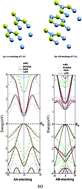
| | Fig. 1 (a) The crystal structure of AA-stacking of C3N4; (b) the crystal structure of AB-stacking of C3N4; (c) the calculated electronic band structure for AA-stacking and AB-stacking of C3N4. | |
3. Results and discussion
3.1. Salient features of the electronic band structures
The calculated electronic band structures of AA- and AB-stacking of C3N4,15,16 which are illustrated in Fig. 1c, suggest that for AA-stacking, the valence band maximum (VBM) and the conduction band minimum (CBM) are located at the A point of the BZ, resulting in a direct band gap of approximately 0.69 eV (LDA), 0.870 eV (GGA), 1.237 eV (EV-GGA), and 2.589 eV (mBJ). For AB-stacking, the VBM and the CBM are situated at the Γ point of BZ, maintaining a direct band gap of approximately 1.204 eV (LDA), 1.357 eV (GGA), 1.680 eV (EV-GGA), and 2.990 eV (mBJ). From the calculated electronic band structures, we obtained the values of the effective mass ratio for electrons (m*e/me), heavy holes (m*hh/me), and light holes (m*lh/me). These values are listed in Table 1.
Table 1 The calculated electron effective mass ratio (m*e/me) and effective mass of the heavy holes (m*hh/me) and light holes (m*lh/me), around the A point for AA- and the Γ point for AB-stacking of C3N4
| Compound |
m*e/me |
m*hh/me |
m*lh/me |
| AA-stacking |
0.02384 |
0.13460 |
0.03978 |
| AB-stacking |
0.02730 |
0.03770 |
0.00985 |
The dispersion of the band structure was characterized by effective masses of electrons and holes calculated from the second derivative of energy with respect to the k-vector at the CBM and VBM, respectively. Fig. 1c exhibits less dispersive VBs, which would imply a larger effective mass for the carriers belonging to the VBs, and hence a high S. However, the presence of carriers with large mobility (η) is required to obtain a higher electrical conductivity (σ/τ). The thermoelectric power factor (S2σ/τ) is indirectly related to the effective mass through σ = ne(ηe + ηh), where ηe = eτe/m*e and ηh = eτh/m*h,30 and where ηe and ηh are the mobility of the electrons and holes, respectively. Therefore, the thermoelectric power factor can be improved if the effective mass is increased, because the gain in S is larger than the decrease in the η.31 The main factors to determine the transport properties are the effective charge-carrier's mass, and the S and σ/τ of the materials. The value ηe characterizes how quickly an electron can move through a metal or semiconductor.
3.2. Transport properties
3.2.1. Electrical conductivity. When thermoelectric materials are exposed to heat, the electrons migrate to the colder side and increase their kinetic energy, resulting in a flow of electrons that forms an electric current. Therefore, the charge carriers gain high mobility, and this will lead to high electrical conductivity according to σ = neη. Following this relation, it is clear that the electrical conductivity is directly proportional to the charge carrier (electrons and holes) density (n) and its mobility (ηe = eτe/m*e andηh = eτh/m*h). We see that the effective mass for electrons and holes greatly influences the mobility of the charge carriers, as carriers with small effective masses possess high mobility. The electrical conductivity of AA- and AB-stacking as a function of chemical potential at two constant temperatures (300 and 600 K) is illustrated in Fig. 2a and b. One can see that increasing the temperature has no significant influence on the electrical conductivity. The chemical potential's critical points for the electrical conductivity in the p-type and n-type region of AA-stacking are ±0.02 μ(eV) and for AB-stacking are ±0.06 μ(eV), respectively. Beyond these points are the best thermoelectric properties for AA- and AB-stacking. The maximum values of the electrical conductivity for AA-stacking are 3.4 × 10²⁰ (Ω m s)−1 and 1.05 × 10²⁰ (Ω m s)−1, and they are achieved at ±0.17 μ(eV) for p-type and n-type. For AB-stacking, the maximum values are 3.8 × 10²⁰ and 3.7 × 10²⁰ (Ω m s)−1 at 300 and 600 K for p-type, whereas it is 2.8 × 10²⁰ (Ω m s)−1 at 300 and 600 K for n-type, and these values are achieved at ±0.2 μ(eV) for p-type and n-type. In Table 2, we have listed the maximum values of the electrical conductivity at 300 and 600 K and the chemical potential between ±0.17 μ(eV) and ±0.2 μ(eV) for AA- and AB-stacking of C3N4.
 |
| | Fig. 2 The calculated transport properties as a function of chemical potential at two constant temperatures 300 and 600 K for AA-stacking and AB-stacking of C3N4; (a and b) electrical conductivity; (c and d) Seebeck coefficient; (e and f) electronic thermal conductivity; (g and h) power factor; (i and j) figure of merit. | |
Table 2 The maximum values of the electrical conductivity at ±0.17 μ(eV) and ±0.2 μ(eV) for AA- and AB-stacking of C3N4
| Temp. |
AA-stacking |
AB-stacking |
| p-Type (×1020) (Ω m s)−1 |
n-Type (×1020) (Ω m s)−1 |
p-Type (×1020) (Ω m s)−1 |
n-Type (×1020) (Ω m s)−1 |
| 300 K |
3.4 |
1.05 |
3.8 |
2.8 |
| 600 K |
3.4 |
1.05 |
3.7 |
2.8 |
3.2.2. Seebeck coefficient. The Seebeck coefficient (S), also called thermopower, is related to the electronic structure of the materials. The Seebeck coefficient is the magnitude of an induced thermoelectric voltage as a response to the temperature gradient inside the material. The Seebeck coefficient can be positive or negative, and therefore, the sign indicates the type of dominant charge carrier; +S represents p-type materials, i.e., positive charge carriers (holes), while n-type materials are denoted by −S. In Fig. 2c and d, we present the Seebeck coefficient for AA- and AB-stacking of C3N4 as a function of chemical potential at constant temperatures (300 and 600 K). It is clear that at the vicinity of the Fermi level, there are two pronounced peaks that represent the Seebeck coefficient for n-/p-types of AA- and AB-stacking of C3N4. One can see that AA-stacking exhibits the highest values of approximately 99.0 (μV K−1) for p-type and 98.0 (μV K−1) for n-type charge carriers, while AB-stacking exhibits the maximum values of approximately 270 (μV K−1) for p-type and 280 (μV K−1) for n-type materials. The critical points of the Seebeck coefficient for p-type and n-type charge carriers are ±0.03 μ(eV) and ±0.08 μ(eV) for AA- and AB-stacking of C3N4, respectively. The values of the critical points are the range where AA- and AB-stacking of C3N4 expected to exhibit good thermoelectric properties, and beyond these critical points, the Seebeck coefficient is zero. In Table 3, we have listed the maximum values of the Seebeck coefficient at 300 and 600 K at the critical points for p-type (±0.03 μ(eV)) and n-type (±0.08 μ(eV)) for AA- and AB-stacking of C3N4, respectively.
Table 3 The maximum values of the Seebeck coefficient at the critical points for p-type and n-type are ±0.03 μ(eV) and ±0.08 μ(eV) for AA- and AB-stacking of C3N4, respectively
| Temp. |
AA-stacking |
AB-stacking |
| p-Type (μV K−1) |
n-Type (μV K−1) |
p-Type (μV K−1) |
n-Type (μV K−1) |
| 300 K |
99.0 |
98.0 |
270.0 |
280.0 |
| 600 K |
50.0 |
45.0 |
110.0 |
110.0 |
3.2.3. Electronic thermal conductivity. The best thermoelectric materials are the materials that possess low thermal conductivity. Thermal conductivity usually consists of two parts – the electronic part (ke), in which the electrons and holes are responsible for transporting heat, and the phonon part (kl), where the phonons travel through the lattice. We should emphasize that BoltzTraP code calculates only the electronic part, i.e., only ke. Fig. 2e and f represents the electronic thermal conductivity of AA- and AB- stacking of C3N4 for two constant temperatures as a function of chemical potentials. AA-stacking shows that for the chemical potential between ±0.03 μ(eV) at 300 K, the materials exhibit the minimum value of electronic thermal conductivity, while for 600 K, the value of the electronic thermal conductivity increases with reduction of the chemical potential range of ±0.02 μ(eV). Therefore, in these regions, the AA-stacking is expected to exhibit maximum efficiency, while for AB-stacking at 300 and 600 K and in the ±0.08 and ±0.05 μ(eV) regions, the material exhibits the lowest electronic thermal conductivity, and hence, the maximum efficiency. In Table 4, we have listed the values of the electronic thermal conductivity for p-type and n-type AA- and AB-stacking of C3N4 at 300 and 600 K, which show that the thermal conductivity of the p-type has higher values than the n-type.
Table 4 The maximum values of the electronic thermal conductivity at ±0.17 μ(eV) and ±0.2 μ(eV) for AA- and AB-stacking of C3N4
| Temp. |
AA-stacking |
AB-stacking |
| p-Type (×1015) (W km−1 s−1) |
n-Type (×1015) (W km−1 s−1) |
p-Type (×1015) (W km−1 s−1) |
n-Type (×1015) (W km−1 s−1) |
| 300 K |
2.5 |
0.7 |
2.7 |
2.0 |
| 600 K |
5.0 |
1.6 |
5.1 |
4.0 |
3.2.4. Power factor. The power factor (P = S2σ) comes as a numerator in the figure of merit relation (ZT = S2σT/κe), and therefore, it is important for calculating the transport properties of materials. We have calculated the power factor at two constant temperatures (300 and 600 K) vs. the chemical potential between ±0.17 μ(eV) and ±0.2 μ(eV) for AA- and AB-stacking of C3N4, respectively, as illustrated in Fig. 2g and h. At approximately 0.0 μ(eV), the power factor is zero and is attributed to the value of σ, which is zero in this region; beyond that, the power factor rapidly increases. In the vicinity of 0.0 μ(eV), there are two pronounced peaks for the p- and n-type of both materials. These peaks are located at ±0.02 μ(eV) for AA-stacking and approximately ±0.5 μ(eV) for AB-stacking. It is clear that AB-stacking exhibits a very high peak in the p-type region at approximately −0.18 μ(eV). This is due to the fact that both S and σ represent some structures in this region, as the power factor is the square value of S, and hence, the power factor exhibits very high peaks.
3.2.5. Figure of merit. Promising thermoelectric materials for thermoelectric applications must possess low κ and high S2σ at the temperature range of interest. The figure of merit is written as ZT = S2σT/κe, which is directly proportional to S2 and σ, and inversely proportional to κe. In Fig. 2i and j, we illustrated ZT as a function of chemical potential for AA- and AB-stacking of C3N4 at two constant temperatures (300 and 600 K). For the p-/n-type of both AA- and AB-stacking, ZT is equal to unity. The highest peaks of ZT are confined between ±0.05 μ(eV) for AA-stacking and ±0.1 μ(eV) for AB-stacking, which confirm our previous finding that these are the regions where AA- and AB-stacking exhibit the highest efficiency for these materials. That is due to the fact that at this region, S exhibits the highest value and κe/τ remains at the minimum value. Beyond ±0.1 μ(eV), the p-type AB-stacking represents a peak of approximately 0.62 at −0.18 μ(eV) for 600 K and 0.4 at −0.19 μ(eV) for 300 K. The maximum efficiency of thermoelectric materials for both power generation and cooling is determined by its ZT. It was previously demonstrated that materials possessing a ZT at approximately unity or greater than unity are considered to be promising candidates for thermoelectric devices.32,33 Tables 1–4 summarize the mechanism of the difference in thermoelectric properties of AA- and AB-stacking of C3N4.
4. Conclusions
The state-of-the-art full-potential augmented plane wave plus local orbitals (FP-APW + lo) based on density functional theory (DFT) within the framework of WIEN2k code was used to calculate the electron structure of AA- and AB-stacking of C3N4. The exchange correlation potential was treated within the Ceperley–Alder local density approximation (LDA-CA), the Perdew Burke and Ernzerhof generalized gradient approximation (GGA-PBE), the Engle–Vosko generalized gradient approximation (EV-GGA), and the modified Becke–Johnson (mBJ) approximation. The calculated electronic band structures of AA-stacking show that the VBM and CBM are located at the A point of the Brillouin zone, resulting in a direct band gap of approximately 0.69 eV (LDA), 0.870 eV (GGA), 1.237 eV (EV-GGA), and 2.589 eV (mBJ). The VBM and CBM of AA-stacking are situated at the Γ point of the BZ, maintaining a direct band gap of approximately 1.204 eV (LDA), 1.357 eV (GGA), 1.680 eV (EV-GGA), and 2.990 eV (mBJ). We have used semi-classical Boltzmann theory as incorporated in the BoltzTraP code to calculate the thermoelectric properties based on the electronic band structure calculation. AA-stacking exhibits maximum values of electrical conductivity of approximately 3.4 × 10²⁰ (Ω m s)−1 and 1.05 × 10²⁰ (Ω m s)−1; these values are achieved at ±0.17 μ(eV) for p-type and n-type charge carriers. For AB-stacking, the maximum values are 3.8 × 10²⁰ and 3.7 × 10²⁰ (Ω m s)−1 at 300 and 600 K for p-type, whereas it is 2.8 × 10²⁰ (Ω m s)−1 for n-type, which are achieved at ±0.2 μ(eV) for p-type and n-type. The AA-stacking exhibits the highest values of Seebeck coefficients of approximately 99.0 (μV K−1) for p-type and 98.0 (μV K−1) for n-type charge carriers. AB-stacking exhibits the maximum values of approximately 270 (μVK−1) for p-type and 280 (μV K−1) for n-type charge carriers. The critical points of the Seebeck coefficient for p-type and n-type are ±0.03 μ(eV) and ±0.08 μ(eV) for AA- and AB-stacking of C3N4, respectively. The values of the critical points are the range where AA- and AB-stacking of C3N4 exhibit good thermoelectric properties, and beyond these critical points, the Seebeck coefficient is zero. AA-stacking shows that the minimum values of the electric thermal conductivity are between ±0.03 μ(eV), and for AB-stacking, between ±0.08 μ(eV). Therefore, in these regions, AA- and AB-stacking exhibit maximum efficiency. The highest peaks of ZT (equal to unity) are confined between ±0.05 μ(eV) for AA-stacking and ±0.1 μ(eV) for AB-stacking. Tables 1–4 summarize the mechanism of the difference in thermoelectric properties for AA- and AB-stacking of C3N4.
Acknowledgements
This research was developed within the CENTEM project, reg. no. CZ.1.05/2.1.00/03.0088, co-funded by the ERDF as part of the Ministry of Education, Youth and Sports OP RDI program. Computational resources were provided by MetaCentrum (LM2010005) and CERIT-SC (CZ.1.05/3.2.00/08.0144) infrastructures.
References
- E. Kroke and M. Schwarz, Coord. Chem. Rev., 2004, 248, 493 CrossRef CAS PubMed.
- M. H. V. Huynh, M. A. Hiskey, J. G. Archuleta and E. L. Roemer, Angew. Chem., Int. Ed., 2004, 43, 5658 CrossRef CAS PubMed; M. H. V. Huynh, M. A. Hiskey, J. G. Archuleta and E. L. Roemer, Angew. Chem., Int. Ed., 2005, 44, 737 CrossRef PubMed.
- L. C. Ming, P. Zinin, Y. Meng, X. R. Liu, S. M. Hong and Y. Xie, J. Appl. Phys., 2006, 99, 033520 CrossRef PubMed.
- D. M. Teter and R. J. Hemley, Science, 1996, 271, 53 CAS.
- A. Y. Liu and M. L. Cohen, Science, 1989, 245, 841 Search PubMed; A. Y. Liu and M. L. Cohen, Phys. Rev. B: Condens. Matter Mater. Phys., 1990, 41, 10727 CrossRef CAS.
- Q. Lv, C. B. Cao, C. Li, J. T. Zhang, H. S. Zhu, X. Kong and X. F. Duan, J. Mater. Chem., 2003, 13, 1241 RSC.
- D. R. Miller, D. C. Swenson and E. G. Gillan, J. Am. Chem. Soc., 2004, 126, 5372 CrossRef CAS PubMed.
- H. Pan, A first-principles study, J. Phys. Chem. C, 2014, 118, 9318–9323 CAS.
- Y. Zheng, J. Liu, J. Liang, M. Jaroniec and S. Z. Qiao, Energy Environ. Sci., 2012, 5, 6717–6731 CAS.
- Y. Liu, Q. Wang, J. Lei, Q. Hao, W. Wang and H. Ju, Talanta, 2014, 122, 130–134 CrossRef CAS PubMed.
- T. Y. Ma, Y. Tang, S. Dai and S. Z. Qiao, Small, 2014, 10, 2382–2389 CrossRef CAS PubMed.
- L. Chen, X. Zeng, P. Si, Y. Chen, Y. Chi, D. H. Kim and G. Chen, Anal. Chem., 2014, 86, 4188–4195 CrossRef CAS PubMed.
- D. Wang, H. Sun, Q. Luo, X. Yang and R. Yin, Appl. Catal., B, 2014, 156–157, 323–330 CrossRef CAS PubMed.
- H. Zhang and A. Yu, J. Phys. Chem. C, 2014, 118, 11628–11635 Search PubMed.
- A. H. Reshak, S. Ayaz Khan and S. Auluck, RSC Adv., 2014, 4, 11967 RSC.
- A. H. Reshak, S. Ayaz Khan and S. Auluck, RSC Adv., 2014, 4, 6957–6964 RSC.
- X. C. Wang, K. Maeda, A. Thomas, K. Takanabe, G. Xin, J. M. Carlsson, K. Domen and M. Antonietti, Nat. Mater., 2009, 8, 76 CrossRef CAS PubMed.
- M. Tahir, C. Cao, F. K. Butt, F. Idrees, N. Mahmood, I. Aslam, Z. Ali, M. Tanvir, M. Rizwan and T. Mahmood, J. Mater. Chem. A, 2013, 1, 13949 CAS.
- J. R. Holst and E. G. Gillan, J. Am. Chem. Soc., 2008, 130, 7373 CrossRef CAS PubMed.
- Y. Guo and W. A. Goddard, Chem. Phys. Lett., 1995, 237, 72 CrossRef CAS.
- J. L. Corkill and M. L. Cohen, Phys. Rev. B: Condens. Matter Mater. Phys., 1993, 48, 17622 CrossRef CAS.
- H. Yao and W. Y. Ching, Phys. Rev. B: Condens. Matter Mater. Phys., 1994, 50, 11231 CrossRef CAS.
- K. Nouneh, I. V. Kityk, R. Viennois, S. Benet, S. Charar, S. Malynych and S. Paschen, Mater. Lett., 2007, 61, 1142–1145 CrossRef CAS PubMed.
- P. Blaha, K. Schwarz, G. K. H. Madsen, D. Kvasnicka and J. Luitz, WIEN2k, An augmented plane wave plus local orbitals program for calculating crystal properties, Vienna University of Technology, Austria, 2001 Search PubMed.
- D. M. Ceperley and B. I. Alder, Phys. Rev. Lett., 1980, 45, 566 CrossRef CAS.
- J. P. Perdew, K. Burke and M. Ernzerhof, Phys. Rev. Lett., 1996, 77, 3865 CrossRef CAS.
- E. Engel and S. H. Vosko, Phys. Rev. B: Condens. Matter Mater. Phys., 1993, 47, 13164 CrossRef CAS.
- F. Tran and P. Blaha, Phys. Rev. Lett., 2009, 102, 226401 CrossRef.
- G. K. H. Madsen and D. J. Singh, BoltzTraP, Comput. Phys. Commun., 2006, 175, 67–71 CrossRef CAS PubMed.
- W. Shi, J. Chen, J. Xi, D. Wang and Z. Shuai, Chem. Mater., 2014, 26, 2669 CrossRef CAS.
- W. Wunderlich, H. Ohta and K. Koumotoa, Phys. B, 2009, 404, 2202 CrossRef CAS PubMed.
- O. Rabin, L. Yu-Ming and M. S. Dresselhaus, Appl. Phys. Lett., 2001, 79, 81–83 CrossRef PubMed.
- T. Takeuchi, Mater. Trans., 2009, 50, 2359–2365 CrossRef CAS.
|
| This journal is © The Royal Society of Chemistry 2014 |
Click here to see how this site uses Cookies. View our privacy policy here.