DOI:
10.1039/C4RA13259A
(Paper)
RSC Adv., 2014,
4, 64688-64691
Antimicrobial effects of silver deposited on nanolayered manganese oxide
Received
27th October 2014
, Accepted 20th November 2014
First published on 21st November 2014
Abstract
Silver deposited on layered manganese oxide was synthesized by a simple method, and characterized by scanning electron microscopy, transmission electron microscopy, X-ray photoelectron spectroscopy, X-ray diffraction spectrometry, atomic absorption spectroscopy, and energy-dispersive X-ray mapping. In the next step, antimicrobial effects of the compound for Escherichia coli and Staphylococcus aureus were considered.
Introduction
The inhibitory and bactericidal effects of Ag and Ag compounds have been known for many years.1 Many groups reported the antimicrobial effects of Ag-containing dressings,2 textiles,3 films,4 composite coatings,5 and dendrimers6 on as many as 12 species of bacteria including Escherichia coli. The mechanism of the effect of Ag on these bacteria is not known, but different groups proposed that Ag(I) has effect on uncouple the respiratory chain from oxidative phosphorylation,7 collapse the proton-motive force across the cytoplasmic membrane,8 interact with thiol groups of membrane-bound enzymes and proteins,9 and interaction with nucleic acids.10a
Ag in very low concentration is not toxic to human cells.10b Thus, it can be considered an environmentally friendly antimicrobial compound. Ag nanoparticles are new forms of bactericidal Ag-based compounds, and there are many reports to show antimicrobial activity of Ag nanoparticles.11–16 The mechanism of antimicrobial activity of Ag nanoparticles is not known, but two hypothesizes are presented. Some groups suggested that Ag could release Ag(I) from its surface, and the ion can interact with the cellular targets,11–13 in this case, Ag nanoparticles have high surface, and can release more Ag(I). On the other hand, other groups reported evidences that the antibacterial effect of Ag nanoparticles may arise from the direct effect of these nanoparticles.14–16
It is interesting that Nature uses Mn oxides to control heavy metals and other trace elements in soils and aquatic sediments.17,18 Layered Mn oxides are a kind of ubiquitous hydrous-layered Mn oxide in geological environments.19 The compound could be used to remove heavy metal ions (Pb(II), Cd(II), As(III), Cr(III) and etc.) from water systems.20 Thus, we combine antibacterial activity of Ag, and the activity of layered Mn oxide to remove heavy metal ions to obtain one compound.
Experimental
Material and methods
All reagents and solvents were purchased from Merck or Sigma-Aldrich, and were used without further purification.
Synthesis
Synthesis of nanolayered Mn oxide. It was synthesized by a previously reported method:21,22Solution 1: Mn(CH3COO)2·2H2O (2.77 mmol, 692.0 mg) was dissolved in the smallest possible amount of water.
Solution 2: to a solution of KMnO4 (2.00 mmol, 316.0 mg) in 35 mL water contains KOH (40.0, 20.0, 10.0 g).
Addition of solution 1 to solution 2 under vigorous stirring resulted in a dark brown precipitate. The obtained suspension was filtered and washed using distilled water (1.0 L) before being allowed to dry for 12 h at 60 °C in an oven.
Synthesis of silver deposited on nanolayered Mn oxide. It was synthesized by a previously reported method.21,22 100.0 mg of the layered Mn oxide was added to a solution contains AgNO3 (10 mL, 60 mg), and the mixture was stirred for 2 h. The solid was washed once with water, and dried at 300 °C.
Characterization
SEM was carried out with LEO 1430VP. The X-ray powder patterns were recorded with a Bruker D8 ADVANCE diffractometer (CuKα radiation). Mn atomic absorption spectroscopy (AAS) was performed on an Atomic Absorption Spectrometer Varian Spectr AA 110. Prior to analysis, each oxide (2.0 mg of oxide) was added to 1 mL of concentrated nitric acid and H2O2, and left at room temperature for at least 1 h to ensure that the oxide was completely dissolved. The solutions were then diluted and analyzed by AAS.
Cell preparation
The bactericidal activities were considered against Escherichia coli (ATCC 25922) (Gram-negative) and Staphylococcus aureus (ATCC 25923) (Gram-positive bacteria). All the samples and glassware were sterilized by autoclaving at 120 °C for 10 min before the experiments. In our procedure, both of bacteria were grown in LB Luria Bertani medium at 37 °C, and harvested in the mid-exponential growth phase. Cultures were centrifuged at 6000 rpm for 10 min to pellet cells, and cells were washed three times with isotonic saline solution to remove residual macromolecules, and other growth medium constituents. The pellets were then resuspended in isotonic saline solution. Bacterial cell suspensions were diluted to obtain cell samples containing 106 to 107 CFU per mL.23,24
Cell viability test
Escherichia coli and Staphylococcus aureus cells were incubated with nanolayered Mn oxide, and Ag deposited on nanolayered Mn oxide dispersions in isotonic saline solutions at 37 °C under 250 rpm shaking speed for reported time. The survival of bacterial of Escherichia coli and Staphylococcus aureus cells were tested by colony counting method. Briefly, series of 10-fold cell dilutions (100 μL each) were spread onto Luria Bertani plates, and left to grow overnight at 37 °C. Colonies were counted and compared with those on control plates to calculate changes in the cell growth inhibition. Isotonic saline solution without Mn oxide-based compounds was used as control. All treatments were prepared in duplicate, and repeated at least on three separate occasions.23,24
Results and discussion
SEM images for nanolayered Mn oxide (Fig. 1a), and Ag deposited on nanolayered Mn oxide (Fig. 1b) show nanoparticles in the range of 20–100 nm (diameter). XRD patterns for nanolayered Mn oxide and Ag deposited on nanolayered Mn oxide are shown in Fig. 1c. The results show patterns for (001), (002), (100) and (110) for nanolayered Mn oxides. For Ag deposited on nanolayered Mn oxide in addition to layered Mn oxide, the three strong diffraction peaks located at 38, 44, and 64° can be indexed as the (111), (200), and (220) planes of metallic Ag (Fig. 1c).25 EDX-mapping shows good dispersion of Ag on the surface of Ag deposited on nanolayered Mn oxide (Fig. 1d and e).
 |
| | Fig. 1 SEM images for nanolayered Mn oxide (a), and Ag deposited on nanolayered Mn oxide (b). XRD patterns nanolayered Mn oxide (pink) and Ag deposited on nanolayered Mn oxide (royal) (c). SEM (d) and SEM-EDX mapping (e) for Ag dispersion on the surface of Ag deposited on nanolayered Mn oxide. | |
TEM images show that nanolayered Mn oxide (Fig. 2a) and Ag deposited on nanolayered Mn oxide (Fig. 2b) contain nanolayers of Mn oxide. Ag nanoparticles can be observed as very small and dark particles in TEM image.
 |
| | Fig. 2 TEM images for nanolayered Mn oxide (a), and Ag deposited on nanolayered Mn oxide (b). | |
XPS spectra show Ag, Mn and O on the surface of oxide at 368, 642, and 532 eV, respectively (Fig. 3). The oxidation states for Mn ions based on XPS spectrum are III and IV that are usual for oxidation state of Mn ions in layered Mn ions.25
 |
| | Fig. 3 XPS spectra for Ag deposited on nanolayered Mn oxide (a), and in the area of Ag (b) and Mn (c). | |
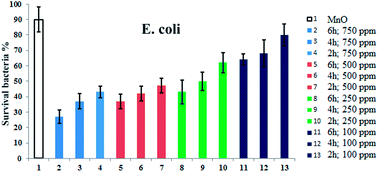
Next, we studied the antimicrobial effects of nanolayered Mn oxide, and Ag deposited on nanolayered Mn oxide. The Escherichia coli and Staphylococcus aureus were used as model bacteria to test antibacterial activities of the compounds. Escherichia coli and Staphylococcus aureus cells (106 CFU per mL) were incubated with the same concentration (100, 250, 500 and 750 μg mL−1) of the compounds in isotonic saline solution for 2, 4, and 6 hours, respectively. The survival of bacterial cells was determined by the colony counting method described in the antimicrobial test section. The isotonic saline solution without nanolayered Mn oxide or Ag deposited on nanolayered Mn oxide materials was used as a control. The shaking speed 250 rpm was used in all antibacterial assays. As shown in Fig. 4, Ag deposited on nanolayered Mn oxide shows good antibacterial activities on both Escherichia coli and Staphylococcus aureus. Although some particles of nanolayered Mn oxide or Ag deposited on nanolayered Mn oxide particles precipitate when the dispersions stand still for 2, 4 and 6 hours under the shaking condition, the particles are well suspended in the saline solution interacting with cells in all assays.
 |
| | Fig. 4 Viable counts of (a) Escherichia coli and (b) Staphylococcus aureus bacteria after interaction by nanolayered Mn oxide (MnO), and Ag deposited on nanolayered Mn oxide. | |
Conclusions
We synthesized nanolayered Mn oxide, and Ag deposited on nanolayered Mn oxide. The compounds characterized by scanning electron microscopy, transmission electron microscopy, X-ray photoelectron spectroscopy, X-ray diffraction spectrometry, atomic absorption spectroscopy, and energy-dispersive X-ray mapping. The Ag deposited on nanolayered Mn oxide shows antibacterial activities toward Escherichia coli and Staphylococcus aureus. As layered Mn oxides are used to remove heavy metal ions (Pb(II), Cd(II), As(III), Cr(III) and etc.) from water systems, we according to deposit of Ag on nanolayered Mn oxide, combine both removing heavy-metal ions activity and antibacterial effect in one compound. The strategy is promising in water treatment.
Acknowledgements
MMN, EA and MKZ are grateful to the Institute for Advanced Studies in Basic Sciences and the National Elite Foundation for financial support.
Notes and references
- G. Zhao and S. E. Stevens Jr, BioMetals, 1998, 11, 27 CrossRef CAS.
- M. E. Olson, J. B. Wright, K. Lam and R. E. Burrell, Eur. J. Surg., 2000, 166, 486 CrossRef CAS PubMed.
- T. Yuranova, A. G. Rincon, A. Bozzi, S. Parra, C. Pulgarin, P. Albers and J. Kiwi, J. Photochem. Photobiol., A, 2003, 161, 27 CrossRef CAS.
- F. R. Fan and A. J. Bard, J. Phys. Chem. B, 2002, 106, 279 CrossRef CAS.
- M. Ignatova, D. Labaye, S. Lenoir, D. Strivay, R. Jerome and C. Jerome, Langmuir, 2003, 19, 8971 CrossRef CAS.
- L. Balogh, D. R. Swanson, D. A. Tomalia, G. L. Hagnauer and A. T. McManus, Nano Lett., 2001, 1, 18 CrossRef CAS.
- W. J. A. Schreurs and H. Rosenberg, J. Bacteriol., 1982, 152, 7 Search PubMed.
- P. Dibrov, J. Dzioba, K. K. Gosink and C. C. Hase, Antimicrob. Agents Chemother., 2002, 46, 2668 CrossRef CAS.
- S. Y. Liau, D. C. Read, W. J. Pugh, J. R. Furr and A. D. Russell, Lett. Appl. Microbiol., 1997, 1125, 279 Search PubMed.
-
(a) M. Duane, C. A. Dekker and H. K. Schachmen, Biopolymers, 1966, 4, 51 CrossRef;
(b) C. Marambio-Jones and E. M. V. Hoek, J. Nanopart. Res., 2010, 12, 1531 CrossRef CAS.
- Q. L. Feng, J. Wu, G. Q. Chen, F. Z. Cui, T. N. Kim and J. O. Kim, J. Biomed. Mater. Res., 2000, 52, 662 CrossRef CAS.
- J. Wu, S. Y. Hou, D. C. Ren and P. T. Mather, Biomacromolecules, 2009, 10, 2686 CrossRef CAS PubMed.
- K. B. Holt and A. J. Bard, Biochemistry, 2005, 44, 13214 CrossRef CAS PubMed.
- J. R. Morones, J. L. Elechiguerra, A. Camacho, K. Holt, J. B. Kouri, J. T. Ramirez and M. J. Yacaman, Nanotechnology, 2005, 16, 2346 CrossRef CAS PubMed.
- I. Sondi and B. Salopek-Sondi, J. Colloid Interface Sci., 2004, 275, 177 CrossRef CAS PubMed.
- M. Yamanaka, K. Hara and J. Kudo, Appl. Environ. Microbiol., 2005, 71, 7589 CrossRef CAS PubMed.
- E. A. Jenne, in Trace Inorganics in Water, ACS Advances in Chemistry Series, American Chemical Society, Washington, DC, 1968, vol. 73, pp. 337–387 Search PubMed.
- L. B. Young and H. Harvey, Geochim. Cosmochim. Acta, 1992, 56, 1175 CrossRef CAS.
-
(a) Y. N. Vodyanitskii, Eurasian Soil Sci., 2009, 42, 1170 CrossRef;
(b) M. Komárek, A. Vaněk and V. Ettler, Environ. Pollut., 2013, 172, 9 CrossRef PubMed;
(c) L. D. Puppa, M. Komárek, F. Bordas, J. C. Bollinger and E. Joussein, J. Colloid Interface Sci., 2013, 399, 99 CrossRef PubMed.
-
(a) X. H. Feng, L. M. Zhai, W. F. Tan, F. Liu and J. Z. He, Environ. Pollut., 2007, 147, 366 CrossRef CAS PubMed;
(b) M. M. Najafpour, M. Hołyńska and S. Salimi, Coord. Chem. Rev., DOI:10.1016/j.ccr.2014.11.001.
- M. M. Najafpour, F. Rahimi, D. Jafarian Sedigh, R. Carpentier, J. J. Eaton-Rye, J. R. Shen and S. I. Allakhverdiev, Photosynth. Res., 2013, 117, 423 CrossRef CAS PubMed.
- M. M. Najafpour, M. Amini, D. Jafarian Sedigh, F. Rahimi and M. Bagherzadeh, RSC Adv., 2013, 3, 24069 RSC.
- S. Liu, T. H. Zeng, M. Hofmann, E. Burcombe, J. Wei, R. Jiang, J. Kong and Y. Chen, ACS Nano, 2011, 5, 6971 CrossRef CAS PubMed.
- O. Akhavan and E. Ghaderi, ACS Nano, 2010, 4, 5731 CrossRef CAS PubMed.
- G. Zhang, L. Zheng, M. Zhang, S. Guo, Z. Liu, Z. Yang and Z. Wang, Energy Fuels, 2012, 26, 618 CrossRef CAS.
Footnote |
| † The second and third authors contributed equally to the work. |
|
| This journal is © The Royal Society of Chemistry 2014 |
Click here to see how this site uses Cookies. View our privacy policy here.