

Nickel-catalyzed cross-coupling of carboxylic anhydrides with arylboronic acids†
Qiang Chenab,
Xin-Heng Fan*a,
Li-Peng Zhangab and
Lian-Ming Yang*a
aBeijing National Laboratory for Molecular Sciences (BNLMS), Key Laboratory of Green Printing, Institute of Chemistry, Chinese Academy of Sciences, Beijing 100190, P. R. China. E-mail: yanglm@iccas.ac.cn; xinxin9968@iccas.ac.cn; Fax: +86-10-62559373
bUniversity of Chinese Academy of Sciences, Beijing 100049, P. R. China
First published on 17th October 2014
Abstract
A nickel-based catalyst was employed in the cross-coupling of carboxylic anhydrides with arylboronic acids, and the reaction was carried out under mild conditions. This new protocol provides an efficient, cheap and convenient alternative to synthesizing aromatic ketones.
Major advantages of the Suzuki–Miyaura cross-coupling reaction in carbon–carbon bond-forming reactions encourage synthetic chemists to continuously expand its scope and enrich its content.1,2 Accordingly, the utility of carboxylic acid derivatives as electrophilic substrates in the Suzuki–Miyaura reaction for ketone synthesis has drawn intensive attention.3 Over the past decade, transition metal-catalyzed coupling reactions of boronic acids with carboxylic acid derivatives, including acid chlorides,4 anhydrides,5,6 thioesters,7 2-pyridyl esters,8 and even carboxylic acids,5a,9 have been investigated. This Suzuki–Miyaura type acylation represents a highly valuable alternative to such classic procedures as the Friedel–Crafts acylation10 and nucleophilic addition of organometallics to carboxylic acid derivatives11 because of its pronounced advantages such as mild conditions, the ease of manipulation, regioselectivity, and high yields, etc.
From economic and practical points of view, the development of cheap metal catalysts for replacing precious metal-based systems is highly desirable in transition metal-catalyzed reactions. To date, however, Suzuki–Miyaura type acylation reactions have largely depended on noble metal-based catalysts (particularly palladium).4–9 In striking contrast, much cheaper nickel, being a well-established counterpart of palladium in Suzuki–Miyaura reactions,2,12 remains missing in the special Suzuki–Miyaura acylation.13 Thus, it was of strong interest to us to explore the application of nickel-based catalysts in cross-couplings of boronic acids with carboxylic acid derivatives. Herein, we wish to disclose our new findings concerning nickel-catalyzed Suzuki–Miyaura acylation reactions.
The cross-coupling of p-methoxybenzoic anhydride with p-tolylboronic acid was used as a model reaction to screen reaction conditions (Table 1). Initially, we selected a NiII–aryl complex (C-1) as pre-catalyst. This is because we have successfully used NiII–(σ-aryl) complexes, trans-haloarylbis(triphenylphosphane)nickel(II) (Fig. 1), as catalyst precursors in the Suzuki–Miyaura reaction.12d,l,m These NiII–aryl complexes are easily prepared from cheap and commercially available starting materials14 and conveniently used due to their stability to air and moisture.
|
||||||
|---|---|---|---|---|---|---|
| Entry | [Ni(II)] (mol%) | Ligand (mol%) | Base | Solvent | Temp. (°C) | Yieldb (%) |
| a Conditions: p-methoxybenzoic anhydride (1.0 mmol), p-tolylboronic acid (1.5 mmol), base (3.0 mmol), 5.0 mL of solvent, 12 h.b Isolated yields.c C-1: Ni(PPh3)2(1-naphthyl)Cl.d C-2: NiCl2·6H2O.e C-3: NiCl2(PPh3)2.f C-4: Ni(acac)2.g 1.5 mmol of K3PO4 used. | ||||||
| 1 | C-1c (5) | None | K3PO4 | Toluene | 50 | Trace |
| 2 | C-1 (5) | PPh3 (10) | K3PO4 | Toluene | 50 | Trace |
| 3 | C-1 (5) | PCy3 (10) | K3PO4 | Toluene | 50 | 85 |
| 4 | C-1 (5) | PCy3 (7.5) | K3PO4 | Toluene | 50 | 71 |
| 5 | C-1 (5) | PCy3 (5) | K3PO4 | Toluene | 50 | 57 |
| 6 | C-2d (5) | PCy3 (10) | K3PO4 | Toluene | 50 | 0 |
| 7 | C-3e (5) | PCy3 (10) | K3PO4 | Toluene | 50 | 0 |
| 8 | C-4f (5) | PCy3 (10) | K3PO4 | Toluene | 50 | 0 |
| 9 | C-1 (5) | DPPE (5) | K3PO4 | Toluene | 50 | Trace |
| 10 | C-1 (5) | DPPP (5) | K3PO4 | Toluene | 50 | Trace |
| 11 | C-1 (5) | DPPF (5) | K3PO4 | Toluene | 50 | 7 |
| 12 | C-1 (2.5) | PCy3 (5) | K3PO4 | Toluene | 50 | 39 |
| 13 | C-1 (5) | PCy3 (10) | K2CO3 | Toluene | 50 | Trace |
| 14 | C-1 (5) | PCy3 (10) | Na2CO3 | Toluene | 50 | 0 |
| 15 | C-1 (5) | PCy3 (10) | K3PO4 | Toluene | 50 | 33g |
| 16 | C-1 (5) | PCy3 (10) | K3PO4 | Dioxane | 50 | 12 |
| 17 | C-1 (5) | PCy3 (10) | K3PO4 | THF | 50 | Trace |
| 18 | C-1 (5) | PCy3 (10) | K3PO4 | Toluene | 30 | 46 |
| 19 | C-1 (5) | PCy3 (10) | K3PO4 | Toluene | 70 | 67 |

 | ||
| Fig. 1 NiII–(σ-aryl) complexes. | ||
As shown in Table 1, although C-1 alone or with common ligands such as PPh3 did not mediate this coupling reaction (Table 1, entries 1 and 2), a combination of C-1 and electron-rich, bulky PCy3 ligand is a very effective catalytic system, giving the desired product in 85% yield (entry 3). And the role of ligand PCy3 was confirmed by the following observations: the yield decreases gradually as the ratio of PCy3 to Ni is reduced (entries 4 and 5). The use of common nickel(II) compounds, such as NiCl2·6H2O, Ni(PPh3)2Cl2 and Ni(acac)2, afforded no ketone product at all (entries 6–8). The reason should be that these NiII precursors are not able to produce the catalytically active Ni0 species in the current reaction system.12d Furthermore, bidentate phosphine ligands, such as DPPE, DPPP and DPPF, appeared to be ineffective ligands (entries 9–11). An attempt to reduce loading amounts of the catalyst led to a substantially reduced yield (entry 12). For the bases used, weaker K2CO3 (entry 13) and Na2CO3 (entry 14) did not work at all; moreover, the reaction was sluggish without the use of excess amounts of base K3PO4 (entry 15). Toluene appeared to be the solvent of choice for the reaction and far superior to ethereal solvents such as dioxane (entry 16) and THF (entry 17). Reaction temperatures were essential for this transformation as well. For example, lower reaction temperatures caused a slower conversion (entry 18), but elevating reaction temperatures did not bring about a positive effect (entry 19), possibly because the competitive hydrolysis of the anhydride would be aggravated at higher temperatures. Finally, our standard conditions were set up as entry 3 in Table 1.
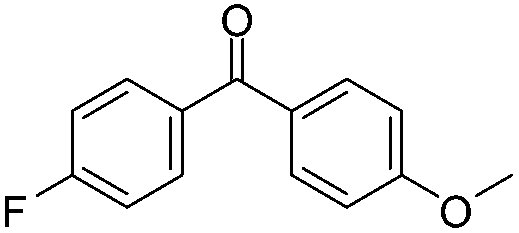
Under the optimized conditions, the scope and limitations of this cross-coupling reaction were investigated, and the results were summarized in Table 2. Generally, electron-neutral (entries 1–6), -rich (entries 9–14) and -poor (entries 17–19) anhydrides were all viable electrophilic substrates for the reaction. Further, we noticed an interesting tendency in the anhydride reactivity that the yield would decrease in the order: electron-rich > -neutral > -poor (e.g., entry 9 vs. 1 vs. 17; entry 11 vs. 3 vs. 18; and entry 13 vs. 5 vs. 19). This phenomenon appeared contrary to usual metal-catalyzed cross-couplings. The reason may be that a competitive hydrolysis side-reaction of anhydrides occurs in the reaction system, and thus the more electron rich the anhydride is, the more substantially its hydrolysis is suppressed. Neither aliphatic carboxylic anhydrides nor aliphatic boronic acids were suitable for this reaction and no coupled product was obtained (entries 21 and 22).
|
||||
|---|---|---|---|---|
| Entry | Acid anhydride | Boronic acid | Product | Yieldb (%) |
| a Reagents: carboxylic anhydride (1.0 mmol), arylboronic acid (1.5 mmol), K3PO4 (3.0 mmol), C-1 (0.05 mmol), PCy3 (0.1 mmol), toluene (5.0 mL).b Isolated yields. | ||||
| 1 |  |
 |
 |
81 |
| 2 |  |
 |
 |
70 |
| 3 |  |
 |
 |
74 |
| 4 |  |
 |
 |
77 |
| 5 |  |
 |
 |
71 |
| 6 |  |
 |
 |
68 |
| 7 |  |
 |
 |
0 |
| 8 |  |
 |
 |
33 |
| 9 |  |
 |
 |
88 |
| 10 |  |
 |
 |
76 |
| 11 |  |
 |
 |
85 |
| 12 |  |
 |
 |
84 |
| 13 |  |
 |
 |
81 |
| 14 |  |
 |
 |
75 |
| 15 |  |
 |
 |
0 |
| 16 |  |
 |
 |
39 |
| 17 |  |
 |
 |
67 |
| 18 |  |
 |
 |
61 |
| 19 |  |
 |
 |
56 |
| 20 |  |
 |
 |
0 |
| 21 |  |
 |
 |
0 |
| 22 |  |
 |
 |
0 |
| 23 |  |
 |
 |
69 |
| 24 |  |
 |
 |
69 |
| 25 |  |
 |
 |
66 |
| 26 |  |
 |
 |
0 |
| 27 |  |
 |
 |
0 |

On the part of arylboronic acids, electron-rich and -neutral ones showed excellent reactivity and delivered the products in good yields (Table 2, entries 1–6, and 9–14); but electron-deficient boronic acid performed poorly (entries 8 and 16). Several heteroaryl boronic acids were also examined under the reaction conditions. Thiophen-3-ylboronic acid could be used in this reaction with appreciable yields (entries 23–25), while thiophen-2-ylboronic acid and 3-pyridinylboronic acid were ineffective (entries 26 and 27).
Additionally, this coupling reaction seemed to be very sensitive to the steric effects of both types of substrates. For example, slightly bulky 1-naphthyl boronic acid gave a relatively lower yield than the phenyl one did (Table 2, entry 6 vs. 5; entry 14 vs. 13), and the steric effects of both types of substrates completely retarded the reaction (entries 7, 15, and 20).
Based on our previous studies,12d,l,m we believed that the catalytically active Ni0 might be in situ generated in the reaction system by the reaction of Ni(PPh3)2(1-naphthyl)Cl and an arylboronic acid under basic conditions, which is consistent with our experimental observations: (i) very small amounts of biaryl were detected in almost all cases; (ii) a deep red colour, usually as an indicator implying the presence of Ni0 species in solutions, occurred in the reaction mixture at the initial stage of the reaction. Therefore, a possible mechanism for the nickel-catalyzed acylation reaction is proposed (Scheme 1): oxidative addition of the aromatic carboxylic anhydride 1 to the Ni0 species generates an acylnickel(II) complex 4; subsequent transmetallation of the organic group on an arylboronic acid 2 onto NiII complex 4 takes places at the Ni–O bond; and finally, reductive elimination of an aromatic ketone 3 from the NiII complex 5 and regenerates the Ni0 species, and then the next cycle starts again.
 | ||
| Scheme 1 A possible mechanistic pathway for the Ni-catalyzed Suzuki–Miyaura acylation. | ||
In summary, we have for the first time demonstrated the feasibility for Ni-catalyzed acylation of arylboronic acids with carboxylic anhydrides. This protocol provides an efficient, cheap and convenient route to synthesizing aromatic ketones. A possible mechanism for this reaction was proposed. Further work to expand the scope of substrates and elucidate the mechanistic details is currently underway in our lab.
Acknowledgements
We thank National Natural Science Foundation of China (Project nos 20872142 and 21102150) for financial support of this work.Notes and references
- For selected reviews on Pd-catalyzed Suzuki–Miyaura reactions, see: (a) N. Miyaura and A. Suzuki, Chem. Rev., 1995, 95, 2457 CrossRef CAS; (b) S. P. Stanforth, Tetrahedron, 1998, 54, 263 CrossRef CAS; (c) A. Suzuki, J. Organomet. Chem., 1999, 576, 147 CrossRef CAS; (d) S. Kotha, K. Lahiri and D. Kashinath, Tetrahedron, 2002, 58, 9633 CrossRef CAS; (e) N. Miyaura, Top. Curr. Chem., 2002, 219, 11 CrossRef CAS; (f) F. Bellina, A. Carpita and R. Rossi, Synthesis, 2004, 2419 CAS; (g) R. Martin and S. L. Buchwald, Acc. Chem. Res., 2008, 41, 1461 CrossRef CAS PubMed.
- For a review involving Ni-catalyzed Suzuki–Miyaura reactions, see: B. M. Rosen, K. W. Quasdorf, D. A. Wilson, N. Zhang, A. M. Resmerita, N. K. Garg and V. Percec, Chem. Rev., 2011, 111, 1346 CrossRef CAS PubMed.
- For a recent review on Suzuki–Miyaura type acylation reactions, see: M. Blangetti, H. Rosso, C. Prandi, A. Deagostino and P. Venturello, Molecules, 2013, 18, 1188 CrossRef CAS PubMed.
- Acid chlorides used in Pd-catalyzed Suzuki–Miyaura reactions: (a) V. V. Bykov, D. N. Korolev and N. A. Bumagin, Russ. Chem. Bull., 1997, 46, 1631 CrossRef CAS; (b) N. A. Bumagin and D. N. Korolev, Tetrahedron Lett., 1999, 40, 3057 CrossRef CAS; (c) M. Haddach and J. R. McCarthy, Tetrahedron Lett., 1999, 40, 3109 CrossRef CAS; (d) Y. Urawa and K. Ogura, Tetrahedron Lett., 2003, 44, 271 CrossRef CAS; (e) S. Eddarir, N. Cotelle, Y. Bakkour and C. Rolando, Tetrahedron Lett., 2003, 44, 5359 CrossRef CAS; (f) B. P. Bandgar and A. V. Patil, Tetrahedron Lett., 2005, 46, 7627 CrossRef CAS; (g) V. Polàckovà, S. Toma and I. Augustìnovà, Tetrahedron, 2006, 62, 11675 CrossRef; (h) K. Ekoue-Kovi, H. Xu and C. Wolf, Tetrahedron Lett., 2008, 49, 5773 CrossRef CAS; (i) L. Zhang, J. Wu, L. Shi, C. Xia and F. Li, Tetrahedron Lett., 2011, 52, 3897 CrossRef CAS; (j) D. Ogawa, K. Hyodo, M. Suetsugu, J. Li, Y. Inoue, M. Fujisawa, M. Iwasaki, K. Takagi and Y. Nishihara, Tetrahedron, 2013, 69, 2565 CrossRef CAS; (k) J. Zhang, Z. Han, J. Li and Y. Wu, ARKIVOC, 2013, 4, 251 Search PubMed.
- Anhydrides used in Pd-catalyzed Suzuki–Miyaura reactions: (a) L. J. Gooßen and K. Ghosh, Angew. Chem., Int. Ed., 2001, 40, 3458 CrossRef; (b) L. J. Gooßen and K. Ghosh, Eur. J. Org. Chem., 2002, 3254 CrossRef; (c) R. Kakino, I. Shimizu and A. Yamamoto, Bull. Chem. Soc. Jpn., 2001, 74, 371 CrossRef CAS; (d) R. Kakino, S. Yasumi, I. Shimizu and A. Yamamoto, Bull. Chem. Soc. Jpn., 2002, 75, 137 CrossRef CAS; (e) R. Kakino, H. Narahashi, I. Shimizu and A. Yamamoto, Bull. Chem. Soc. Jpn., 2002, 75, 1333 CrossRef CAS; (f) B. Xin, Y. Zhang and K. Cheng, J. Org. Chem., 2006, 71, 5725 CrossRef CAS PubMed; (g) B. Xin, Y. Zhang and K. Cheng, Synthesis, 2007, 1970 CAS; (h) B. Xin, Synth. Commun., 2008, 38, 2826 CrossRef CAS; (i) X.-B. Shen, T.-T. Gao, J.-M. Lu and L.-X. Shao, Appl. Organomet. Chem., 2011, 25, 497 CrossRef CAS; (j) A. Yu, L. Shen, X. Cui, D. Peng and Y. Wu, Tetrahedron, 2012, 68, 2283 CrossRef CAS.
- Anhydrides used in Rh-catalyzed Suzuki–Miyaura reactions: C. G. Frost and K. J. Wadsworth, Chem. Commun., 2001, 2316 RSC.
- Thioesters used in Pd-catalyzed Suzuki–Miyaura reactions: (a) L. S. Liebeskind and J. Srogl, J. Am. Chem. Soc., 2000, 122, 11260 CrossRef CAS; (b) Y. Yu and L. S. Liebeskind, J. Org. Chem., 2004, 69, 3554 CrossRef CAS PubMed.
- Pyridyl ester used in Pd-catalyzed Suzuki–Miyaura reactions: H. Tatamidani, F. Kakiuchi and N. Chatani, Org. Lett., 2004, 6, 3597 CrossRef CAS PubMed.
- The direct use of carboxylic acid in Pd-catalyzed Suzuki–Miyaura reactions: (a) L. J. Gooßen and K. Ghosh, Chem. Commun., 2001, 2084 Search PubMed; (b) Y. B. Kwon, B. R. Choi, S. H. Lee, J.-S. Seo and C. M. Yoon, Bull. Korean Chem. Soc., 2010, 31, 2672 CrossRef CAS; (c) A. Pathak, C. S. Rajput, P. S. Bora and S. Sharma, Tetrahedron Lett., 2013, 54, 2149 CrossRef CAS.
- G. A. Olah, Friedel–Crafts Chemistry, Wiley, New York, 1973 Search PubMed.
- For selected papers on the acylation of organometallics with carboxylic acid derivatives: (a) J. W. Labadie and J. K. Stille, J. Am. Chem. Soc., 1983, 105, 669 CrossRef CAS; (b) C. K. Reddy and P. Knochel, Angew. Chem., Int. Ed., 1996, 35, 1700 CrossRef CAS; (c) M. Arisawa, Y. Torisawa, M. Kawahara, M. Yamanaka, A. Nishida and M. Nakagawa, J. Org. Chem., 1997, 62, 4327 CrossRef CAS PubMed; (d) T. C. Wu, H. Xiong and R. D. Rieke, J. Org. Chem., 1990, 55, 5045 CrossRef CAS; (e) G. W. Kabalka, R. R. Malladi, D. Tejedor and S. Kelley, Tetrahedron Lett., 2000, 41, 999 CrossRef CAS; (f) C. S. Cho, K. Itotani and S. Uemura, J. Organomet. Chem., 1993, 443, 253 CrossRef CAS; (g) H. Tatamidani, F. Kakiuchi and N. Chatani, Org. Lett., 2004, 6, 3597 CrossRef CAS PubMed.
- For representative papers on nickel-catalyzed Suzuki–Miyaura reactions, see: (a) V. Percec, J.-Y. Bae and D. H. Hill, J. Org. Chem., 1995, 60, 1060 CrossRef CAS; (b) S. Saito, S. Oh-tani and N. Miyaura, J. Org. Chem., 1997, 62, 8024 CrossRef CAS PubMed; (c) K. Inada and N. Miyaura, Tetrahedron, 2000, 56, 8657 CrossRef CAS; (d) C. Chen and L.-M. Yang, Tetrahedron Lett., 2007, 48, 2427 CrossRef CAS; (e) D. Zim, V. R. Lando, J. Dupont and A. L. Monteiro, Org. Lett., 2001, 3, 3049 CrossRef CAS PubMed; (f) V. Percec, G. M. Golding, J. Smidrkal and O. Weichold, J. Org. Chem., 2004, 69, 3447 CrossRef CAS PubMed; (g) Z.-Y. Tang and Q.-S. Hu, J. Am. Chem. Soc., 2004, 126, 3058 CrossRef CAS PubMed; (h) S. B. Blakey and D. W. C. MacMillan, J. Am. Chem. Soc., 2003, 125, 6046 CrossRef CAS PubMed; (i) K. W. Quasdorf, X. Tian and N. K. Garg, J. Am. Chem. Soc., 2008, 130, 14422 CrossRef CAS PubMed; (j) B.-T. Guan, Y. Wang, B.-J. Li, D.-G. Yu and Z.-J. Shi, J. Am. Chem. Soc., 2008, 130, 14468 CrossRef CAS PubMed; (k) M. Tobisu, T. Shimasaki and N. Chatani, Angew. Chem., Int. Ed., 2008, 47, 4866 CrossRef CAS PubMed; (l) X.-H. Fan and L.-M. Yang, Eur. J. Org. Chem., 2010, 2457 CrossRef CAS; (m) X.-H. Fan and L.-M. Yang, Eur. J. Org. Chem., 2011, 1467 CrossRef CAS.
- There have been a few reports on Ni-catalyzed ketone synthesis via a reductive coupling of alkyl iodide and carboxylic acid derivatives. See: (a) M. Onaka, Y. Matsuoka and T. Mukaiyama, Chem. Lett., 1981, 10, 531 CrossRef; (b) A. C. Wotal and D. J. Weix, Org. Lett., 2012, 14, 1476 CrossRef CAS PubMed; (c) H. Yin, C. Zhao, H. You, K. Lin and H. Gong, Chem. Commun., 2012, 48, 7034 RSC.
- For the preparation of trans-haloarylbis(triphenylphosphane)nickel(II), see: (a) J. van Soolingen, H. D. Verkruijsse, M. A. Keegstra and L. Brandsma, Synth. Commun., 1990, 20, 3153 CrossRef CAS; (b) L. Brandsma, S. F. Vasilevsky and H. D. Verkruijsse, in Application of Transition Metal Catalysts in Organic Synthesis, Springer, New York, 1998, pp. 3–4 Search PubMed.
Footnote |
| † Electronic supplementary information (ESI) available: General experimental procedures, characterization details, 1H and 13C NMR spectra of products. See DOI: 10.1039/c4ra11520a |
| This journal is © The Royal Society of Chemistry 2014 |