
Yuan Zhaoab,
Liqiang Liu
a,
Hua Kuang*a,
Libing Wanga and
Chuanlai Xua
aState Key Lab of Food Science and Technology, School of Food Science and Technology, Jiangnan University, Wuxi, Jiangsu 214122, People's Republic of China. E-mail: kuangh@jiangnan.edu.cn
bThe Key Lab of Food Colloids and Biotechnology, Ministry of Education, School of Chemical and Materials Engineering, Jiangnan University, Wuxi, Jiangsu 214122, People's Republic of China
First published on 22nd October 2014
An innovative Raman sensor was developed for DNA detection, based on silver@gold (Ag@Au) core–shell nanoparticle (NP) assemblies fabricated by a polymerase chain reaction (PCR). The combination of exponential amplification by PCR and the amplified Raman signal achieved DNA detection of 11.8 aM.
Despite the extraordinary limits of detection (LODs) for small organic molecules and ions provided by SERS,10–14 the quantitative application of ultrasensitive biomacromolecules, particularly related to long DNA detection, are necessary for early disease diagnosis and pharmacogenomics, but have significant challenges in the actual applications: (a) the requirements to label Raman reporters on a DNA probe are complex and time-consuming; (b) the restricted LODs at picomolar, and in some cases, femtomolar levels due to large interparticle gaps (Table 1).6,15–20
| General features | Signal | LODs | Ref. |
|---|---|---|---|
| a SERRS, surface-enhanced resonance Raman scattering. | |||
| Dye-labeled SERS primers | SERS | 1 nM | 7 and 44 |
| Raman reporter dye-coded Ag NPs | SERRSa | 1.25 nM | 45 |
| SERS-active dye labeled DNA probes, requires lambda exonuclease | SERS | 21.7 pM | 6 |
| Graphene with in situ grown Au NPs, reporter-labeled DNA | SERS | 10 pM | 16 |
| Au NPs-on-Au nanowires, reporter DNA with Raman dye | SERS | 10 pM | 17 |
| Hybridization chain reaction coupled with DNA-mediated Ag NPs growth | SERS | 3.4 pM | 15 |
| Dye-labeled oligonucleotide probe | SERS | 750 fM | 43 |
| NPs with Raman spectroscopic fingerprints, Raman dye-labeled DNA | SERS | 20 fM | 18 |
| The adsorption of a colored molecule onto Ag NPs | SERRS | 1.17 fM | 20 |
| Silicon nanowires with in situ grown Ag NPs, dye-attached DNA | SERS | 1 fM | 46 |
The design of an efficient and label-free substrate with a consistently high density of hot-spots is crucial for SERS sensors in sensitive long DNA detection.21 Anisotropic NPs of various sizes and shapes have recently been engineered to optimize high electromagnetic fields in a controlled arrangement.22–24 Compared to the widely studied Au NPs,25,26 Ag NPs should be of interest in SERS properties, due to their better plasmonic oscillations at visible frequencies. However, the easy oxidation and toxicity of Ag NPs is an intrinsically challenging problem in actual applications. To satisfy the criteria of large-scale stable electromagnetic enhancement, a stable and biocompatible Au shell was deposited on the surface of Ag NPs assemblies. Au shell deposition takes advantage of the excellent plasmon properties of the Ag core, and directly guides the interparticle distance of NPs and engineers the intensity of electromagnetic fields.
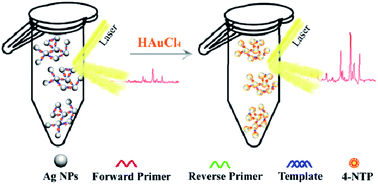
Herein, Ag NPs multimers were first assembled by PCR attributing to its advantages of exponential amplification and high specificity benefiting from the heat transfer properties of NPs, as well as its automatic manipulations.27–29 The enormous enhancement of the SERS signals for Ag NPs assemblies at the sub-3.7 nm gap was exploited by Au shell deposition at different PCR cycles (Fig. 1). Depending on the exponential amplification of interface-PCR and the amplified SERS signal, we determined the bioanalytical potential of Ag@Au core–shell NPs assemblies, which achieved Raman-signal based attomolar DNA detection. Shell driven strong Raman signals allow the fabrication of label-free and highly reproducible SERS-active materials with reliable nanometer gap sizes for biomacromolecule detection.
![]() | ||
| Fig. 1 Schematic illustration of SERS detection of DNA by PCR-based Ag@Au core–shell NPs assemblies. | ||
18.0 ± 2.3 nm Ag NPs were synthesized by the reduction of silver nitrate using sodium borohydride (Fig. S1, ESI†).30 Forward primers and reverse primers were respectively modified on the surface of Ag NPs by Ag–SH covalent bonds at a molar ratio of 100
:
1.28,29 Under optimized amplification conditions, Ag NPs assemblies were prepared using 1.56 pM target templates (Fig. 1). From 2 to 5 cycles, Ag NPs oligomers involving dimers, trimers and tetramers were gradually assembled; From 10 to 40 cycles, the degree of NPs assemblies increased, resulting in the formation of large sized multimers (Fig. S2, ESI†).28
A layer of Au shell was post-deposited on the surface of Ag NPs assemblies by the reduction of HAuCl4 solution to prevent Ag NPs from atmospheric oxidation.11 Bright-field TEM images clearly demonstrated the Ag core and Au shell attributing to their distinct contrast grades (Fig. 2a, insert). With an increase in the number of cycles from 2 to 40, Ag@Au core–shell NPs number of assemblies was systematically increased (Fig. 2). Note that the interface configuration of Ag@Au core–shell NPs was not as smooth as that of Ag NPs and transformed into Au dendrites.31 Such branched protrusions enabled Ag@Au core–shell NPs to exhibit extraordinary properties in the intensification of the electromagnetic field.32–34 The interparticle distance between NPs was decreased from 16.5 nm to 3.7 ± 1.0 nm after Au shell deposition and can be employed to obtain large intensifications in SERS (Fig. S3, ESI†).35 The underlying shell deposition had a significant influence on the plasmonic properties of the assemblies. Compared to the plasmonic peak at 404 nm of single Ag NPs, only 4 nm red shifts were observed for Ag NPs multimers assembled after 20 cycles, while a significant red shift of 85 nm for Ag@Au core–shell NPs assemblies was seen in the plasmonic resonance peaks which were determined by the LSPR of the encapsulated Ag core and deposited Au shell (Fig. 3).36 Ag NPs assemblies after Au deposition from 2 to 40 cycles showed distinct plasmon resonance which ranging from 489 nm to 499 nm.
![]() | ||
| Fig. 3 UV-vis spectra of Ag NPs, Au NPs, Ag NPs assemblies, Ag@Au core–shell NPs assemblies after different cycles. | ||
Clear evidence of narrow-gap plasmonic coupling of Au and Ag heterogeneous elements in Ag@Au core–shell NPs assemblies prompted us to explore their potential SERS properties. In comparison, SERS signals obtained from 4-NTP and the control groups (0 cycles) were weak (Fig. 4a). Ag NPs assemblies showed increased Raman signals, and a Raman shift at 1346 cm−1 exhibited the highest intensity (Fig. S4, ESI†).37,38 From 2 to 20 cycles, the SERS intensity of Ag NPs assemblies correspondingly increased, which was related to the number of hot spots between the gaps of two NPs with increasing degree of aggregation of the Ag NPs. From 20 to 40 cycles, no obvious increase in Raman signals was observed, but a slight decrease was seen, due to the formation of large aggregates which caused sedimentation and induced instability of the solution. Ag NPs multimers assembled at 20 cycles showed the highest Raman signal, but the intensity was only 1295 due to the large gaps between NPs.29,39 However, Ag NPs assemblies after Au shell deposition exhibited as much as 3 orders of magnitude more intensity than that of pure Ag NPs assemblies and showed 8-fold higher intensity than pure 4-NTP (Fig. 4b). The variation law of Raman intensity at different cycles was similar. Particle structure and interparticle distance markedly affected the “hot spots” between metal nanostructures, which were spatial regions where the electromagnetic field was extremely intense contributing to the plasmon coupling between neighboring NPs.35,40 After Au shell deposition, neighboring NPs were closer and the nanofocusing effect was particularly pronounced originating from strong “hot spots” at their junctions where the electromagnetic field was enormously enhanced, and numerous enhanced regions containing a high density of hot spots. Of particular importance were the slits between small Au tips and Ag cores which acted as novel hot spot generating regions and were favorable for significantly magnifying SERS signals.41 The highest plasmonic resonance of Ag NPs, the narrow gaps between NPs and the formation of multi-shaped tips on the NPs surface after Au deposition were the deciding factors in the response to SERS signals.23,32,42 Assemblies at 20 cycles was not only more stable than that of 30 and 40 cycles, but contained the maximum NPs number than that of 2, 5 and 10 cycles. Ag@Au core–shell NPs assemblies at 20 cycles possessed the highest density of hot spots and showed the strongest SERS signal which reached up to 3070.
A particularly exciting sensing application utilizing the resultant high-efficiency SERS-active Ag@Au core–shell NPs assemblies was exploited. An overview of the experimental data is depicted in Fig. 4. Ag NPs assemblies at 20 PCR cycles after Au deposition exhibited the highest Raman signals, with promising application in the detection of biomolecules. The Raman shift at 1346 cm−1 was employed as the identification position for the quantitative analysis. As shown in Fig. 5a, the fewer the target templates applied, the smaller the degree of NPs assemblies was formed by PCR. The target concentration was in proportion to the Raman intensity of the assemblies. A standard curve was established between the intensity of the 1346 cm−1 peak of 4-NTP and the logarithm of DNA concentration in the range of 1.56 pM to 15.6 aM, which exhibited a good correlation (R2 = 0.993) (Fig. 5b). There were no obvious changes in Raman intensity when the DNA concentration was lowered to 1.56 aM and even 156 zM. The LOD was calculated to be 11.8 aM which demonstrated at least a three-fold enhancement of sensitivity compared to previous reports.19,20,43 It was instructive to evaluate plasmonic-dependent Raman sensors with ultraviolet-visible absorption utilizing the plasmonic properties of NPs. The decreased concentration of target DNA induced a slight blue shift in the ultraviolet-visible absorption spectra (Fig. S5, ESI†).
The specificity of the developed method was investigated in the presence of non-target DNAEC (the genome of Escherichia coli). There were no repeated fragments between the genome of Escherichia coli and λDNA through standard nucleotide BLAST on NCBI. PCR products assembled at 1 fM DNAEC after 20 cycles still showed single NPs dispersity in despite of a few oligomers (Fig. S6, ESI†). No obvious changes of SERS intensity was observed between the PCR products and the control groups. Therefore, strong SERS signal in our study mainly came from the nanostructures assembled by target templates attributing to the specific recognition and amplification between primers and λDNA, and was correspondingly enhanced with the increasing concentration of λDNA The reliability and reproducibility of this method was evaluated by investigating the recovery of six different concentrations of target DNA in spiked detection buffer. The results showed satisfactory recovery in the range of 93.18–105.24% (Table S1, ESI†). These data demonstrated that this assay would be an accurate and reliable Raman sensor in real sample analysis. The novel combination of the exponential amplification of target DNA by interface-PCR and the amplified intensification of the electromagnetic field after Au shell deposition ensured a shell driven label-free Raman biosensor with high sensitivity and good selectivity for long DNA detection (Table 1).44–46
In summary, a Raman signal based attomolar DNA detection platform was developed for the first time. The as-fabricated Ag@Au core–shell NPs assemblies exhibited SERS activities which were superior to commercial SERS substrates in terms of signal intensity and reproducibility. Au deposition not only preserved the strongest plasmonic resonance of Ag NPs, but reduced the gaps between NPs and endowed assemblies with SERS-active tips, which were required to enhance the electromagnetic field. The amplified Raman signal with the aid of exponential amplification by interface-PCR significantly improved the sensitivity of the established Raman sensor with a LOD as low as attomolar level. Post-deposited shell driven amplified SERS signals provide the opportunity to fabricate ideal and reproducible SERS-active substrates, has potential application for the ultrasensitive and may single-molecular level detection of biomacromolecules from biological systems.
Footnote |
| † Electronic supplementary information (ESI) available: Detail Experimental section and additional TEM images and Raman spectra of Ag NPs assemblies, statistical analysis of Au shell thickness. See DOI: 10.1039/c4ra11112e |
| This journal is © The Royal Society of Chemistry 2014 |