Xiaolin Liub,
Caijun Luob,
Chao Jiangab,
Lei Shaob,
Yingwei Zhang*a and
Feng Shi*a
aState Key Laboratory of Chemical Resource Engineering & Key Laboratory of Carbon Fiber and Functional Polymer, Ministry of Education, Beijing University of Chemical Technology, Beijing, China. E-mail: shi@mail.buct.edu.cn; zhangyw@mail.buct.edu.cn; Tel: +86 10 6442 3889
bState Key Laboratory of Organic-Inorganic Composites, Beijing University of Chemical Technology, Beijing, China
First published on 4th November 2014
Rapid construction of layer-by-layer (LbL) self-assembled multilayers on non-planar substrates is challenging because most conventional LbL processes are time consuming, which restricts further applications of LbL in industry and its commercialization. Therefore, herein we introduced the high gravity (HG) technique, which is a well-established industrial chemical engineering process for intensification of mass transfer, into the LbL assembly process to realize rapid film deposition on porous nickel foam. By using a model system of electrostatically driven PDDA/AuNPs multilayers, the adsorption kinetics, LbL procedure and film morphology have been examined under both conventional dipping conditions and a HG field. The results show that the time to reach saturated adsorption of building blocks with the HG field has been shortened remarkably by up to 16 times while the film quality remains identical. In this way, the fabrication of LbL multilayers can be highly accelerated in the presence of a HG field without disturbing the film quality on non-planar substrates. Moreover, the mechanism for the rapid construction of LbL multilayers using the HG technique is interpreted using the boundary layer theory that the highly turbulent flow in the HG field enhanced the mass transfer rate for the rapid adsorption of building blocks onto substrates.
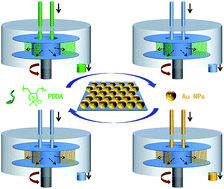
Herein we wondered whether we could address this problem by introducing the high gravity (HG) field technique into the LbL assembly process to realize rapid film deposition on non-planar substrates. The HG technique, which was developed in 1979, is a well-established industrial method for process intensification in chemical engineering.27–30 Using HG equipment, the liquid flow can be accelerated by a large rotating speed and thus the flow rapidly passes through the packing layer, during which the liquid will be separated into tiny droplets by the irregular packing layer and generate new interfaces. In this way, the mass transfer between liquid–liquid or liquid–gas for mixing, adsorption and so on, will be largely enhanced due to the sharply increased new interfaces; normally the mass transfer rate can be accelerated by one to three orders of magnitude. In our previous report, we developed a novel method of HG-assisted LbL (HG-LbL) deposition on planar quartz or silicon substrates and demonstrated that HG-LbL deposition could greatly improve the adsorption efficiency of building blocks through shortening the time taken to reach adsorption equilibrium by more than five times; meanwhile the film quality obtained is comparable to that fabricated using the conventional method of LbL dipping.31 Until now, the question of whether rapid film construction could be achieved on non-planar substrates by using HG remains to be investigated. Therefore we have applied the HG-LbL method to the construction of multilayers of polyelectrolyte/nanoparticles on a non-planar substrate of porous nickel foam in a highly efficient way. The results showed that by alternating pumping solutions of polyelectrolyte and gold nanoparticles into the HG equipment, we could realize rapid film deposition on nickel foam by the HG-LbL process. Moreover, with increasing rotation speed of the HG machine, saturated adsorption could be reached up to 16 times faster; the obtained film had a higher quality with a smoother and more closely packed surface compared with that prepared by the conventional LbL process.
000–350
000) was from Aldrich. H2SO4 (98%), H2O2 (30%), HAuCl4 and sodium citrate were purchased from Sinopharm Chemical Reagent Beijing Co. (Beijing, China).
The quartz and silicon substrate were cleaned in a Piranha solution mixed with H2SO4 (98%) and H2O2 (30%) at a volume ratio of 7
:
3 (caution: Piranha solution is extremely corrosive and the cleaning process should be handled with protective gloves in a fume cupboard), followed by washing with deionized water and drying in nitrogen.
The as-purchased nickel foam was porous with high specific surface area,32 which was cleaned in a sequence of acetone, ethanol and water for 5 min each in ultrasonic field, respectively. Subsequently, the nickel foam was dried in nitrogen flow.
For the LbL assembly under the HG field, the cycled deposition procedure was conducted as follows: after inserting the substrates in the HG machine, the AuNPs (aq, 0.05 mg mL−1) were continuously pumped for 2 min while the HG machine was rotated; subsequently, empty rotation of the HG machine was continued for another 1 min without pumping of solutions; then deionized water was pumped for 1 min to remove physically adsorbed building blocks and to clean the substrates; this was followed by further empty rotation for 1 min to dry the substrates; afterwards, PDDA (aq, 1 mg mL−1) solution was pumped for 1 min for deposition on the quartz substrates; similarly, the HG machine was rotated while empty for 1 min, washed for 1 min, and dried for 1 min. The above process was cycled to achieve a multilayer of PDDA/AuNPs. Considering that the multilayer was deposited on the meshes of nickel foam, we have illustrated the above film assembly process in Scheme 2 by taking example of one nickel mesh. The optical photograph of nickel foam was displayed in Scheme 2a.
In order to check whether HG-assisted LbL was favorable for rapid film construction of PDDA/AuNPs, we firstly investigated the adsorption kinetics of AuNPs through UV-visible spectra on planar quartz substrates coated with positively charged PDDA through a conventional immersion method. We traced the adsorption kinetics of AuNPs on quartz substrate with PDDA and related the absorbance values at 520 nm with each immersion time interval. The feature peak of AuNPs can be observed from the UV-visible spectrum of aqueous dispersion of AuNPs in Fig. 1a, which is taken as the reference in the adsorption kinetics of AuNPs onto quartz substrates. As shown in Fig. 1b, the adsorption of AuNPs undergoes a rapid increase in absorbance during the early adsorption stage up to 2 min of immersion, then slows down gradually, and at 16 min finally reaches saturated adsorption, and this absorbance value remains almost constant at 20 min and 24 min. The adsorption kinetics of AuNPs under the normal dipping method suggested that it took at least 16 min to reach saturated adsorption, which indicated that in the further LbL process the adsorption of AuNPs would be a time-consuming procedure.
With regard to the adsorption kinetics of AuNPs under an HG field, the pre-treatment of the substrate used to obtain a layer of PDDA was identical, but the adsorption of AuNPs proceeded using the HG equipment. From Fig. 1b, we can observe that the AuNPs experience a fast-growing absorbance during the early adsorption phase but soon reach adsorption saturation at 2 min; besides, the saturated absorbance is identical to that obtained using the dipping method. The large difference in the time taken to reach saturated adsorption between the conventional dipping LbL and HG-LbL methods demonstrated that the introduction of the HG field efficiently enhanced the adsorption rate of building blocks. The deposition time of AuNPs was eight times shorter, as it was reduced from the original 16 min to 2 min, and thus might contribute to rapid film deposition in the further LbL process of PDDA/AuNPs multilayer assembly.
After we had determined the saturated adsorption time of AuNPs, we wondered whether the LbL PDDA/AuNPs assembly could be realized under an HG field. For comparison, dipping LbL assembly of the PDDA/AuNPs multilayer was carried out by subsequent deposition of PDDA and AuNPs, followed by washing and drying. The deposition was cycled in an alternate way to obtain a multilayer of PDDA/AuNPs. After each cycle of AuNPs deposition, UV-visible spectra were used to track the film growth step by step. As displayed in Fig. 1c, the UV-visible absorption curve of AuNPs deposited on the quartz substrate showed a featured absorption at around 520 nm, which corresponded well with that observed for aqueous dispersion of AuNPs. As the number of deposition cycles increased, the absorbance increased correspondingly and meanwhile the featured absorption of AuNPs shifted gradually from 520 nm for (PDDA/AuNPs)1 to 620 nm for (PDDA/AuNPs)7, which was attributed to the aggregation of AuNPs within the multilayer. For each bilayer of PDDA/AuNPs, the absorbance at the featured absorption peak was correlated with the number of deposited bilayers, as shown in Fig. 1d; the film growth behavior showed a close to exponential increase. For the LbL assembly under the HG field, the cycled deposition procedure of PDDA/AuNPs was conducted in the presence of the HG field, during which the film deposition was characterized by UV-visible spectra stepwise. The results are summarized in Fig. 1e and f, which shows an almost identical red shift of AuNPs with the increasing number of deposition cycles and the same exponential film growth as that observed under the LbL dipping method. These phenomena confirmed that the introduction of the HG field has little influence on the film growth behaviors of the PDDA/AuNPs multilayer.
Although HG-LbL was proven to be efficient in rapid film construction and had little effect on film growth, the question of whether or not the film quality of the as-prepared multilayer under the HG field is improved compared to the normal dipping method remains to be clarified. Therefore we used AFM and SEM to characterize the surface roughness and surface morphology of the multilayers fabricated on silicon wafers with and without an HG field; thus the film quality could be evaluated with homogeneous properties and surface roughness. From the AFM image of (PDDA/AuNPs)20 prepared by the LbL dipping method in Fig. 2a, we can observe that the film showed a homogeneous surface with a surface roughness of 12.6 nm; its local magnification in Fig. 2b and c showed a higher roughness of 14.8 nm and 15.3 nm respectively, which further confirmed the uniformity of the film. For the multilayer of (PDDA/AuNPs)20 fabricated by the HG-LbL method, the film also displayed a uniform surface identical to the one prepared using the dipping method; the surface roughness decreased to 10.2 nm in Fig. 2d, 10.1 nm and 10.8 nm in the magnified AFM image of Fig. 2e and f, correspondingly, which suggested a smoother surface than that obtained by the LbL dipping method. Furthermore, the surface morphology was compared using the SEM images in Fig. 3. From the top view, the film assembled by dipping showed tiny protrusions on the surface (Fig. 3a and b), while the multilayer assembly by the HG-LbL process presented an entirely homogeneous coating (Fig. 3d and e), which might contribute to a lower surface roughness and matched the AFM results well. As a result of the decreased surface roughness, from the side images in Fig. 3c and f we can observe that the multilayer obtained by the HG-LbL process presented more closely-packed structures whereas the film prepared by LbL dipping was relatively loose and porous; thus with the same number of deposition cycles, the film prepared by the HG-LbL process showed a thinner thickness (60 nm) than that obtained by the LbL dipping method (90 nm), which corresponded well with the decreased UV-visible absorbance for the multilayer under the HG field in Fig. 1. The differences in surface morphology and surface roughness might be caused by the removal of rough structures by the strong shear stress of liquid under the HG field, thus leading to a smooth multilayer with improved film quality.
![]() | ||
| Fig. 2 AFM images of (PDDA/AuNPs)20 multilayers: (a), (b) and (c) dipping method; (d), (e) and (f) HG-LbL. Size: (a) and (d) 20 × 20 μm; (b) and (e) 10 × 10 μm; (c) and (f) 5 × 5 μm. | ||
![]() | ||
| Fig. 3 SEM images of (PDDA/AuNPs)20 multilayer by (a–c) dipping method and (d–f) HG-LbL. Scale bar: 500 nm. | ||
After demonstrating that the HG field is effective in accelerating film deposition and improving the film quality of the PDDA/AuNPs multilayer on the planar quartz substrate, we used an irregular porous nickel foam to replace the quartz substrate in order to investigate rapid film construction by the HG-LbL method on non-planar substrates. For the conventional dipping method, the LbL deposition on nickel foam was almost the same as that carried out using the quartz substrate; for the HG-LbL process, the nickel foam was cut into small rectangular pieces and inserted into the slots for further film deposition under the HG field. Considering that the nickel foam consisted of numerous staggered meshes and thus had a large aspect ratio, we prolonged the washing time by immersing the nickel foam in deionized water for 2–3 min in the dipping method and by increasing the rotation time from 1 to 1.5 min when pumping water into the HG machine. Other procedures were similar to those carried out on quartz substrates. After 20 cycles of dipping deposition of PDDA and AuNPs, the nickel foam was observed on SEM images as shown in Fig. 4a and b. At low magnifying power, the nickel foam showed a porous structure with an average hole diameter of around 300 μm (Fig. 4a), and it was hard to observe the deposited film on the nickel foam. When one mesh was locally magnified in Fig. 4b, the surface morphology of the multilayer could be observed and showed a homogeneous coating with random defects. This result could be expected because the LbL dipping process is independent of the shape and size of substrates. For the (PDDA/AuNPs)20 fabricated under the HG field, the nickel mesh was also covered with a uniform coating, which was much more closely-packed and smoother with fewer defects than that obtained by the dipping method. Therefore, HG-LbL deposition could also be achieved on a non-planar substrate and led to an improved film quality.
![]() | ||
| Fig. 4 SEM images of (PDDA/AuNPs)20 multilayer on nickel foams by (a) and (b) dipping method and (c) and (d) HG-LbL. Scale bar: (a) and (c), 200 μm; (b) and (d), 200 nm. | ||
In order to further elaborate the mechanism of the HG-LbL assembly for accelerated adsorption for rapid film construction, we proposed the hypothesis that the HG field decreased the thickness of the laminar boundary layer, leading to enhanced mass transfer and adsorption in Scheme 3. In the LbL dipping process, the adsorption occurred in static flow, which could be described by flow through a substrate at a velocity of v0 = 0 (Scheme 3a). Under this condition, the adsorption of building blocks onto substrates should be largely determined by the molecular diffusion rate at the interface, which depends on the solution properties, for example viscosity, temperature, concentration, and so on. When increasing the flow velocity below a critical value of v1, the flow status was the ideal laminar flow; in this situation, because the mass transfer rate was relatively low, the adsorption of building blocks might be similar to that of the static solution. When the flow velocity was larger than v1, most of the flow was replaced by turbulent flow and only a thin laminar boundary layer remained; if the laminar boundary layer was still thicker than the molecular diffusion layer at the solid–liquid interface, the adsorption rate of building blocks could hardly be affected and improved. With the increase in flow velocity to above v2, the laminar boundary layer was further replaced by the turbulent layer and became thinner than the molecular diffusion layer, which would have dramatically accelerated the adsorption behavior due to the enhanced mass transfer rate at the solid–liquid interface. In the chemical engineering industry, an HG field is known to provide a highly turbulent flow and to increase the mass transfer rate considerably. Hence in the adsorption of AuNPs under the HG field, the thickness of the laminar boundary layer would be considerably reduced, resulting in a high mass transfer efficiency, allowing quick adsorption of the AuNPs onto the substrate. To confirm the above hypothesis, we explored the effect of the rotation speed of the HG rotator on the adsorption kinetics of AuNPs, because the degree of turbulence grew with increasing rotation speed. From Fig. 5a, we could observe that when the rotation speed increased from 0 to 1200 rpm min−1, the time taken to reach saturated adsorption of AuNPs was shortened to 8 min (half of the original time of 16 min). On further increasing the rotating speed to 1800, 2400, and 3000 rpm min−1, the time taken to reach saturation declined to 4, 2, and even 1 min, respectively. Meanwhile, the amount of saturated adsorption was identical under all conditions. The correlation between the saturated adsorption time and rotation speed is displayed in Fig. 5b, which shows the positive effect of increasing the rotation speed, and hence the turbulence, on the rapid film deposition.
Footnote |
| † Electronic supplementary information (ESI) available: TEM images of AuNPs. See DOI: 10.1039/c4ra11048j |
| This journal is © The Royal Society of Chemistry 2014 |