Feng Wang,
Lei Xu,
Mian Hasnain Nawaz‡
,
Feng Liu and
Weian Zhang*
Shanghai Key Laboratory of Functional Materials Chemistry, East China University of Science and Technology, 130 Meilong Road, Shanghai 200237, China. E-mail: wazhang@ecust.edu.cn
First published on 10th November 2014
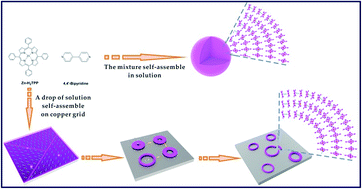
We synthesized (5,10,15,20-tetrakisphenyl-porphine) zinc (ZnTPP), and investigated its self-assembly behaviour with 4,4′-bipyridine (Bipy) via different self-assembly protocols. The self-assembly experiments were performed in organic solvents and on a carbon-coated copper grid, which gave well-defined nanospheres and microrings, respectively.
To date, a variety of metalloporphyrin nanostructures such as spheres, tubes, rods, sheets, wires, and rings, have been reported.13–18 Shelnutt et al. synthesized Sn(IV) 5-(4-pyridyl)-10,15,20-triphenyl-porphyrin dichloride and obtained porphyrin nanosheets by self-assembly.19 Nguyen et al. reported narrowly dispersed porphyrin nanowires with tunable lengths which were synthesized using an amphiphilic polymer surfactant, Pluronic F127.20 Liu et al. constructed porphyrin self-assembled morphologies from nanospheres to nanofibers with a tunable length by surfactant-assisted method.21 More recently, the ring-shaped architectures are attractive because of their resemblance to the light harvesting complexes in natural photosynthetic systems, such as bacterial light-harvesting complex LH2, which is arranged in a precise orientation beneficial for the absorption of light and transportation of light energy.22,23 The ring-shaped molecular aggregates have also been reported by several researchers.24–29 Nolte group reported an interesting phenomenon porphyrin “wheels” formation and also proposed the mechanism for the formation of these types of assemblies.26 In this way, although many efforts have been devoted to the self-assembly behaviour of metalloporphyrins, which resulted in some interesting assembled morphologies, we can find there are few reports on the tuneable morphologies by the simple assembled protocols.
In this report, we employed simple metalloporphyrin i.e. zinc-5,10,15,20-tetraphenyl-porphine (ZnTPP) molecule, and study its self-assembly behaviour via its complexation with 4,4′-bipyridine (Bipy). The tunable self-assembled morphologies have been controlled by solvophobic effect.30 Firstly, the self-assembly of ZnTPP and Bipy in various solvents was investigated using UV-vis absorption spectroscopy and fluorescence spectra; secondly, nanostructures were determined by transmission electron microscopy (TEM), atomic force microscope (AFM).
The general molecular structures of Zn-TPP and Bipy are illustrated in Scheme 1. The synthesis of ZnTPP was shown in Scheme S1.† The structure of ZnTPP was confirmed by 1H NMR by the disappearance of singlet peak at −2.7 ppm (assigned to –NH) in TPP spectrum (Fig. S1†). Furthermore, the molecular weight of TPP and ZnTPP was determined by TOF-MS, which was in good agreement with theoretical molecular weight (Fig. S2 and S3†). In the FT-IR spectrum, the characteristic strong band around 1630 cm−1, corresponding to the C
N stretching vibration of pyrrole, splitted into two peaks, which meant that the Zn–N metal–ligand coordination was formed (Fig. S4†).31
Initially the self-assembly experiments were performed by mixing chloroform solution of ZnTPP with Bipy solution in a glass sample vial, followed by continuous stirring for two weeks. TEM images of such self-assemblies showed uniform spherical aggregates with the diameter about 150 nm (Fig. 1a). Hydrodynamic diameter (Dh) of these spheres was also measured from dynamic light scattering (DLS), which was found around 180 nm.
To understand more about the self-assembly behaviour, we changed the solvent and further performed self-assembly experiments in dichloromethane and carbon tetrachloride solution, respectively. Similar to the previous case, uniform spherical aggregates of diameter about 120 nm and 310 nm were observed by TEM images (Fig. 1b and c), while the hydrodynamic diameters (Dh) were about 160 nm and 350 nm, respectively (Fig. 1e and f).
However, on changing the self-assembly protocol, the spherical assembled morphology was also changed. Well-defined ring-shaped morphology was observed when a droplet of chloroform solution of ZnTPP and Bipy (2.5 × 10⁻⁴ M) was placed on a carbon-coated copper grid (the copper grids were placed in high humidity in a closed container in advance) and the solution was allowed to evaporate in high humidity in a sealed container. The humidity was created by placing small pieces of wet tissue into the container for 1 h. The sample was then taken out from the container and dried under ambient conditions. For further insight into the morphology, different solvents (carbon tetrachloride and dichloromethane) were used with the same assembly protocol.
The self-assembled morphologies of ZnTPP with Bipy were characterized by TEM. As shown in Fig. 2a–c, the well-defined rings could clearly be observed. Upon analysing the images, the size of the rings is not uniform with the average diameter about 300–1000 nm and the width of the rim in range of 10–50 nm, respectively. From dichloromethane to chloroform and then to carbon tetrachloride, we could find that the rings became gradually perfect since the boiling points of these solvents also increased successively and the high boiling point made the evaporation process more smooth and steady. To further study the effect of concentration on assembled morphology, the self-assembled experiment was performed with the higher concentration (1.0 × 10⁻³ M). The TEM image was shown in Fig. 2d, where the diameter of rings and the width of the rim increase to about 4 μm and 100 nm, respectively.
The morphologies of these aggregates were also investigated by AFM (Fig. 3), which were relatively in accordance with those shown in TEM images. It was observed that the size of uniform spherical aggregates was about 350–420 nm (Fig. 3a–c), which was larger than that of the TEM images. The difference in size between AFM and TEM measurements should be resulted from the pinpoint effect and convolution effect in AFM measurement.36 However, the diameter of the ring-shaped architectures was about 5–20 μm (Fig. 3d–f), which was quite different from the images observed by TEM due to the forming of rings on different substrates. Additionally, from dichloromethane to chloroform and then to carbon tetrachloride, we could also find that the rings became gradually perfect.
As the self-assembly behaviour could directly be envisioned via absorption spectra and emission spectra of porphyrins, we performed the UV-vis and fluorescence analysis of the self-assembled solutions to get further insights of the complexation. Fig. 4 showed UV-vis absorption of ZnTPP solutions and the mixture solutions of ZnTPP with Bipy in dichloromethane, chloroform, and carbon tetrachloride separately. One intense peak centred at 418 nm (Soret-band, characteristic absorption of the electronic spectrum of porphyrin) and a less intense band at 548 nm (Q band) were all observed in absorption spectra of ZnTPP, which was in agreement with the previous literature.32 After adding Bipy, we found that the Soret-band was clearly red-shifted to 421 nm. Similarly, the red shift in Soret band of ZnTPP solution also occurred in both chloroform and carbon tetrachloride with the addition of the Bipy (Fig. 4b and c), indicating the complexation between ZnTPP and Bipy. Moreover, the fluorescence spectra were also performed (Fig. S5†). Once adding Bipy to the solutions of ZnTPP, the fluorescence was clearly quenched at both 590 nm and 648 nm, suggesting the aggregation of ZnTPP molecules formed from the complexation between ZnTPP and Bipy in the form of one Bipy with dimeric porphyrins.
![]() | ||
| Fig. 4 UV-vis absorption spectra of ZnTPP and the mixture solution of ZnTPP and Bipy in (a) dichloromethane, (b) chloroform and (c) carbon tetrachloride. | ||
To further confirm the complexation between ZnTPP with Bipy, 1H NMR measurements were performed in CDCl3 (Fig. 5). It can be seen that the signals of protons on both ZnTPP and Bipy moieties exhibited obvious change with the adding Bipy to ZnTPP solution. The proton signals H1 (8.75 ppm) and H2 (7.55 ppm) on Bipy shifted to the high field region at 6.01 ppm and 5.12 ppm, respectively (Fig. 5c). The proton H3 (8.95 ppm), H4 (8.22 ppm), H5 (7.76 ppm) on ZnTPP also exhibited slight change in their chemical shifts at 8.80 ppm, 8.12 ppm, 7.70 ppm, which meant the complexation occurred between ZnTPP and Bipy.
On the basis of the above-mentioned research results, we could propose an interpretation for the results in our present systems, as schematically illustrated in Scheme 2. Zinc complexes of porphyrins could bind ligands containing nitrogen, oxygen and sulphur. 4,4′-Bipyridine (Bipy) was a classical ligand towards zinc complexes of porphyrins since ligands containing nitrogen were more stable. In our work, the mixing of ZnTPP with Bipy in the solvents either dichloromethane, chloroform, or carbon tetrachloride may result in “sandwich” complexation structure of one Bipy with dimeric porphyrins, in which Bipy ligand was perpendicular to the porphyrin planes.8,33 When the mixed solution was kept stirring for two weeks, the dimeric building blocks in the solution slowly aggregate. Due to π–π interactions, the porphyrin plane of one dimeric building block connected with the porphyrin plane of the other one building block. Just in this way, the spherical aggregates were obtained, where the building block probably arranged in a random way.
For the ring-shaped architecture, the possible formation mechanism so-called “pinhole mechanism” (or “2D-bubble mechanism”) of the rings was suggested. The ring-shaped molecular aggregates were formed as a result of a complex process due to the effect of hydromechanics and surface34,35 When a drop of mixing solution was placed on carbon-coated copper grids in high humidity, a liquid film was formed on the surface of copper grids, and then the film started thinning with evaporation of the solution resulting in nucleated holes. At this stage a balance between the thinning by evaporation of solvent and the wetting of the surface of copper grids occurred. The pinholes opened when the porphyrin building blocks were aggregated around the growing inner perimeter. The pinhole sites became larger and the concentration of solution increased since the evaporation progress continued. The speed of evaporation was higher at the circumference of the holes than at the most of the solution film. In order to compensate for this loss of liquid, the solute was transported inward by the convection, which further resulted in an increase in concentration at the inner circumference of the ring structures. The porphyrin rings are then formed by evaporating the rest of the solvent. In this case, a drop of ZnTPP and Bipy solution was placed on a carbon-coated copper grid in high humidity, and a film formed first. The surface is dewettable to chloroform, dichloromethane and carbon tetrachloride due to the adsorption of water molecules, and then the pinhole opened in the film. The porphyrin “sandwich” building blocks are collected around the holes. After the solvent was completely evaporated, the columnar stacks were deposited in a face-to-face manner radially around the holes, and then porphyrin rings formed.
Footnotes |
| † Electronic supplementary information (ESI) available. See DOI: 10.1039/c4ra10087e |
| ‡ Interdisciplinary Research Center in Biomedical Materials, COMSATS Institute of Information Technology, Lahore, Pakistan. |
| This journal is © The Royal Society of Chemistry 2014 |