



Structural variation from heterometallic heptanuclear or heptanuclear to cubane clusters based on 2-hydroxy-3-ethoxy-benzaldehyde: effects of pH and temperature†
Abstract
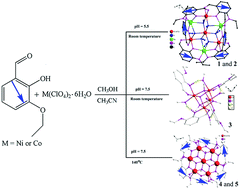
Five new Hheb complexes, HN(C2H5)3·[M4Na3(heb)6(μ3-N3)6], (M = Ni (1), and Co (2), [Co4(heb)4(μ3-OCH3)4(μ1-HOCH3)4]·(H2O)2 (3), [M7(heb)6(μ3-OCH3)6]·(ClO4)2 (M = Ni (4), and Co (5), Hheb = 2-hydroxy-3-ethoxy-benzaldehyde), were synthesized by reaction of hexahydrate perchlorate salt, Hheb, and NaN3 under different temperature and pH conditions. Careful investigation of the effect of the reaction temperature and pH resulted in a series of compounds with different compositions and nuclearities. The diverse compounds obtained illustrate the marked sensitivity of the structural chemistry of Co- or Ni-Hheb ligand-like systems to synthesis conditions. Complexes 1 and 2, which are heterometallic heptanuclear anion [M4Na3(heb)6(N3)6]− clusters, are formed at a pH of 5.5 and at room temperature. At a pH of 7.5 and at room temperature, a neutral molecular cubane cluster, namely 3, is formed with a lower nuclearity. Further increase of the reaction temperature to 140 °C at the same pH resulted in formation of two heptanuclear cation [M7(heb)6(μ3-OCH3)6]2+ clusters, 4 and 5. The results show that the pH and reaction temperatures play a key role in the structural control of the self-assembly process. Interestingly, heterometallic heptanuclear anion [M4Na3(heb)6(N3)6]− clusters have never been reported for the family of μ3-N3− or μ3-O-bridged heptanuclear clusters. The magnetic properties of 1–5 were investigated and are discussed in detail.
 Please wait while we load your content...


