
Avinash Baji*ab,
Yiu-Wing Maia,
Rattikorn Yimnirunc and
Sujitra Unruand
aCentre for Advanced Materials Technology (CAMT), School of Aerospace, Mechanical and Mechatronic Engineering J07, The University of Sydney, Sydney, Australia
bEngineering Product Development (EPD) Pillar, Singapore University of Technology and Design (SUTD), Singapore, Singapore. E-mail: avinash_baji@sutd.edu.sg; Fax: +65-6779-5161; Tel: +65-6499-4502
cSchool of Physics, Institute of Science, Suranaree University of Technology, Nakhon Ratchasima, Thailand
dDepartment of Materials Engineering, Faculty of Engineering and Architecture, Rajamangala University of Technology Isan, Nakhon Ratchasima, Thailand
First published on 20th October 2014
In this study, we use a versatile sol–gel based electrospinning technique to fabricate nanostructured barium titanate (BaTiO3)/cobalt ferrite (CoFe2O4) composite fibers and analyze their magnetoelectric response. Scanning and transmission electron microscopy images indicate that the obtained fibers are composed of fine grains which are self-assembled and arranged. X-ray diffraction (XRD) studies of the composite fibers revealed the presence of perovskite and spinel structures corresponding to BaTiO3 and CoFe2O4 phases, respectively. The magnetic hysteresis loops of the resultant fibers showed that the fibers were ferromagnetic with magnetic coercivity of 650 Oe and saturation magnetization of 31 emu g−1. Moreover, the magnetoelectric coefficient developed on the surface of the fibers was measured as a function of the applied external DC magnetic field. A maximum magnetoelectric coefficient of 13.3 mV cm−1 Oe−1 was determined for the composite fibers, which is much higher than the commonly reported values for bulk or thin film counterparts. The large magnetoelectric coefficient of the composite fibers was attributed to the nano-sized grains and their arrangement within the fibrous geometry. The intimate contact and the large interfacial area presented by the nanostructures ensured that the composites displayed strong magnetoelectric behavior. Such composite fibers show tremendous potential for magnetic field sensor applications and for magnetoelectric devices.
The numbers of monophasic multiferroic materials that are capable of displaying the ME effect are limited because it is difficult for the electric and magnetic dipoles to coexist at ambient temperatures within the asymmetrical structures.10,11 Furthermore, the ME effect in monophasic materials is usually very small.12,13 Hence, many efforts have been directed towards fabrication of two-phase hetero-structures. ME composites consisting of two phases offer greater flexibility, multi-functionality, and higher ME coupling compared to naturally occurring monophasic materials.1,2,13,14 The ME effect in such composites depends on the magnetic-strain-electrical coupling between the magnetostrictive and ferroelectric phases.1,15 When a magnetic field is applied, the magnetostrictive phase within the composite induces a strain in terms of a change in dimensions, which in turn transfers the stress to the ferroelectric phase, resulting in an electric polarization.2,3,16 This strong coupling enables composites capable of displaying large ME coefficients.9 However, obtaining good interfacial bonding between the phases is a prerequisite for fabricating composites which are capable of displaying significant ME effects.17 Composites fabricated using conventional techniques, such as sintering, microwave sintering and hot pressing are found to exhibit low ME coefficients due to the presence of micro-cracks, impurity phases, non-ideal interfaces between the phases, defects, and high leakage currents.2,18,19 To address this issue, recent studies have focused on fabricating nanostructured composites.15,20–22 It has been demonstrated that the nanometer length scale of the constituent phases within the composites ensures strong interfacial coupling and intimate contact between the phases.15,16,23
Herein, we report the fabrication of nanostructured composite fibers using a sol–gel enabled electrospinning technique, hitherto unexplored, and demonstrate that these fibers display well-defined ME behavior. Indeed, very few studies24–26 have explored the magnetoelectric behavior of electrospun fibers. These studies used piezoresponse force microscopy (PFM) to investigate the local magnetoelectric coupling of the fibers. Magnetic domain patterns were obtained in response to external electric fields imposed on the fibers to confirm the presence of ME coupling. Here, we obtain BaTiO3/CoFe2O4 composite fibers using electrospinning enabled techniques and investigate the ME coefficient of the fibers as opposed to using PFM to probe the local ME coupling and estimating their ME coefficient. The ME coefficient values for bulk composite typically vary between 0.19 to 4 mV cm−1 Oe−1.10 We demonstrate that electrospinning is not only useful to fabricate BaTiO3/CoFe2O4 composite fibers but it can also help achieve composites that display sizeable ME coefficients. BaTiO3 and CoFe2O4 are chosen in this study as they are individually known to display good ferroelectric and ferromagnetic behaviors, respectively. In the composite fiber form, they combine the electric and magnetic polarizations to exhibit a prominent ME effect. These one-dimensional ME fibers are suitable for many applications, such as microelectric devices, electromagnetic devices and nano-systems among others.
:
1 between CoFe2O4 and BaTiO3.
000 in 11 g of DMF–ethanol solvent mixture (1
:
1 wt/wt). Solution A was added to the PVP solution drop-wise and under constant stirring condition; then, solution B was added drop by drop. The mixture solution was stirred for 24–36 h until a homogenous solution was obtained.
A syringe with a 23-gauge metal needle was used to electrospin the mixture solution. Electrospinning was conducted at 21 kV and the flow rate of the solution was 0.07 mm min−1. 15 cm spacing was used between the tip of the needle and the collector surface.
The obtained fibers were initially dried in an oven at 100 °C for 24 h and subsequently transferred to a furnace for thermal annealing. The fibers were heated from ambient temperature to 750 °C. The heating rate was 5 °C min−1 and the dwelling time at 750 °C was 1 h.
000 Gauss to −18
000 Gauss and back to 18
000 Gauss.Our results demonstrate that these fibers composed of nanostructured BaTiO3 and CoFe2O4 grains display well-defined ferromagnetism and ME coefficient.
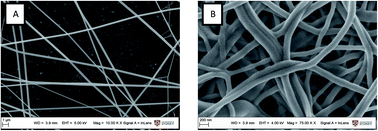
The surface morphology of as-spun fibers and fibers obtained after thermal annealing is evaluated using SEM. Fig. 1A and B show such images of as-spun fibers and BaTiO3/CoFe2O4 fibers, respectively. The as-spun precursor fibers in Fig. 1A show an average fiber diameter of 300 nm with a smooth fibrous morphology. After thermal annealing, brownish black fibers, tens of micrometers in length, are formed. It is clear from Fig. 1B that the resultant BaTiO3/CoFe2O4 fibers retained their fibrous morphology. However, the diameter of BaTiO3/CoFe2O4 fibers is reduced to 140 ± 30 nm, which is attributed to the decomposition of the polymer and crystallization of BaTiO3/CoFe2O4.
Fig. 2 shows typical TEM images of a BaTiO3/CoFe2O4 composite fiber. It is evident that the fiber is composed of fine nanoparticles that are linked and tightly bound. Fig. 2B shows that the linked particles display interference of two crystallographic orientations, which originate from the crystals of BaTiO3 and CoFe2O4. A magnified image using Digital Micrograph software identified the crystallographic phases by measuring the inter-planar spacing, d. BaTiO3 is identified by the (100) plane, while CoFe2O4 the (220) plane. Fig. 2B also demonstrates that the BaTiO3 and CoFe2O4 particles are in close proximity with each other. These results confirm the formation of crystalline BaTiO3/CoFe2O4 composite fibers.
![]() | ||
| Fig. 2 (A) TEM micrograph of BaTiO3/CoFe2O4 composite fiber. (B) High magnification TEM micrograph of a selected region. The image in (B) shows clearly the crystalline lattice structures. | ||
X-ray diffraction patterns of the samples are also obtained to confirm the crystalline phases corresponding to BaTiO3 and CoFe2O4. The XRD patterns of the as-spun precursor fibers (not shown in Fig. 3) do not show any peaks, which indicate that the as-spun fibers are amorphous. However, XRD patterns of the thermally annealed sample (Fig. 3) shows clear distinct peaks, confirming that the sample is polycrystalline. The diffraction pattern peaks are indexed to the reflections of BaTiO3 and CoFe2O4 phases.10,20,27 This illustrates that the BaTiO3 and CoFe2O4 phase evolution occurs from the amorphous solid phase and during the thermal annealing process. The phases are distinct and appear well segregated. All the reflections can be indexed according to the structures of BaTiO3 and CoFe2O4 (ref. 10,11 and 23). Thus, it confirms the presence of both perovskite and spinel phases corresponding to BaTiO3 and CoFe2O4, respectively (JCPDS card number 81-2196 and JCPDS card number 22-1086). The presence of a few unidentified peaks suggests some form of chemical reactions between BaTiO3 and CoFe2O4 phases during sintering. The peak seen at 37° corresponds to the Co3O4 impurity phase (JCPDS card number 42-1467).
Next, we investigate the multiferroic properties of the fabricated composite fibers by measuring their ferromagnetic and direct ME coupling behavior. The magnetic hysteresis loop of the composite fiber measured along the in-plane direction and at room temperature is given in Fig. 4 and is typical of magnetic materials.6,15,21,28 This indicates the existence of an ordered magnetic structure in the fibrous composite. The saturation magnetization of the BaTiO3/CoFe2O4 composite fiber is determined from the intercept to the y-axis (magnetization) as 1/H approaches zero. Hence, the saturation magnetization (Ms) of the sample is ∼31 emu g−1. It is evident from Fig. 4 that the hysteresis loop is asymmetrical about the origin and is displaced to its left. Such displaced hysteresis loops are often seen in composites due to the exchange anisotropy at the ferromagnetic/anti-ferromagnetic interface.29,30 The exchange interactions between ferromagnetic and anti-ferromagnetic materials result in the displacement of the hysteresis loops. Our samples are composites consisting of a ferrite phase and a ferroelastic phase. These phases are randomly dispersed within the fiber geometry, causing lattice distortion of the ferrite phase. Hence, the stress generated by this lattice distortion and magnetoelastic coupling between the phases may be responsible for the displaced hysteresis.31 The presence of the piezoelectric phase within the composite should also play a role in influencing the hysteresis behavior. This is also supported by the results of Rizwan and co-workers.29,30 They suggest that the coupling between the ferromagnetic and piezoelectric domains and the hindrance to the magnetic ordering of the ferrite phases provided by the ferroelectric phase leads to the asymmetrical hysteresis loops. Study of the exact mechanism responsible for the displaced M − H hysteresis loop is beyond the scope of this work. The coercive field for asymmetric loops can be defined by: Hc = (Hc1 − Hc2)/2, where Hc1 and Hc2 are the right and left coercive fields of the hysteresis loop. Thus, the coercive field is determined to be ∼670 Oe. This magnetic coercive field depends on several factors including magneto-crystalline anisotropy, grain size, interface, defects, doping and nature of the surface.23 The low value of the coercive field recorded at room temperature indicates that the BaTiO3/CoFe2O4 composite fibers are magnetically soft and show tremendous potential for device applications.13 However, the coercive field determined for BaTiO3/CoFe2O4 composite fibers is slightly higher than the theoretical coercive field 430 Oe of CoFe2O4.32 We attribute this to the presence of the BaTiO3 phase, which is a non-magnetic phase and makes the magnetization difficult.28
![]() | ||
| Fig. 4 Magnetic hysteresis loop of BaTiO3/CoFe2O4 composite fibers recorded at 300 K. The magnetic hysteresis loop confirms the ferromagnetic behavior of the fibers. | ||
The saturation magnetization of these composite fibers obtained using the electrospinning technique is found to be higher than the saturation magnetization of some of the ferrite/ferroelectric composite systems reported in the literature.13,27,28 The higher Ms of our composite fibers can be attributed to the unique processing method. Similar results are obtained by Arias et al.33 They show that electrospinning leads to elongated grains of the ferrite fibers possessing enhanced magnetic properties. These results are well supported by theory, which predicts that fibrous systems having grains arranged and aligned in a linear chain configuration will have their magnetic dipoles also aligned along the fiber axis. The interaction between the dipoles of neighboring grains and the alignment of dipoles contribute towards the enhancement of saturation magnetization.21,33–35 However, the Ms value for the composite fibers is lower than the theoretical value of 71 emu g−1 for pure CoFe2O4.32 This is caused by the presence of the non-magnetic BaTiO3 phase within the composite.
Fig. 5 shows the dependence of the ME coefficient of the composite fibers on the DC magnetic field. The ME coefficient recorded for the composite fibers is a measure of changes in the electric voltage in response to the applied external magnetic field. During the measurements, a small AC magnetic field (HAC) of 5 Oe is used in conjunction with the DC magnetic field (HDC). It is evident from Fig. 5 that the BaTiO3/CoFe2O4 composite fibers have a small initial ME coefficient value near zero magnetic bias. At zero magnetic field, the ME coefficient of the composite fibers is ∼1.7 mV cm−1 Oe−1. As the magnetic field is increased, the ME coefficient of the composite fibers shows an approximate linear increase with magnetic field and attains a maximum value of 13.3 mV cm−1 Oe−1 at DC magnetic field of ∼1810 Oe. At magnetic field greater than 1810 Oe, the ME coefficient value saturates and then decreases with magnetic field. The value (13.3 mV cm−1 Oe−1) at which ME saturates is taken as the ME coefficient of the composite fibers.
![]() | ||
| Fig. 5 Dependence of the magnetoelectric (ME) coefficient of BaTiO3/CoFe2O4 composite fibers on the DC magnetic field. An AC magnetic field of 5 Oe was applied during the measurements. | ||
Table 1 summarizes the results of some current CoFe2O4/BaTiO3 ME composites. Evidently, the ME coefficient we obtained is much larger than those commonly reported on ME coefficient of BaTiO3/CoFe2O4 composites prepared from core–shell powder or powder10,11,36–39 and comparable to those containing nano-lamellar bicrystals.40 This indicates strong coupling between the ferroelectric (BaTiO3) and ferromagnetic (CoFe2O4) phases in our fabricated composite fibers. Differences in ME coefficient values reported in the literature may be due to differences in sample characteristics such as constituents, compositions of compounds, sintering temperature, microstructure, size, etc.10,41 For example, coupling between the phases can be improved by increasing the sintering temperature. However, high sintering temperature can lead to the formation of Fe2+ ions in the ferrite phase. These Fe2+ ions can reduce the electrical resistivity of the composite, which is important to achieve a high ME signal.36 Nie et al.41 reported a high ME coefficient value of ∼17 mV cm−1 Oe−1 for their composite particles. They sintered the samples at 1200 °C for 2 h and were able to control the crystallite size of their composite between 35 and 80 nm. Furthermore, their samples were poled before the ME measurements were made. However, low ME values (0.3 to 2 mV cm−1 Oe−1) were also reported in other studies10,11,38 for similar composites. This could be because of the high sintering temperature and the duration for sintering used for sample preparation. For example, Corral-Flores et al.38 sintered the samples at 1200 °C for 12 h. In addition, the sizes of BaTiO3 and Co2FeO4 in the composite were much larger at ∼2 μm. These factors could explain the differences in ME coefficient values reported for composite particles in ref. 41 and 38.
| No. | Composite morphology | CoFe2O4 : BaTiO3 ratio |
Characteristic size | Ms (emu g−1) | ME coefficient (mV cm−1 Oe−1) | Ref. |
|---|---|---|---|---|---|---|
| 1 | Fibers | 1 : 1 |
140 nm | 31 | 13.3 at ∼2 kOe | This study |
| 2 | Core–shell powder | — | 10 nm | 72 | 3.4 at 1 kOe | 11 |
| 3 | Core–shell powder | — | 10 nm | 72 | 2 at 1 kOe | 10 |
| 4 | Powder | 1 : 4 |
— | 16 | 0.43 at ∼5.2 kOe | 36 |
2 : 3 |
— | 30 | 0.375 at ∼5.7 kOe | |||
| 5 | Core–shell powder | 2 : 10 |
40 nm | — | 0.3 | 38 |
3 : 10 |
0.48 | |||||
4 : 10 |
1 | |||||
5 : 10 |
1.47 | |||||
6 : 10 |
0.42 | |||||
| 6 | Multi-layered composite | — | CoFe2O4 – 150 nm; BaTiO3 – 100 nm | ∼90 | 0.036 at 2.8 kOe | 45 |
| 7 | Powder | 1 : 1 |
50–80 nm | 37.5 | 17.04 at 2 kOe | 41 |
| 8 | Nano-lamellar bi-crystals | 1 : 1 |
— | — | 20 at 10 Oe | 40 |
| 9 | Feather-like nanostructures | — | Diameter – 250 nm; length – 5 μm | 20 | 51 at 3 kOe | 42 |
| 10 | CoFe2O4 nanorods embedded in BaTiO3 matrix | 7 : 13 |
Thickness – 400 nm | ∼400 (emu cm−3) | 1.2 × 10³ | 43 |
Studies which have reported even higher ME coefficient values fabricated composites by dispersing CoFe2O4 nanorods within the BaTiO3 matrix phase. The dispersion of single crystal nanorods within the BaTiO3 matrix played a role in enhancing the interfacial area between the ferroelectric and ferromagnetic phases and also ensured good ME coupling between these two phases.42,43 For example, Bai et al.43 reported a ME coefficient of 1.2 × 10³ mV cm−1 Oe−1. Such a high ME coefficient value could be attributed to the large interfacial area obtained by dispersing CoFe2O4 nanorods within the BaTiO3 phase. Also, the ME coefficient values were obtained using piezoresponse force microscopy (PFM), which only measured the local ME response. BaTiO3 phase was electrically poled prior to ME measurements to increase its ferroelectric response. It is well-known that when the PFM tip contact the sample surface for measurements, it exerts a compressive stress of ∼100 MPa.44 This stress is large enough to induce strains in the local piezo/ferro electric domains, which has an effect on the measured ME coefficient. Similarly, Deng et al.42 used hydrothermal reaction and polymer assisted deposition to fabricate single crystal CoFe2O4 nanorods embedded in BaTiO3 matrix and obtained a ME coefficient of 51 mV cm−1 Oe−1. This quite high ME coefficient value obtained is attributed to the large interfacial area induced by the nano-sized CoFe2O4 and BaTiO3 phases and ‘perfect interface’ achieved by using polymer assisted deposition. It should be noted that multi-layered BaTiO3/CoFe2O4 composites45 give the lowest ME coefficient value.
It is well-known that the ME effect in composites is a product tensor property and is typically affected by (i) the geometry and morphology of the phases, (ii) interfacial bonding between the phases, (iii) individual properties of each constituent phase, and (iv) thickness and number of magnetostrictive and ferroelectric phases.2,3,5 In our work, we believe the increased ME coefficient is a direct result of the electrospinning process. Electrospinning followed by thermal annealing of precursor fibers leads to the formation of composite fibers composed of BaTiO3 and CoFe2O4 grains. The grain sizes of individual phases are in the range of tens of nanometers. Nanoscale sizes of these grains can induce large interfacial area, which will favour elastic interactions between the ferroelectric and ferromagnetic phases. It is also known that large interfacial area and good phase connectivity play a role in contributing to the strong ME effect. Moreover, it is clear from the TEM images in Fig. 2 that the obtained fibers have BaTiO3 and CoFe2O4 in close proximity. This ensures that the phases are tightly bound and the strains can be readily transferred to the neighboring grains. Hence, the phase-connectivity of these nanostructures also contributes towards the ME effect of the composite.
Further increase in magnitude of the magnetic field beyond the critical value of 1810 Oe leads to decreasing ME coefficient values. Ferromagnetic materials can change their shape during the process of magnetization and this property is called magnetostriction. As the magnetic field is increased, the magnetostriction increases gradually and attains a maximum value. During this stage, the strain produced in the ferromagnetic material is transferred to the ferroelectric BaTiO3 phase due to the coupling between the ferromagnetic and ferroelectric phases. The ferroelectric phase produces a voltage in response to the strain. Beyond ∼1810 Oe, the magnetostriction and the strain produced in the composite would produce a constant electric field in the ferroelectric phase. Thus, beyond saturation magnetization, the magnetostriction and the strain produced in the CoFe2O4 phase generates a constant electric field in the piezoelectric BaTiO3 phase.39 This suggests that change of electric field (dE) per applied magnetic field change (dH), dE/dH, which is a measure of magnetoelectric coefficient, decreases as the magnetic field is increased beyond the critical value of ∼1810 Oe. Thus, the magnetostrictive coefficient reaches saturation at ∼1810 Oe. This explains why the ME coefficient increases initially and then begins to decrease when the applied magnetic field is increased beyond a critical value. This trend in the ME coefficient versus magnetic field can be attributed to the spinel ferrite phase of CoFe2O4.10,11,39
| This journal is © The Royal Society of Chemistry 2014 |