Directed self-assembly of genomic sequences into monomeric and polymeric branched DNA structures

Ashok K. Nayakab and Umakanta Subudhi*ab
aBioresources Engineering Department, CSIR-Institute of Minerals & Materials Technology, Lab #229, Bhubaneswar 751 013, India. E-mail: usubudhi@immt.res.in
bAcademy of Scientific & Innovative Research (AcSIR), New Delhi 110 025, India

Received 19th August 2014 , Accepted 6th October 2014

First published on 8th October 2014


Abstract

It is demonstrated that error-free hybridization between primers and its complementary sequences can act as the driving force to construct monomeric as well as polymeric branched DNA materials by molecular self-assembly. The mechanism, stability and application of the self-assembled products have been described.
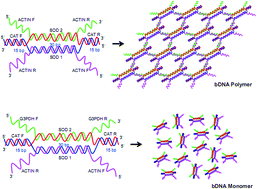

Deoxyribonucleic acid, the master molecule of heredity, is now considered as a powerful material in the field of nanoscale engineering.1 In the last 31 years, DNA hybridization-based self-assembly principles have been extensively explored to generate diverse nanostructures,2 three dimensional objects,3 DNA nanomachines,4 and assembled nanomaterials.5 Particularly, the breakthrough came with the concept of ‘DNA origami’, in which a long scaffold strand of M13 phage genome was folded with the help of hundreds of short staple strands into defined 2D shapes.1b However, the development of more advanced structures and applications will require a number of issues to be addressed. The most significant of which is the high-error rate of self-assembly.6 We are interested in approaching the above issue in an alternative perspective. The error-free hybridization between primers (or probes) and its complementary sequences can be utilized for construction of DNA nanostructure. Such oligonucleotides have already proven to be highly specific during polymerase chain reaction,7 microarrays8 and in situ hybridization.9 In cDNA synthesis or probe-hybridization reaction, a particular oligo selectively binds to its complementary sequences in the presence of thousands of diverse mRNAs. In the present study, these oligos are explored for molecular self-assembly.

Moreover, evolutionary stable genomic DNA is the mother of all structural and functional diversities of protein, ribozyme, and different RNAs; hence, numerous stable nanostructures with diverse functions can be designed utilizing the genomic sequences for the application in DNA nanotechnology. Various structural and functional DNA tiles, 2D DNA origami and super-origami structures can thus be attained using linear genomic sequences as building blocks.

In this communication, a remarkably simple strategy has been presented for the designing of oligos from the genomic sequences of Rattus norvegicus for the generation of monomeric and polymeric branched DNA (bDNA) materials. Hybridizing portion of each oligo was derived from the primers of different genes (β-actin, catalase, G3PDH, SOD1 and SOD2), which we have earlier10 used for gene expression studies (Scheme 1). Currently, two sets of four oligos with 3T or 5T in the loop were designed to self-assemble for rigid or flexible monomeric structure (Table 1, Fig. S1). Since consecutive oligos have nearly 50% complementarity, self-assembly between two oligos either results into internal bubble or external single stranded overhangs (Scheme 2). Each monomer contains 15 nt long overhangs for the self-assembly to occur in one plane to form the two-dimensional arrays of polymeric bDNA materials.11 A quick self-assembly process was followed for the generation of bDNA structures.12 The mechanism, stability and application of the self-assembled products have been demonstrated through native polyacrylamide gel electrophoresis (nPAGE). The nature of the bDNA conformation has been examined by circular dichroism (CD) spectroscopy, whereas structural stability in solution was assessed by DNA melting curve analysis.


image file: c4ra08873e-s1.tif
Scheme 1 Sequence design of the 4 oligos (strands A, B, C, and D with 3T loop and E, F, G, and H with 5T loop). The four different strands are derived from exon regions of β-actin, SOD1, SOD2, and CAT.
Table 1 Oligos derived from different genes are used for self-assembly study
image file: c4ra08873e-u1.tif


image file: c4ra08873e-s2.tif
Scheme 2 Schematic representation of putative structures of self-assembled oligos in different combinations. Monomer-I with complementary overhangs further self-assemble into polymeric bDNA structure in solution.

To verify the oligo designing strategy and their selective hybridization, different oligonucleotides were allowed to hybridize among themselves and analyzed in nPAGE. As expected, individual oligos did not hybridize with each other since they are not self-complementary. It is also noticed that strands A and C, strands B and D, strands E and G, or strands F and H never interacted with each other (Fig. S2a). Hence, these unpaired oligos migrated equally to the distance of individual oligos without forming di-oligo complexes, which is similar to the earlier observations.13 With equimolar concentration complementary oligos hybridized to form di-oligo complexes and appeared only one band in the nPAGE (Fig. S2b–e). These complexes have much slower mobility than the individual oligos, while little deviation in ratio leaves some unused oligos. This indicates that designed oligos are interacting as expected without any agglomeration or undesired products; hence, this ensures error-free hybridization among the oligos for the self-assembly study. Henceforth, equimolar concentration (1 μM) of oligos was used in all the reactions.

To generate polymeric structure and its associated di- and tri-oligo complexes, equimolar concentration of PAGE purified oligos (strands A, B, C, and D or strands E, F, G, and H) were allowed to hybridize among each other in different combination. Since the electrophoretic mobility of a nucleic acid oligomer or its assembly in non-denaturing condition is a function of its size, shape, and extent of base pairing, both the molecular mass and conformational based retarded mobility of DNA complexes were observed in 10% nPAGE (Fig. 1a and b). Band shifting among di-, tri-, and tetra-oligo complexes is due to higher molecular mass because more number of oligonucleotides (two to four) are involved gradually in the self-assembly process. On the contrary, differential mobility among the di- or tri-oligo complexes is because of differential structural conformations of the assembled bDNAs (Fig. 1c and d), which corroborates with earlier observation.13 The overhangs of monomer units self-assemble themselves and results into polymeric bDNA structures. This large structure could not migrate through 10% nPAGE, and hence it appeared near the well. This finding is in line with the earlier reported complex DNA nanostructures in nPAGE.14 Self-assembly among desalted oligos have also resulted similar bDNA structures as compared to PAGE purified oligos (Fig. S3). Moreover, for the first time, it is evident that desalted-oligos are equally competent to participate in the self-assembly process for the generation of bDNA structures. Hence, they may be preferred in some applications, in which PAGE purified oligos are not essential.


image file: c4ra08873e-f1.tif
Fig. 1 Characterization of the self-assembled bDNA structures in nPAGE (10%). The sample composition is labeled on the top of each lane. (a and b) Self-assembly of PAGE-purified oligos. (c and d) Representing gels showing the differential migration of individual oligos (A or E), non-complementary oligos (A, C or E, G), di-oligo complexes (BC, AB, AD, FG, EF, and EH), tri-oligo complexes (ABC, ABD, EFG, and EFH), monomeric (ABCD and EFGH) and polymeric structures. The identities of all bands are suggested in the middle of the gels.

To prove the generality of this approach we replaced the overhangs of oligos (with G3PDH primer), which are responsible for self-assembly process. It was noticed that oligos derived from G3PDH gene (oligos I, J, K and L) are also equally effective as that of β-actin to form the desired product, i.e. IBCJ and KFGL, both with PAGE purified and desalted-oligos (Fig. S4). Hence, the proposed strategy is not confined to any particular set of genes rather any exon region can be explored for the designing of oligonucleotides for self-assembly. Currently, we are actively exploring this strategy for other established DNA nanostructures.

In order to understand the mechanism of self-assembly, our first attempt was to study the role of loop length on the generation of bDNA structures. When the assembled products (strands with 3T and 5T) were electrophoresed in a single gel (Fig. 2), it appeared that oligos with 5T loop produce higher molecular mass structure than their corresponding structures with 3T in the loop. Moreover, the band intensity of polymer units of ABCD and IBCJ is higher than EFGH and KFGL. This suggests that oligos with 3T in the loops dominantly assemble into larger complex because of rigidity as compared to 5T loop.15 Nevertheless, two intense bands of monomer units (monomer-I and II) are clearly noticed with EFGH and KFGL in contrast to ABCD and IBCJ. In Scheme 2, two possible conformations of monomer units are presented, depending on the loop length. Since monomer-I contain free-overhangs (with 3T in the loop), it is suitable for self-assembly process to form the polymeric structure. On the other hand, overhangs containing 5T in the loop are more flexible and hence self-hybridize to form monomer-II.


image file: c4ra08873e-f2.tif
Fig. 2 Characterization of the self-assembled bDNA structures in nPAGE (10%). The sample composition is labeled on the top of each lane. (a and b) Effect of loop length on self-assembly of bDNA structures. The mobility of self-assembled products with 5T is more retarded than 3T.

To know further how monomers I and II are generated and affect the self-assembly process, different combinations of oligos containing 3T and 5T loop were chosen for self-assembly. As a result, AFGD, EBCH, ABGH, and EFCD with their corresponding di- and tri-oligo complexes were produced (Fig. S5). However, when all the polymeric structures were compared in a single gel (Fig. 3a), it was clearly observed that the formation of monomer-I and II is a direct reflection of the loop length. In case of ABCD or IBCJ, monomer-I is observed predominantly, whereas with EFGH or KFGL both monomer-I and II were equally intense. It is interesting to note that AFGD also showed a clear monomer-I, because both the overhangs contain 3T in the loop. When the overhangs are replaced with oligos having 5T in the loop and internal strand containing 3T (EBCH), the monomer-II increased with drastic decrease in the monomer-I. This clearly suggests that monomer-II is only possible when the overhangs contain 5T in the loop, and hence the structure is more relaxed. It is important to note that both monomer I and II are the assembled products of di-oligo complexes AB and CD (Fig. 3b). Therefore, for better yield of self-assembled bDNA materials, individual strand must contain optimal number of thymine in the loop. It is worthy to mention that when the loop length was reduced to zero only polymeric structure appeared near the well (Fig. 3c). This clearly shows that loop length of the oligos is a determining factor for the desired monomeric and polymeric structures. Moreover, the four overhangs of each monomer unit contain 15 nt oligos that bind to adjacent bDNA tiles and result in a 1.5 turn distance. This n + 0.5 turns (n is an integer) between two interacting tiles ensure the bDNA tiles to tessellate a plane instead of forming one-dimensional arrays or tubular structures.11 Hence, the self-assembly would results in two-dimensional arrays of large and regular bDNA material. However, a thorough AFM study is required to know the extent of self-assembly and dimension of the polymeric bDNA structure. Similar to an earlier report,16 the present polymeric bDNA material contains large number of single stranded arms and double stranded ends that can be used in the assembly of heteroelements such as proteins and nanoparticles.


image file: c4ra08873e-f3.tif
Fig. 3 Characterization of polymeric structure. (a) Comparison among self-assembled bDNA structures. Self-assembly among oligos with 3T in the loop results monomer-I while with 5T in the loop results both monomer-I and II. (b) A proposed mechanism of formation of monomer I and II from the self-assembly of AB and CD. (c) Self-assembly among oligos without loop (strands M, N, O, and P or Q, N, O, and R) results only polymeric bDNA structure.

Once it is clear that self-assembly among monomers results into polymeric bDNA materials, we desired to produce only monomeric structure having single stranded overhangs and double stranded ends. This is possible if the self-assembly process among monomers is prohibited. As expected, only monomeric bDNA structures were produced by self-assembly process with four oligonucleotides (I, B, C, and D or K, F, G, and H), in which external oligos of strands I and D or K and H are not complementary to each other (Fig. S1, Fig. 4a and b). Moreover, the migration of monomers IBCD and KFGH was equal to the monomeric units of ABCD and EFGH, respectively. This homogenous preparation of bDNA nanostructures may find special application in near future.


image file: c4ra08873e-f4.tif
Fig. 4 Characterization of monomeric structure and its application as antisense molecule. (a and b) Self-assembly of strands I, B, C, and D or strands K, F, G, and H results into monomeric bDNA structures. The migration distance of monomeric structure IBCD and KFGH is comparable to the monomeric units of ABCD and EFGH. (c) Selective binding of monomer bDNA structure (IBCD) to oligo 1 and 2 in presence of 10 different non-complementary (NC*) oligos.

To demonstrate a potential application of our simple strategy of utilization of genomic sequences for DNA nanotechnology, we utilized the monomeric structures (IBCD) for antisense application. Since the overhangs are designed from the exon regions, the monomeric structure can selectively bind to its complementary sequences in the presence of total RNAs. This kind of biomedical application of DNA nanotechnology is suitably possible if genomic sequences are taken into consideration. To demonstrate the proof of principle, IBCD monomeric structures were incubated with complementary oligos in the presence of a mixture of ten numbers of non-complementary oligonucleotides. It was found that monomeric unit is successfully binding only to the complementary oligos and the complex was retarded in nPAGE. The unbound oligos were observed at the bottom of the gel (Fig. 4c). If required, the four overhangs can be simultaneously targeted to four different mRNAs and suppress their expression. Currently, we are extending its application to cellular model.

The storage stability of bDNA samples were evaluated using nPAGE. bDNA structures were stable for more than 120 days at −20 °C without any degradation (Fig. 5a and b). Similar stable structures of G1 DL-DNA were reported after 45 days of storage at 4 °C.17 The conformation of bDNA structures was analyzed by CD spectroscopy.18 The changes in CD spectra intensity at 280 nm indicate that the bDNA structure of MNOP and QNOR are more rigid as compared to ABCD and IBCD, respectively (Fig. 5c and d). Nevertheless, the CD spectra of various bDNAs had negative bands at 250 nm and positive bands at 280 and 220 nm (Fig. 5c and d, Fig. S6), which is a characteristic of B-DNA conformation similar to DNA homo-DX molecule.11,18 The conformational stability of monomeric and polymeric structures were investigated by DNA melting curves using SYBR Green I.19 Moreover, this method can provide the precise spatial stability data in solution.20 The Tm of polymeric bDNA is higher (84.2 °C) than the monomeric (78.0 °C) bDNA structure, suggesting self-assembly results a higher order bDNA material (Fig. 5e and f). This increase in Tm is one of the highest reported Tm compared to the appended metal–DNA complex21 and suggests significant stability of the polymeric bDNA materials.


image file: c4ra08873e-f5.tif
Fig. 5 Stability of self-assembled bDNA materials. (a) Representative samples of ABCD and its corresponding di- and tri-oligo complexes were electrophoresed after 120 days of storage. (b) Stability of polymeric bDNA structures was evaluated at different time intervals (1, 21, 45, 105, and 120 days). (c and d) All bDNA structures exhibit typical B-DNA conformation. The assembled structures MNOP and QNOR are more rigid as compared to the respective bDNA structures. (e and f) Melting curves of bDNA materials after binding to SG. Fluorescence spectra of SG in complex with polymeric bDNA showing higher melting temperature than SG complex with monomeric bDNA.

We note that in our assembly approach, primers and its complementary oligos are straight way used for self-assembly study unlike software-based sequences that are tested by trial and error.19 Nevertheless, all these primers or probes derived from the genomic sequences have already undergone the designing phase by software. Hence, any primer or probe sequences can be reoriented and used for the construction of DNA materials with an error-free manner. We have demonstrated that using eukaryotic genomic sequences both monomeric and polymeric bDNA structures can be easily generated without any non-specific product. It should also be possible to implement a similar strategy on other types of established DNA nanomotifs and DNA origami. It has not escaped from our notice that the basic concept of utilization of exon sequences for the preparation of bDNA structures might further extend to other parts of a genome such as introns, intergenic sequences, DNA quadruplexes, telomeric sequences, and protein binding domains, which should be of interest for biochemical applications.

Acknowledgements

This work was funded by the Council of Scientific and Industrial Research, Government of India, under the National Laboratory Scheme ‘EMPOWER’ (Encouraging and Motivating Pursuit of World Class Exploratory Research, Grant no. 41/3/EMPOWER) to U.S. We thank Prof. Barada K. Mishra for going through the manuscript and giving valuable advice.

Notes and references

  1. (a) N. C. Seeman, Annu. Rev. Biochem., 2010, 79, 65 CrossRef CAS PubMed; (b) P. W. K. Rothemund, Nature, 2006, 440, 297 CrossRef CAS PubMed; (c) S. M. Douglas, Nature, 2009, 459, 414 CrossRef CAS PubMed; (d) Y. Chen, N. Dalchau, N. Srinivas, A. Phillips, L. Cardelli, D. Soloveichik and G. Seelig, Nat. Nanotechnol., 2013, 8, 755 CrossRef CAS PubMed; (e) D. Y. Zhang, S. X. Chen and P. Yin, Nat. Chem., 2012, 4, 208 CrossRef CAS PubMed.
  2. (a) C. Lin, Y. Liu, S. Rinker and H. Yan, ChemPhysChem, 2006, 7, 1641 CrossRef CAS PubMed; (b) U. Feldkamp and C. M. Niemeyer, Angew. Chem., Int. Ed., 2006, 45, 1856 CrossRef CAS PubMed; (c) D. Han, S. Pal, Y. Yang, S. Jiang, J. Nangreave, Y. Liu and H. Yan, Science, 2013, 339, 1412 CrossRef CAS PubMed.
  3. (a) E. S. Andersen, M. Dong, M. M. Nielsen, K. Jahn, R. Subramani, W. Mamdouh, M. M. Golas, B. Sander, H. Stark, C. L. P. Oliveira, J. S. Pedersen, V. Birkedal, F. Besenbacher, K. V. Gothelf and J. Kjems, Nature., 2009, 459, 73 CrossRef CAS PubMed; (b) F. C. Simmel, Angew. Chem., Int. Ed., 2008, 47, 5884 CrossRef CAS PubMed; (c) Y. Ke, L. L. Ong, W. M. Shih and P. Yin, Science, 2012, 338, 1177 CrossRef CAS PubMed.
  4. (a) C. Mao, W. Sun, Z. Shen and N. C. Seeman, Nature, 1999, 397, 144 CrossRef CAS PubMed; (b) B. Yurke, A. J. Turberfield, A. P. Mills Jr, F. C. Simmel and J. L. Neumann, Nature, 2000, 406, 605 CrossRef CAS PubMed; (c) J. Bath and A. J. Tuberfield, Nat. Nanotechnol., 2007, 2, 275 CrossRef CAS PubMed; (d) S. Modi, C. Nizak, S. Surana, S. Halder and Y. Krishnan, Nat. Nanotechnol., 2013, 8, 859 CrossRef PubMed.
  5. (a) A. P. Alivisatos, K. P. Johnsson, X. Peng, T. E. Wilson, C. J. Loweth, M. P. Bruchez Jr and P. G. Schultz, Nature, 1996, 382, 609 CrossRef CAS PubMed; (b) F. A. Aldaye, A. L. Palmer and H. F. Sleiman, Science, 2008, 321, 1795 CrossRef CAS PubMed; (c) R. J. Macfarlane, B. Lee, M. R. Jones, N. Harris, G. C. Schatz and C. A. Mirkin, Science, 2011, 334, 204 CrossRef CAS PubMed.
  6. A. V. Pinheiro, D. Han, W. M. Shih and H. Yan, Nat. Nanotechnol., 2011, 6, 763 CrossRef CAS PubMed.
  7. R. K. Saiki, D. H. Gelfand, S. Stiffel, S. J. Scharf, R. Higuchi, G. T. Horn, K. B. Mullis and H. A. Erlich, Science, 1988, 239, 487 CAS.
  8. (a) M. Schena, D. Shalon, R. W. Davis and P. Q. Brown, Science, 1995, 270, 467 CAS; (b) K. L. Gunderson, F. J. Steemers, G. Lee, L. G. Mendoza and M. S. Chee, Nat. Genet., 2005, 37, 549 CrossRef CAS PubMed; (c) H. Koltai and C. Weingarten-Baror, Nucleic Acids Res., 2008, 36, 2395 CrossRef CAS PubMed.
  9. E. F. DeLong, G. S. Wickham and N. R. Pace, Science, 1989, 243, 1360 CAS.
  10. (a) U. Subudhi and G. B. N. Chainy, Mol. Biol. Rep., 2012, 39, 9849 CrossRef CAS PubMed; (b) S. Chattopadhyay, D. K. Sahoo, U. Subudhi and G. B. N. Chainy, Comp. Biochem. Physiol., Part C: Toxicol. Pharmacol., 2007, 146, 383 CrossRef CAS PubMed.
  11. S. H. Ko, M. Su, C. Zhang, A. E. Ribbe, W. Jiang and C. Mao, Nat. Chem., 2010, 2, 1050 CrossRef CAS PubMed.
  12. R. P. Goodman, I. A. T. Schaap, C. F. Tardin, C. M. Erben, R. M. Berry, C. F. Schmidt and A. J. Turberfield, Science, 2005, 310, 1661 CrossRef CAS PubMed.
  13. N. R. Kallenbach, R. Ma and N. C. Seeman, Nature, 1983, 305, 829 CrossRef CAS.
  14. (a) C. Zhang, M. Su, Y. He, X. Zhao, P. Fang, A. E. Ribbe, W. Jiang and C. Mao, Proc. Natl. Acad. Sci. U. S. A., 2008, 105, 10665 CrossRef CAS PubMed; (b) C. Zhang, S. H. Ko, M. Su, Y. Leng, A. E. Ribbe, W. Jiang and C. Mao, J. Am. Chem. Soc., 2009, 131, 1413 CrossRef CAS PubMed.
  15. (a) Y. He and C. Mao, Chem. Commun., 2006, 968 RSC; (b) X. Sun, S. H. Ko, C. Zhang, A. E. Ribbe and C. Mao, J. Am. Chem. Soc., 2009, 131, 13248 CrossRef CAS PubMed.
  16. C. K. Mclaughlin, G. D. Hamblin, K. D. Hanni, J. W. Conway, M. K. Nayak, K. M. M. Carneiro, H. S. Bazzi and H. F. Sleiman, J. Am. Chem. Soc., 2012, 134, 4280 CrossRef CAS PubMed.
  17. Y. Li, Y. D. Tseng, S. Y. Kwon, L. D'Espaux, J. S. Bunch, P. L. Mceuen and D. Luo, Nat. Mater., 2004, 3, 38 CrossRef CAS PubMed.
  18. J. Kypr, I. Kejnovska, D. Renciuk and M. Vorlickova, Nucleic Acids Res., 2009, 37, 1713 CrossRef CAS PubMed.
  19. (a) K. M. Ririe, R. P. Rasmussen and C. T. Wittwer, Anal. Biochem., 1997, 245, 154 CrossRef CAS PubMed; (b) A. Schallon, C. V. Synatschke, D. V. Pergushov, V. Jerome, A. H. E. Muller and R. Freitag, Langmuir, 2011, 27, 12042 CrossRef CAS PubMed.
  20. J. B. Lee, A. S. Shai, M. J. Campolongo, N. Park and D. Luo, ChemPhysChem, 2010, 11, 2081 CrossRef CAS PubMed.
  21. H. Yang and H. F. Sleiman, Angew. Chem., 2008, 120, 2477 CrossRef.

Footnote

Electronic supplementary information (ESI) available. See DOI: 10.1039/c4ra08873e

This journal is © The Royal Society of Chemistry 2014
Click here to see how this site uses Cookies. View our privacy policy here.