Giacomo Saiellia,
Riccardo Binib and
Alessandro Bagno*b
aIstituto per la Tecnologia delle Membrane del CNR, Unità di Padova, Via Marzolo, 1, 35131, Padova, Italy
bDipartimento di Scienze Chimiche, Università degli Studi di Padova, Via Marzolo, 1, 35131, Padova, Italy. E-mail: alessandro.bagno@unipd.it
First published on 28th August 2014
Fluorine-19 NMR chemical shifts have been calculated for a wide variety of fluorinated organic molecules by relativistic density functional methods. The study includes, along with common fluorine-containing functional groups, several fluorinated biologically active molecules or models thereof. These calculations further showcase the predictive power of DFT-NMR, and illustrate how they can be used to assign 19F spectra for the structure determination of organofluorine compounds.
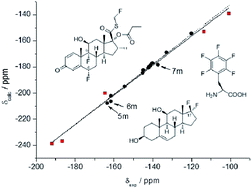
The structural characterization of organofluorine compounds is greatly aided by 19F NMR, alongside with the usual 1H and 13C array of NMR spectroscopic tools. The 19F nucleus has quite favorable NMR properties (I = 1/2, 100% natural abundance, high magnetogyric ratio, wide chemical shift range). As a result, 19F NMR is a generally applied tool in such investigations; recent examples can be found in ref. 11 and 12. Often, the relatively small number of fluorine atoms in a given compound makes the assignment of the 19F resonances straightforward. However, in general, the simpler the assignment the less informative is the NMR spectrum for the structural identification of the compound. On the other hand, the presence of several fluorine atoms may render spectral interpretation a non-trivial task.
Quantum chemical protocols based on density functional theory have proven to be of invaluable help in structural identification of organic molecules by comparison of predicted 1H and 13C NMR spectra of putative structures with the experimental data.13–20 However, the prediction of fluorine chemical shifts by DFT methods is less developed. Indeed, inaccuracies in Kohn–Sham eigenvalues were reported to produce large errors in fluorine shieldings.21 In a previous work,22 we provided an overview of the developments in this field and carried out a systematic exploration of the performance of DFT methods for a wide range of fluorinated compounds, including inorganic and simple organic molecules, and showed that the main features of 19F chemical shifts can be predicted across the range spanned by inorganic fluorine compounds (1300 ppm). It should be remarked that in most such cases only one fluorine atom is present and assignment is straightforward. On the other hand, many organofluorine compounds possess several fluorine atoms, often in similar or identical functional groups; obviously, this is the context where 19F NMR would be most helpful for structure elucidation, and the demands on the computational end strictest.
Even though DFT predictions of 19F chemical shift have been successfully applied to the structural identification of fluorinated organic compounds,23,24 a matching systematic analysis concerning organic fluorine compounds, whose 19F shifts lie in a much smaller range (ca. 300 ppm), has not yet been carried out. Therefore, in this work we present the results of DFT calculations of 19F chemical shift for a wide variety of organic compounds and functional groups.
) and the corrected MAE
:
CMAE = |δcalc. − δfit|/n. The maximum deviation (MD) is the largest difference between an experimental and a calculated point while the corrected maximum deviation (CMD) is the largest distance between a calculated point and its projection on the linear fit line.
The compounds considered have been loosely categorized as in ref. 29 (although the classification is blurred), as follows (RF denotes an organofluorine group). (a) Fluoromethanes (−272 to 19 ppm); (b) fluoroethanes (−239 to −64.5 ppm); (c) fluoroethylenes (−205 to −66 ppm); (d) primary (RCH2F, −232 to −206 ppm), (e) secondary (R2CHF, −213 to −165 ppm) and (f) tertiary (R3CF, −182 to −127 ppm) monofluorides; (g) primary (RCHF2, −129 to −110 ppm) and (h) secondary (R2CF2, −149 to −84 ppm) geminal difluorides; (i) trimethylsilyl fluorides (Me3Si–RF, −277 to −58 ppm); (j) trifluoromethyl derivatives (CF3, −93 to −49 ppm); (k) trifluoroacetyl and trifluoromethanesulfonyl derivatives (CF3C(O) and CF3SO2, −84 to −53 ppm); (l) monosubstituted fluorobenzenes (X–C6H4–F, −166 to −94 ppm); (m) other fluorobenzenes (−166 to −108 ppm); (n) miscellaneous compounds (H3Si–RF, PhO–RF, PhS–RF, −265 to −43 ppm). Experimental data were taken from ref. 29 and 30.
Chemical shifts therefore span a range of about 300 ppm, from the most shielded resonance of (CH3)3SiCH2F (−277 ppm) to the most deshielded one CF2I2 (18.6 ppm). This range, while much smaller than the full range including inorganic compounds (ca. 1300 ppm) is still wide if compared with the variation in functional groups. Given the large number of compounds investigated, numerical data are presented only in the ESI (Table S1a–n†) for brevity.
The general correlation between calculated and experimental chemical shifts is shown in Fig. 1. Broadly speaking, the performance of the computational protocol is satisfactory: for the 256 data considered, the overall correlation overestimates the shift by 15% with an offset of −17 ppm, and a mean absolute error of 35 ppm, i.e. 10% of the range considered.
![]() | ||
Fig. 1 Correlation between calculated and experimental 19F chemical shifts. Solid line: linear fitting δcalc. = a + bδexp. a = −17 ± 1 ppm, b = 1.15 ± 0.01, R2 = 0.9808, MAE = 34.6 ppm, MD = 67.5 ppm, CMAE = 6.2 ppm, CMD = 37.6 ppm. The compounds are categorized as (see text): methane, ethane and ethylene derivatives; primary (RCH2F), secondary (R2CHF) and tertiary (R3CF) monofluorides; primary (RCHF2) and secondary (R2CF2) geminal difluorides; trimethylsilyl fluorides (Me3Si–RF); trifluoromethyl groups (CF3); trifluoroacetyl and trifluoromethanesulfonyl derivatives (CF3C O, CF3SO2); aryl fluorides (Ar–F) and miscellaneous compounds. Data in Table S1.† | ||
Some issues arise immediately. (a) Almost all the categories indicated above have overlapping shift ranges; therefore such indicators are not of major importance for the evaluation of these results. (b) While the correct range of shift is always predicted, the scatter of data points is noticeable.
Since the data set includes a diverse array of functionalities, we will discuss some of the classes of organofluorine compounds separately to highlight their issues. Several factors deserve analysis, i.e. relativistic effects caused by the heavy halogens Br and I, solvent, steric and conformational effects. These will be discussed in turn; however, whereas the classification mentioned above is chemically intuitive, it is more meaningful to dissect the data starting from the compounds that, in principle, present fewer problems in connection with the computed results. The discussion will then begin with fluoroarenes (l)–(n), which are conformationally rigid (although they may include polar substituents) and contain only light atoms. Conformational effects are best highlighted by firstly referring to rigid compounds, for which a single conformation is sufficient, and excluding both heavy halogens (which may be subject to relativistic effects) and polar functional groups (which are likely to show specific solvent effects).
![]() | ||
| Fig. 2 Correlation between calculated and experimental 19F chemical shifts for polyfluorobenzenes. δcalc. = a + bδexp: a = −30.2 ppm, b = 1.036, R2 = 0.9993, MAE = 35 ppm, CMAE = 0.4 ppm, MD = 37 ppm, CMD = 1 ppm. Data in Table S1(n).† | ||
![]() | ||
| Fig. 3 Correlation between calculated and experimental 19F chemical shifts for (top to bottom) ortho, meta and para monosubstituted fluorobenzenes. Fitting parameters for para derivatives: δcalc. = a + bδexp: a = −5.05 ppm, b = 1.261, R2 = 0.9752, MAE = 34 ppm, CMAE = 1 ppm, MD = 38 ppm, CMD = 3 ppm. Data in Table S1(l) and (m).† | ||
![]() | ||
| Fig. 4 Correlation between calculated and experimental 19F chemical shifts of fluorohalomethanes. Solid line: linear fitting δcalc. = a + bδexp. a = −3 ± 3 ppm, b = 1.21 ± 0.03, R2 = 0.9856, MAE = 20.6 ppm, MD = 58.2 ppm, CMAE = 9.1 ppm, CMD = 22.7 ppm. Data in Table S1(a).† | ||
When dealing with compounds containing heavy atoms such as Br or I, it is important to recall that strong relativistic effects may arise in the resonance frequencies of other nuclei; large shielding effects (i.e. very negative chemical shifts compared to those for analogues with light atoms) are often found for atom nuclei directly bonded to a heavy atom; e.g. δ(13C) = −293 ppm in CI4, often called “normal halogen effect”. In such cases, inclusion of spin–orbit coupling in the Hamiltonian is mandatory.31–36 The magnitude of σSO can be traced to the s character of the bond between the light and the heavy atom.31,32 However, contrary to what happens with 13C, relativistic effects on 19F shifts in the F–C–X arrangement of fluoromethanes are only modest; the spin–orbit contribution to the shielding (σSO) amounts to 1–5 ppm, i.e. 5% of σ at most, as expected for bonds with small s character. In any case, σSO > 0 like in the case of 13C, as expected for high-lying occupied orbitals with π local symmetry of the bond connecting the heavy atom and the observed nucleus.37,38 The small absolute values of σSO do not warrant a more detailed analysis.
Indeed, the spread of shieldings observed is essentially due to changes in the paramagnetic term (σp). Therefore, 19F shifts, even in polyiodoalkanes, are hardly affected by heavy-atom effects and can be predicted with fair accuracy even without taking relativistics into account. This recognition opens the possibility of running non-relativistic calculations with other software as well.
Overall, with few exceptions the theoretical level we have adopted can, at least, pinpoint the correct range of 19F chemical shift in a wide variety of organofluorine compounds. The predictions are understandably better if one only considers structurally related, rigid, non-polar molecules. Whereas such problems are invariably encountered in all investigations of NMR chemical shifts, such effects are prominent in the case of 19F.
While there is room for improvement, even at this stage it seems possible to address issues in the structural chemistry of fluorine compounds; hereafter we shall present some examples of application in problems related to biological chemistry and drug development. Several fluorinated drugs have been synthesized2 and 19F NMR spectroscopy is a powerful tool to trace their metabolism, owing to the ease of detection and to the absence of natural sources of fluorine in biological fluids and tissues which may interfere or overlap with the resonances of interest. On the other hand, 19F can also be used in structural assignment of novel drugs as it has been shown recently in ref. 39 and 40.
Ampt et al.40 have used 19F NMR spectroscopy for the identification of fluorinated steroids, including the drug fluticasone propionate (8) and a challenging derivative with two diastereotopic fluorine atoms (9). These two compounds have also been investigated computationally herein.
Experimental and calculated chemical shifts are collected in Table 1, while the correlation is shown in Fig. 7. The correlation for the fluorophenylalanines is particularly good; the three resonances that are slightly offset compared to the others are those of the fluorine nuclei in the meta position of compounds 5, 6 and 7, where hydrogen bonding to the para substituent may play some role, but all signals are predicted in the correct sequence. It is noteworthy that the fitting line of this subset of data is very close to the fitting line of the calibration set shown in Fig. 1. We can therefore inspect the outcome of the application of the linear relation derived from the calibration set. If we estimate the chemical shift, δest, using the linear fitting parameters of Fig. 1 and the DFT predicted values for the set of fluorophenylalanines and fluorinated steroids (i.e. assuming that the experimental chemical shifts are unknown) we obtain the values reported in Table 1. The agreement is very good, the MAE being just 1.8 ppm, and even the relatively small difference between ortho and meta fluorine nuclei in 2 is correctly predicted. Therefore the computational protocol appears sufficiently robust for practical applications and assignments of 19F resonances in organic molecules.
| Compound | δexp | σ | δcalc. | δesta |
|---|---|---|---|---|
| a Chemical shifts estimated using the linear fitting parameters of Fig. 1 and the reported σ values. | ||||
| 1 o | −142.0 | 300.0 | −180.0 | −141.7 |
| 1 m | −161.5 | 322.3 | −202.3 | −161.1 |
| 1 p | −154.4 | 315.0 | −195.0 | −154.8 |
| 2 o | −141.3 | 299.3 | −179.3 | −141.1 |
| 2 m | −140.7 | 297.5 | −177.5 | −139.6 |
| 3 o | −140.8 | 298.3 | −178.3 | −140.3 |
| 3 m | −133.0 | 289.0 | −169.0 | −132.2 |
| 4 o | −140.2 | 297.3 | −177.3 | −139.4 |
| 4 m | −120.1 | 274.4 | −154.4 | −119.5 |
| 5 o | −144.8 | 302.5 | −182.5 | −144.0 |
| 5 m | −163.4 | 328.0 | −208.0 | −166.1 |
| 6 o | −145.3 | 304.7 | −184.7 | −145.8 |
| 6 m | −161.5 | 326.5 | −206.5 | −164.7 |
| 7 o | −142.2 | 300.7 | −180.7 | −142.3 |
| 7 m | −137.3 | 298.4 | −178.4 | −140.4 |
| 8 F9α | −164.6 | 320.3 | −200.3 | −159.4 |
| 8 F6α | −186.7 | 356.8 | −236.8 | −191.1 |
| 8 SCH2F | −192.0 | 358.7 | −238.7 | −192.7 |
| 9 F17α | −100.8 | 259.3 | −139.3 | −106.3 |
| 9 F17β | −113.6 | 272.9 | −152.9 | −118.2 |
![]() | ||
| Fig. 7 Correlation between calculated and experimental 19F chemical shifts of para-substituted tetrafluorophenylalanines 1–7 (black circles) and fluorinated steroids 8 and 9 (red squares). Solid line: linear fitting δcalc. = a +bδexp. a = −21.1 ± 4.5 ppm, b = 1.13 ± 0.03, R2 = 0.9861. Dotted line: linear fitting of the complete calibration set of Fig. 1. | ||
![]() | ||
| Scheme 2 Fluorinated taxoids. Compound numbers in parentheses are those of the original paper (ref. 42). | ||
Compounds 10 and 11 were obtained in mixture in similar yield; compounds 13, 14 and 15 were also obtained in mixture by reacting 12 with Selectfluor (1-chloromethyl-4-fluoro-1,4-diazoniabicyclo[2.2.2]octane); 16 was obtained from 15 and exhibits a germinal F2 pair; 17 and 18 were obtained in ca. 1
:
2 mixture by reducing 10; 19 and 20 were obtained by reduction of 15 and 16, respectively.42 Hence, this set of molecules offers an intriguing selection of similar chemical environments of fluorine atoms to test the capability of the computational protocol to discriminate the different resonances. The results are reported in Table 2.
| Compounda | δcalc. | δestb | |
|---|---|---|---|
| a Compound numbers in parentheses are those of the original paper (ref. 42).b Chemical shifts estimated using the linear fitting parameters of Fig. 1 and the reported σ values. | |||
| 10 (8) | F12 | −162.6 | −126.6 |
| F14 | −257.8 | −209.4 | |
| 11 (9) | F14 | −232.8 | −187.7 |
| 12 (3a) | F7 | −207.2 | −165.4 |
| 13 (11) | F7 | −206.2 | −164.5 |
| F14 | −232.8 | −187.6 | |
| 14 (12) | F14 | −231.9 | −186.9 |
| 15 (13) | F7 | −203.7 | −162.3 |
| F10 | −213.9 | −171.2 | |
| 16 (14) | F7 | −212.5 | −170.0 |
| F10a | −123.9 | −93.0 | |
| F10b | −127.8 | −96.3 | |
| 17 (30a) | F12 | −158.1 | −122.7 |
| F14 | −241.9 | −195.6 | |
| 18 (30b) | F12 | −184.6 | −145.7 |
| F14 | −253.0 | −205.2 | |
| 19 (31) | F7 | −207.5 | −165.7 |
| F10 | −246.6 | −199.7 | |
| 20 (32) | F7 | −208.4 | −166.4 |
| F10a | −117.2 | −87.1 | |
| F10b | −120.3 | −89.8 | |
In addition to the DFT predicted values we also report in Table 2 the estimated “experimental” values based on the linear regression of the calibration set of Fig. 1. Fluorine at position 14 (F-14) exhibits a significant variation from 10 to 11 and from 10 to 17 and 18, while in 11, 13 and 14 (which differ in a remote position compared to position 14), the chemical shift of F-14 is essentially constant around −187 ppm. Geminal fluorines in 16 and 20 are quite similar; a deshielding of about 6 ppm is observed in the calculated values upon reduction of the carbonyl in position 9 of 16 to give compound 20. Interestingly, the reduction of the same carbonyl in the analogous compound 15 (where there is only one fluorine in position 10 of the carbon skeleton) to obtain 19, causes a large shielding of about 30 ppm of the fluorine in position C10, in contrast to the effect observed in the 16/20 pair. Finally, depending on the arrangement of the hydroxyl on carbon C13 a significant shift is observed in both F-12 and F-14 when comparing compound 10 with 17 and 18. Therefore, DFT predictions allow to distinguish the slightly different chemical environments of fluorine in these compounds (or mixtures thereof), and can be envisioned as a valuable help in their structure determination.
Footnote |
| † Electronic supplementary information (ESI) available: Calculated chemical shifts and shielding constants for all compounds investigated. See DOI: 10.1039/c4ra08290g |
| This journal is © The Royal Society of Chemistry 2014 |