
Zhong Sua,
Chenglong Gaob,
Hanlin Lia,
Sanjay Nandab,
Chao Lai*ab and
Kai Xib
aSchool of Chemistry and Chemical Engineering, Jiangsu Key Laboratory of Green Synthetic Chemistry for Functional Materials, Jiangsu Normal University, Xuzhou, Jiangsu 221116, China. E-mail: laichao@jsnu.edu.cn
bDepartment of Materials Science and Metallurgy, University of Cambridge, Cambridge, CB2 3QZ, UK
First published on 19th September 2014
A facile ball-milling route, which can help in large-scale synthesis, is developed to prepare graphene-wrapped sulfur/carbon nanotubes composite. Electrochemical tests show that the obtained composite demonstrates high sulfur utilization and good cycle performance. As calculated by the total mass of the composite, a high reversible capacity of 626.0 mA h g−1 can be obtained after 70 cycles at a current density of 400 mA g−1.
000 cm2 V−1 s−1), high chemical and thermal stability, and superior mechanical flexibility.1–9 For composites based on graphene and sulfur, a significantly enhanced electrochemical performance has been obtained. However, due to the strong π–π stacking and hydrophobic interactions, graphene sheets are easy to agglomerate during the experiment, and thus a complicated solution process is always needed to obtain uniform graphene-based composites.4–9 This results in high cost and poor control in the consistency of the active material, seriously limiting their practical applications. Thus, the development of facile and large-scale synthesis routes to prepare homogeneous cathodes based on sulfur and graphene is of immense importance for commercial production of lithium–sulfur batteries.
Ball-mill technology is widely used for grinding materials in industrial applications. For its application in the synthesis of electrode materials, the advantages can be described as follows: (1) the large-scale synthesis of homogeneous electrode materials can be easily realized, which is important for the consistency of the battery materials; (2) reliable operation to ensure reproducible results; and (3) it is suitable for various synthesis systems and appealing for many practical applications, due to its economy and easy replicability.10–13 Following all the discussions above, we designed a continuous ball-milling strategy to prepare a high performance graphene-wrapped sulfur/carbon nanotubes composite. In this strategy, first, sulfur and carbon nanotubes are homogeneously mixed via ball-milling, as it has been suggested that sulfur particles will be closely attached to the surface of carbon nanotubes during the ball-milling process, thereby producing a highly uniform mixture.12–15 Then, graphene oxide and hydrazine are added during the continuous ball-milling process to produce a surface coating layer. The hollow and cross-linked carbon nanotubes ensure the fast transport of electrons from carbon to sulfur and facilitate lithium-ion diffusion throughout the whole material. Moreover, the surface coating layer can further restrict the dissolution of polysulfide. The unique structure of the designed surface of the graphene-coated sulfur/carbon nanotubes composite can offer a high electrochemical performance.
:
2 were added in the agate tank (50 mL) and then mixed well by ball-milling. The ball-milling was performed in a planetary ball mill (QM-3SP04, Nanjing) under ambient conditions at a speed of 300 rpm for 3 h. For the synthesis of graphene-wrapped sulfur/CNT composite (graphene@S/CNT composite), graphene oxide (0.2 g, Tianjin Plannano Technology Co., Ltd) and S/CNT composite (0.4 g) were first distributed homogenously in ethanol (10 mL) by stirring. Then, the mixture and hydrazine (1 mL, 35 wt% solution in water, Sigma Aldrich) were added in the agate tank and ball-milled at a speed of 500 rpm for 3 h. The obtained sample was washed with water and ethanol, and finally, dried at 60 °C for 12 h.
The as-prepared samples were characterized by X-ray diffraction (XRD, Model LabX-6000, Shimadzu, Japan), thermogravimetric analysis (TGA, SDT Q600), scanning electron microscopy (SEM, JSM-7001F), and transmission electron microscopy (TEM, FEI Tecnai F20).
:
20
:
10. Lithium metal was used as the counter and reference electrodes. The electrolyte was lithium bis(trifluoromethanesulfonyl)imide (2.8 M) dissolved in a mixture of dimethoxyethane (DME) and dioxolane (DOL) in a volume ratio of 1
:
1. LAND-CT2001A galvanostatic testers were employed to measure the electrochemical capacity at a current density of 400 and 800 mA g−1, and the cycle life of the working electrodes at room temperature. The cut-off potentials for charge and discharge were set at 3.0 and 1.5 V (vs. Li+/Li), respectively. Cyclic voltammetry (CV) experiments were conducted using a CHI 600E potentiostat at a scan rate of 0.1 mV s−1.
![]() | ||
| Fig. 1 XRD patterns of sulfur, carbon nanotubes, S/CNT composite and graphene@S/CNT composite (a); TGA curves of the S/CNT composite and graphene@S/CNT composite (b). | ||
SEM was carried out to illustrate the morphology of the as-prepared samples. As shown in Fig. 2a and b, it can be clearly seen that the S/CNT composite is composed of micro-sized particles with cross-linked carbon nanotubes. No sulfur particles can be observed, indicating the homogenous mixture of sulfur and carbon nanotubes. For the graphene@S/CNT composite, a different morphology is observed. It can be seen that there is further aggregation of the composite particles, which are coated by graphene. The reduction of graphene oxides leads to the shrinkage and re-stacking of graphene nanosheets,19 thus wrapping the particles together to form the surface-coated composite. By comparing Fig. 2b and d, it can be seen that the loose cross-linked structure disappears and that the S/CNT composite is completely encapsulated by the graphene coating layer. To further illustrate the microstructure of the sulfur-based composite, TEM images are shown in Fig. 2e and f. For the graphene@S/CNT composite, it can be clearly seen that the reduced graphene sheets encapsulate the S/CNT composite particles to form a hierarchical structure, and the surface coated graphene layer can be clearly observed in Fig. 2f. It should be mentioned that some small amounts of nanotubes are not wrapped, and hence, further research focused on the ball-milling speed or solvent is still needed to obtain more uniform composite. On the other hand, the exposed nanotubes can also facilitate the transport of electrolyte ions into the composite, to produce a high electrochemical performance.
Fig. 3 shows the cyclic voltammograms (CVs) of the as-prepared S/CNT composite and graphene@S/CNT composite at a scan rate of 0.1 mV s−1. Two clearly different curves can be observed. For the graphene coated composite, during the initial cathodic process, a pair of peaks around 2.18 and 1.85 V can be observed, which relate to the two-step reduction of S8 to lithium polysulfides and eventually to Li2S.1–3 In contrast with the previous reports,6–8,16,17,20,21 the second peak is obviously broadened. The possible reason can be attributed to the tight package of graphene during the ball-milling process and the strong adsorption ability of the carbon nanotubes, which can lead to a high electrochemical polarization.22 For the S/CNT composite, only one cathodic peak around 2.1 V can be observed, due to the dissolution of Li2S8, further confirming the restriction effect of graphene in the graphene@S/CNT composite.
![]() | ||
| Fig. 3 Cyclic voltammograms of the S/CNT composite and the graphene@S/CNT composite at a scan rate of 0.1 mV s−1. | ||
Based on the above results, it can be concluded that the obtained composite contains a cross-linked conductive matrix, hollow channels, and a tight surface coated graphene layer, which makes it a promising high-performance sulfur-based cathode. To evaluate the electrochemical performance of the as-prepared samples, cell tests were conducted (Fig. 4). Fig. 4a includes the initial discharge–charge curves of the obtained composites at a current density of 400 and 800 mA g−1. For the S/CNT composite, it demonstrates a low discharge and charge capacity of 170 and 164 mA h g−1 at a current density of 400 mA g−1, respectively. In comparison, the graphene@S/CNT composite presents a different discharge–charge curve, and a flat potential plateau around 2.1 V can be observed, which corresponds to the transfer from S82− to lower-order polysulfide.1–3 Without graphene wrapping, the S82−ions will dissolve into the electrolyte before transformation, and the conventional flat plateau disappears, accounting for the sulfur/carbon nanotubes composite, which is consistent with the result of the CVs. On the other hand, the initial discharge and charge capacity of graphene@S/CNT composite is 906.6 and 840.3 mA h g−1, whereas it is about 1813.2 and 1680.6 mA h g−1 as calculated by weight of sulfur, further confirming the restriction on the dissolution of polysulfides by introducing the graphene coating. A high initial discharge capacity, exceeding the theoretical capacity of sulfur, can be observed in the other sulfur/carbon composite.18,23,24 However, if the extra weight loss (4 wt%) of the graphene-wrapped composite is attributed to the loss of sulfur, the initial discharge capacity calculated by the sulfur is 1678 mA h g−1, perfectly equal to the theoretical capacity of element sulfur. When the current density is enhanced to 800 mA g−1, it is obvious that the discharge–charge curves are well-retained, and the initial discharge capacity is 658 mA h g−1. The capacity retention can be as high as 72.6%, indicating the good kinetic process of the composite.
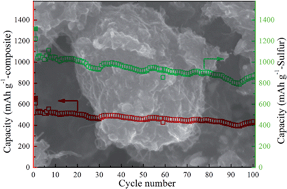
Fig. 4b includes the cycle curves of the obtained composites at different current densities. As shown, the graphene@S/CNT composite shows a good cycle performance, and after 70 cycles, the discharge capacity can be retained at 626.0 mA h g−1 at the current density of 400 mA g−1, which is about 1252.0 mA h g−1 as calculated by the weight of sulfur. Furthermore, it is worth mentioning that the composite shows a high coulombic efficiency above 95% after the 2nd cycle. The reversible discharge capacity (1256.0 mA h g−1) is among the best results compared to the graphene and sulfur-based composites synthesized by other methods,7–9,25–29 indicating that the ball-milling route is a practical route for the large-scale synthesis of high performance sulfur-based composites. At a current density of 800 mA g−1, it can be seen that the obtained composite still shows a good cycle performance and even after the 100th cycle, a discharge capacity of 425.8 mA h g−1 can be obtained, which is about 851.6 mA h g−1 as calculated by the weight of sulfur. It should be emphasized that although the sulfur content is low, the graphene@S/CNT composite still demonstrates a high discharge capacity, as calculated for the composite due to the high sulfur utilization. The high reversible capacity of 626.0 mA h g−1 is among the best results compared to the graphene and sulfur-based composites prepared via complicated solution synthesis processes and/or templates.4,5,7–9,25–27
By considering all the results above, it can be concluded that a high discharge capacity has been obtained by a simple ball-milling route, without employing a complex solution synthesis or thermal treatment processes. The high performance of the graphene@S/CNT composite can be attributed to its unique structure and can be elaborated as follows: (1) the hollow carbon nanotubes conductive matrix ensures fast electron and Li-ion transport throughout the composite, thus producing a high sulfur utilization at a high current density; (2) the intact hollow tubes of the carbon nanotubes trap the polysulfides and accommodate a volume change to maintain the structural stability of the composite during the discharge–charge process; and (3) the homogeneous and tight surface coating of graphene effectively restricts the dissolution of the polysulfides and further enhances the utilization of sulfur, due to its excellent conductivity. In conclusion, sulfur-based composites with the same high performance can be obtained via a practical ball-milling route as compared to fabrication via a complicated solution route.
| This journal is © The Royal Society of Chemistry 2014 |