
Ke Zhanga,
Shujun Zhoua,
Yiwen Tanga,
Ge Wangb,
Han Zhoua,
Tongxiang Fan*a and
Di Zhanga
aState Key Lab of Metal Matrix Composites, Shanghai Jiaotong University, Shanghai 200240, P.R. China. E-mail: txfan@sjtu.edu.cn; Fax: +86-21-34202497; Tel: +86-21-54747779
bInstrumental Analysis Center, Shanghai Jiaotong University, Shanghai 200240, P.R. China
First published on 17th September 2014
Diverse biological microstructures that result in advanced optical effects have been systematically investigated. However, the mechanisms of polarization-sensitive color have not been fully understood. Here, we report a combined architecture comprising upper deep grating and bottom multilayer in butterfly iridescent scales that leads to polarization-sensitive color related with scale azimuth. The polarization process is unraveled through detailed investigations on the green scales in butterfly Ornithoptera priamus poseidon and the orange scales in butterfly Ornithoptera croesus lydius. The bright green and orange scales result from the interaction between the transmitted 0th order diffraction of upper grating and the 1st order interference of the bottom multilayer. Combining experimental results with calculation, we clarify the structural origin and the mechanism of the polarization conversion. Tapered grating achieves form-birefringence rotating polarized light and the multilayer selectively reflects the incident light dominating the reflection color. The height of the grating, which determines the phase difference of the two decomposed polarized lights, is essential to polarization conversion. To our knowledge, it is the first study to provide a structural prototype comprising deep grating and multilayer for achieving polarization-sensitive color. These findings show significant promise in biosensing, anticounterfeiting and optical-material design.
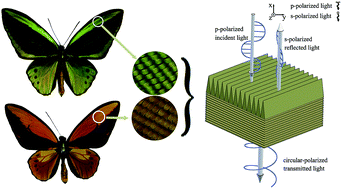
The polarization-sensitive color is caused by the polarization-dependent reflection and can increase the perceived visual contrast of light with different brightness and wavelengths.15
Previous studies show that many organisms having polarization-sensitive photoreceptors can potentially discriminate objects through the polarization-dependent reflectance.16,17 The polarized light signals contribute to biological signalling functions in mating, feeding, and oviposition.18–20 For example, the Papilio aegeus and Heliconius butterflies use polarized light in mate recognition.18 Utilizing the polarized light signals is highly useful for species living in complex light environments,20 where illumination can dramatically change in brightness and spectral properties.
Here, we report a polarization-sensitive phenomenon in the butterfly Ornithoptera iridescent scales. Detailed investigations on the green scales of butterfly Ornithoptera priamus Poseidon (O.p.poseidon) and the orange scales of butterfly Ornithoptera croesus lydius (O.c.lydius) reveal the structural origin of the polarization-sensitive color. Combined architecture comprising upper deep grating and bottom multilayer is extracted from scale structure for unraveling the polarization mechanism. Through experiments and calculations, we clarify that the combined architecture selectively reflects and rotates incident polarized light.
Reflectance spectra were measured on a spectrophotometer with an integrating sphere under normal incident light. The green and orange scales have a reflectance peak at 550 nm and 670 nm, respectively, as shown in Fig. 1e. To identify the pigments in the scales, we investigated the absorption spectra of the pigments in green and orange scales. A single green scale and a single orange scale were immersed in bromoform (RI is 1.6), approximately matching the RI of chitin (RI is 1.56).21 The absorbance spectra of both the wing scales have similar main bands in the violet-blue wavelength ranging from 350 nm to 480 nm (Fig. 1f), suggesting that the pigments in both the green and orange scales have similar light-absorbing effects.
FESEM and TEM images reveal the similar structures of the green and orange scales (Fig. 1g–j). Tapered ridges, with tiny inclination cross-ribs, run parallel to the longitudinal axis of the scale. The adjacent distance of the ridges is 0.54 μm for green scale and 0.76 μm for orange scale (Fig. 1g and h). Images of the cross section perpendicular to the longitudinal axis of scale show anatomical architecture consisting of upper tapered ridges and bottom multilayer (Fig. 1i and j). In the green scales, the tapered ridge structure is 1.90 μm and the multilayer is 2.50 μm in height. In the orange scale, the tapered ridge structure is 2.60 μm and the multilayer is 2.60 μm in height. The bottom multilayer structure is composed of alternative chitin and hybrid layers (hybrid layer is composed of chitin columns and air). The thickness of the chitin layer is about 0.10 μm, and the thickness of the hybrid layer is about 0.11 μm for green scale, and 0.12 μm and 0.14 μm, respectively, for orange scale (Fig. S1, ESI†). A schematic model of the scale structure was established, the average dimensions of which were statistically determined based on FESEM and TEM images. (Fig. S2a and Table S1, ESI†).
This model was further simplified to facilitate analysis on the optical effects in the green and orange scales (Fig. S2b, ESI†). The tapered ridge structure was simplified into tapered triangular grating structure, and the bottom multilayer structure (alternative chitin and hybrid layers) was simplified into an ideal multilayer structure (Fig. S2b, ESI†). The optical mechanism was analyzed based on the simplified architecture composed of an upper grating structure and a bottom multilayer structure.
The RIs of chitin and air are 1.56 and 1.00, respectively.21 According to the parameters of the scales (Table S1, ESI†) and the effective RI theory,10
![]() | (1) |
| Butterfly | O.p.poseidon | O.c.lydius | ||
|---|---|---|---|---|
| Structure | Hybrid layer | Grating | Hybrid layer | Grating |
| Chitin volume ratio | 0.11 | 0.9 | 0.06 | 0.80 |
| Effective RI | 1.08 | 1.50 | 1.04 | 1.48 |
When the normal incident light illuminates the combined architecture, the upper triangular grating should cause the grating diffraction and the bottom multilayer should cause the multilayer interference.22 The grating diffraction and multilayer interference orders were calculated to explain the optical phenomenon in the O.p.poseidon and O.c.lydius butterflies.
It has been shown that the tapered triangular grating acts as an antireflection layer that reduces the reflected diffraction order.23 In our model, the grating has adjacent distance comparable with the wavelength of visible light; therefore, the modal method is effective for interpreting the diffraction behavior.24,25 According to the modal method, only the transmitted 0th order and ±1st orders diffraction lights (0th and ±1st mode lights) will be nonevanescent at normal incident light.24–26 The 0th and ±1st mode lights pass through the upper grating and reach the bottom multilayer in the 0th and ±1st transmitted diffraction angles, respectively.
In the case of the 0th mode light, the 0th transmitted diffraction angle is zero. The 0th mode light normally reaches the bottom multilayer and causes the optical coherent interference. The constructive interference equation of the multilayer is given by22
![]() | (2) |
The calculation peaks of the multilayer are at 550 nm and 670 nm (m = 1) in the green and orange scales, respectively. The experimental reflectance peaks (Fig. 1e) are approximately the same with the results of the 1st order multilayer interference of the 0th mode light, indicating that the 0th mode light contributes to the striking color of the green and orange scales.
In the case of the ±1st mode lights, incident lights reach the multilayer in the diffraction angles,
, respectively.24 The relevant calculation is shown in Text S1, ESI.† According to the multilayer interference theory, the obtained calculated peaks of the multilayer are at 410 nm and 550 nm (m = 1) in green and orange scales, respectively, which are shorter than the experimental results (Fig. S4, ESI†). Therefore, the ±1st mode lights should have little contribution to the main bands of the reflectance spectra. The reflected lights of the transmitted ±1st diffraction order of the green scales are probably suppressed by the pigment, which has a main absorbance band from 350 nm to 480 nm. The reflected lights of the transmitted ±1st diffraction orders in the orange scale slightly widen the reflection range.
Theoretical calculation based on our model indicates that the main reflection bands of the green and orange scales mainly result from the interaction between transmitted 0th order diffraction of the grating and the 1st order interference of the multilayer.
Fig. 2 shows angle-dependent optical microscopic images and reflectance spectra in the plane perpendicular to the ridges. The incident light and detector are rotated in the plane perpendicular to the scale ridges to achieve different mirror angles. The observed color of the green scales gradually changes from yellowish green to bluish green with increasing viewing angle, and becomes yellow at 60°. In the case of the orange scales, the observed color gradually changes from orange to yellow (Fig. 2a). The peaks of angle-dependent reflectance spectra of both the butterflies undergo blue shift with increasing viewing angle and vanish at 60° (Fig. 2b). The chromatic diagram confirms the relation between the color variation and reflectance spectrum, revealing that the yellow color at 60° is caused by the disappearance of the spectrum peaks. The tendency of color variation in the chromatic diagram is the same as that in the experimental microscopic images (Fig. 2c).
Both the angle-dependent spectra show blue shift tendency with increasing incident angle (Fig. 2b). Their reflectance amplitudes decrease with increasing incident angle, which is similar to the angle-dependent spectra of the breast-feather barbules in Lawes' parotia.28,29 However, for the classical multilayer, the reflectance amplitude will increase with the increasing angle of incidence.27,28 Thus, the upper tapered ridges probably affect the reflectance of the bottom multilayer under oblique incidence and lead to the reflectance amplitude different from that of the classical multilayer. The vanishing of peaks at 60° in reflectance spectra may be caused by imperfect structures of the wing scales such as disordered array and curvature. The valley from ultraviolet to about 480 nm in reflectance spectra, which exhibits low reflection, is strongly suppressed by the pigment filter.30
A fiber optical spectrometer was equipped on the Zeiss Axio Scope A1 Microscope to collect reflectance spectra to investigate the polarization-dependent reflection of the scales. The input linear polarizer is parallel to the y axis, and the angle between scale ridges and input linear polarizer was 45° (Fig. 4a). Here, the polarized orientation of p-polarized light is parallel to the y coordinate axis and the polarized orientation of s-polarized light is parallel to the x coordinate axis. Under the crossed polarizers, the s-polarized reflection bands are at 500–600 nm and 650–730 nm in the green and orange scales, respectively. Under the collinear polarizers, the p-polarized reflectance of the green and orange scales is approximately less than 5% (Fig. 4b). The polarization-dependent reflected spectra reveal that when the scale is at the 45° azimuth, it selectively reflects the incident light and rotates the p-polarized incident light into s-polarized light.
Previous studies show that polarized light can be caused by differential reflection or differential scattering, double reflection, or differential absorption.31,32 To demonstrate that the polarization conversion is caused by the anisotropic ridge structure rather than the pigments, we set the imaginary part of the material's RI to zero to eliminate the influence of pigments.
The normal incident light is a p-polarized light, and the combined architecture is at 45° azimuth (Fig. 4a). Simulation was performed with FDTD, and the calculated reflectance spectra are shown in Fig. 4c. The simulated s-polarized reflectance spectra show a reflection band at about 460–640 nm with the green scale model and a reflection band at about 570–730 nm with the orange scale model. Both the calculated p-polarized reflectance with the green and orange scale models is approximately less than 10%. Although the calculated s-polarized reflection bands with the green and orange scale models are wider than their experimental counterparts, both the calculated and experimental s-polarized reflection bands exhibit the same polarization conversion property, suggesting that the polarization conversion should be mainly caused by the structure of anisotropic ridges.
To further clarify the polarization conversion progress caused by the scale model (45° azimuth), we analyzed the optical process using the form-birefringence. Here, we only analyzed the 0th mode light because it is the main contributor to the reflection band. Previous studies show that the triangular grating achieves form-birefringence, leading to nonsymmetric effective RIs.33,34
The form-birefringence effective RI theory33 is given by.
![]() | (3) |
The different effective RIs along parallel and perpendicular grating orientations should cause a phase difference. We decomposed the incident p-polarized light at normal incidence into two polarized light components, the parallel and perpendicular grating lights (Fig. S6, ESI†). The phase difference, δi, is described with the following equation:
![]() | (4) |
The s-polarized reflection intensity IiR(s) and the p-polarized reflection intensity IiR(p) are given by35
![]() | (5) |
sin2(0.25π/λi) for green scale and IiR(s) = Ii0Ri
sin2(0.32π/λi) for orange scale. The values of the sin2(δi/2) approximately match those of Ri in both the green and orange scales, suggesting that the height of the grating may be essential for the polarization-dependent reflection. These calculated results can well explain our experimental observations that the color of the 45° azimuth scales is intense under the crossed analyzer (Fig. 3c and g) whereas it dims under the collinear analyzer (Fig. 3d and h).
When the linearly polarized light illuminates on the 45° azimuth quarter-wave plate, the transmitted light will be circular polarized.36 In our model, the upper triangular grating acts as a quarter-wave plate. When p-polarized light illuminates on the 45° azimuth simplified model, the transmitted light will be circular polarized. Our study reveals that the reflected light will be s-polarized. Therefore, the entire combined architecture at 45° azimuth selectively reflects and rotates the incident p-polarized light into the s-polarized light (Fig. 5).
Footnote |
| † Electronic supplementary information (ESI) available. See DOI: 10.1039/c4ra07988d |
| This journal is © The Royal Society of Chemistry 2014 |