
Marija Baranac-Stojanović*
Faculty of Chemistry, University of Belgrade, Studentski trg 12-16, P.O.Box 158, 11000 Belgrade, Serbia. E-mail: mbaranac@chem.bg.ac.rs
First published on 5th September 2014
The origin of the gauche preference in 1,2-difluoroethane has been investigated by using an energy decomposition analysis (EDA). The EDA results show that favourable orbital interactions are not the sole source of stabilization in this conformer. Electrostatic interactions, too, are more attractive in the gauche than in the anti form. This finding opposes our traditional view of electrostatic interactions and their influence on conformational equilibria, but points out that they should be considered as an all-charge phenomenon, rather than partial interaction between pairs of bonds.
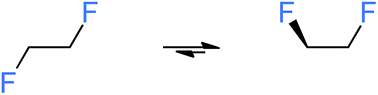
Currently, there are two main explanations for the “gauche effect” in DFE: bent bonds and hyperconjugation. According to the bent bond model, proposed by Wiberg and co-workers,6 the highly electronegative fluorine creates bond bending at the carbon nuclei, the sense of which weakens the C–C bond in anti conformer more than in gauche conformer (Fig. 1a).6 The bent bond model was questioned by the natural bond orbital (NBO) study of Goodman and co-workers,7 who calculated too small difference in the amount of orbital overlap between conformers to account for the observed gauche stabilization. More widely used hyperconjugation model invokes σC–H → σ*C–F charge transfer as a stabilizing factor in the gauche form. This type of orbital interaction is maximized when C–H and C–F bonds adopt antiperiplanar orientation (Fig. 1b).3,7,8 However, the computational data have shown that the magnitude of σC–H → σ*C–X hyperconjugative interactions increase in the order X = F < Cl < Br.3,8c,9 Obviously, other factors are involved, too. Thus, it was found that the σC–X → σ*C–X hyperconjugation (X = Cl, Br) contributes to the stabilization of anti DCE and DBE.3,8c,9a In an interesting work, designed to test the hyperconjugation model in 2-substituted-1-fluoroethanes, Rablen et al.2 concluded that it is the interplay of hyperconjugation, electrostatic and steric effects that influences conformational behaviour of the studied molecules.
![]() | ||
| Fig. 1 Bent bond model (a) and hyperconjugation model (b) used to explain the gauche preference in 1,2-difluoroethane. | ||
Interestingly, the “gauche effect” in DFE was correctly predicted by dipolar and lone pair interactions of molecular mechanics, without invoking molecular orbital effects.10 A recent work of Freitas et al.11 showed that 1JCF coupling constant in DFE is independant of hyperconjugation.
The fluorine “gauche effect” is also found in various fluorinated compounds having an electronegative or positively charged substituent in the β-position,8b,12 with a significant potential for synthetic application.13 In the latter case (β-positively charged group), the gauche preference is attributed to both hyperconjugative and attractive electrostatic interactions.
Although, the “gauche effect” is found in many other molecules,4,8a,14 DFE has been considered as a benchmark to understand its origin. Moreover, the F/F gauche preference influences conformational stability of extended and of polyfluorinated molecules, as well.15 Hence, in this study, the conformational preference in DFE is addressed from the standpoint of energy decomposition analysis (EDA), with an aim to get a further insight into its origin.
| ΔE = ΔEprep + ΔEint | (1) |
The ΔEprep represents the amount of energy required to deform two CH2F radicals from their equilibrium geometry to the one they adopt in DFE. The ΔEint is the energy change occurring when these two prepared radicals interact to form the molecule. Localized molecular orbital EDA (LMOEDA) of Su and Li,16 implemented in the Gamess program package,17 allows a further decomposition of ΔEint into five energy terms (eqn (2)).
| ΔEint = ΔEes + ΔEex + ΔErep + ΔEpol + ΔEdisp | (2) |
Electrostatic energy ΔEes involves nucleus–nucleus and electron–electron repulsion, and nucleus–electron attraction between two prepared CH2F radicals that adopt their positions in the final molecule. Total electrostatic energy is usually stabilizing (negative), since nucleus-electron attraction outweighs the two repulsive terms. Exchange energy ΔEex refers to the quantum-mechanical exchange of electrons. Repulsion energy ΔErep comes from partially overlapping electron densities of the two fragments. The first one is stabilizing, the second destabilizing. Taken together, they form the exchange repulsion18 or Pauli repulsion19 of other EDA schemes, which is a destabilizing (positive) energy term. Polarization energy ΔEpol is an orbital relaxation energy which arises from a change in orbital shapes upon binding, including also empty-occupied orbital mixing within one fragment due to the presence of another one (polarization) and between two fragments (charge transfer). Dispersion energy ΔEdisp comes from electron correlation. Both ΔEpol and ΔEdisp are stabilizing effects.
Geometry optimizations were done by using the Gaussian 09 program package,20 at the DFT level using the B3LYP functional21 and 6-311+G** basis set.22
| Conformation | Method | dCC | dCF | dCHa | dCHb | τCCF | τCCHa | τCCHb | θFCCF |
|---|---|---|---|---|---|---|---|---|---|
| a Gauche to the CF bond on the other carbon.b Anti to the CF bond on the other carbon.c From ref. 23a (infrared spectroscopy).d From ref. 23b (microwave spectroscopy). | |||||||||
| Anti-DFE | B3LYP/6-311+G** | 1.5184 | 1.3994 | 1.0922 | 108.04 | 111.24 | 180 | ||
| Experimentalc | 1.501(4) | 1.401(6) | 1.094(2) | 107.4(5) | 111.4(2) | ||||
| Gauche-DFE | B3LYP/6-311+G** | 1.5046 | 1.3966 | 1.0930 | 1.0950 | 110.90 | 110.98 | 109.62 | 71.96 |
| Experimentald | 1.493(8) | 1.390(3) | 1.099(2) | 1.093(5) | 110.6(5) | 108.4(6) | 111.3(6) | 71.0(3) | |
| ΔGauche–anti | B3LYP/6-311+G** | −0.0138 | −0.0028 | 0.0008 | 0.0028 | 2.86 | −0.26 | −1.62 | |
The EDA was done at the UB3LYP/6-311+G** level. Effects of various structural changes that accompany anti → gauche rotation on the individual energy terms are presented in Table 2 (absolute values for various structures are given in Table S1 in the ESI†). First, rigid anti → gauche rotation will be examined. This means that only torsional angle changes from 180° in anti to 72° in gauche conformer. The total energy ΔE decreases by 0.48 kcal mol−1, which is mainly due to the more favourable orbital interactions, that is ΔEpol decreases (becomes more negative) by 0.65 kcal mol−1. The exchange repulsion (or Pauli repulsion), ΔEex+rep, and ΔEdisp also contribute to the energy lowering by 0.15 kcal mol−1 and 0.14 kcal mol−1, respectively. A decrease in the repulsive term appears a bit counterintuitive, since the two fluorine atoms come closer to each other. However, it should be noted that this energy change refers to the total exchange repulsion. Moreover, small atomic volume of fluorine should not bring about strong repulsion. The electrostatic energy is raised by 0.46 kcal mol−1, which is consistent with our intuitive prediction that two C–F bond dipoles repel each other in gauche conformer.
| Structural change | ΔEes | ΔEex+rep | ΔEpol | ΔEdisp | ΔEint | ΔEprep | ΔE |
|---|---|---|---|---|---|---|---|
| a ΔEes = electrostatic energy, ΔEex+rep = exchange repulsion energy, ΔEpol = polarization energy, ΔEdisp = dispersion energy, ΔEint = interaction energy, ΔEprep = preparation energy, ΔE = total bonding energy. | |||||||
| Rigid anti → gauche rotation | 0.46 | −0.15 | −0.65 | −0.14 | −0.48 | 0.00 | −0.48 |
| Effect of geometry relaxation after rigid rotation | −4.55 | 8.81 | −5.00 | −0.04 | −0.78 | 0.36 | −0.42 |
| Flexible anti → gauche rotation | −4.09 | 8.66 | −5.65 | −0.18 | −1.26 | 0.36 | −0.90 |
| Effect of all bonds relaxation after rigid rotation | −5.61 | 10.26 | −4.24 | −0.26 | 0.15 | −0.16 | −0.01 |
| Effect of only C–C bond shortening | −5.33 | 9.74 | −4.17 | −0.27 | −0.02 | 0.00 | −0.02 |
| Effect of C–H and C–F bond changes | −0.28 | 0.52 | −0.07 | 0.01 | 0.17 | −0.16 | 0.01 |
| Effect of all angles relaxation after rigid rotation | 1.06 | −1.45 | −0.76 | 0.22 | −0.93 | 0.53 | −0.40 |
| Effect of CCF bond angles widening | 2.08 | −3.99 | −0.33 | 0.27 | −1.97 | 1.70 | −0.27 |
| Effect of CCH bond angles closing | −1.02 | 2.54 | −0.43 | −0.05 | 1.04 | −1.18 | −0.14 |
In the next step, we consider the effect of geometry relaxation, following the rigid rotation. It lowers the energy by additional 0.42 kcal mol−1, resulting in the total gauche/anti energy difference of 0.90 kcal mol−1. This additional energy decrease comes from a decrease in the interaction energy ΔEint by 0.78 kcal mol−1, while preparation energy ΔEprep increases by 0.36 kcal mol−1, due to further deformation of CH2F fragments.24 Now, let us see how geometry relaxation affects individual energy terms contributing to ΔEint. The only energy that becomes more destabilizing is the Pauli repulsion, which increases by 8.81 kcal mol−1. The ΔEdisp changes negligibly, while both orbital and electrostatic interactions become more stabilizing by 5.00 kcal mol−1 and 4.55 kcal mol−1, respectively.
The total effect of structural relaxation can be divided into two parts: effect of bond length changes and effect of bond angle changes (Table 2). Changes of all bond lengths have almost no effect on the total energy since ΔEprep decreases by 0.16 kcal mol−1, but ΔEint increases by 0.15 kcal mol−1. The insensitivity of the total energy on the bond length changes has also been found by Goodman et al.7 The only cause for ΔEint becoming less stabilizing after bonds relaxation is the increase in the Pauli repulsion energy by 10.26 kcal mol−1. All the remaining three energies, ΔEdisp, ΔEpol and ΔEes, strengthen bonding interactions between CH2F groups by 0.26 kcal mol−1, 4.24 kcal mol−1 and 5.61 kcal mol−1, respectively. The main effect is exerted by the C–C bond shortening (Table 2). Changes of C–H and C–F bond lengths have significantly smaller influence on individual energy terms. Thus, the increase in both orbital and electrostatic attractive interactions can be considered as a driving force for the C–C bond shortening. The slight C–H bond lengthening, which is anti to the C–F bond on the other carbon, can be viewed as a consequence of σC−H → σ*C–F hyperconjugative interaction. However, instead of being increased, too, due to hyperconjugation, the C–F bond length decreases slightly, thus enhancing the electrostatic attractive interactions by 0.31 kcal mol−1 with almost no effect on the orbital interaction energy. Apparently, bond length changes increase attractive electrostatic interactions more than the repulsive ones, resulting in stronger electrostatic attraction.
Bond angles relaxation increases ΔEprep by 0.53 kcal mol−1, but makes ΔEint more attractive by 0.93 kcal mol−1, enhancing total bonding interactions by 0.40 kcal mol−1 (Table 2). The main cause for this enhancement is the relief of Pauli repulsion by 1.45 kcal mol−1, caused by the CCF bond angle expansion. There is also increase in orbital interactions by 0.76 kcal mol−1 induced by both CCF and CCH bond angle changes. The ΔEes and ΔEdisp, however, become less attractive by 1.06 kcal mol−1 and 0.22 kcal mol−1, respectively. Hence, the release of Pauli repulsion can be considered as major driving force for bond angle changes, and additional enhancement of orbital interactions as minor.
Overall, the 0.90 kcal mol−1 stabilization of gauche conformer of DFE relative to anti does not arise solely from stronger orbital interactions (including hyperconjugation), as is widely accepted in the literature. Contrary to our intuitive predictions, gauche conformer is also stabilized by electrostatic interactions more than the anti conformer. This observation points out that electrostatic interactions should be considered as an all-charge phenomenon, not as a partial interaction between pairs of bonds. Stabilization of gauche conformer relative to anti by orbital and electrostatic interactions amount 5.65 kcal mol−1 and 4.09 kcal mol−1, respectively (Table 2). Additional stabilization is provided by dispersion interactions, with significantly smaller magnitude of 0.18 kcal mol−1, as could be expected for weakly polarizable atoms. These stabilizing interactions are opposed mostly by an increased Pauli repulsion, ΔEex+rep = 8.66 kcal mol−1, and to smaller extent by the energy required to further deform CH2F groups upon anti → gauche rotation, ΔEprep = 0.36 kcal mol−1. The observed electrostatic stabilization of gauche conformer supports the significance of nucleus–electron attraction recognized earlier by Wolfe4 and is also somewhat consistent with the correct prediction of “gauche effect” in DFE by molecular mechanics.10 Although, according to the presented EDA, without either electrostatic or orbital stabilization interactions, anti conformer would be the preferred one.
Footnote |
| † Electronic supplementary information (ESI) available: Absolute EDA values for various structures of DFE, absolute energies and x, y, z coordinates of the optimized anti and gauche form of DFE. See DOI: 10.1039/c4ra07909d |
| This journal is © The Royal Society of Chemistry 2014 |