Gladstone Christopher Jayakumarac,
Nagarajan Usharanib,
Kohsaku Kawakamic,
Jonnalagadda Raghava Rao*a and
Balachandran Unni Naira
aChemical Laboratory, CSIR-Central Leather Research Institute, Adyar, Chennai-600 020, India. E-mail: clrichem@lycos.com
bCHORD, CSIR-Central Leather Research Institute, Adyar, Chennai-600 020, India
cNational Institute for Materials Science, Tsukuba, Japan
First published on 18th August 2014
Biomaterial microparticles have versatile applications in biomedical formulations in site specific targeting treatment due to their size. There are many types of particulate formulations available in the pharmaceutical industry. But still it is difficult to produce protein solid particles due to their high sensitivity to heat. In this study, collagen–pectin microparticles (solid aerosol) are prepared using an electrospray method under ambient temperature and pressure conditions in a single step process. Pectin is used as a stabilizing and natural antiglycation agent for diabetic wound treatment. Collagen molecules can form various structures and aggregation states in solutions. During microparticle preparation, the electrospray method might affect the particle morphology. The significance of particle morphology was investigated using various analytical techniques. The effect of acetic acid concentration was monitored by viscosity, conductivity, differential scanning calorimetry (DSC), X-ray diffraction (XRD) and Fourier transform infrared spectroscopic (FTIR) measurements. The surface modifications of the microparticles were studied using scanning electron microscopy (SEM) and atomic force microscopy (AFM). The optimized results indicate that the collagen–pectin microparticles are obtained by electrospraying collagen dissolved in 50–80% acetic acid with 0.25% NaCl. Collagen–pectin microparticles are obtained which measure less than 150 μm in size when sprayed using a 0.65 mm sized nozzle. The prepared microparticles were also tested for antimicrobial activity to ensure high efficiency use during wound infection. Thus, the collagen–pectin microparticles prepared can potentially be used as biomedical particles for clinical applications including wound healing and lung regeneration for diabetic patients.
Pectin is one of the most common biopolymers due to its advantages such as non-toxicity, processibility and biodegradability. Moreover, it has important role in plant growth, morphology, development, cell adhesion and plant defence and also works as an emulsifier, gelling and stabilizing agent in diverse food and specialty products. It also reveals defence mechanisms against plant pathogens and wounding. In the present study an approach is carried out to improve the cyto-compatibility of pectin by interacting with collagen through surface modification because collagen can specifically bind with integrins on cell membrane, which can effectively accelerate cell attachment and spreading.3,4 Polysaccharide nanoparticles have acknowledged considerable attention over the years and playing a pivotal role in delivering cancer chemotherapeutics and genetic therapy drugs. It was anticipated that due to small volume, they can easily pass through tissue interstice and they can be absorbed by particular cells and can be removed by phagocytes. The properties of polysaccharide nanoparticles have to be altered depending on the specific requirements. Natural biodegradable materials have recently been investigated for preparation of nanoparticles because of their exceptional physiochemical properties and biocompatible nature which is beneficial for biomedical use. Recently thiolated pectin based nanoparticles has been developed and its potential for ocular drug delivery was investigated.
Electro-Spray Deposition (ESD) is a method to produce monodisperse droplets with varied size measurements.5–9 In the present study this technique is employed to prepare the pectin based collagen microparticles.
Antibacterial effect of wound healing material is of great interest due to delay in curing process. Disclosure of subcutaneous tissue which results causes damage to structural integrity of skin provides environment that is conducive to microbial growth through a moist, warm, and nutritious conditions. Furthermore, the profusion and diversity of microorganisms in any wound will be prejudiced by factors such as type of wound and the antimicrobial efficacy of the host immune response.10 Pathogenic microflora are usually transferred by resources used for the treatment. The presence of infection chiefly depends on the type of micro-organisms present in the wound and the healing process depends on the micro-organisms strains and their pathogenicity. Generally, ulcerations contain diverse flora consisting of various bacterial strains. Aerobic microorganisms such as Escherichia coli, Streptococcus pyogenes, Staphylococcus aureus, Pseudomonas aeruginosa and other anaerobic microorganisms are also infect the wound areas.11 So far, the mechanism by which bacteria hinder the healing process is not completely understood. It is postulated that the virulence factors of bacteria is primarily due to bacterial adhesions, proteins on the surface of bacterial cells which are responsible for their adhesion to host cells, which allows bacteria to grow, degradation of cell materials such as collagen and fibrogen. Release of toxins, protein substances is also an indicator of bacterial infection.12 In the present study, collagen–pectin microparticles are evaluated for antimicrobial efficiency to overcome this clinical wound diseased conditions.
In the current investigation, we demonstrate the capabilities of the ESD technique for the preparation of biopolymer based microparticles containing protein. Pectin–collagen based microparticles is prepared using ESD for biotherapeutics. In our previous work13 collagen particles are prepared using ESD and used as a carrier in drug delivery systems. This study aims at preparation and characterisation of pectin based collagen microparticles with antibacterial activities.
![]() | ||
| Fig. 1 Effect of neutral salts in the conductivity measurements as a function of acetic acid concentration in collagen–pectin complex solution. | ||
This is mainly due to the ability of positively charged ion such as sodium (Na+) as major contributors and negatively charged ions such as chloride (Cl−) as minor contributors to conductivity. The ionic composition of the experimental solution also found to be critical in the spraying process. The study is initially carried out by subjecting 0.25% NaCl. It is observed that at 50% acetic acid concentration the conductivity of the solution increased more intensely in the range 998 μS cm−1. But it shows a gradual decrease as the acetic acid concentration increases and reaches about 418 μS cm−1 at 80% acetic acid concentration. This marked variation is mainly due to the presence of more free ions in 0.25% NaCl added collagen solution with high conductivity.
The solution property based on conductivity measurements varied markedly based on its swelling nature due to presence of polyions in the acid solubilised collagen solution. They form the aggregates as a uniformly charged domain and an undrained particle. The counter ions bound inside the domains have no contribution to the conductivity. In case of 0.25% NaCl addition, it was observed that subjected salts do not alter the structure of collagen to greater extent. The data indicates that some salts are bound it to collagen and it is more accessible for electrospraying process. This is because the sodium ions combine more prominently with the suspended carboxyl groups in the acetic acid solubilized collagen solution. The collagen solution with 0.25% salt addition was chosen for further characterization to obtain solid collagen–pectin microparticles from our previous study.
The particle size measurement of collagen–pectin solution before electrospraying was analyzed using Dynamic light scattering analysis. DLS studies of the collagen–pectin showed the critical aggregation behaviour in salt solution. The concentrations of collagen–pectin complexes are the evidence for significant increase in particle size. From Fig. 2, it is evident that the particle size of collagen–pectin molecule was found to be relatively decreasing as a function of acetic acid solution. Before spraying, it had a narrow size particle distribution in the native collagen solution, with an average size of 3.5–1.2 μm as a function of acetic acid concentration. Moreover, the polydispersity of the solution also shows a similar trend in the presence of neutral salts as a function of acetic acid concentration.
![]() | ||
| Fig. 2 Particle size distribution and polydispersity of collagen–pectin microparticles at different acetic acid concentration in the absence and presence of NaCl. | ||
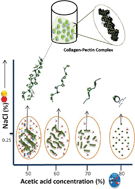
The collagen–pectin molecule carries a net positive charge at acidic pH conditions. The neutral salts may account for drastic changes in the protein molecule13 and leads to huge variation in the particle preparation (Fig. 3).
The zeta potential variations for collagen–pectin complexes prepared at different concentrations of acetic acid (50, 60, 70 and 80%) are given in Table 1. Pectin interacted collagen exhibits a tendency to shift in lower potential value as a function of acetic acid concentration, evidencing the partial covering of the collagen molecule by pectin. The result clearly indicates that the rate of mobility of interacted complex decreased as compared to control inferring the extent of binding. This explains that collagen may have a variable number of amino acids with charged side chains, resulting in different surface charge values. The free or liberated ions in the medium might decrease the double layer effect.14
| Sample | Zeta potential (mv) | Mobility (cm2 V−1 s−1) | Conductivity (mS cm−1) | Doppler shift (Hz) | Base frequency (Hz) |
|---|---|---|---|---|---|
| 0 | 42.50 | 3.314 | 0.5960 | 25.86 | 115.1 |
| CP50Na | 1.80 | 1.407 | 2.5354 | 1.08 | 114.5 |
| CP60Na | 2.11 | 1.648 | 2.0941 | 1.27 | 114.9 |
| CP70Na | 0.92 | 2.301 | 1.5506 | 0.55 | 115.6 |
| CP80Na | −4.05 | −3.157 | 1.141 | −2.45 | 114.9 |
:
1) (CP) microparticles [1
:
1] with 0.25% content of NaCl at varying acetic acid concentration (50–80%)
| Sample | Amide A (cm−1) | Amide I (cm−1) | Amide II (cm−1) | Amide III (cm−1) |
|---|---|---|---|---|
| CP50Na | 3420 | 1533 | 1410 | 1074 |
| CP60Na | 3413 | 1525 | 1410 | 1072 |
| CP70Na | 3404 | 1524 | 1410 | 1072 |
| CP80Na | 3320 | 1522 | 1410 | 1070 |
The DSC heating curve for collagen–pectin complex in the presence of salt as a function of acetic acid concentration is shown in Fig. 4. The characteristic endothermic peaks in the figure are termed as denaturation temperature (Td). The electrospraying process is performed at high acidic conditions and salts substituent. The matrices prepared are characterized for their thermal stability as there is a chance for denaturation of the collagen molecule.16 As illustrated in Fig. 4, the DSC scans show an endothermal peak with a maximum at 120 °C for collagen solution dissolved at 50% acetic acid concentration. From the thermograms it is observed that as the acetic acid concentration increases, Td slightly shifts to the lower temperature. Even at high acetic acid concentration it is observed that matrices are thermally stable of about 75–80 °C. Moreover, during the subsequent cooling and second heating cycle other transitions could not be detected.
![]() | ||
| Fig. 4 DSC profiles for collagen–pectin microparticles with the effect of acetic acid (50–80%) and added neutral salts (NaCl). | ||
X-ray diffraction is used to investigate the collagen fibril distribution and orientation in mineralized tissues. Fig. 5 shows the XRD spectra of collagen–pectin complex. There are two diffraction peaks at the diffraction angles (2θ) about 7.5° and 20.1°. The first one is sharp but the second one is wide, which are in accordance with the characteristic diffraction pattern of collagen.16 The first peak are related to the diameter of the triple helix collagen molecule and second one with the single left-hand helix chain. Typical amorphous broad peak shifted at around 22° as seen in Fig. 5. From that data it is observed that it exhibit their characteristic amorphous broad peak for pectin. Whereas in case of NaCl, in addition to broad amorphous peak around 22° they also posses the two sharp characteristic peak around 26 and 32° for NaCl as seen in Fig. 5.
![]() | ||
| Fig. 5 X-ray spectrum showed collagen–pectin microparticles prepared by varying acetic acid concentration with the addition NaCl. | ||
Hence, it is observed that collagen–pectin cannot crystallize during electrospraying and predominantly give similar amorphous structure in microparticles.
The effect of acetic acid dependency on average particle size of collagen–pectin microparticles and its structural morphology is shown in Fig. 6a–d. The electrospraying of collagen–pectin solution by increasing the acetic concentration resulted in spinning fibres without any salt addition. The neutral salts are used as an antidote to produce individual particles for drug delivery system. Hence, salts such as NaCl was chosen, optimized from their solution properties and studied for their dependency in particle production. The structural transition of collagen molecule in the presence of salts makes it more feasible for producing the relatively monodisperse collagen and collagen–pectin microparticles by electrospraying. As seen in Fig. 6a–d, the collagen–pectin microparticles obtained by addition of NaCl yielded quasi-monodisperse particles with average diameter of approximately 120 μm at 50% acetic acid.
Generally the concentration of acetic acid increases particle size also increases in turn by decreasing solution conductivity.12 In the presence of salts the conductivity increased much higher and provides a reverse effect on the solution property. By this means the relatively small solid particles is produced at 50% acetic acid itself. The variation in the structural forms at higher concentration of acetic acid, is failed to produce individual particles. Moreover, the solutions could not be electrosprayed when acetic acid concentrations lower than 50%. The particles produced are predominantly of doughnut shaped (Fig. 6a). The increasing production rate from a single cone by at least one order of magnitude can be achieved by augmenting the liquid flow rate.
The AFM images shows the collagen–pectin microparticles surface morphology similar to that of the SEM images obtained (Fig. 7a and b).
![]() | ||
| Fig. 7 Topographic images by AFM representing collagen–pectin complex in phase imaging (A) and topographic imaging prepared from 50% acetic acid with addition of 0.25% of NaCl. | ||
The present study has shown that changes in the phase image of collagen helix transition are well confirmed from the AFM images as seen in Fig. 7a. Moreover, AFM enables the direct visualization of the surface topography of collagen molecules at higher magnification (Fig. 7b). The formation of collagen–pectin microparticles in the form of sickle or doughnut shaped structures by means of salt assisted process is distinctively observed. Moreover, the data from AFM images indicates that collagen–pectin molecule in the acetic acid medium are in the long range ordering in the form of dispersed helical forms or random coils without denaturation. Thus the results of these analysis methods indicate visibly the structural modifications in collagen–pectin molecule in the presence of neutral salts.
In case of Lactobacillus acidophilus (gram positive microorganisms) showed antibacterial activity in the reverse manner compared to other gram positive organisms. Here, this species has the ability to with stand the high acetic conditions and show a sustainable growth compared to the other species. Antibacterial activity decreased with increase in acetic acid concentration containing microparticles. Although, there is a noteworthy inhibitory action compared to the control. Collagen–pectin microparticles are responsible for the mechanism of antimicrobial activity on probiotic effect of Lactobacillus sp.
Collagen–pectin microparticles used characteristically have an acidic pH, which is low enough to inhibit pathogenic bacterial species. In case of gram negative organisms (Escherichia coli and Pseudomonas aeruginosa) collagen–pectin microparticles with highest concentration (100 μg mL−1) showed almost no growth for up to 24 h representing a bactericidal effect at this concentration (Fig. 8). The bactericidal effect on Escherichia coli is mainly due to the disruption of cell membrane integrity by the collagen–pectin microparticles. In case of Pseudomonas aeruginosa, collagen–pectin microparticles results in the leakage of the cytoplasmic component and lead to the eventual death of the organism.
The gram positive bacteria such as Bacillus subtilis, Streptococcus pyogenes, Lactobacillus thermophilus are found to be susceptible to the activity of collagen–pectin microparticles indicated by the zone of inhibition measuring more than 10 mm. Except for the Lactobacillus acidophilus, Bacillus subtilis and Streptococcus pyogenes follows a similar trend undergoing maximum cell death with maximum zone of inhibition (>24 mm) at 90% acetic acid concentration with NaCl. With respect to Lactobacillus, a reverse trend has been followed indicating maximum inhibition at 50% acetic acid concentration prepared from NaCl (24 mm) and decreased as the acetic acid concentration increases. This is mainly due to the tendency of collagen–pectin microparticles on Lactobacillus to show high resistance towards cell death at higher % of acetic acid concentration. The activity of gram negative bacteria on collagen–pectin microparticles showed a same trend compared to that of gram positive bacteria. Collagen–pectin microparticles (NaCl) demonstrated a maximum zone of clearance of about 24–28 mm at higher % acetic acid concentration. The zone of inhibition data for both gram positive and gram negative explains the significant biocidal activity of collagen–pectin microparticles. The antimicrobial activity of collagen–pectin microparticles can be explained by its capability to penetrate the outer layer of cells of microorganism.
![]() | ||
| Fig. 11 Cell image at different concentration of collagen–pectin particles. (A) Control, (B) 50% AA, (C) 60% AA, (D) 70% AA and (E) 80% AA (magnification ×20). | ||
The cytotoxicity study is carried out to understand the biocompatibility of the prepared microparticles. From the current research, it can be postulated that CP50 (50% acetic acid) is a optimum concentration to prepare collagen–pectin microparticles.
The particle size variation of collagen–pectin microparticles are determined by dynamic light scattering (DLS) equipment (Delsa Nano C particle analyser, Beckman counter) with a He–Ne laser (632.8 nm, 35 mW) as light source. All the measurements are repeated three times. The particle size and the standard deviations obtained are used to fit the particle size distribution to a lognormal distribution. The zeta potential of the samples is determined by a Zeta Potential Analyzer from Delsa Nano C analyzer with Beckman counter. The zeta (ξ) potential is automatically calculated from electrophoretic mobility based on the Smoluchowski equation, v = (εE/η)ξ, where v is the measured electrophoretic velocity, η is the viscosity, ε is the electrical permittivity of the electrolytic solution and E is the electric field. When an electric field is applied to charged particles in the suspension, particles move towards an electrode opposite to their surface charge. Since the velocity is proportional to the amount of charge of the particles, zeta potential can be estimated by measuring the velocity of the particles.
| This journal is © The Royal Society of Chemistry 2014 |