L-Cysteine-induced chiroptical activity in assemblies of gold nanorods and its use in ultrasensitive detection of copper ions

Tao Wen ab, Shuai Houab, Jiao Yanab, Hui Zhangab, Wenqi Liuab, Yinglu Ji*a and Xiaochun Wu*a
aCAS Key Laboratory of Standardization and Measurement for Nanotechnology, National Center for Nanoscience and Technology, Beijing 100190, P. R. China. E-mail: wuxc@nanoctr.cn; jiyl@nanoctr.cn; Fax: +86 10 8254 5577; Tel: +86 10 8254 5577
bUniversity of the Chinese Academy of Sciences, Beijing 100190, P. R. China

Received 26th July 2014 , Accepted 10th September 2014

First published on 10th September 2014


Abstract

Herein we demonstrated a simple and effective strategy to produce plasmonic optical activity in non-chiral assemblies of gold nanorods (GNRs) via adsorption of L-cysteine (L-Cys). Furthermore, by making use of the catalytic role of Cu2+ in the oxidation of L-Cys by dissolved oxygen, the plasmonic CD intensity can be tuned and used for the detection of copper ions. A dynamic detection range is achieved between 10 pM to 10 nM with a limit of detection (LOD) of 2.6 pM. This strategy offers a simple and ultrasensitive detection of Cu2+ in aqueous solution.

Circular dichroism (CD) spectroscopy is a powerful tool for chiral molecule detection and conformational analysis. Often, the CD bands of chiral molecules, especially biomolecules, are weak and confined to the UV region, thus making their sensitive detection challenging. In 2009, Kotov group demonstrated the plasmonic circular dichroism (PCD) in the tetrahedral assemblies of spherical gold nanoparticles (NPs) using PCR technique.1 After this pioneering work, PCD effects in the superstructures composed of metal NPs (especially Au and Ag) and various chiral molecules have attracted much attention and achieved great progress.2,3 Two prominent benefits of the PCD effect are the transfer of CD response of chiral molecules from UV spectral region to visible or near IR (vis/NIR) region and the significant amplification of CD signals. Based on these two advantages, PCD has been demonstrated to be an effective platform for chiral recognition and ultrasensitive detection.4–6 For instance, an extremely low limit of detection (LOD) of prostate-specific antigen (1.5 × 10⁻²⁰ M) was exhibited using chiral nanoparticle dimers.4 All these efforts point out that analyte detection based on PCD effect may be a general strategy with high sensitivity.

Considering the great potential of PCD-based assays in ultrasensitive detection, simple and feasible ways to build up robust PCD probes are helpful. Fabrication of plasmonic assemblies in a chiral structure has been found to be an effective way to obtain large PCD. Often, aligning plasmonic NPs on a chiral template or positioning them in a chiral configuration are employed.7–13 For instance, both theoretical simulation and experimental observation indicate that in the side-by-side (SS) dimer of the gold nanorods (GNRs), even a slight twisting of the two rods from parallel position can produce strong PCD.11 Previously, mainly large chiral molecules were employed to link GNRs and induce strong PCD. Herein, we introduce another very simple way to induce PCD. The GNRs were first linked using non-chiral molecules, such as sodium citrate, in a SS fashion. The obtained SS assemblies exhibited ignored PCD and are termed “PCD-silent” here. Addition of small chiral molecules with SH groups in such assemblies make them “PCD-active” and a pronounced PCD response occurs. Obviously, using different linkers and chiral guides provides us more flexibility in fabricating PCD probe. Furthermore, combining with the catalytic oxidation of SH groups by copper ions, we realized ultrasensitive detection of Cu2+ using the fabricated PCD probe.

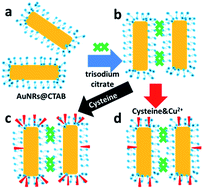
The fabrication of chiral plasmonic assemblies and detection mechanism of copper ions are shown in Scheme 1. As reported previously, in the ensemble suspension of the discrete GNRs, addition of trisodium citrate can induce their assembly in a SS fashion via electrostatic interaction (Scheme 1A-, B-a and b).14 Here, we employed this way to obtained PCD-silent SS assemblies, which show negligible PCD signals (Scheme 1C-a and b). After adding L-cysteine (L-Cys) molecules in such PCD-silent assemblies, an obvious PCD response occurs in the longitudinal surface plasmon resonance (LSPR) region of the assemblies (Scheme 1C-c). Adsorption of L-Cys causes no change in extinction spectra (Scheme 1B-c). The discrete GNRs with or without L-Cys adsorption do not exhibit any PCD response. The PCD intensity shows a positive correlation with the concentration of L-Cys at certain range. Cupric ions can accelerate the oxidation of L-Cys by dissolved oxygen (Scheme 1D), thus reducing the obtained PCD signals (Scheme 1C-d) with no influence on extinction spectra (Scheme 1B-d). Through the change of the PCD intensity vs. the concentration of Cu2+, its amount can be determined.


image file: c4ra07642g-s1.tif
Scheme 1 Driving PCD-silent GNRs SS assemblies (a and b) into PCD-active ones (c and d) by adsorption of L-cysteine and their use in the detection of Cu2+. The course of fabricating robust PCD probes with GNRs assemblies and its application on detection (A). Extinction (B) and CD spectra (C) of the GNRs during this course. The scheme of the catalytic role of Cu2+ in the oxidation of L-cysteine by dissolved oxygen (D). For simiplity, a GNR dimer is used to demonstrate the principle.

In order to verify that the CD signal is mainly affected by chiral molecules (Fig. S2 in ESI), D-Cys, N-acetyl-L-cysteine (L-NAC), L-glutathione (L-GSH) and its oxidized form (L-GSSG) were also tested (Fig. 1A). All SH-terminated chiral molecules induce obvious PCD signals. Furthermore, adding D-Cys gives rise to the mirror PCD spectra of adding L-Cys, indicating the guiding role of chiral molecules. L-GSSG does not produce obvious PCD response possibly due to its low adsorption ability on rod surface. SH-terminated non-chiral molecules, 4-mercaptopyridine (4-MP), produce obvious SERS signal upon adsorption on the Au surface of the assemblies (Fig. 1B), but the assemblies give no PCD response (Fig. 1A). Based on these observations, we conclude that chiral molecules binding strongly to the Au surface can induce strong PCD response in the assemblies. At the moment, the exact PCD mechanism is still elusive and needs further investigation.15


image file: c4ra07642g-f1.tif
Fig. 1 Production of PCD (A) by adding chiral molecules containing thiol groups: L-Cys, D-Cys, L-GSH, L-NAC. 4-MP and L-GSSG are used as the control for nonchiral molecules and chiral molecules with disulfide bond, respectively. Extinction spectra of 4-MP-adsorbed GNRs in discrete and assembled states (B). Insert: corresponding SERS spectra of 4-MP and TEM images of GNRs and their assemblies. Assembly conditions: [GNRs] = 0.1 nM, [CTAB] = 0.5 mM, [citrate] = 0.15 mM. The concentration of various molecules is fixed at 1 μM.

At a given GNR concentration, increasing L-Cys concentration, the PCD signal at 605 nm first increases and reaches the maximum of ca. 27 mDeg at around 0.7 μM. Further increasing L-Cys concentration reduces the PCD signal. From the extinction spectra, the influence of adding L-Cys to the assemblies can be ignored at the employed concentration range (Fig. 2A). Based on this, we choose 0.6 μM L-Cys as the optimal condition for the detection of copper ions because a positive correlation between the PCD intensity and copper ions could be acquired. More Cu2+ ions result in more oxidation of L-Cys, hence lower PCD intensity.


image file: c4ra07642g-f2.tif
Fig. 2 Extinction (A) and CD spectra (B) of the GNRs SS assemblies after adding different concentrations of L-Cys. PCD signals at 605 nm and 735 nm vs. L-Cys concentration (C).

A good SS assembly is beneficial for a large PCD signal (Fig. S3 in ESI). The concentrations of CTAB, linker molecules, and GNRs as well as assembly temperature all affect the final state of assembly. At the fixed concentrations of the GNRs (0.1 nM) and citrate (0.15 mM), the optimal CTAB concentration is ca. 0.5 mM. 0.3 mM CTAB reduces the degree of order in SS assemblies as witnessed by the obvious tailing in the long wavelength region (>800 nm). On the other hand, the SS assembly cannot be initiated at CTAB ≥ 0.8 mM (Fig. S4 in ESI). At fixed concentrations of the GNRs (0.1 nM) and CTAB (0.5 mM), linker citrate plays an important role in controlling assembly. Increasing citrate accelerates the assembly kinetics. Bad assemblies are obtained at citrate concentrations above 0.3 mM (Fig. S5 in ESI). For the building block, good SS assemblies could be obtained at GNRs concentration between 0.05 nM to 0.15 nM (Fig. S6 in ESI). At [GNRs] = 0.025 nM, too fast assembly leads to obvious long wavelength tailing due to high ratio of citrate to the GNRs. Assembly temperature is another effective parameter to tailor assembly (Fig. S7 in ESI). Good SS assemblies could be obtained with a low temperature (27 °C) for 30 min or a high temperature (70 °C) for only 1 min. The extinction spectra indicate that it can keep stable for hours in ambient environment after forming good SS assemblies (Fig. S7D in ESI).

From the change of PCD signal, L-Cys can reach adsorption equilibrium after adding ca. 30 min (Fig. S8 in ESI). The reaction time of L-Cys oxidation catalyzed by Cu2+ ions is determined to be 20 min by measuring the changes of PCD intensity under different incubating times (Fig. S9A in ESI). Small changes in pH value cause negligible change in PCD (Fig. S9B in ESI).

Under the optimal conditions, the PCD intensity shows a high sensitivity to copper ions, especially in the low concentration range. The change of chiral signal gradually increases with increasing Cu2+ (Fig. 3A). A dynamic range is obtained between 10 pM to 10 nM with an LOD of 2.6 pM using a signal-to-noise ratio of 3 (S/N = 3). At the same conditions, the PCD spectra in the presence of other common metal ions were recorded. At 100 fold excess of Cu2+ (10 nM), except Fe3+, Ag+ and Hg2+ ions, the other ions at 1 μM caused few changes compared to the blank control (Fig. 3B). At the upper limit of the dynamic range (10 nM), the influence of the interfering ions is greatly reduced. Thus, the proposed method meets the selectivity requirements of Cu2+ assay. Different from other PCD strategies, where the analyte itself directly affects the assembly degree and thus produces an effect on the PCD, the addition of L-Cys does not affect the assembly of the GNRs in our case.


image file: c4ra07642g-f3.tif
Fig. 3 Relationship between the PCD intensity changes and the concentrations of Cu2+ (A), and effect of various metal ions on PCD intensity (B). The inset shows a linear relationship (R2 = 0.9789) in the concentration range from 10 pM to 10 nM. The standard deviations are obtained from at least three independent experiments.

The accumulation of Cu2+ in human body can lead to many harmful consequences, such as neurodegenerative and prion diseases and even cancers.16,17 Ultrasensitive detection of copper ions is therefore very important. Many simple and fast assays have been developed to obtain sensitive detection of copper ions.17 Table S1 (in ESI) lists the gold nanoparticle based detection modes for copper ions. Except an LOD of 2 fM from Chen et al.,18 our system exhibits the lowest LOD.

In conclusion, we demonstrated a simple strategy to fabricate a robust chiral plasmonic assembly structures and the utilization of such chiral probes for the ultrasensitive detection of copper ions. Under the optimal conditions, a detection limit of this sensing system is 2.6 pM with a dynamic range between 10 pM and 10 nM. As Cu2+ involves many different reactions, such as oxidizing proteins in alkaline condition, the PCD probes can be further extended to detect other molecules.

Acknowledgements

The work was supported by the National Key Basic Research Program of China (2012CB934001 and 2011CB932802) and the National Natural Science Foundation of China (Grant no. 91127013 and 21173056).

Notes and references

  1. W. Chen, A. Bian, A. Agarwal, L. Liu, H. Shen, L. Wang, C. Xu and N. A. Kotov, Nano Lett., 2009, 9, 2153–2159 CrossRef CAS PubMed.
  2. A. Guerrero-Martínez, J. L. Alonso-Gómez, B. Auguié, M. M. Cid and L. M. Liz-Marzán, Nano Today, 2011, 6, 381–400 CrossRef PubMed.
  3. A. Ben-Moshe, B. M. Maoz, A. O. Govorov and G. Markovich, Chem. Soc. Rev., 2013, 42, 7028–7241 RSC.
  4. X. L. Wu, L. G. Xu, L. Q. Liu, W. Ma, H. H. Yin, H. Kuang, L. B. Wang, C. L. Xu and N. A. Kotov, J. Am. Chem. Soc., 2013, 135, 18629–18636 CrossRef CAS PubMed.
  5. Y. Y. Zhu, L. G. Xu, W. Ma, Z. Xu, H. Kuang, L. B. Wang and C. L. Xu, Chem. Commun., 2012, 48, 11889–11891 RSC.
  6. W. Ma, H. Kuang, L. Xu, L. Ding, C. Xu, L. Wang and N. A. Kotov, Nat. Commun., 2013, 4, 2689 Search PubMed.
  7. B. Auguié, J. L. Alonso-Gãmez, A. s. Guerrero-Martínez and L. M. Liz-Marzán, J. Phys. Chem. Lett., 2011, 2, 846–851 CrossRef.
  8. A. Guerrero-Martínez, B. Auguié, J. L. Alonso-Gómez, Z. Džolić, S. Gómez-Graña, M. Zinic, M. M. Cid and L. M. Liz-Marzán, Angew. Chem., Int. Ed., 2011, 50, 5499–5503 CrossRef PubMed.
  9. Z. Li, Z. Zhu, W. Liu, Y. Zhou, B. Han, Y. Gao and Z. Tang, J. Am. Chem. Soc., 2012, 134, 3322–3325 CrossRef CAS PubMed.
  10. Z. Zhu, W. Liu, Z. Li, B. Han, Y. Zhou, Y. Gao and Z. Tang, ACS Nano, 2012, 6, 2326–2332 CrossRef CAS PubMed.
  11. W. Ma, H. Kuang, L. Wang, L. Xu, W.-S. Chang, H. Zhang, M. Sun, Y. Zhu, Y. Zhao, L. Liu, C. Xu, S. Link and N. A. Kotov, Sci. Rep., 2013, 3, 1934 Search PubMed.
  12. X. Lan, Z. Chen, G. L. Dai, X. X. Lu, W. H. Ni and Q. B. Wang, J. Am. Chem. Soc., 2013, 135, 11441–11444 CrossRef CAS PubMed.
  13. X. Shen, A. Asenjo-Garcia, Q. Liu, Q. Jiang, F. J. Garcia de Abajo, N. Liu and B. Ding, Nano Lett., 2013, 13, 2128–2133 CrossRef CAS PubMed.
  14. A. McLintock, N. Hunt and A. W. Wark, Chem. Commun., 2011, 47, 3757–3759 RSC.
  15. S. Hou, T. Wen, H. Zhang, W. Liu, X. Hu, R. Wang, Z. Hu and X. Wu, Nano Res., 2014 DOI:10.1007/s12274-014-0530-z.
  16. D. C. Brady, M. S. Crowe, M. L. Turski, G. A. Hobbs, X. Yao, A. Chaikuad, S. Knapp, K. Xiao, S. L. Campbell, D. J. Thiele and C. M. Counter, Nature, 2014, 509, 492–496 CrossRef CAS PubMed.
  17. Z. Chen, R. Liu, S. Wang, C. Qu, L. Chen and Z. Wang, RSC Adv., 2013, 3, 13318–13323 RSC.
  18. S. Chen, Q. Zhao, F. Liu, H. Huang, L. Wang, S. Yi, Y. Zeng and Y. Chen, Anal. Chem., 2013, 85, 9142–9147 CrossRef CAS PubMed.

Footnotes

Electronic supplementary information (ESI) available: Details of experimental section, figures and tables. See DOI: 10.1039/c4ra07642g
These authors contributed equally to this work.

This journal is © The Royal Society of Chemistry 2014
Click here to see how this site uses Cookies. View our privacy policy here.