
DOI:
10.1039/C4RA07095J
(Paper)
RSC Adv., 2014,
4, 56571-56581
A DFT study on structure, stabilities and electronic properties of double magnesium doped gold clusters†
Received
14th July 2014
, Accepted 14th October 2014
First published on 14th October 2014
Abstract
Density functional theory (DFT) with PW91PW91 functional has been applied to investigate the structures, relative stabilities and electronic properties of small bimetallic neutral, cationic and anionic AunMg2 (n = 1–5) clusters. The results show that doping with two Mg atoms dramatically affects the geometries of the ground-states of Aun (n = 1–7) clusters. The relative stabilities of the clusters are compared on the basis of average binding energies, fragmentation energies and second order difference of energies. These parameters show even-odd alternation phenomenon. The electronic properties are calculated using hardness values and this suggests that even numbered clusters are more stable than odd counterparts in both bare, as well as doped ones. The nature of the bonding interaction is also investigated using Bader's quantum theory of atoms in molecules (QTAIM), which indicates the presence of covalent bonding in the studied clusters. The population analysis reveals the transfer of electrons from Mg to Au atoms, which is in turn responsible for the enhanced stability of doped clusters.
1. Introduction
The discovery of unusual catalytic abilities of gold nanoclusters by the revolutionary work of Haruta considerably increases the attention in the study of gold at the nano level.1
Based on this work, a large number of theoretical and experimental studies were carried out on the structural, as well as catalytic properties of gold nanoclusters.2–9 It has been reported that, from Au2 to Au12, all of the most possible lowest energy structures adopt a planar configuration.10 On the other hand, in case of anionic clusters also, Au4− to Au12− exhibit planar structures,2 whereas in case of cationic clusters a transition from 2D to 3D occurs from Au8+.5 Apart from these monometallic nanoclusters of Au, bimetallic nanoclusters also find wide interest in recent studies.10–13 They are composed of two different metal elements and are more promising than the monometallic nanoparticles because a synergistic effect is expected.10 They show novel catalytic behaviour based on the effect of the second metal element. This effect can often be explained in terms of an ensemble11 or a ligand effect in catalysis.12 Recently, researchers have focused considerable attention on Au clusters doped with different atoms. Wang et al.13 carried out a density functional theory study on Cu doped Au clusters and compared them with pure Au clusters. They determined that for neutral and anionic clusters, the structures are planar for both bare and Cu doped Au clusters. However, in the case of cationic clusters, a transition from 2D to 3D occurs at Au6Cu+. Using DFT, Manzoor et al.14 studied the effect of Si doping in Au7 and Au8 clusters. They determined that silicon doped Au7Si clusters show considerable binding and activation of O2 molecules in comparison to pristine Au8 clusters and this fact was further confirmed by geometrical parameters (O–O and Au–O bond length) and O–O stretching frequency observations. Shao et al.15 also performed a DFT study of Be doped cationic Aun (n = 1–8) clusters. They revealed that doping with Be can remarkably increase the stability of Au clusters as compared to bare clusters. Similarly, Ju-Wang et al.16 theoretically studied the Al doped anionic Au clusters and reported that doping with a single Al atom can dramatically affect the ground-state geometries of the Au clusters and the stability order follows even–odd alternation. Very recently, we also performed DFT and QTAIM study on Be doped Au clusters and found that Be doping can also increase the stability of Au clusters.17
It is a well known fact that magnesium (Mg), an alkaline earth element, is extremely reactive in the free state. It is resistant to corrosion when alloyed with certain metals such as Fe, Ni, Cu and Co.18 For Mg doped Au clusters, Kyasu et al.19 performed an anion photoelectronic study on AunMg− (n = 2–7) clusters. Majumdar et al.20 observed in a theoretical study the structure and bonding of the Au5Mg cluster. They determined that the Au5Mg cluster adopts a planar structure similar to Au6. In an another study, Li et al.21 systematically analysed the properties of anionic AunMg (n = 1–8) clusters and determined that the lowest energy structures for AunMg clusters are different to that of the bare Au clusters. However, to the best of our knowledge, no systematic theoretical investigations into Mg2Aun clusters have been performed. For example, if two Mg atoms are doped in gold clusters together, do their structures and properties differ from those of bare gold clusters? Therefore, by applying DFT we studied the structural and electronic properties of Au clusters doped with two Mg atoms, AunMg2 (n = 1–5). During this study, we optimised a certain type of structures by doping Mg atoms at different positions in the bare Au clusters. The importance of this work lies in the fact that nanosized Au clusters already show tremendous catalytic activity for different types of reactions and doping of a metal can further enhance its catalytic properties. The novelty of the work with reference to the previous work lies in the facts that for the first time we have studied the all neutral and charged clusters for two Mg metal doped Au clusters and compared with the pure ones. Therefore, our present study can provide powerful guidelines concerning Mg doped Au clusters in further experimental research.
2. Computational methods
The initial structure at neutral state was generated by performing a classical simulated annealing using the Forcite Plus code as encoded in the MATERIAL STUDIO software.22 The Universal force field (UFF)23 was adopted to perform this simulation. Previous studies24,25 have shown that UFF provides reliable results for gold based systems. The cut-off radius was chosen to be 15.5 Å and a NVE ensemble was used. A total of 100 annealing structures were generated at high temperature (1000 K) and 50 heating ramps per cycle. The most stable structure obtained by this simulation was used as the input for DFT calculations.
Geometry optimizations and frequency analysis of AunMg2 clusters have been performed using the GAUSSIAN 09 suite of programs.26 In the framework of DFT, we employ the gradient-corrected exchange and correlation functional of Perdew-Wang (PW91PW91)27 to explore the stationary points on the potential energy surface. As we all know, the relativistic effects play a primary role in the structure and energetics of Au-containing clusters, we used the Los Alamos LANL2DZ28,29 effective core pseudopotentials (ECP) and valence double-ζ basis sets for Au. The Mg atoms are treated with a 6–311+G(d) basis set. The PW91PW91 functional is successfully used in the study of previous Mg doped Au clusters,20,21 as well as studies on other metal clusters also.15,30,31 We first perform the calculations on Aun+2 (n = 2–5) clusters in order to discuss the effects of doped impurity atoms on gold clusters. Full geometry optimizations have been performed for the neutral clusters, as well as ionic clusters without imposing any symmetry constraints. In order to obtain the lowest energy doped isomers, initial structures were constructed by substituting Au atoms with Mg atoms in the pure gold structures at various attachment sites. The most stable clusters are obtained by comparing their relative energies. The vibrational frequencies are found to be positive for all the structures confirming them to be at energy minima. The zero-point vibrational energy corrections have been included in all the calculations. The total energies of the most stable clusters are used to determine their binding energy, relative stability, ionization potential, electron detachment energy, as well as chemical hardness as a function of clusters size to describe the stability of the clusters. We analysed the nature of bonding in the studied clusters, based on Bader's quantum theory of atoms in molecules (QTAIM).32–34 For QTAIM analysis, we have generated the wave function using Gaussian 09 at the same level of theory as employed in structure optimization, and then used the AIMALL package35 to study different bond parameters.
3. Results and discussion
3.1 Structural study of AunMg2 clusters
The various lowest energy structures for neutral and charged Aun and AunMg2 clusters are presented in Fig. 1–3. Among different isomers obtained for a particular cluster, the energy of the most stable isomer is taken as zero and energy of the others are compared relative to it.
 |
| | Fig. 1 Optimized structures of neutral Aun+2 and AunMg2 (n = 1–5) clusters. | |
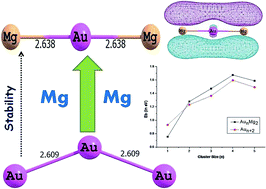
3.1.1 Neutral clusters. The structures obtained in the present work for neutral Au clusters are identical to those in the previous study.2 Moving on to doped clusters, from Fig. 1, it can be seen that the most stable structure for AuMg2 is 1(1a) having a linear shape. The Au–Mg bond lengths are determined to be 2.638 Å. The other isomer, 1(1b) is found to be higher in energy compared to 1(1a) by 0.22 eV. For Au2Mg2 clusters, the structure 1(2a) with square planar shape is found to be the most stable having D2h symmetry. Here the Au–Mg bond lengths are found to be 2.614 Å. In case of Au3Mg2 clusters, the most stable structure is 1(3a) with symmetry C1. However, here we obtained a 3D isomer, 1(3b), which is higher in energy than 1(3a) by 0.01 eV. Thus, a transition from 2D to 3D is obtained for Au3Mg2 for the neutral clusters. Moving on to Au4Mg2, the most stable isomer is 1(4a). It has C2ν symmetry with the shortest Au–Mg distance of 2.476 Å. This bond length is found to be in good agreement with that of 2.56 Å for the single Mg doped cluster.20 Finally, a planar isomer 1(5a) having C2ν symmetry is found for the most stable structure of Au5Mg2. The calculated values of the shortest Au–Mg and Au–Au bond lengths are 2.587 and 2.729 Å, respectively. However, we observed 2D structures for the neutral clusters except 1(3b) for which 3D structure is observed.From the above discussion, it can be noted that almost all the lowest energy structures of Mg2Aun favor a 2D planar structure. It is seen from the Fig. 1 that the most stable structures of Au2Mg2 and Au4Mg2 are similar to that of their bare counterparts. In addition to these stable structures, there exists at least one isomer, which is structurally similar to the bare Au clusters in the other clusters. However, a transition from 2D to 3D is obtained at n = 3 in case of doped clusters. Moreover, the stable isomers for Au3Mg2 and Au4Mg2 have different geometry to that of the pure gold clusters. These indicates that the doubly doped Mg atoms can affect the geometries of the ground-state of neutral Aun clusters.
3.1.2 Charged clusters. The different charged (cationic and anionic) isomers for Aun+2 and AunMg2 (n = 1–5) are shown in Fig. 2 and 3. For AuMg2+, the most stable cluster is 2(1a) having the linear shape. Similarly the stable isomers are 2(2a), 2(3a), 2(4a) and 2(5a) for Au2Mg2+, Au3Mg2+, Au4Mg2+ and Au5Mg2+, respectively, as depicted in Fig. 2. Here we obtained only 2D planar structures and no any transition to 3D structure seems to occur. On comparing the doped structures with that of the bare ones, it seems that apart from AuMg2 and Au3Mg2, the stable isomers for other clusters are found to be similar to the bare clusters. However, various high energy isomers viz. 2(2b), 2(4c) and 2(5b) along with stable isomers of AuMg2 and Au3Mg2 adopt different geometries to that of the pure gold counterpart. For anionic clusters, the most stable isomers are found to be 3(1a), 3(2a), 3(3a), 3(4a) and 3(5a) for AuMg2−, Au2Mg2−, Au3Mg2−, Au4Mg2− and Au5Mg2−, respectively (Fig. 3). It is interesting to compare the structures for anionic clusters reported in this study with those of the previous observation for single Mg doped Au-clusters.21 It is found that all the stable isomers for doubly doped clusters are different to that of the singly doped clusters. However, the shortest Au–Mg bond lengths are found to be comparable in both the types of clusters. In this study, a transition from 2D to 3D cluster occurs at Au3Mg2−. Furthermore, the isomers 3(3b), 3(3c), 3(4a), 3(4b), 3(4c) and 3(5c) have different geometries to those of pure gold clusters. All of these results indicate that in the case of charged clusters also, doubly doped Mg atoms can play a key role to effect the geometries of the ground-state Aun clusters and also they are structurally different to that of the singly doped clusters.
 |
| | Fig. 2 Optimized structures of cationic Aun+2 and AunMg2 (n = 1–5) clusters. | |
 |
| | Fig. 3 Optimized structures of anionic Aun+2 and AunMg2 (n = 1–5) clusters. | |
3.2 Stability of AunMg2 clusters
The relative stabilities of the AunMg2 clusters are calculated in terms of average binding energies per atom, (Eb) fragmentation energies, D, and second-order difference of energies, Δ2E, using formulae (1–7) given below. These three parameters have already proved to be a powerful tool to reflect the relative stability of the clusters.
For Aun clusters average binding energies Eb(Aun+2), fragmentation energies ΔE(Aun+2), and second-order difference of energies Δ2E(n) are calculated using the following formulae:
| | |
Eb(Aun+2) = [(n + 2)E(Au) − E(Aun+2)]/(n + 2)
| (1) |
| | |
Eb(Aun+2)q = [E(Au)q + nE(Au) − E(Aun+2)q]/(n + 2)
| (2) |
| | |
ΔE(Aun+2)q = [E(Aun+1)q + E(Au) − E(Aun+2)q]
| (3) |
| | |
Δ2E(Aun+2)q = [E(Aun+1)q + E(Aun+3)q − 2E(Aun+2)q]
| (4) |
where,
E(Au) represents the ground state energy of Au,
q is the charge on the cluster,
q = 0, +1 and −1 for neutral, cationic and anionic clusters, respectively, and
n is the number of gold atoms associated with the clusters.
Similarly, for AunMg2 clusters averaged binding energies Eb(n), fragmentation energies ΔE(n) and second-order difference of energies Δ2E(n) are calculated using the following formulae:
| | |
Eb(AunMg2)q = [2E(Mg)q + nE(Au) − E(AunMg2)q]/(n + 2)
| (5) |
| | |
ΔE(AunMg2) = [E(Aun−1Mg2) + E(Au) − E(AunMg2)q]
| (6) |
| | |
Δ2E (AunMg2)q = [E(Aun−1Mg2) + E(Aun+1Mg2) − 2E(AunMg2)q]
| (7) |
where,
E(Mg
2Au
n),
E(Au),
E(Mg) denote the total energy of the Mg
2Au
n, Au and Mg, respectively.
3.2.1 Binding energies per atom. The variation of calculated binding energies per atom (Eb) for the most stable isomers as a function of cluster size is shown in Fig. 4. Here we compared the binding energies of the doped clusters relative to pure gold clusters. It is observed from the figure that the binding energy per atom for the pure cluster increases with cluster size for the neutral clusters; therefore, the clusters continue to gain energy during the growth process. However, for the charged clusters, the B.E. values show an even–odd alternation. For neutral and anionic doped clusters, we obtained a sharp peak at n = 4 and n = 3, 5, respectively, indicating the higher stability of these clusters in the region n = 1–5. However, for the cationic doped clusters, the Eb values decrease with cluster size. The comparison of binding energies reveals that doped clusters are more stable compared to pure clusters. The binding energy plots (Fig. 4) suggested that in all the neutral, cationic and anionic clusters, the doping of two Mg atoms increase the stability of the Au clusters. For the anionic clusters, we determined that the variation of the binding energy plot is similar to that of the previous study on singly doped clusters.21 It is also clear from the plot that the binding energy values are higher for doubly doped clusters compared to single ones. This indicates the enhanced stability of our studied clusters. When we compare the binding energies of charged and neutral clusters (Fig. S1 of ESI†), the binding energy order is found to increase as: neutral < anionic < cationic for Mg doped clusters.
 |
| | Fig. 4 Variation in binding energies with respect to cluster size for (A) neutral, (B) cationic and (C) anionic clusters in bare and magnesium doped gold clusters. | |
3.2.2 Fragmentation energies. The variation of values of fragmentation energies for the most stable isomers as a function of cluster size is shown in Fig. 5. The fragmentation energies are sensitive to the relative stabilities that can be observed in mass abundance spectra. From Fig. 5, it can be seen that both the bare, as well as doped clusters exhibit even–odd alternation with respect to cluster size. For neutral bare clusters, the clusters with an even number of atoms are more stable compared with an odd number of atoms. However, the reverse is observed for the charged clusters and the clusters bearing an odd number of atoms are more stable. For neutral and anionic cluster, AunMg2 clusters follow the same trend as observed for bare clusters and also the plot for anionic clusters is similar to the previous study.21 For neutral clusters, a sharp peak occurs at n = 4, whereas for cationic and anionic clusters, sharp peaks occur at n = 2 and n = 3, respectively, indicating the stability of these clusters in the region n = 1–5.
 |
| | Fig. 5 Variation in fragmentation energies with respect to cluster size for (A) neutral, (B) cationic and (C) anionic clusters in bare and magnesium doped gold clusters. | |
3.2.3 Second-order difference of energies. The second-order difference of energies (Δ2E), generally known to provide the relative stability of a cluster of size n with respect to its neighbor. Fig. 6 provides the variation of values of fragmentation energies for the most stable isomers as a function of cluster size. Fig. 6 clearly indicates the even–odd alternation for bare, as well as doped clusters. For neutral doped clusters, the cluster with n = 4 shows a sharp peak indicating its higher stability. Similarly, n = 2 and n = 4 show greater stability for cationic and anionic clusters, respectively, and the plot for anionic cluster is similar to the previous study.21
 |
| | Fig. 6 Variation in second order difference of energies with respect to cluster size for (A) neutral, (B) cationic and (C) anionic clusters in bare and magnesium doped gold clusters. | |
3.3 Electron detachment from anionic clusters and ionization of neutral clusters
Using the same level of theory, we have calculated the vertical electron detachment energy (VDE), adiabatic detachment energy (ADE), vertical ionization potential (VIP) and adiabatic ionization potential (AIP) values of Aun−, AunMg2−, Aun and AunMg2 clusters. It is noteworthy to mention that VDE and ADE values are properties of anions, whereas VIP and AIP are properties of neutral species.
VDE is defined as the energy difference between the neutral clusters at optimized anion geometry clusters and optimized anion clusters, i.e.;
| | |
VDE = E(neutral at optimized anion geometry) − E(optimized anion)
| (8) |
Similarly, ADE is calculated using the following formula:
| | |
ADE = E(optimized neutral) − E(optimized anion)
| (9) |
The other parameter i.e., ionization potential (IP), measures the energy difference between the ground state of the neutral and the ionized clusters. If the ionized cluster has the same geometry as the ground state of the neutral, the ionization energy corresponds to the vertical ionization potential (VIP). On the other hand, the energy difference between the ground state of the cation and ground state of the neutral is referred to as the adiabatic ionization potential (AIP). VIP is generally calculated using the following formula:
| | |
VIP = E(cation at optimized neutral geometry) − E(optimized neutral)
| (10) |
Similarly, AIP is calculated as:
| | |
AIP = E(optimized cation) − E(optimized neutral)
| (11) |
The VDE and ADE values obtained for Aun− and AunMg2− are shown in Table 1. The values obtained from our calculations for Aun− are in excellent agreement with the previous experimental results.36 Unfortunately, because of the lack of experimental values, it is not possible to make a direct comparison of the doped clusters. By plotting the calculated VDE values of bare and doped clusters with respect to cluster size (Fig. S2 of ESI†), we observed that the VDE values for the doped AunMg2− clusters show even–odd alternation. Moreover, the VDE values significantly decreases for Au clusters when doped with two Mg atoms and the values obtained for even sized clusters are lower than that of their odd counterparts.
Table 1 Vertical and adiabatic detachment energies of anionic Aun+2 and AunMg2 clusters (n = 1–5)
| |
VDE (in eV) |
ADE (in eV) |
|
|
|
| |
Aun+2 |
AunMg2 |
Aun+2 |
AunMg2 |
|
|
|
| n |
Calculated |
Experimental32 |
Calculated |
Calculated |
Experimental32 |
Calculated |
|
|
|
| 1 |
3.59 |
3.77 |
1.9 |
3.56 |
3.63 |
1.53 |
|
|
|
| 2 |
2.48 |
2.63 |
1.26 |
2.48 |
2.48 |
1.26 |
|
|
|
| 3 |
2.99 |
2.98 |
2.13 |
2.99 |
2.75 |
2.12 |
|
|
|
| 4 |
2.02 |
2.0 |
1.43 |
2.02 |
1.75 |
1.43 |
|
|
|
| 5 |
2.69 |
3.38 |
2.59 |
2.69 |
3.13 |
2.59 |
|
|
|
The VIP and AIP values obtained for Aun and AunMg2 are provided in Table 2. The values obtained from our calculations for Aun are in excellent agreement with the previous experimental results.37 Because of the lack of experimental values, it is not possible to make direct comparison on the doped clusters. The plot of VIP values with regards to cluster size (Fig. S3 of ESI†) shows even–odd alternation and indicates that the values obtained for odd sized clusters are lower than that of their even counterparts.
Table 2 Vertical and adiabatic ionization potentials of neutral Aun+2 and AunMg2 clusters (n = 1–5)
| n |
Aun+2 |
AunMg2 |
| VIP (in eV) |
AIP (in eV) |
Experimental33 |
VIP (in eV) |
AIP (in eV) |
| 1 |
6.99 |
6.99 |
7.27 |
5.84 |
5.84 |
| 2 |
7.81 |
10.2 |
8.60 |
6.28 |
6.28 |
| 3 |
7.06 |
7.06 |
7.61 |
6.36 |
6.36 |
| 4 |
8.38 |
8.38 |
8.80 |
7.88 |
7.19 |
| 5 |
6.48 |
6.48 |
7.80 |
6.43 |
6.43 |
3.4 Chemical hardness
Chemical hardness has been established as an electronic quantity to characterize the relative stability of molecules and aggregates. It is based on the principle of maximum hardness (PMH) proposed by Pearson.38 It is favored by small-sized atoms, thus we can also discuss the stability of our studied clusters on the basis of their hardness. Based on a finite-difference approximation and Koopmans theorem39 chemical hardness (η) is expressed as:
where, IPv is the vertical ionization potential and EAv is vertical electron affinity. The calculated values of hardness obtained during our calculations are listed in Table 3. The values of hardness obtained for Aun clusters are in good agreement with the previously reported results.40 The hardness values for both pure and doped clusters show even–odd alternation with respect to the cluster size (Fig. S4 of ESI†). For both type of clusters, the hardness is higher for even numbered clusters compared to their odd counterparts indicating the greater stability of the former one. The trend of change in hardness is also determined to be similar to that of fragmentation energy and second order difference of energy.
Table 3 Hardness values of the Aun+2 and AunMg2 clusters (n = 1–5)
| |
Hardness values, (η) |
| |
Aun+2 |
AunMg2 |
| n |
Calculated |
Reported36 |
Calculated |
| 1 |
3.40 |
5.15 |
3.94 |
| 2 |
5.32 |
5.64 |
5.03 |
| 3 |
4.07 |
4.51 |
4.23 |
| 4 |
6.35 |
6.38 |
6.45 |
| 5 |
3.79 |
4.01 |
3.84 |
3.5 QTAIM analysis
To study the topology of electron density, we have used Bader's quantum theory of atoms in molecules (QTAIM).28–30 This theory is mainly based on the three dimensional electron density functions, ρ(r). The topological analysis is the investigation of critical points of this function, ρ(r). The parameters that are commonly used to ascertain the nature and extent of bonding between two atoms are the electron density, ρ and the Laplacian of electron density, ∇2ρ at the bond critical point (BCP). Normally, a large value of ρ(r) (>0.2 au) and large and negative value of ∇2ρ indicates a covalent or open-shell interaction, whereas a small value of ρ(r) (<0.10 au) and a positive value of ∇2ρ indicates an ionic or closed-shell interaction. However, this view can not be extended to transition metal complexes because the electron distribution of these elements are diffuse in nature. Hence, in transition metal complexes, the rule is changed and it is generally observed that ρ has a small value and ∇2ρ has a small and positive value for a covalent interaction.41
The presence of BCP in all the clusters indicates the interaction between the Au and Mg atoms. In QTAIM analysis, we take into account only the most stable isomers that are found during geometry optimization. The focus of this QTAIM study was to notice the type of bonding involved and the variation of bonding on doping Mg in Au clusters. The different values of the two parameters that we observed during QTAIM are shown in Table 4 for some selected most stable bare and doped clusters. The values for the remaining clusters are given in Table S1 of ESI.†
Table 4 Electron density, ρ and the Laplacian of electron density, ∇2ρ at the bond critical points (BCP) for some selected clusters
| Cluster |
Interaction |
ρ |
∇2ρ |
| Neutral |
| Au3 |
Au1–Au2 |
0.06 |
0.15 |
| Au1–Au3 |
0.06 |
0.15 |
| Au4 |
Au2–Au4 |
0.06 |
0.15 |
| Au1–Au2 |
0.05 |
0.12 |
| Au2–Au3 |
0.05 |
0.12 |
| Au1–Au4 |
0.05 |
0.12 |
| AuMg2 |
Mg1–Au3 |
0.03 |
0.07 |
| Mg2–Au3 |
0.03 |
0.07 |
| Au2Mg2 |
Mg1–Au3 |
0.03 |
0.1 |
| Mg2–Au3 |
0.03 |
0.1 |
| Mg1–Au4 |
0.03 |
0.1 |
| Mg2–Au4 |
0.03 |
0.1 |
![[thin space (1/6-em)]](https://www.rsc.org/images/entities/char_2009.gif) |
| Cationic |
| Au3 |
Au1–Au2 |
0.06 |
0.13 |
| Au1–Au3 |
0.06 |
0.13 |
| Au2–Au3 |
0.06 |
0.13 |
| Au4 |
Au2–Au4 |
0.05 |
0.12 |
| Au1–Au2 |
0.05 |
0.12 |
| Au2–Au3 |
0.05 |
0.12 |
| Au1–Au4 |
0.05 |
0.12 |
| Au3–Au4 |
0.05 |
0.12 |
| AuMg2 |
Mg1–Au3 |
0.03 |
0.08 |
| Mg2–Au3 |
0.03 |
0.08 |
| Au2Mg2 |
Mg1–Au3 |
0.03 |
0.11 |
| Mg2–Au3 |
0.03 |
0.11 |
| Mg1–Au4 |
0.03 |
0.11 |
| Mg2–Au4 |
0.03 |
0.11 |
![[thin space (1/6-em)]](https://www.rsc.org/images/entities/char_2009.gif) |
| Anionic |
| Au3 |
Au1–Au2 |
0.06 |
0.14 |
| Au1–Au3 |
0.06 |
0.14 |
| Au4 |
Au2–Au4 |
0.04 |
0.1 |
| Au1–Au2 |
0.05 |
0.12 |
| Au2–Au3 |
0.05 |
0.12 |
| Au1–Au4 |
0.05 |
0.12 |
| AuMg2 |
Mg1–Au3 |
0.02 |
0.06 |
| Mg2–Au3 |
0.02 |
0.06 |
| Au2Mg2 |
Au1–Mg3 |
0.02 |
0.07 |
| Au2–Mg3 |
0.02 |
0.07 |
| Au1–Mg4 |
0.02 |
0.07 |
| Au2–Mg4 |
0.02 |
0.07 |
The small and positive values obtained for ρ and ∇2ρ for all the analysed structures in Table 4 indicates the covalent interaction between Au–Au and Au–Mg atoms. However, compared to that of Au–Au bonds, the bond critical point shifts towards Mg atom in Au–Mg bonds as shown in Fig. S5 of ESI.† When we observed the basin paths for the some clusters (Fig. 7) it clearly confirms the interaction between the Au–Au and Au–Mg atoms. Moreover, the presence of ring critical points (RCP) in several clusters confirms the cyclic structures that we obtained during optimisation. For example, we obtained a triangular structure for cationic Au3 cluster. The QTAIM analysis confirms this structure results in the RCP as shown in Fig. 7. It can be concluded from the QTAIM analysis that the studied clusters possess covalent bonds among the bonding atoms. Various smaller values of ρ and ∇2ρ obtained for doped clusters compared to that of pure clusters (Table 4) indicate that the extent of covalent bonding may be strong in the former one.
 |
| | Fig. 7 Trajectory field in some of the Aun+2 and AunMg2 clusters. Gold and magnesium atoms are represented by yellow and green spheres, respectively. Bond paths and basin paths are indicated by dark green and blue lines, while the interatomic surfaces are indicated by dark blue lines. Red and green dots indicate bond critical points and ring critical points, respectively. | |
3.6 Population analysis
The variation of atomic and orbital contributions on doping Mg atoms in Au clusters was observed by performing population analysis on neutral Au3 and AuMg2 clusters. The HOMO–LUMO isosurfaces for Au3 and AuMg2 are shown in Fig. 8. The isosurfaces clearly indicate the formation of π-bonds in both the cases by sidewise overlapping and it supports the formation of covalent bonds in accordance with our QTAIM study. For Au3, the atomic contribution is found to be 13% Au + 74% Au + 13% Au and the orbital contribution is 0.86(sp0.01d0.05)Au + 0.51(sp0.01d0.02)Au + 0.51(sp0.01d0.02)Au. The percentage of s, p and d-orbitals in Au atoms in the Au3 trimer are 94.80%, 1.01% and 4.20%, respectively. However, on doping two Mg atoms, the atomic contribution changed to 30% Mg + 40% Au + 30% Mg. The orbital contribution is 0.78(sp0.04)Mg + 0.62(sp1.02 d0.02)Au+ 0.78(sp0.04)Mg. The percentage of s, p and d-orbitals in Au atoms of AuMg2 are determined to be 94.31%, 1.03% and 4.66%, respectively, and that of Mg atoms are 80.48% and 19.52% for s and p-orbitals, respectively. It reveals that there occurs transfer of electron density from p-orbitals of Mg atoms to the d-orbitals of Au-atoms, which results in an increase of the d-orbital electron density. This seems to be the reason for the enhanced stability in AuMg2 clusters. When we analysed the Mulliken charges in neutral AuMg2 clusters, it was found that Mg atoms have positive charges (0.477 e), whereas that of gold has negative charges (−0.954). Similarly, for the cationic AuMg2 cluster, Mg atoms possess positive charges (1.041) and Au atoms have negative charge (−1.083), whereas that of anionic AuMg2 clusters have charges of 0.048 and −1.096 for Mg and Au atoms, respectively. This suggests the transfer of charges from Mg atoms to Au atoms, which may arise because of the larger electronegativity of Au (2.54) as compared to Mg (1.31).
 |
| | Fig. 8 HOMO and LUMO isosurfaces of Au3 and AuMg2 clusters. | |
4. Conclusions
We have presented a systematic study of the structures, stabilities and electronic properties of small bare gold clusters Aun and bimetallic complexes of doubly Mg doped AunMg2 (charged as well as neutral) using PW91PW91 level of theory. All the results are summarized as follows:
1. Most of the Mg doped Aun clusters adopt planar structures. The structures of doped clusters are different to that of pure clusters indicating the effect of doubly doped Mg in the Au clusters.
2. The relative stabilities as a function of cluster size are studied in detail in terms of binding energy per atom, fragmentation energies and second-order difference of energies. These curves show even–odd oscillory behaviours and the calculated results reveal that Au6, Au5+, Au6−, Au4Mg2, Au2Mg2+, Au3Mg2− structures have enhanced chemical stabilities. The stability trends clearly indicates that the studied doped clusters are more stable to that of bare clusters.
3. Ionization potentials and electron detachment energies (both vertical and adiabatic) of Aun and AunMg2 clusters are discussed and compared with experimental results. Our theoretical results are determined to be in good agreement with experimental values. Consequently, our obtained atomic structures of AunMg2 clusters should be reliable. The chemical hardness values show an oscillatory behaviour and suggests that even numbered clusters are comparatively more stable to odd numbered ones.
4. The QTAIM analysis reveals that the values of electron density, ρ, and its Laplacian, ∇2ρ, at the Au–Au and Au–Mg BCPs are very small and positive. These two parameters confirm the presence of covalent interactions in the studied clusters. The population analysis suggests the transfer of electrons from Mg to Au atoms. Such that we can conclude that the doping of doubly doped Mg can increase the stability of the pure Au clusters.
We hope that the detailed investigation into structures, stability and electronic properties of small bimetallic clusters in the present research work will provide an insight into understanding the larger doped clusters of gold as well as other metals.
Acknowledgements
The work is funded by the Department of Science and Technology, New Delhi in the form of a research project (SR/NM/NS-1023/2011 G). One of the authors, D.B. is thankful to CSIR, New Delhi for providing Senior Research fellowship. The financial support in the form of Dr. D. S. Kothari Post-doctoral fellowship to B.K.M. from University Grants Commission, New Delhi is also acknowledged.
References
- M. Haruta, T. Kobayashi, H. Samo and N. Yamada, Chem. Lett., 1987, 2, 405 CrossRef.
- A. Deka and R. C. Deka, J. Mol. Struct.: THEOCHEM, 2008, 870, 83 CrossRef CAS PubMed.
- H. Hakkinen, B. Yoon, U. Landman, X. Li, H. J. Zhai and L.-S. Wang, J. Phys. Chem. A, 2003, 107, 6168 CrossRef.
- N. Shao, W. Huang, W.-N. Mei, L. S. Wang, Q. Wu and X. C. Zeng, J. Phys. Chem. C, 2014, 118, 6887 CAS.
- S. Gilb, P. Weis, F. Furche, R. Ahlrichs and M. M. Kappes, J. Chem. Phys., 2002, 116, 4094 CrossRef CAS PubMed.
- J. Li, X. Li, H.-J. Zhai and L.-S. Wang, Science, 2003, 2003(299), 864 CrossRef PubMed.
- X. Xing, B. Yoon, U. Landman and J. H. Parks, Phys. Rev. B: Condens. Matter Mater. Phys., 2006, 74, 165423 CrossRef.
- R. C. Deka, D. Bhattacharjee, A. K. Chakrabartty and B. K. Mishra, RSC. Adv., 2014, 4, 5399 RSC.
- H. Hakkinen and U. Landman, J. Am. Chem. Soc., 2001, 123, 9704 CrossRef CAS.
- N. Toshima, H. Yan and Y. Shiraishi, Metal Nanoclusters in Catalysis and Materials Science, Elsevier, UK, 2008 Search PubMed.
- F. Maroun, F. Ozanam, O. M. Magnussen and R. J. Behm, Science, 2001, 293, 1811 CrossRef CAS PubMed.
- M. Chen, D. Kumar, C. W. Yi and D. W. Goodman, Science, 2005, 310, 291 CrossRef CAS PubMed.
- H.-Q. Wang, X.-Y. Kuang and H.-F. Li, Phys. Chem. Chem. Phys., 2010, 12, 5156 RSC.
- D. Manzoor, S. Krishnamurty and S. Pal, J. Phys. Chem. C, 2014, 118, 7501 CAS.
- P. Shao, X.-Y. Kuang, Y.-R. Zhao, Y.-F. Li and S.-J. Wang, J. Mol. Model., 2012, 18, 3553 CrossRef CAS PubMed.
- C.-J. Wang, X.-Y. Kuang, H.-Q. Wang, H.-F. Li, J.-B. Gu and J. Liu, Comput. Theor. Chem., 2012, 1002, 31 CrossRef CAS PubMed.
- D. Bhattacharjee, B. K. Mishra, A. K. Chakrabartty and R. C. Deka, Comput. Theor. Chem., 2014, 1034, 61 CrossRef CAS PubMed.
- http://en.wikipedia.org/wiki/Magnesium.
- K. Koyasu, Y. Naono, M. Akutsu, M. Mitsui and A. Nakajima, Chem. Phys. Lett., 2006, 422, 62 CrossRef CAS PubMed.
- C. Majumder, A. K. Kandalam and P. Jena, Phys. Rev. B: Condens. Matter Mater. Phys., 2006, 74, 205437 CrossRef.
- Y.-F. Li, X.-Y. Kuang, S.-J. Wang and Y.-R. Zhao, J. Phys. Chem. A, 2010, 114, 11619 Search PubMed.
- Accelrys Material Studio 7.0.
- A. K. Rappé, C. J. Casewit, K. S. Colwell, W. A. Goddard III and W. M. Skiff, J. Am. Chem. Soc., 1992, 114, 10024 CrossRef.
- S. Antonello, G. Arrigoni, T. Dainese, M. D. Nardi, G. Parisio, L. Perotti, A. René, A. Venzo and F. Maran, ACS Nano, 2014, 8, 2788 CrossRef CAS PubMed.
- S. E. Huber, C. Warakulwit, J. Limtrakul, T. Tsukudad and M. Probst, Nanoscale, 2012, 4, 585 RSC.
- M. J. Frisch, G. W. Trucks, H. B. Schlegel, G. E. Scuseria, M. A. Robb, J. R. Cheeseman, G. Scalmani, V. Barone, B. Mennucci, G. A. Petersson, H. Nakatsuji, M. Caricato, X. Li, H. P. Hratchian, A. F. Izmaylov, J. Bloino, G. Zheng, J. L. Sonnenberg, M. Hada, M. Ehara, K. Toyota, R. Fukuda, J. Hasegawa, M. Ishida, T. Nakajima, Y. Honda, O. Kitao, H. Nakai, T. Vreven, J. A. Montgomery Jr, J. E. Peralta, F. Ogliaro, M. Bearpark, J. J. Heyd, E. Brothers, K. N. Kudin, V. N. Staroverov, R. Kobayashi, J. Normand, K. Raghavachari, A. Rendell, J. C. Burant, S. S. Iyengar, J. Tomasi, M. Cossi, N. Rega, N. J. Millam, M. Klene, J. E. Knox, J. B. Cross, V. Bakken, C. Adamo, J. Jaramillo, R. E. Gomperts, O. Stratmann, A. J. Yazyev, R. Austin, C. Cammi, J. W. Pomelli, R. Ochterski, R. L. Martin, K. Morokuma, V. G. Zakrzewski, G. A. Voth, P. Salvador, J. J. Dannenberg, S. Dapprich, A. D. Daniels, O. Farkas, J. B. Foresman, J. V. Ortiz, J. Cioslowski and D. J. Fox, Gaussian 09, Revision A.08, Gaussian, Inc., Wallingford CT, 2009 Search PubMed.
- P. Perdew, J. A. Chevary, S. H. Vosko, K. A. Jackson, M. R. Pederson, D. J. Singh and C. Fiolhais, Phys. Rev. B: Condens. Matter Mater. Phys., 1992, 46, 6671 CrossRef.
- J. Hay and W. R. Wadt, J. Chem. Phys., 1985, 82, 270 CrossRef PubMed.
- P. J. Hay and W. R. Wadt, J. Chem. Phys., 1985, 82, 299 CrossRef CAS PubMed.
- H. Xie, X. Li, L. Zhao, Z. Qin, X. Wu, Z. Tang and X. Xing, J. Phys. Chem. A, 2012, 116, 10365 CrossRef CAS PubMed.
- J. Zhou, Z.-H. Li, W.-N. Wang and K.-N. Fan, J. Phys. Chem. A, 2006, 110, 7167 CrossRef CAS PubMed.
- R. F. W. Bader, Atoms in Molecules: A Quantum Theory, Oxford University Press, Oxford, U.K., 1990 Search PubMed.
- R. F. W. Bader, J. Phys. Chem. A, 1998, 102, 7314 CrossRef CAS.
- R. F. W. Bader, Chem. Rev., 1991, 91, 893 CrossRef CAS.
- AIMAll (Version 13.02.26), ed. Todd A. Keith, TK Gristmill Software, Overland Park KS, USA, 2013, http:\\aim.tkgristmill.com Search PubMed.
- K. J. Taylor, C. L. Pettiette-Hall, O. Cheshnovsky and R. E. Smalley, J. Chem. Phys., 1992, 96, 3319 CrossRef CAS PubMed.
- M. A. Cheeseman and J. R. Eyler, J. Phys. Chem., 1992, 96, 1082 CrossRef CAS.
- R. G. Pearson, Chemical Hardness: Applications from Molecules to Solids, Wiley-VCH, Weinheim, 1997 Search PubMed.
- R. G. Parr and W. Yang, Density functional theory of atoms and molecules, Oxford University Press, New York, 1989 Search PubMed.
- Y.-R. Zhao, X.-Y. Kuang, B.-B. Zheng, S.-J. Wang and Y.-F. Li, J. Mol. Model., 2012, 18, 275 CrossRef CAS PubMed.
- L. J. Farrugia, C. Evans and M. J. Tegel, J. Phys. Chem. A, 2006, 110, 7952 CrossRef CAS PubMed.
Footnote |
| † Electronic supplementary information (ESI) available. See DOI: 10.1039/c4ra07095j |
|
| This journal is © The Royal Society of Chemistry 2014 |
Click here to see how this site uses Cookies. View our privacy policy here.