
P. S. Hariharan and
Savarimuthu Philip Anthony*
School of Chemical & Biotechnology, SASTRA University, Thanjavur-613401, Tamil Nadu, India. E-mail: philip@biotech.sastra.edu; Fax: +914362264120; Tel: +914362264101
First published on 26th August 2014
Highly selective strong turn-on fluorescence for Mg2+ (Φ = 0.03 to 0.57) was realized with a simple Salen based Schiff base chemosensor (1a) using dimethylformamide (DMF) or dimethyl sulfoxide (DMSO) as solvent. Importantly, Ca2+ that often interferes in the Mg2+ fluorescence sensing did not show any significant influence on the selectivity. The fluorescence sensing of Mg2+ is highly solvent as well as amine structure dependent. Fluorescence sensing of Mg2+ only by 1,2-phenylenediamine condensed Schiff bases in DMF or DMSO was observed. Different substituents (1b–e) on the salicylaldehyde unit were synthesized and we explored the effect of substitution on Mg2+ sensing and selectivity. Except 1c, other chemosensors showed selective fluorescence sensing of Mg2+ in DMF/DMSO. Interestingly, 1a–e (except 1c) exhibited selective strong turn-on fluorescence for Fe3+ (λmax = 462 nm, Φ = 0.421) in different solvents (DMSO, DMF, THF, CH3CN) after 1 h. The concentration dependent studies showed linear enhancement of fluorescence intensity for Mg2+ with the detection limit of 10−7 M. The practical applications of the chemosensor for selective sensing of Mg2+ in real samples such as pond, tap, river and ground water have also been demonstrated.
Particularly, molecular chemosensors have drawn significant attention in recent years due to its convenience, real-time response, high sensitivity, selectivity, versatility and relatively simple handling.6 Coumarin based diketone or β-keto acid derivatives are the highly explored fluorescent sensors for selective detection of Mg2+ ions as well as molecular imaging of local changes in intracellular Mg2+ concentration.7 Dong et al. showed Na+ triggered coumarin based Salen fluorescence sensor for Mg2+.8 Crown ether derivatives,9 polymer based ligands10 and nanoparticles,11 have also been successfully employed for selective detection of Mg2+ ions. However, most of these chemosensor molecules require intricate synthetic methodologies and hence are relatively difficult to prepare. The major issues with many of the reported chemosensors for Mg2+ is their low selectivity against Zn2+ and Ca2+. The similar chemical properties of Mg2+ and Ca2+ make it difficult for chemosensor to distinguish them.12 Hence it is still interesting and of importance to design a highly selective and sensitive fluorescent sensor that can recognize Mg2+ without the interference from other metal ions.
The ease of synthesis coupled with tailorability, good biological activities, strong photophysical properties and coordination ability with metal ions has made Schiff bases as one of the most widely explored molecular chemosensors for selective sensing of metal ions.13 Particularly, Salen based π-conjugated tetradentate [O⁁N⁁N⁁O] chelating ligands have been widely employed for selective sensing of various metal ions such as Zn2+, Cu2+, Al3+, La3+, and Pt2+. The interaction of organic ligands with metal ions and resultant solid state structural organization are highly influenced by solvent, temperature, anions and pH.14 A subtle change of organic ligand structure or solvent resulted in completely different molecular organization and properties.14b,c Herein, we report the highly selective fluorescence sensing of Mg2+ ions by simple 1,2-phenylenediamine based Salen Schiff base chemosensor (1a–e) in DMF or DMSO. The chemosensor did not show fluorescence turn-on for Mg2+ other than DMF and DMSO solvent. Chemosensors with different substituent was prepared and studied their role on Mg2+ sensing and selectivity. Importantly, Ca2+ that often interferes in the Mg2+ fluorescence sensing did not show any significant influence on the selectivity. The linear enhancement of fluorescence with concentration of Mg2+ was observed. The chemosensors showed the detection limit of 10−7 M. The practical application of the chemosensor in selective sensing of Mg2+ in real samples such as pond, tap, and ground water have also been demonstrated.
N)), 7.66–7.68 (d, 2H (aromatic)), 7.40–7.48 (m, 6H (aromatic)), 6.95–7.00 (m, 4H (aromatic)). 13C NMR (200 MHz, d6-DMSO, δ ppm) 166.61, 160.54, 146.41, 133.50, 132.44, 130.24, 126.50, 122.70, 117.64, 116.96. C20H16N2O2 (316.12): calcd C 75.93, H 5.10, N 8.86; found C 75.57, H 5.31, N 8.67. m/z (LC-MS) 317.00 (M + H).
N)), 7.53–7.55 (d, 2H (aromatic)), 7.41–7.44 (m, 2H (aromatic)), 7.34–7.37 (m, 2H (aromatic)), 6.53–6.56 (d, 2H (aromatic)), 6.48 (s, 2H (aromatic)), 3.80 (s, 6H (OCH3)). 13C NMR (200 MHz, d6-DMSO, δ ppm) 168.12, 166.76, 162.53, 144.50, 134.74, 133.94, 128.50, 118.80, 116.31, 55.84. C22H20N2O4 (376.14): calcd C 70.20, H 5.36, N 7.44; found C 70.11, H 5.23, N 7.52. m/z (LC-MS) 377.00 (M + H).
N)), 7.51–7.52 (d, 2H (aromatic)), 7.42–7.45 (m, 2H (aromatic)), 7.30–7.33 (m, 2H (aromatic)), 6.51–6.54 (d, 2H (aromatic)), 6.34 (s, 2H (aromatic)), 3.31–3.37 (q, 8H), 1.05–1.10 (t, 12H). 13C NMR (200 MHz, d6-DMSO, δ ppm) 163.45, 162.19, 155.12, 144.45, 134.22, 133.00, 128.92, 122.78, 117.78, 116.78, 43.73, 12.53. C28H34N4O2 (458.27): calcd C 73.33, H 7.47, N 12.22; found C 73.42, H 7.30, N 12.41. m/z (LC-MS) 459.20 (M + H).
N)), 7.42–7.44 (d, 2H (aromatic)), 7.37–7.39 (m, 2H (aromatic)), 7.30–7.33 (m, 2H (aromatic)), 6.37–6.40 (d, 2H (aromatic)), 6.28 (s, 2H (aromatic)). 13C NMR (200 MHz, d6-DMSO, δ ppm) 164.88, 163.42, 161.87, 145.85, 133.33, 128.26, 122.32, 116.23, 115.90. C20H16N2O4 (348.11): calcd C 68.96, H 4.63, N 8.04; found C 68.80, H 4.45, N 8.20. m/z (LC-MS) 349.00 (M + H).
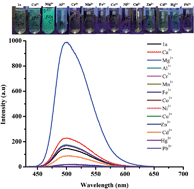
N)), 8.53–8.55 (d, 2H (aromatic)), 7.96–7.98 (d, 2H (aromatic)), 7.82–7.84 (d, 4H (aromatic)), 7.53–7.58 (t, 2H (aromatic)), 7.44–7.46 (t, 2H (aromatic)), 7.36–7.40 (t, 2H (aromatic)), 7.08 (s, 2H (aromatic)). 13C NMR (200 MHz, d6-DMSO, δ ppm) 166.74, 162.51, 147.90, 135.22, 134.40, 133.74, 133.02, 128.89, 127.78, 124.62, 122.86, 122.12, 118.88, 114.90. C28H20N2O2 (416.15): calcd C 80.75, H 4.84, N 6.73; found C 80.55, H 5.11, N 6.80. m/z (LC-MS) 417.00 (M + H).1a showed weak fluorescence in DMF (λmax = 499 nm, Φ = 0.0092). Addition of Mg2+ ions into 1a lead to the strong enhancement of fluorescence without altering the fluorescence λmax (Φ = 0.1787, Fig. 1). Importantly, other metal ions with 1a did not show any significant fluorescence enhancements. It is noted that Ca2+ addition showed only a small enhancement in the fluorescence intensity. Absorption studies of 1a with Mg2+ in DMF revealed distinct changes that suggest the formation of coordination complex between Mg2+ and 1a (Fig. 2). 1a in DMF showed a strong absorption at 270 nm and 330 nm. The former is assigned to π–π* transition involving the molecular orbitals of imine. As Scheme 2 describes, 1a exist in equilibrium between the two configurations (normal and tautomer) due to excited state intramolecular proton transfer (ESIPT).16 The absorption at 330 nm could be assigned to the transition of O
C–C
C–(NH).
Addition of Mg2+, Cu2+, Zn2+, Cd2+, Cr3+, Mn2+, Co2+ and Ni2+ reduced the intensity at 330 nm since the metal coordination prevents the ESIPT and tautomer formation (Scheme 2). The metal coordination with imine nitrogen that increase the electron withdrawing property of imine leads to the strong absorption at longer wavelength (380 nm to 440 nm).17 Mg2+ with 1a in DMF showed a strong red shifted absorption at 396 nm. 1a exhibited similar strong selective turn-on fluorescence with higher intensity for Mg2+ in DMSO (Table 1).
| Compound | Φ(DMF) | ΦDMSO | ΦCH3CN | ΦTHF |
|---|---|---|---|---|
| a Measured immediately.b Measured after 1 h. | ||||
| 1a | 0.0092 | 0.021 | — | — |
| 1b | 0.0083 | 0.019 | — | — |
| 1d | 0.015 | 0.034 | — | — |
| 1e | 0.003 | 0.007 | — | — |
| 1a-Mg2+ | 0.1787a | 0.3603a | — | — |
| 1b-Mg2+ | 0.1811a | 0.4194a | — | — |
| 1d-Mg2+ | 0.1861a | 0.5767a | — | — |
| 1e-Mg2+ | 0.025a | 0.088a | — | — |
| 1a-Fe3+ | 0.1318b | 0.421b | 0.353b | 0.431b |
| 1b-Fe3+ | 0.0942b | 0.406b | 0.092b | 0.316b |
| 1d-Fe3+ | 0.021b | 0.193b | 0.073b | 0.174b |
| 1e-Fe3+ | 0.041b | 0.073b | 0.035b | 0.122b |
The strong enhancement of fluorescence upon Mg2+ coordination is due to the restriction of C
N isomerisation and rigidification of fluorophore structure.18 It is noted that 1a showed strong turn-on fluorescence as well as absorption changes for Mg2+ either in DMF or DMSO. Other solvents such as acetonitrile, methanol and THF did not show any turn-on fluorescence for Mg2+. Absorption studies also showed that Mg2+ did not show any changes in other solvents with 1a (Fig. S1†). This suggests that both DMF and DMSO facilitate the formation of stable Mg2+ coordination complex with 1a by involving the coordination. The possible structure of the Mg2+ complex with 1a is shown in Scheme 2. The concentration dependent studies of 1a with Mg2+ are shown in Fig. 3a. A steady fluorescence enhancement was observed with 1a in DMF (10−7 M) up to the addition of 1 equivalent of Mg2+ (10−7 M). These results suggest the formation of 1
:
1 coordination complex between 1a and Mg2+. It is noted that most of the reported Mg2+ chemosensor showed only micromolar (10−6 M) detection limit.8−11 The selectivity studies of 1a for Mg2+ in presence of other metal ions revealed that Ca2+, Al3+, Cd2+ and Hg2+ had negligible interference. But no turn-on fluorescence was observed for Mg2+ in presence of Zn2+. Transition metal ions (Cr3+, Fe3+, Mn2+, Co2+, Ni2+ and Cu2+) showed strong influence on the Mg2+ selectivity that could be due to the stronger coordination with 1a (Fig. 3b).
![]() | ||
| Fig. 3 (a) 1a (10–6 M in DMF) fluorescence vs. concentration of Mg2+ (10–6 M in water) and (b) interference studies of other metal ions (mM) on the selectivity of Mg2+ (μM). | ||
In order to study the effect of substitutional change on the selectivity and sensitivity of Mg2+, chemosensor 1b–e was synthesized (Scheme 1). Except 1c, other three chemosensors exhibited highly selective strong turn-on fluorescence for Mg2+ in DMF and DMSO (Fig. 4, S2†). Surprisingly 1c did not show turn-on fluorescence for any metal ions in explored solvents. 1b showed a weak broad fluorescence with two peaks (480 nm and 504 nm). Addition of Mg2+ showed 10 fold fluorescence enhancements with a small red shift λmax (480 nm to 484 nm, Fig. 4a). 1d chemosensor exhibited weak and two clear fluorescence peaks at 520 nm and 547 nm. Addition of Mg2+ increases the fluorescence by 4 fold without affecting the fluorescence λmax (Fig. 4b). 1e chemosensor showed 30 fold fluorescence enhancements selectively for Mg2+ ions in DMF (Fig. S2†). The quantum yield measurements revealed strong fluorescence for chemosensors with Mg2+ in DMSO compared to DMF (Table 1). Among the chemosensors, 1e with Mg2+ exhibited weak fluorescence both in DMF and DMSO and 1d with Mg2+ exhibited strong fluorescence in DMSO. The concentration dependent studies of 1b, 1d, 1e also showed steady enhancement of fluorescence up to the addition of 1 equivalent of Mg2+ (Fig. S3†). However, the detection limit of Mg2+ was differed for 1e. 1a, 1b and 1d showed selective detection of Mg2+ up to the level of 10−7 M. But 1e showed selective turn-on fluorescence only for the addition of 10−4 M Mg2+. The selectivity studies of 1b, 1d and 1e for Mg2+ showed that Ca2+, a strong competitor with Mg2+, had little interference on the selectivity with all chemosensor in DMF (Fig. 5, S4†). The transition metal ions had strong interference (no fluorescence turn-on) on the selectivity of Mg2+ that is due to the strong coordination character of these metal ions.
The selective fluorescence sensing of Mg2+ by 1a–e is highly solvent dependent. Similarly, Mg2+ fluorescence sensing also depends on the structure of amine moiety in the chemosensor (Scheme S2†). For example, use of ethylene diamine or cyclohexane diamine instead of ortho-phenylenediamine did not show any fluorescence sensing for Mg2+ in any solvents including DMF or DMSO. Instead, the ethylene or cyclohexane diamine based Schiff base chemosensor showed highly selective turn-on fluorescence for Zn2+ ions (Fig. S5–8†). These results indicate that along with solvent the structural rigidity amine also plays a role in the formation of Mg2+ coordination complex. The practical applicability of 1a for selective sensing of Mg2+ ion in different samples such as river, ground, pond and tap water have also been demonstrated. Mg2+ was dissolved in different water (10−6 M) and addition of 100 μl into 1a in DMF (10−6 m) clearly showed the strong bluish green fluorescence (Fig. 6).
![]() | ||
| Fig. 6 Selective sensing of Mg2+ by 1a in different water. 1a was dissolved in DMF (10–6 M) and Mg2+ (10−6 M) was dissolved in different water. 100 mL of Mg2+ was added into 1a-DMF. | ||
Interestingly, 1a with Fe3+ also exhibited selectively strong blue fluorescence (λmax = 462 nm) in DMF/DMSO but after 1 h (Fig. 7). However, it takes 1 h to produce strong blue fluorescence with Fe3+. 1a-Fe3+ fluorescence is completely different from 1a-Mg2+ fluorescence. The absorption studies also revealed a clear change in the absorption after 1 h. A new peak appeared at 317 nm along with 330 nm peak. It is noted that the absorption peak of 1a has also been changed from broad to sharp (Fig. S9†). It is noted that absorption spectra of 1a and 1a with Mg2+ did not show significant variation after one hour. Unlike Mg2+ that showed turn-on fluorescence only in DMSO and DMF, Fe3+ addition into 1a as well as 1b, 1d,e exhibited strong blue fluorescence in DMF, DMSO, acetonitrile and THF after 1 h (Fig. S10,† Table 1).
Footnote |
| † Electronic supplementary information (ESI) available: Colorimetric absorption spectra for metal ions and turn-on fluorescence sensing by 1a–d and 2a–d. See DOI: 10.1039/c4ra5827e |
| This journal is © The Royal Society of Chemistry 2014 |