
Anselmo del Prado*,
Rodrigo Navarro,
Alberto Gallardo,
Carlos Elvira and
Helmut Reinecke
Instituto de Ciencia y Tecnología de Polímeros, ICTP-CSIC, Juan de la Cierva 3, 28006 Madrid, Spain. E-mail: andollan@ictp.csic.es; Fax: +34 915644853; Tel: +34 915622900
First published on 7th August 2014
In this work, a versatile synthetic route to functionalize vinylpyrrolidone (VP) with protected or unprotected aliphatic primary amine groups is described for the first time. Using these monomeric precursors polyvinylpyrrolidones (PVPs) with controlled load of side amine groups randomly distributed along the chains have been prepared. These functionalized VP and PVP systems are active molecules highly desirable for further couplings, i.e. they can easily afford the simple preparation of water soluble covalent side chain conjugates onto the PVP backbone. To show the potential of this functionalization, we have prepared functionalized polymers as a controlled release delivering vehicle, employing the bactericide and preservative 2-phenoxyethanol as a hydroxyl-containing model drug.
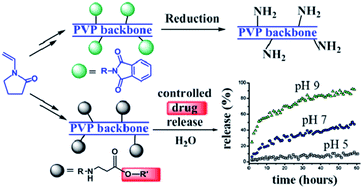
Polyethylene glycol (PEG), poly N-(2-hydroxypropyl)methacrylamide (PHPMA) or polyvinylpyrrolidone are first choice supports to prepare polymer–drug conjugates. Their desirability can be attributed to their solubility in water and protection from the environment through a ‘soft’ and ‘charge-free’ hydrated macromolecular carrier. They typically exhibit high residence time in plasma and low tissue distribution compared to other synthetic polymers.5,6 It has been described that these polymer–drug conjugates with antitumor agents can profit from the imperfection of the newly formed tumor vasculature and extravasate in that area in a specific way (the so-called ‘enhanced permeation retention’-EPR effect7).
PVP has a chemical limitation in terms of conjugation since the monomer lacks any active functional groups. PEG and PHPMA, on the other hand, have end groups or side chain hydroxyl functions, which allow for direct chemical modification; several polymer conjugates derived from both can be found in clinical therapies as PEGylated products8 or PHPMA based polymer–drug conjugates which are already on the market or in advanced clinical trials.9
The functionalization of PVP has therefore been a goal over the last few decades. Other authors have tried to modify the ring lactams of the polymer chains under harsh reaction conditions, which lead to non-controlled modification reactions.10–13 End-chain functionalization and conjugation – similar to PEG – may be achieved using special polymerization14,15 techniques by using functional transfer agents or controlled polymerization approaches. Pseudo-side-chain type functionalization – similar to PHPMA – may be obtained by copolymerization of VP with a functional vinyl comonomer,16–18 although this procedure leads to ‘false’ PVP functionalization. In this case a copolymer system is formed obtaining a heterogeneous backbone due to the different reactivity of the monomeric units (where acrylate/methacrylate/styrene monomers have reactivity rates higher than VPs). A superior alternative seems to be a homologous bottom-up route consisting of the modification of VP followed by its easy copolymerization with unmodified monomer.19,20 This homologous route, which leads to true side chain PVP conjugates, exhibits great flexibility in the control of its load that may be defined just by adjusting the feed comonomer ratio.
The incorporation of aliphatic primary amines as side substituents on some of the VP units may be extremely useful in many of the aforementioned applications. Aliphatic primary amines are certainly first choice groups for conjugation and bioconjugation,21 which may allow for the preparation – on a PVP backbone – of functional foods, functional surfactants or therapeutic nanocarriers similar to the PHPMA derivatives.22 Besides, primary amines are cationizable and therefore their incorporation into neutral PVP provides positive charges in aqueous media below the pKa of the amine. These charges may modulate the interaction of PVP with biological entities such as DNA or cell surfaces, simulating the behavior of other polymers such as chitosan or poly-L-lysine.23,24 Other primary amines have been incorporated into contact lens formulations to provide antibacterial properties.25
In this work, a simple and versatile synthetic methodology to prepare VP monomer bearing primary aliphatic amine is described for the first time. The protected form of the new monomer has been transformed by conventional radical copolymerization with VP, followed by deprotection, into novel aminated PVP. It should be noted that the monomer-based ‘bottom-up’ approach used here allows for great flexibility in the control of the amine load; furthermore, extra components may be easily incorporated by including extra comonomers in the polymerization. Finally, this aminated VP has been used in the design of a novel synthetic route to prepare PVP conjugates with hydroxylic compounds through a hydrolysable ester group, as one example of many possibilities that may provide this monomer. The model compound 2-phenoxyethanol (2PE), a common preservative and bactericide drug, was chosen as a model drug which can be found in many dermatological, cosmetical or pharmaceutical formulations. The bioactive compound release was monitored in situ by NMR analysis at different pHs.
:
1, 200 mL). The aqueous layer was extracted with CH2Cl2 (2 × 100 mL), and the organic layers were combined and dried over anhydrous sodium sulfate (Na2SO4). The solvent was evaporated at low pressure. The residue was purified by column chromatography using silica gel as the stationary phase and hexane/ethyl acetate (4
:
1) as the eluent to give a yellow oil as the product. Yield: 30%.
1H NMR (CDCl3, 500 MHz): δ = 7.08 (dd, 1H, N–CH
CH2, J = 16.0 and 9.0 Hz), 4.44 (d, 1H, cis N–CH
CHH, J = 9.0 Hz), 4.40 (d, 1H, trans N–CH
CHH, J = 16.0 Hz), 3.51 (td, 1H, CO–N–CHH, J = 5.0 Hz), 3.47–3.36 (m, 3H, CO–N–CHH and CH2–Br), 2.53 (qd, 1H, CH–CO, J = 9.0 and 5.0 Hz), 2.34–2.27 (m, 1H, CO–CH–CHH), 2.05–1.91 (m, 3H, CO–CH–CHH and CH2–CH2–CH2), 1.79–1.71 (m, 1H, N–CH2–CHH), 1.63–1.54 (m, 1H, N–CH2–CHH). 13C NMR (CDCl3, 125 MHz): δ = 174.42, 129.38, 94.36, 42.75, 41.56, 33.26, 30.32, 29.87, 24.44. FTIR (cm−1): 2944, 2881, 1699, 1633, 1426, 1388, 1328, 1268, 981, 851. MS (ESI): calculated m/z 232.033 and 234.031 (M + 1)+, found m/z 232.032 and 234.030.
1H NMR (CDCl3, 500 MHz): δ = 7.83 (dd, 2H, C–H, J = 5.5 and 3.0 Hz), 7.70 (dd, 2H, C–H, J = 5.5 and 3.0 Hz), 7.07 (dd, 1H, N–CH =, J = 16.0 and 9.0 Hz), 4.42 (d, 1H, cis N–CH
CHH, J = 9.0 Hz), 4.38 (d, 1H, trans N–CH
CHH, J = 16.0 Hz), 3.72 (t, 2H, CH2–N(CO)2, J = 10.0 Hz), 3.49 (td, 1H, N–CHH, J = 10.0 and 3.0 Hz), 3.37 (dt, 1H, N–CHH, J = 10.0 and 8.0 Hz), 2.55 (qd, 1H, CH–CO, J = 9.0 and 5.0 Hz), 2.33–2.27 (m, 1H, CO–CH–CHH), 1.96–1.89 (m, 1H, CHH–CH–CH2), 1.82–1.69 (m, 3H, CH2–CH2–CH2 and CO–CH–CHH), 1.47–1.39 (m, 1H, CHH–CH2–CH2). 13C NMR (CDCl3, 125 MHz): δ = 174.50, 168.33, 133.90, 132.03, 129.42, 123.19, 94.24, 42.75, 41.83, 37.62, 28.31, 26.20, 24.39. FTIR (cm−1): 2943, 2883, 1771, 1698, 1630, 1425, 1394, 1328, 1266, 1051, 982, 851, 718. MS (ESI): calculated m/z 299.139 (M + 1)+, found m/z 299.139.
1H NMR (DMSO-d6, 500 MHz): δ = 6.88 (dd, 1H, C–H, 15.0 and 9.0 Hz), 4.45 (d, 1H, trans N–CH
CHH, J = 15.0 Hz), 4.42 (d, 1H, cis N–CH
CHH, J = 9.0 Hz), 3.43 (dt, 1H, N–CHH, J = 12.0 and 3.0 Hz), 3.30 (td, 1H, N–CHH, J = 12.0 and 6.0 Hz), 2.54–2.44 (m, 3H, CH2–NH2 and CH–CO), 2.26–2.19 (m, 1H, CO–CH–CHH), 1.71–1.62 (m, 2H, CO–CH–CHH and CHH–CH2–CH2), 1.42–1.24 (m, 3H, CH2–CH2–CH2, CHH–CH2–CH2). 13C NMR (DMSO-d6, 125 MHz): δ = 175.74, 129.52, 95.55, 43.22, 42.12, 41.72, 30.50, 28.47, 24.30. FTIR (cm−1): 3341, 2932, 2857, 1684, 1630, 1563, 1470, 1427, 1388, 1326, 1265, 981, 844, 821, 723, 691. MS (ESI): calculated m/z 169.133 (M + 1)+, found m/z 169.134.
:
10
:
2) as the eluent, resulting a white solid. Yield: 90%.1H NMR (CDCl3, 500 MHz): δ = 7.28 (t, 2H, C–H, J = 7.5), 7.08 (dd, 1H, N–CH
CH2, J = 16.0 and 9.0 Hz), 6.96 (t, 1H, C–H, J = 7.5), 6.92–89 (m, 2H, C–H) 4.45–4.36 (m, 4H, N–CH
CH2 and COO–CH2), 4.18–4.16 (m, 2H, COO–CH2CH2–O), 3.48 (td, 1H, N–CHH, J = 10.0 and 3.5 Hz), 3.36 (dt, 1H, N–CHH, J = 10.0 and 8.0 Hz), 2.89 (t, 2H, NH–CH2–CH2–COO, J = 6.5 Hz), 2.65–2.60 (m, 2H, CH2CH2CH2–NH), 2.58 (t, 2H, CH2–COO, J = 6.5 Hz), 2.49 (qd, 1H, CH–CO, J = 9.0 and 4.5 Hz), 2.29–2.23 (m, 1H, N–CH2–CHH), 1.91–1.67 (m, 3H, N–CH2–CHH, –NH– and CO–CH–CHH), 1.54 (quint, 2H, J = 7.5 Hz), 1.44–1.36 (m, 1H, CO–CH–CHH). 13C NMR (CDCl3, 125 MHz): δ = 174.90, 172.65, 158.39, 129.48, 121.15, 114.56, 94.14, 65.75, 62.79, 42.45, 44.92, 42.80, 42.20, 34.57, 28.79, 27.56, 24.32. FTIR (cm−1): 2929, 2881, 2825, 1733, 1697, 1630, 1599, 1589, 1494, 1426, 1387, 1327, 1245, 1168, 1120, 1060, 982, 849, 754, 692. MS (ESI): calculated m/z 361.212 (M + 1)+, found m/z 361.212.
Thermal stability of poly-(VP-co-VP-2PE) and PVP were estimated by thermogravimetry analysis registered in a TGA equipment model Q500, using sample weight of 6 mg, temperature range 25 to 500 °C, at 10 °C min−1, under nitrogen atmosphere. Differential scanning calorimetry was carried out in a Perkin-Elmer DSC7 equipment under nitrogen atmosphere, using 12 mg of sample weight with a temperature range of 30–200 °C and a heating rate of 20° C min−1. Glass transition temperature, Tg, was measured in the second scan and taken as the inflexion point of the transition region of the Tg.
![]() | (1) |
![]() | (2) |
The Copol software uses the compositional data of copolymers studied over a wide compositional interval with mole fractions in the monomer feed (FVPPhta) from 0.20 to 0.80, as shown in Table 1 of the supporting information, and determines the reactivity ratios according to the general copolymerization equation by application of the non-linear least squares treatment proposed by Tidwell and Mortimer.31 The copolymers were prepared in the same conditions as those described in the previous section. The reaction time was adjusted to obtain conversions lower than 5% weight to satisfy the copolymerization equation (approximately 2 hours). Residual monomers were eliminated by dialysis using membranes of cut-off 1000 Da and 1,4-dioxane as solvent. Finally, polymers were obtained by precipitation in diethylether.
| FVPPhta | fVPPhta | Mn (Da) | PDI |
|---|---|---|---|
| 0.20 | 0.17 | 15 300 |
1.6 |
| 0.40 | 0.37 | 17 100 |
1.6 |
| 0.60 | 0.60 | 20 000 |
1.8 |
| 0.80 | 0.75 | 18 300 |
1.6 |
| 1.00 | 1.00 | 17 700 |
1.6 |
The experimental molar fractions of VPPhta in copolymer (fVPPhta) were obtained by 1H-NMR in CDCl3. These fVPPhta were estimated comparing the area of the aromatic band (8.0–7.5 ppm) with that of the group of signals between 3.4–2.9 ppm (corresponding to the hydrogens next to the nitrogen in the lactam cycle) using these equations:
| A8.0−7.5 = 4HVPPhta | (3) |
| A3.4−2.9 = 2HVP + 2HVPPhta | (4) |
| A4.30 = 2Hconjugate | (5) |
| A4.16 = 2H2PE | (6) |
Therefore the release percentage R is given by
![]() | (7) |
Despite the low conversion of this first step, VPBr derivative was converted with very high conversions, under gentle conditions, into protected amines (VPPhta, protected with a phtalimide group) by a simple reaction with phthalimide potassium salt. These protected forms could be easily transformed, also with very high conversion, into the free amines (VPNH2) by reduction with hydrazine.
To the best of our knowledge, VP has not been functionalized previously with an aliphatic amine. We have previously described the derivatization of VP with much less activated primary and secondary aromatic amines.35 Aliphatic amines such as those described for the first time in this work are certainly highly reactive functional groups with many chemical possibilities to link different active compounds.
VPPhta did homopolymerize and copolymerize with VP in 1,4-dioxane, and the obtained polymers could be deprotected to the free amine species by reduction according to the Scheme shown in Fig. 2 and the 1H-NMR spectra of Fig. 3 (A-protected polymers, B-deprotected forms).
Four copolymers poly-(VP-co-VPNH2) with FVPPhta from 0.20 to 0.80 as indicated in Table 1, as well as the homopolymer poly-(VPPhta), have been prepared at high conversion. Spectra of Fig. 3A show signals corresponding to poly-(VP-co-VPPhta) copolymers. The signals assigned to the VPPhta units, such as the aromatics bands at 8.0–7.5 ppm and the –CH2Phta band at 3.8–3.5 ppm, increase when increasing the FVPPhta. Fig. 3B shows how aromatic bands disappeared when the reduction was complete in each polymer, as well as a displacement of the 3.8–3.5 ppm band (–CH2Phta) to 2.9–2.6 ppm (–CH2NH2).
VPNH2 did not polymerize by conventional radical reaction either in organic solvents (1,4-dioxane and DMF) or in water. A primary aliphatic amine group is actually an active group that may suffer from different secondary reactions in radical polymerization, such as Michael additions or transamidation in the case of (meth)acrylics, or it may react with radicals, thus preventing polymerization. In order to avoid some of these problems, commercial methacrylic monomers bearing amine groups are usually provided as hydrochloride salt.
The copolymer compositions of polymerizations carried out at high conversion determined as indicated in experimental section are very similar to the feed values indicating that both monomers are properly incorporated into the macromolecular chains (Table 1). Their GPC analysis has shown some relatively low Mn ranging between 15
000 and 20
000 Da.
The values of the reactivity ratios, rVPPhta = 0.44 and rVP = 0.98, determined as indicated in the experimental section from the compositional values of reactions carried out at conversion lower than 5% weight (Table 1 of ESI†), indicate that growing radicals are slightly more reactive towards VP. In any case, their values are not far from unity which is in agreement with the structural homology of both polymerizable double bonds, leading randomly distribution along the chains. Fig. 1 of ESI† shows how the compositional diagram obtained using rVPPhta=0.44 and rVP = 0.98 adjust to the experimental compositional data.
Focusing on the usefulness of VPNH2 in the bottom up approach for obtaining PVP–drug conjugates by (1) preparing the precursor VP–drug and (2) copolymerizing it with VP, in this work we have designed a route to couple the amine to a hydroxyl group containing-drug through a hydrolysable spacer as indicated in Fig. 4.
![]() | ||
| Fig. 4 Synthetic route designed in this work to prepare hydrolysable conjugates of PVP with hydroxyl group-containing drugs from the aminated VP. | ||
This synthetic design proposes the transformation of the hydroxyl group-containing drug to an acrylic ester, which is susceptible to undergoing Michael addition with the aliphatic amine, leading to a β-amino ester (more labile than others aliphatic esters). Alkyl acrylates are known to be good Michael acceptors and easily accept weak nucleophiles such as amines.36 This reaction forms an ester with a much higher sensitivity towards hydrolysis than is normally shown by other aliphatic esters. This has been reported to be related to the position of the amine in the β position.37
This synthetic approach has been put into practice by selecting VPNH2 and 2-phenoxyethanol (2PE) as the hydroxyl group-containing model drug. The VP-2PE conjugate formed is depicted in Fig. 5.
This synthetic route uses high conversion couplings. In fact, the acylation reaches high yields and the Michael addition is nearly quantitative. Carrying out a global synthetic analysis for the preparation of the VP-2PE conjugate, the limiting reaction in terms of conversion is the first step of functionalization of VP with Br since the other steps are almost quantitative.
VP-2PE has exhibited a good copolymerizability with pure VP. A copolymer labeled poly-VP-2PE20, with a nominal VP
:
VP-2PE ratio of 4
:
1 (20% mol of VP-2PE in the polymer) was prepared by conventional radical polymerization.
The relative molecular weight of the copolymer was determined by GPC versus polystyrene standards. Values of number average molecular mass (Mn) of 38
400 Da and PDI of 2.0 were obtained.
The 1H-NMR spectrum of poly-VP-2PE20 in Fig. 6 shows broad peaks that are typical for polymeric species. In addition, it shows peaks characteristic of the VP-2PE unit, such as the aromatic one or the CH2 signals at 6.82, 4.45 and 4.18 ppm respectively. Comparison of the area of the isolated peak centered at 4.45 ppm with that of the group of signals between 3.4 and 2.9 ppm (assigned previously) was used to determine the experimental copolymer composition according to these equations:
| A4.45 = 2HVP-2PE | (8) |
| A3.4−2.9 = 2HVP + 2HVP-2PE | (9) |
![]() | ||
| Fig. 6 1H-NMR spectrum of the conjugate Poly VP-2PE20, recorded in CDCl3. The spectrum of PVP has been included for comparative purposes. | ||
A copolymer composition of fVP-2PE = 0.17 was obtained, which is very close to the monomer feed ratio (FVP-2PE = 0.20), which indicates that both units are incorporated properly along the copolymer chains. The similar reactivity of VP and VP-2PE is to be expected for this copolymerization due to the electronic and structural similarity of the polymerizable vinyl groups.
TGA and DCS analysis of the copolymer poly VP-2PE20 have confirmed the incorporation of VP-2PE (see Fig. 2 and 3 in Supporting Information). On one hand the TGA analysis has shown a 15% weight loss in the interval 270–310 °C not present in the thermogram of control PVP, which has been assigned to the loss of 2PE following the ester hydrolysis. The 15 weight percent is in agreement with this loss for the composition determined from NMR, fVP-2PE = 0.17 (Fig. 2 and 3 of ESI†). This result confirms the lability of the ester. On the other hand DSC analysis has shown a Tg at 78 °C, much lower than control PVP (Tg of 170 °C). This is in agreement with the presence of VP-2PE, which bears a side chain with two flexible spacers between the pyrrolidone ring, the ester and the aromatic ring. The hydrolytic behavior of the poly VP-2PE20 conjugate has been studied by proton NMR in situ at 37 °C using different buffer solutions in D2O. Fig. 7 (right) schematically shows the hydrolytic process. A VP unit bearing a side β-amino carboxylic acid is formed as a residue after the hydrolysis and the 2PE release.
![]() | ||
| Fig. 7 Scheme of the hydrolytic process and release of 2PE (right). Details of the 1H-NMR regions used to determine the release rate for three spectra recorded at 0, 8 and 24 hours at pH 9 (left). | ||
The degradation could be monitored in situ by analyzing the region between 4.5 and 4.0 ppm (see Fig. 7 left). In this region, the hydrolysis produces the reduction of a broad polymeric –CH2– signal centered at 4.30 ppm, while a resolved triplet of another non-polymeric –CH2– peak at 4.16 ppm shows a correlative increase. These signals, assigned to a –CH2– group of the VP-2PE unit and to free 2PE respectively, have been used to determine the release rate, which is depicted in Fig. 8 at different pHs. A more detailed explanation of this calculation can be found in the Experimental section.
![]() | ||
| Fig. 8 Release percentage, R, versus time at different pHs obtained by in situ 1H-NMR monitoring as explained in the text. | ||
As expected, there is a clear dependency between the rate of hydrolysis and the pH of the medium. The half-life times of the kinetics change from hours at pH 9 to days at pH 7, and months at pH 5, due to the well-known sensitivity of the ester group to basic media and to the higher ester activation by the β-amino group in its neutral state.
The preparation of a VP–drug conjugate by Michael addition using this aminated monomer was performed as an example of the many coupling possibilities afforded by the primary amine. PVP–drug conjugates were synthesized by coupling 2-phenoxyethanol through a hydrolysable spacer. The synthetic design of this coupling may be extended to other hydroxyl containing drugs. The poly VP-2PE20 conjugate allows for a pH modulated drug release, increasing the hydrolysability with pH. As PVP is an approved food and drink additive, this dependence with the pH may be used to prepare some PVP conjugates for oral delivery to be administered in drinks or food.
Footnote |
| † Electronic supplementary information (ESI) available. See DOI: 10.1039/c4ra05354k |
| This journal is © The Royal Society of Chemistry 2014 |