DOI:
10.1039/C4RA04897K
(Paper)
RSC Adv., 2014,
4, 55210-55216
Arginine thioacid in synthesis of arginine conjugates and peptides†
Received
23rd May 2014
, Accepted 9th October 2014
First published on 9th October 2014
Abstract
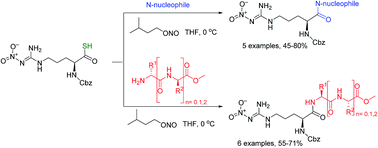
Protected arginine thioacid enables convenient N-acylation with no detectable racemization. We report efficient syntheses of potentially biologically active arginine conjugates and novel arginine-containing di-, tri- and tetrapeptides in good yields without loss of chiral integrity.
Introduction
Arginine, an essential amino acid, is one of the most metabolically versatile amino acids and is involved in numerous biological processes.1 Arginine is also the precursor for the synthesis of urea, ornithine, nitric oxide (NO), polyamines, proline, creatine, glutamate and agmatine.2,3 Synthetic arginine-rich peptides are efficient transporters of diverse biomolecules including nucleic acids, peptides, and proteins.4–6 Arginine conjugates are reported to enhance gene expression in tumors7,8 and arginine peptides are known for targeted gene delivery.9,10
Arginine is the source of nitrogen in the biosynthesis of nitric oxide (NO),2,11,12 which is important in the elimination of numerous pathogens. The synthesis of NO requires L-arginine (but not D-arginine) entering the binding site of NO synthase.13,14 Overproduction of NO may lead to diseases like Alzheimer's or Parkinson,15,16 and inflammatory diseases such as arthritis17 or colitis.18 The synthesis of NO from L-arginine can be inhibited by Nω-methyl-L-arginine and Nω-ethyl-L-arginine.19 More selective inhibition was observed with dipeptides and dipeptide esters containing Nω-nitroarginine and phenylalanine.20
The highly basic nature of the arginine guanidine moiety can cause serious problems during chemical transformations. Even protection of the guanidine moiety before chemical manipulation does not completely prevent side reactions. A major problem is lactam formation which frequently occurs during the activation of the arginine carboxyl group.21,22 It has also been shown that urethanes as guanidino protecting groups do not hinder the acylation and as a result arginine is converted to ornithine.23 One possible way to avoid this problem could be prior transformation of the carboxyl group to thioacid. Indeed during the last decade close attention has been paid to the potential of thioacids, and these compounds have been increasingly applied in the design of complex molecules particularly for peptide synthesis.24 Danishefsky's group reported that thioacids can act as highly reactive acyl donors in peptide ligation reactions25 and methods have been developed for peptide and amide bond formation using thioacids and azides26,27 or isonitriles.28,29 Recently, coupling procedures between thioacids and dithiocarbamate terminal amines has been investigated.30 In general, the mild conditions and selectivity of thioacid reactions make them attractive intermediates in bioorganic and peptide chemistry. Synthetic methods using thioacids usually include pre-activation of the carboxyl group with carbodiimides,31 CDI,32 or conversion to such reactive intermediates as p-nitrophenyl esters,33 N-hydroxysuccinimide esters,34 mixed anhydrides,35 or N-acylbenzotriazoles.36 An alternative approach using Lawesson's reagent developed by Danishefsky avoids the activation step but requires harsh reaction conditions.37 Melnyk's group recently reported the synthesis of peptide thioacids at neutral pH using bis(2-sulfanylethyl)amido peptide precursors in moderate yield.38
Herein, we present a novel approach to arginine-containing compounds comprising the coupling of protected Nω-nitroarginine thioacid to the N-termini of amino acids, peptides and other N-nucleophiles.
Results and discussion
The well-known intramolecular cyclization during carboxyl group activation of protected arginines has caused difficulty in the synthesis of the corresponding C-terminus derivatives. A recently reported benzotriazole-activated arginine, Cbz-protected L-ωNO2-Arg-Bt (ref. 22) is potentially an attractive precursor for the synthesis of novel arginine conjugates. For this purpose, in our initial study we examined benzotriazole-activated arginine and encountered some limitations. First, partial decomposition of L-Cbz-ωNO2-Arg-Bt was observed in solution although this compound was stable in the solid state for at least 6 months at room temperature.22 Moreover, attempts to couple benzotriazole derivatives with a bulky amine such as dipropylamine, led to formation of cyclic lactam 3. However, benzotriazole-activated arginine reacted smoothly with primary amine or amino acids to form the products shown in Table 1.
Table 1 Preparation of Cbz-protected arginine conjugates from Cbz-protected arginine benzotriazolide
| N-Nucleophile |
Solvent |
Yield of product 2 (%) |
Yield of by-product 3 (%) |
| n-Propylamine |
THF |
85% |
11% |
| N-(3-Aminopropyl)imidazole |
THF |
83% |
12% |
| Dipropylamine |
THF |
Traces |
90% |
| Glycine |
Acetonitrile–H2O |
80% |
15% |
The tendency of benzotriazole-activated arginine 1 to undergo cyclization prompted us to find a new synthetic derivative of arginine which could be easily obtained and handled during synthetic manipulations (Scheme 1).
 |
| | Scheme 1 Synthesis of Cbz-protected arginine conjugates from Cbz-protected arginine benzotriazolide. | |
The ability to efficiently convert Cbz-L-ωNO2-Arg-Bt to the corresponding thioacid with retention of chirality36 without any side reactions, inspired use of the arginine thioacid as a new precursor for the synthesis of arginine C-terminus derivatives.
The thioacid of protected L-arginine, Cbz-L-ωNO2-Arg-SH 4, is a stable white crystalline compound readily soluble in EtOAc, MeOH, THF and CH3CN. However, arginine thioacid 4 hydrolysed to corresponding carboxylic acid in wet-DMSO-d6 at room temperature (Fig. 1).
 |
| | Fig. 1 Fragments of 13C NMR (DMSO-d6) of Cbz-L-Arg(NO2)-SH 4 in DMSO-d6 at rt: A – freshly prepared thioacid, B – after 24 h, C – pure protected arginine. | |
Preparation of arginine conjugates
Recently several strategies of amide bond formation have been developed using simple thioacid and amine as starting materials. Thus S-nitrosation of thioacids results in very reactive S-nitrosothioacid intermediates which react with a wide range of amines.39 Another very mild and fast method of converting thioacids to the corresponding amides includes simple treatment of a thioacid with amine in presence of Cu(II) salts.40,41 These carboxylic acid derivatives did not show any reactivity towards hydroxyl groups.
Both methods were tried, but in our hands S-nitrosation is more efficient (Table 2). The optimized standard conditions39 were found to be slow addition of isoamyl nitrite (2.0 equiv.) to a solution of arginine thioacid, Cbz-L-ωNO2-Arg-SH (1.0 equiv.), and amine (1.2 equiv.) in THF at 0 °C and in the dark. Although, formation of the arginine amide products was observed immediately, consumption of starting arginine thioacid required 0.5–2 h depending on the amine substrate. Thus, bulky dipropylamine reacts slowly under these conditions. In this approach formation of the cyclic side product 3 was not observed, and the desired arginine conjugates were easily obtained in pure form by precipitation from ether (Scheme 2) (Table 3).
Table 2 Preparation of Cbz-protected arginine conjugates from Cbz-protected arginine thioacid
| Conjugates, 2 |
N-Nucleophile |
Yield (%) |
| 2a |
n-Propylamine |
80 |
| 2b |
N-(3-Aminopropyl)imidazole |
78 |
| 2c |
Dipropylamine |
45 |
| 2d |
Benzylamine |
66 |
| 2e |
Piperidine |
56 |
 |
| | Scheme 2 Synthesis of Cbz-protected arginine conjugates from Cbz-protected arginine thioacid 4. | |
Table 3 Preparation of Cbz-protected arginine peptides
| Product |
Amino acid/peptide |
Yield (%) |
Mp (°C) |
[α]20Da |
| c = 1.0, MeOH. |
| 5a |
D-Ala-OMe |
55 |
149–151 |
+15.8 |
| 5b |
L-Ala-OMe |
58 |
158–160 |
−18.3 |
| 5c |
DL-Ala-OMe |
56 |
140–142 |
Racemic |
| 5d |
L-Val-OMe |
68 |
138–139 |
−25.0 |
| 5e |
L-Ala-L-Phe-OMe |
71 |
152–154 |
−44.3 |
| 5f |
Gly-L-Ala-L-Phe-OMe |
56 |
103–105 |
−35.2 |
Preparation of arginine di- and tri-peptides
As a further application of arginine thioacid 4 in peptide synthesis, different esters of amino acids, dipeptides and tripeptides were used in the above S-nitrosation reaction resulting in the synthesis of arginine di-, tri- and tetrapeptides in good yields without loss of chiral integrity (Scheme 3). Arginine containing peptides are known for their better penetration ability and bioactivity.
 |
| | Scheme 3 Synthesis of Cbz-protected arginine peptides. | |
To prove the retention of chirality in our described method we coupled the protected arginine thioacid 4 with D-Ala-OMe, L-Ala-OMe and dl-Ala-OMe. Compound 5c displayed duplicate peaks in the NMR spectra. However, duplication of peaks in cases of 5a and 5b was not observed (Fig. 2). The chiral integrity of other synthesized products was supported by NMR data. For further proof, HPLC analysis of 5a–c using a chiral column showed single peak for 5a and 5b but two peaks in the case of 5c, this indicates 5c is mixture of diastereoisomers of 5a and 5b (Fig. 3).
 |
| | Fig. 2 13C NMR (DMSO-d6) of compounds 5a–c. | |
 |
| | Fig. 3 HPLC spectra of compounds 5a–c (chiral column, 50% ACN/H2O, 1.0 mL min−1). | |
Conclusion
In conclusion, Cbz-protected arginine thioacid is a convenient coupling reagent, sufficiently reactive to form amide bonds at ambient temperature. This reagent offers an efficient method to prepare N-protected arginine conjugates and arginine peptides in synthetically useful yields without detectable racemization or intramolecular cyclization.
Experimental section
General
All solvents were reagent grade. Tetrahydrofuran was distilled from sodium/benzophenone under dry nitrogen. Melting points were determined on a capillary point apparatus equipped with a digital thermometer. NMR spectra were recorded in DMSO-d6 on Mercury, Gemini or Varian NMR spectrometers operating at 300 MHz for 1H and 75 MHz for 13C. Elemental analyses were performed on a Carlo Erba-EA1108 instrument and mass spectrometry was done with electro spray ionization (ESI). HPLC spectra were recorded on a Shimadzu instrument using Supelco chiral HPLC column.
(S)-2-(((Benzyloxy)carbonyl)amino)-5-(2-nitro guanidino)pentanethioic-S-acid (4). Thio arginine 4 was prepared by following our previous protocol36 with a modified workup procedure. After completion of the reaction, THF was evaporated and residue was vigorously stirred with a mixture of diethyl ether and 1 N HCl (2
:
1) at 0 °C for 2 h. The resulting white solid was filtered, washed with cold diethylether and dried under high vacuum at room temperature. White microcrystals (344 mg, 93%); mp 153–155 °C (lit36 mp 153–155 °C); [α]20D −9.0 (c = 0.5, MeOH); 1H NMR (DMSO-d6, 300 MHz) δ 8.47 (s, 1H), 8.14–7.79 (m, 3H), 7.30–7.42 (m, 5H), 5.04–5.21 (m, 2H), 4.28–4.41 (m, 1H), 3.07–3.22 (m, 2H), 1.51–1.82 (m, 4H); 13C NMR (DMSO-d6, 75 MHz) δ 196.3, 159.4, 156.3, 136.7, 128.5, 128.0, 127.8, 66.1, 63.6, 60.9, 32.5, 28.0; anal. calcd for C14H19N5O5S: C, 45.52; H, 5.18; N, 18.96. Found: C, 45.85; H, 5.15; N, 18.62%.
General procedure for the synthesis of N-protected arginine conjugates. To a stirred solution of arginine thioacid, Cbz-L-ωNO2-Arg-SH (1.0 mmol), and amine (1.2 equiv.) (or 1.2 mmol amino acid/peptide hydrochloride and 1.2 mmol TEA) in 10 mL THF, isoamyl nitrite (2.0 mmol) was added at 0 °C in the dark. The reaction was stirred for 2 h while slowly warming to rt. The reaction mixture was then concentrated under reduced pressure, diluted with ethyl acetate, and washed with sat. NaHCO3, 1 N HCl and brine. The organic layer was dried with anhydrous MgSO4 and solvent was removed under reduced pressure. Treatment of the resulting crude product with ether followed by filtration and washing 2–3 times with ether afforded the desired product in analytical purity.
Benzyl-(S)-(5-(2-nitroguanidino)-1-oxo-1-(propyl amino)pentan-2-yl)carbamate (2a). White solid (316 mg, 80%); mp 133–135 °C; 1H NMR (300 MHz, DMSO-d6) δ 8.60–7.60 (m, 4H), 7.28–7.50 (br s, 5H), 5.01 (br s, 2H), 4.01–3.85 (m, 1H), 3.19–3.07 (m, 2H), 2.93–3.05 (m, 2H), 1.69–1.43 (m, 4H), 1.44–1.31 (m, 2H), 0.82 (t, J = 7.4 Hz, 3H); 13C NMR (75 MHz, DMSO-d6) δ 171.5, 155.9, 137.1, 128.5, 128.4, 127.8, 127.7, 65.5, 54.5, 39.5, 29.4, 22.3, 11.4. HRMS (ESI) calcd for C17H27N6O5 [M + H]+ 395.2037, found: 395.2033, calcd for C17H26N6O5Na [M + Na]+ 417.1857, found: 417.1865%.
Benzyl-(S)-(1-((3-(1H-imidazol-1-yl)propyl)amino)-5-(2-nitroguanidino)-1-oxopentan-2-yl)carbamate (2b). White solid (359 mg, 78%); mp 157–159 °C; 1H NMR (300 MHz, DMSO-d6) δ 8.61–8.20 (br s, 1H), 8.19–7.65 (m, 3H), 7.58 (br s, 1H), 7.42 (d, J = 8.4 Hz, 1H), 7.39–7.24 (m, 5H), 7.13 (br s, 1H), 6.86 (br s, 1H), 5.01 (br s, 2H), 4.00–3.84 (m, 3H), 3.18–3.05 (m, 2H), 3.04–2.93 (m, 2H), 1.86–1.72 (m, 2H), 1.68–1.38 (m, 4H); 13C NMR (75 MHz, DMSO-d6) δ 171.8, 156.0, 137.3, 137.0, 128.4, 128.3, 127.8, 127.7, 119.3, 65.4, 54.5, 43.4, 35.6, 30.7, 29.1. Anal. calcd for C20H28N8O5: C, 52.17; H, 6.13; N, 24.33. Found: C, 52.25; H, 6.07; N, 24.12%.
Benzyl-(S)-(1-(dipropylamino)-5-(2-nitroguanidino)-1-oxopentan-2-yl)carbamate (2c). White solid (196 mg, 45%); mp 95–97 °C; 1H NMR (300 MHz, DMSO-d6) δ 8.66–7.55 (m, 3H), 7.48 (d, J = 8.3 Hz, 1H), 7.40–7.26 (m, 5H), 5.01 (br s, 2H), 4.41–4.27 (m, 1H), 3.28–3.18 (m, 2H), 3.16–3.00 (m, 4H), 1.62–1.50 (m, 4H), 1.52–1.32 (m, 4H), 0.84 (t, J = 7.8 Hz, 3H), 0.78 (t, J = 7.8 Hz, 3H); 13C NMR (75 MHz, DMSO-d6) δ 171.6, 159.8, 156.4, 137.5, 128.8, 128.2, 128.1, 65.8, 50.9, 48.9, 47.3, 29.4, 22.5, 20.9, 11.6, 11.4. Anal. calcd for C20H32N6O5: C, 55.03; H, 7.39; N, 19.25. Found: C, 54.65; H, 7.80; N, 19.12%.
Benzyl-(S)-(1-(benzylamino)-5-(2-nitroguanidino)-1-oxopentan-2-yl)carbamate (2d). White solid (292 mg, 66%); mp 133–135 °C; 1H NMR (300 MHz, DMSO-d6) δ 8.56–7.51 (m, 3H), 7.43 (d, J = 8.0 Hz, 2H), 7.36–7.17 (m, 10H), 5.02 (s, 2H), 4.31–4.20 (m, 2H), 4.06–3.93 (m, 1H), 3.17–3.05 (m, 2H), 1.73–1.39 (m, 4H); 13C NMR (75 MHz, DMSO-d6) δ 171.8, 159.3, 156.0, 139.3, 137.0, 128.4, 128.3, 127.8, 127.7, 127.1, 127.1, 126.8, 126.7, 65.5, 54.5, 42.1, 39.5, 29.2. Anal. calcd for C21H26N6O5: C, 57.00; H, 5.92; N, 18.99. Found: C, 56.70; H, 6.30; N, 19.11%.
Benzyl-(S,E)-(5-(2-nitroguanidino)-1-oxo-1-(piperidin-1-yl)pentan-2-yl)carbamate (2e). White solid (235 mg, 56%); mp 86–88 °C; 1H NMR (300 MHz, DMSO-d6) δ 8.70–7.47 (m, 3H), 7.45 (d, J = 8.3 Hz, 1H), 7.40–7.24 (m, 5H), 5.02 (s, 2H), 4.50–4.35 (m, 1H), 3.51–3.33 (m, 4H), 3.19–3.07 (m, 2H), 1.65–1.32 (m, 10H); 13C NMR (75 MHz, DMSO-d6) δ 169.8, 159.69, 156.3, 137.5, 128.8, 128.2, 128.1, 65.8, 65.4, 50.6, 46.2, 43.0, 29.1, 26.5, 25.8, 24.5, 15.6. Anal. calcd for C19H28N6O5: C, 54.27; H, 6.71; N, 19.99. Found: C, 53.90; H, 7.03; N, 20.32%.
Methyl-N2-((benzyloxy)carbonyl)-Nω′-nitro-L-arginyl-D-alaninate (5a). White solid (241 mg, 55%); mp 149–151 °C. 1H NMR (300 MHz, DMSO-d6) δ 8.56–7.53 (br s, 1H), 8.32 (d, J = 7.2 Hz, 1H), 7.43–7.25 (m, 5H), 5.03 (s, 2H), 4.27 (q, J = 7.2 Hz, 1H), 4.11–3.98 (m, 1H), 3.62 (s, 3H), 3.17–3.07 (m, 2H), 1.68–1.41 (m, 4H), 1.26 (d, J = 7.2 Hz, 3H); 13C NMR (75 MHz, DMSO-d6) δ 172.8, 171.5, 159.3, 155.8, 137.0, 128.3, 127.7, 109.5, 65.4, 54.0, 51.9, 47.5, 43.7, 29.4, 17.2. Anal. calcd for C18H26N6O7: C, 49.31; H, 5.98; N, 19.17. Found: C, 49.23; H, 6.37; N, 19.54%.
Methyl-N2-((benzyloxy)carbonyl)-Nω′-nitro-L-arginyl-L-alaninate (5b). White solid (232 mg, 58%); mp 158–160 °C. 1H NMR (300 MHz, DMSO-d6) δ 8.56–7.53 (m, 1H), 8.35 (d, J = 7.2 Hz, 1H), 7.43–7.25 (m, 5H), 5.02 (br s, 2H), 4.26 (q, J = 7.2 Hz, 1H), 4.09–3.94 (m, 1H), 3.60 (s, 3H), 3.15–3.04 (m, 2H), 1.71–1.44 (s, 4H), 1.28 (d, J = 7.2 Hz, 3H); 13C NMR (75 MHz, DMSO-d6) δ 173.4, 172.1, 159.1, 156.3, 137.4, 128.8, 128.2, 128.1, 65.8, 54.3, 52.3, 48.0, 29.6, 17.3. Anal. calcd for C18H26N6O7: C, 49.31; H, 5.98; N, 19.17. Found: C, 49.00; H, 6.23; N, 18.81%.
Methyl-N2-((benzyloxy)carbonyl)-Nω′-nitro-L-arginyl-dl-alaninate (5c). White solid (246 mg, 56%); mp 140–142 °C. 1H NMR (300 MHz, DMSO-d6) δ 8.12–7.40 (m, 3H), 8.36–8.28 (m, 1H), 7.37–7.25 (m, 5H), 5.07–4.95 (m, 2H), 4.26 (q, J = 7.2 Hz, 1H), 4.10–3.95 (m, 1H), 3.59 (s, 3H), 3.15–3.04 (m, 2H), 1.70–1.44 (s, 4H), 1.31–1.20 (m, 3H); 13C NMR (75 MHz, DMSO-d6) δ 173.4, 173.3, 172.1, 172.0, 159.7, 156.3, 137.4, 128.8, 128.2, 128.1, 128.1, 65.9, 65.8, 54.5, 52.3, 52.3, 48.0, 29.6, 25.3, 17.6, 17.3. Anal. calcd for C18H26N6O7: C, 49.31; H, 5.98; N, 19.17. Found: C, 49.27; H, 6.16; N, 19.45%.
Methyl-N2-((benzyloxy)carbonyl)-Nω′-nitro-L-arginyl-L-valinate (5d). White solid (317 mg, 68%); mp 138–139 °C. 1H NMR (300 MHz, DMSO-d6) δ 8.62–7.51 (m, 3H), 8.10 (d, J = 8.1 Hz, 1H), 7.43 (d, J = 7.8 Hz, 1H), 7.40–7.23 (m, 5H), 5.02 (s, 2H), 4.25–4.02 (m, 2H), 3.62 (s, 3H), 3.20–3.04 (m, 2H), 2.12–1.94 (m, 1H), 1.71–1.41 (m, 4H), 0.97–0.75 (m, 6H); 13C NMR (75 MHz, DMSO-d6) δ 172.6, 172.3, 159.7, 156.3, 137.5, 128.8, 128.8, 128.3, 128.2, 128.1, 65.8, 57.8, 54.4, 52.1, 30.4, 29.6, 25.3, 25.2, 19.4, 18.6. Anal. calcd for C20H30N6O7: C, 51.49; H, 6.48; N, 18.02. Found: C, 51.16; H, 6.79; N, 18.09%.
Methyl-N2-((benzyloxy)carbonyl)-Nω′-nitro-L-arginyl-L-alanyl-L-phenylalaninate (5e). White solid (416 mg, 71%); mp 152–154 °C. 1H NMR (500 MHz, DMSO-d6) δ 8.55–8.37 (br s, 1H), 8.31 (d, J = 7.8 Hz, 1H), 7.93 (d, J = 7.9 Hz, 1H), 7.43 (d, J = 8.0 Hz, 1H), 7.38–7.16 (m, 10H), 5.02 (s, 2H), 4.50–4.38 (m, 1H), 4.32–4.24 (m, 1H), 4.04–3.95 (m, 1H), 3.57 (s, 3H), 3.16–3.04 (m, 2H), 3.05–2.87 (m, 2H), 1.68–1.40 (m, 4H), 1.18 (d, J = 6.8 Hz, 3H); 13C NMR (75 MHz, DMSO-d6) δ 172.7, 172.2, 171.6, 159.7, 156.4, 137.4, 129.5, 128.8, 128.7, 128.2, 128.1, 127.0, 65.9, 54.5, 54.1, 52.2, 48.2, 37.0, 29.6, 25.1, 18.8. HRMS (ESI+) calcd for C27H36N7O8 [M + H]+ 586.2620, found: 586.2619, calcd for C27H35N7O8Na [M + Na]+ 608.2439, found: 608.2439%.
Methyl-N2-((benzyloxy)carbonyl)-Nω′-nitro-L-arginylglycyl-L-alanyl-L-phenylalaninate (5f). White solid (360 mg, 56%); mp 103–105 °C. 1H NMR (500 MHz, DMSO-d6) δ 8.49 (br s, 1H), 8.31 (d, J = 7.7 Hz, 1H), 8.21–8.16 (m, 1H), 7.88 (d, J = 7.6 Hz, 1H), 7.51 (d, J = 7.4 Hz, 1H), 7.39–7.11 (m, 10H), 5.07–4.96 (m, 2H), 4.49–4.40 (m, 1H), 4.35–4.27 (m, 1H), 4.04–3.96 (m, 1H), 3.73–3.64 (m, 2H), 3.57 (s, 3H), 3.17–3.07 (m, 2H), 3.05–2.90 (m, 2H), 1.72–1.43 (m, 4H), 1.16 (d, J = 7.0 Hz, 3H); 13C NMR (126 MHz, DMSO-d6) δ 172.7, 172.5, 172.2, 168.6, 159.7, 156.5, 137.5, 137.4, 129.5, 128.8, 128.7, 128.3, 128.2, 127.0, 66.0, 54.8, 54.1, 52.3, 48.2, 42.4, 37.0, 29.4, 25.1, 18.7, 15.7. HRMS (ESI+) calcd for C29H39N8O9 [M + H]+ 643.2835, found: 643.2830, calcd for C29H38N8O9Na [M + Na]+ 665.2654, found: 665.2658%.
Acknowledgements
We thank the University of Florida, the Kenan Foundation for financial support. The work was also funded in part by support from King Abdulaziz University under grant no. (D-006/431). The authors, therefore, acknowledge the technical and financial support of KAU.
Notes and references
- M. D. Cooper and H. Kenneth, Advanced Nutritional Therapies, Thomas Nelson, Inc., Nashville, 1996, pp. 87–88, 93, 94 Search PubMed
. - J. Satriano, Amino Acids, 2004, 26, 321–329 CrossRef CAS PubMed
. - M. A. Grillo and S. Colombatto, Amino Acids, 2004, 26, 345–351 CAS
. - R. Cartier and R. Reszka, Gene Ther., 2002, 9, 157–167 CrossRef CAS PubMed
. - H. H. Kim, W. S. Lee, J. M. Yang and S. Shin, Biochim. Biophys. Acta, 2003, 1640, 129–136 CrossRef CAS
. - Y.-H. Wang, C.-P. Chen, M.-H. Chan, M. Chang, Y.-W. Hou, H.-H. Chen, H.-R. Hsu, K. Liu and H. J. Lee, Biochem. Biophys. Res. Commun., 2006, 346, 758–767 CrossRef CAS PubMed
. - H. Aldawsari, B. S. Raj, R. Edrada-Ebel, D. R. Blatchford, R. J. Tate, L. Tetley and C. Dufes, Nanomedicine, 2011, 7, 615–623 CrossRef CAS PubMed
. - L. Cardo, V. Sadovnikova, S. Phongtongpasuk, N. J. Hodges and M. J. Hannon, Chem. Commun., 2011, 47, 6575–6577 RSC
. - C. Liu, W. Yu, Z. Chen, J. Zhang and N. Zhang, J. Controlled Release, 2011, 152(suppl. 1), e155–e157 CrossRef CAS PubMed
. - O. Veiseh, F. M. Kievit, H. Mok, J. Ayesh, C. Clark, C. Fang, M. Leung, H. Arami, J. O. Park and M. Zhang, Biomaterials, 2011, 32, 5717–5725 CrossRef CAS PubMed
. - J. B. Hibbs Jr, R. R. Taintor, Z. Vavrin and E. M. Rachlin, Biochem. Biophys. Res. Commun., 1988, 157, 87–94 CrossRef CAS
. - R. M. J. Palmer, D. S. Ashton and S. Moncada, Nature, 1988, 333, 664–666 CrossRef CAS PubMed
. - A. P. Gobert, S. Daulouede, M. Lepoivre, J. Luc Boucher, B. Bouteille, A. Buguet, R. Cespuglio, B. Veyret and P. Vincendeau, Infect. Immun., 2000, 68, 4653–4657 CrossRef CAS PubMed
. - D. D. Rees, Shock, Sepsis, and Organ Failure, 1999, pp. 1–21 Search PubMed
. - M. L. Flinspach, H. Li, J. Jamal, W. Yang, H. Huang, J.-M. Hah, J. A. Gomez-Vidal, E. A. Litzinger, R. B. Silverman and T. L. Poulos, Nat. Struct. Mol. Biol., 2004, 11, 54–59 CAS
. - A. R. Mueller, K.-P. Platz, A. Schirmeier, N. C. Nussler, D. Seehofer, V. Schmitz, A. K. Nussler, C. Radke and P. Neuhaus, Transplant. Proc., 2000, 32, 1275–1277 CrossRef CAS PubMed
. - C. O. Bingham III, J. Rheumatol., Suppl., 2002, 65, 3–9 Search PubMed
. - C. H. Cho, J. Physiol., 2001, 95, 253–256 CrossRef CAS
. - W. M. Moore, R. K. Webber, K. F. Fok, G. M. Jerome, C. M. Kornmeier, F. S. Tjoeng and M. G. Currie, Bioorg. Med. Chem., 1996, 4, 1559–1564 CrossRef CAS PubMed
. - R. B. Silverman, H. Huang, M. A. Marletta and P. Martasek, J. Med. Chem., 1997, 40, 2813–2817 CrossRef CAS PubMed
. - L. Juliano, M. A. Juliano, A. De Miranda, S. Tsuboi and Y. Okada, Chem. Pharm. Bull., 1987, 35, 2550–2553 CrossRef CAS PubMed
. - A. R. Katritzky, G. Meher and T. Narindoshvili, J. Org. Chem., 2008, 73, 7153–7158 CrossRef CAS PubMed
. - H. Rink, P. Sieber and F. Raschdorf, Tetrahedron Lett., 1984, 25, 621–624 CrossRef CAS
. - K. Sasaki, S. Aubry and D. Crich, Phosphorus, Sulfur Silicon Relat. Elem., 2011, 186, 1005–1018 CrossRef CAS
. - P. Wang and S. J. Danishefsky, J. Am. Chem. Soc., 2010, 132, 17045–17051 CrossRef CAS PubMed
. - R. V. Kolakowski, N. Shangguan, R. R. Sauers and L. J. Williams, J. Am. Chem. Soc., 2006, 128, 5695–5702 CrossRef CAS PubMed
. - R. Mhidia, N. Beziere, A. Blanpain, N. Pommery and O. Melnyk, Org. Lett., 2010, 12, 3982–3985 CrossRef CAS PubMed
. - T. Wang and S. J. Danishefsky, Proc. Natl. Acad. Sci. U. S. A., 2013, 110, 11708–11713 CrossRef CAS PubMed
. - X. Wu, J. L. Stockdill, P. Wang and S. J. Danishefsky, J. Am. Chem. Soc., 2010, 132, 4098–4100 CrossRef CAS PubMed
. - W. Chen, J. Shao, M. Hu, W. Yu, M. A. Giulianotti, R. A. Houghten and Y. Yu, Chem. Sci., 2013, 4, 970–976 RSC
. - T. M. Vishwanatha, M. Samarasimhareddy and V. V. Sureshbabu, Synlett, 2012, 1, 89–92 Search PubMed
. - M. A. Mckervey, M. B. O'Sullivan, P. L. Mayers and R. H. Green, Chem. Commun., 1993, 94–96 RSC
. - J. Blake, Int. J. Pept. Protein Res., 1981, 17, 273–274 CrossRef CAS PubMed
. - Y. V. Mitin and N. P. Zapelova, Int. J. Pept. Protein Res., 1990, 35, 352–356 CrossRef CAS PubMed
. - M. W. Cronyn and J. Jiu, J. Am. Chem. Soc., 1952, 74, 4726–4727 CrossRef CAS
. - R. Khaybullin, S. S. Panda, A. O. Al-Youbi and A. R. Katritzky, Synlett, 2014, 25, 247–250 CAS
. - Y. Rao, X. Li, P. Nagorny, J. Hayashida and S. J. Danishefsky, Tetrahedron Lett., 2009, 50, 6684–6686 CrossRef CAS PubMed
. - S. L. Pira, E. Boll and O. Melnyk, Org. Lett., 2013, 15, 5346–5349 CrossRef CAS PubMed
. - J. Pan, N. O. Devarie-Baez and M. Xian, Org. Lett., 2011, 13, 1092–1094 CrossRef CAS PubMed
. - S. M. Mali, S. V. Jadhav and H. N. Gopi, Chem. Commun., 2012, 48, 7085–7087 RSC
. - S. M. Mali, R. D. Bhaisare and H. N. Gopi, J. Org. Chem., 2013, 78, 5550–5555 CrossRef CAS PubMed
.
Footnote |
| † Electronic supplementary information (ESI) available: Copy of 1H NMR, 13C NMR, HRMS/elemental analysis of all the compounds. See DOI: 10.1039/c4ra04897k |
|
| This journal is © The Royal Society of Chemistry 2014 |
Click here to see how this site uses Cookies. View our privacy policy here.