Carolina Caicedoa,
Cristina Iugab,
Romina Castañeda-Arriagaa and
J. Raúl Alvarez-Idaboy*a
aDepartamento de Física y Química Teórica, Facultad de Química, Universidad Nacional Autónoma de México. Circuito Exterior SN. Ciudad Universitaria, C.P. 04510 Coyoacán, D.F., México. E-mail: jidaboy@unam.mx
bUniversidad Autónoma Metropolitana-Xochimilco, Calzada del Hueso 1100, 04960 México, D.F., Mexico
First published on 7th August 2014
In this work, we have carried out a quantum chemistry and computational kinetics study on the reactivity of six natural polyphenolic compounds found in soy and soybean products, towards two peroxyl free radicals (˙OOH and ˙OOCH3), in aqueous and lipid simulated biological environments. We have considered two reaction mechanisms: hydrogen transfer (HT) and single electron transfer (SET). Rate constants and relative branching ratios for the different paths contributing to the overall reaction, at 298.15 K, are reported. In water media, equol (EQL) reacts faster with ˙OOH radicals, followed by 8-hydroxiglycitein (8-HGLY) and genistein (GEN). Regarding the reactivity towards ˙OOCH3 radicals, we found that 8-HGLY is more effective than EQL. The total HT rate constants are smaller than the SET ones for all the studied compounds. In water, the presence of the 4-piranone ring decreases the reactivity but increases the acidity which favours deprotonation, which in turn increases the capability of oxidizing via electron loss. In lipid environment, due to the unfeasibility of deprotonation, the studied polyphenols are poor antioxidants. The results were compared against similar polyphenolic antioxidants such as resveratrol previously reported in the literature.
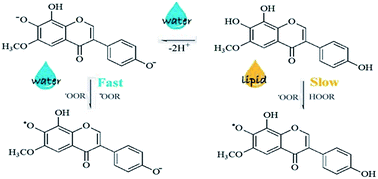
The two main functions of the antioxidants are to inhibit oxidation and to stop an oxidation chain reaction.12 For these compounds, it is crucial to perform both theoretical and experimental studies of their antioxidant activity, the mechanisms and the radical-molecule reaction kinetics.13 It is important to mention that risk factors produce the generation of reactive oxygen species and these can be endogenous or exogenous.14 These species attack cellular components, thus contributing to metabolic alterations which can result in diseases.15,16 Some studies have proven that soy ingestion reduces the risk of different types of cancer and heart disease.17,18
The chemical structure of isoflavonoid compounds has a diphenylpyran (C6–C3–C6′) skeleton that consists of two phenyl rings (A and B) linked through a pyran ring (C) (see Fig. 1).19 In this structure, rings A and C are condensed, and the binding of the ring B with the ring C at C3 position generates the isoflavone nucleus (Fig. 1).
Some of the polyphenolic compounds found in soy and soybean products are isoflavonoid-type compounds: genistein (GEN), daidzein (DAI), glycitein (GLY), equol (EQL), 6-hydroxidaidzein (6-HDAI) and 8-hydroxiglycitein (8-HGLY). Their chemical structures are presented in Fig. 2. Although these compounds have the same skeleton, their antioxidant activity is probably related to the amount and relative position of the hydroxyl groups, therefore it is expected that different molecular structures will have different antioxidant activity. Equol is a reduced metabolite of daidzein and as such is expected greater antioxidant capacity than its parent isoflavonoid.20,21
The primary antioxidant activity is related to the capacity of a certain molecule to sacrifice itself by becoming oxidized instead of an important biological target. Thus, the most common role of an antioxidant is to scavenge free radicals, and thus preventing their attack. From a chemical point of view, the analysis of these processes is related to the study of the mechanisms involved, and the rate of these reactions will be a measure of the antioxidant capacity. However, from an experimental point of view it is very difficult and costly to perform such a study, because it implies performing many experiments with highly purified natural compounds, which are relatively expensive. The alternative is to use plant extracts, but in this case it is not possible to identify from all the polyphenolic compounds which ones are in fact responsible for the overall antioxidant activity, nor can they be ranked. On the other hand, the experimental determination of the reaction rates of free radicals involved in oxidative stress in the organism is a very difficult task. Water radiolysis is the most common experimental procedure to generate ˙OH free radicals. However, these radicals are so reactive that they react practically with any organic molecule at diffusion controlled rates, and therefore almost any molecule acts as an antioxidant. It is true that the ˙OH radical is responsible for most of the damage in the living organism; however, when it is formed, it will damages the neighbour molecules. In this way, one of the roles of the antioxidants is to capture the radicals that could lead to the OH radicals formation.
In this work, we have carried out a quantum chemistry and computational kinetics study on the reactivity of six natural poliphenolic compounds (GEN, DAI, EQL, GLY, 6-HDAI, 8-HGLY) found in soy and soybean products, towards two peroxyl free radicals (˙OOH and ˙OOCH3), in aqueous and lipid media. We have considered two reaction mechanisms: (i) hydrogen transfer (HT) and (ii) single electron transfer (SET). Rate constants and relative branching ratios for the different channels contributing to the overall reaction, at 298.15 K, are reported.
Solvent effects are introduced with the SMD continuum model28 using water and pentylethanoate as solvents, in order to mimic different cellular environments. Liquid phase effects on entropy loss have been included according to the corrections proposed by Okuno,29 taking into account the free volume theory.30 These corrections are in good agreement with those independently obtained by Ardura et al.31 and have been successfully used by other authors.32 In this work, the expression used to correct the Gibbs free energy is:
| ΔGFVsol ≅ ΔG0sol − RT{ln[n102n−2] − (n − 1)} | (1) |
![]() | (2) |
![]() | (3) |
| λ = ΔESET − ΔG0SET | (4) |
![]() | (5) |
| kD = 4πRDABNA | (6) |
![]() | (7) |
In this eqn (7) it is taken into account the Boltzmann constant (kB), the temperature (T), the viscosity of the solvent (η) in our case water (η = 8.91 × 10⁻⁴ Pa s) and pentylethanoate (η = 8.62 × 10⁻⁴ Pa s); and the radius of the solute (a).
The branching ratios of the different reaction channels, which represent the percent of their contribution to the total reaction, have been calculated as:
![]() | (8) |
The methodology used in this work has been previously proven to accurately reproduce experimental rate constants in solution.45
In recent publication,(ref. 46) it has been proposed that the transition states corresponding to the H abstraction from the hydroxyl group in phenols by ˙OOCH3 are affected by multireference effects. These findings may lead to the conclusion that H transfers from OH groups, linked to π electron systems, to oxygenated radicals; present multireference character. However, we previously tested several real phenolic antioxidants (canolol47 and esculetin48) which are more reactive and present much earlier transition states. They do not present significant multireference character according to the T1 diagnostic. We are assuming that the polyphenols studied here do not present multireference character either.
The optimized more stable structures of the studied polyphenols in water environment are depicted in Fig. 3. It is important to mention that the geometric parameters don't change with the media.
These structures are not planar, and therefore the electronic effects from the ring B to A and viceversa are hindered. This effect is more perceptible in EQL, because the carbon atom which links the rings B and C is saturated, so rings A and B are “isolated” and they are almost perpendicular to each other, while the dihedral angle between B and C rings is about 121°. In the DAI, GLY, GEN, 6-HDAI and 8-HGLY structures, the B ring interacts with the oxygen atom of the C
O group, whereas the EQL structure do not present this interaction.
In water, molar fractions of the neutral and deprotonated species for each studied compound were estimated from its two acid constant values (pKas) at physiological pH. The acid constant values used in this work for the studied compounds at pH = 7.4, in water, are reported in Table 1. In this table, the reported pKa values found in the literature were averaged, while values that have not been reported in the literature were calculated through isodesmic or relative methods.49 It is noteworthy that in the case of 8-HGLY and 6-HDAI compounds, the acid constant values of their closely related compounds GLY and DAI, respectively, was considered as references.
It can be observed (Table 1) that the value of the first pKa of the GEN, GLY and 8-HGLY is of 7.25 and for DAI and 6-HDAI is 7.40, while the EQL presents a first pKa value of 9.84, much higher than the other polyphenols. This effect occurs because in the isoflavonoids structures the C
O is an electroattractor group that compensates the negative charge of the anion at position 7-OH, stabilizing them, and at the same time decreasing the pKa. However, in the EQL structure lacks the C
O group, and therefore, this effect does not exist. For the EQL, the value of its first pKa is close to the second pKa of DAI, whose structure is very similar to the EQL one, except the C
O group. Thus, for all compounds except EQL, the deprotonation of 7-OH position generates the most stable anionic structure, and the second deprotonation occurs at the 4′-OH position, while for EQL, the deprotonation of 4′-OH position generates the most stable anionic structure.
Calculated molar fractions corresponding to the neutral and deprotonated species for all the studied polyphenols at pH = 7.4, in water, are presented in Table 2. In this table, the neutral species are denoted as Hnisof, and the monoanion and dianion deprotonated species are denoted as Hn−1isof− and Hn−2isof2−, respectively (n = 2 for DAI, GLY and EQL, and n = 3 for GEN, 6-HDAI and 8-HGLY).
| Compound | Hnisof | Hn−1isof− | Hn−2isof2− |
|---|---|---|---|
| DAI | 0.498 | 0.498 | 0.002 |
| GLY | 0.414 | 0.585 | 0.001 |
| EQL | 0.996 | 0.004 | — |
| GEN | 0.414 | 0.583 | 0.003 |
| 6-HDAI | 0.498 | 0.498 | 0.002 |
| 8-HGLY | 0.414 | 0.585 | 0.001 |
It can be observed (Table 2) that, in general, the molar fraction of the neutral species are approximately equal to the molar fraction of the monoanionic species and the molar fractions of the dianionic species are very low, except for EQL, that exists mainly in its neutral form (99.6%), and its deprotonated monoanionic form represents only =0.4%.
Taking into consideration that in aqueous solution at physiological pH the studied polyphenols exist in both neutral and anionic forms, in this work we have studied the reactions of all these species towards the two proposed peroxyl radicals.
As mentioned before, in order to quantify the antioxidant capacity of the studied polyphenols, we have considered two reaction mechanisms:
(i) hydrogen transfer (HT):
In aqueous media, both hydrogen atom transfer (HT) and single electron transfer (SET) from neutral and anionic forms were studied for each one of the polyphenols against the hydro- and methyl-peroxyl free radicals. The depotonation followed by SET is known as Sequential Proton Loss Electron Transfer (SPLET), if the phenol loses two protons the mechanism could be named SdPLET (Sequential double Proton Loss Electron Transfer). The two latter correspond to Single Electron Transfer (SET) processes from the mono- and di- anions, respectively. The SPLET mechanism was first proposed by Litwinienko and Ingold for the reactions of substituted phenols with the DPPH radical.54–57 The SdPLET mechanism is a particular case of SPLET which becomes important for phenolic acids because they present more than one acid/base sites. In lipid media, only the hydrogen atom transfer from the neutral species was considered, due to the lack of acid–base equilibrium which enables the ionic species. Finally, we have calculated the individual and total reaction rate constants for the studied mechanisms.
In what follows, the thermochemical feasibility of the different HT reaction channels for each one of the studied compounds was investigated first, since it determines the viability of chemical processes. Thus, we have calculated the relative Gibbs free energies of reaction for all the possible HT pathways, for the neutral and deprotonated species reacting with ˙OOH and ˙OOCH3 radicals, in water at 298.15 K, are they are presented in Table 3.
| Compound | Channel | Hnisof | Hn−1isof− | Hn−2isof2− | Hnisof | Hn−1isof− | Hn−2isof2− |
|---|---|---|---|---|---|---|---|
| ΔG (˙OOH) | ΔG (˙OOCH3) | ||||||
| DAI | 7-OH | 6.78 | 7.31 | ||||
| 4′-OH | −0.16 | −0.75 | 0.37 | −0.22 | |||
| GLY | 7-OH | 5.39 | 6.36 | ||||
| 4′-OH | 0.36 | 1.33 | 1.33 | 0.59 | |||
| EQL | 4′-OH | −0.84 | 0.13 | ||||
| 7-OH | −1.57 | −1.96 | −0.6 | −0.99 | |||
| GEN | 7-OH | 8.05 | 9.02 | ||||
| 4′-OH | 8.49 | −0.6 | 9.46 | 0.37 | |||
| 5-OH | 0.19 | 6.7 | 3.43 | 1.16 | 7.67 | 4.4 | |
| 6-HDAI | 7-OH | 0.73 | 1.7 | ||||
| 4′-OH | −0.22 | −0.97 | 0.75 | 0.002 | |||
| 6-OH | −2.09 | −6.25 | −6.41 | −1.12 | −5.28 | −5.44 | |
| 8-HGLY | 7-OH | −3.7 | −2.74 | ||||
| 4′-OH | −0.73 | 3.51 | 0.24 | 4.48 | |||
| 8-OH | −3.32 | −13.45 | −13.98 | −2.36 | −12.48 | −13.01 | |
A brief inspection of the values presented in Table 3, reveals that the most reactive channel appears to be the H abstraction from the 8-OH site in the neutral, monoanion and dianion 8-HGLY molecule, and the same behavior is observed for both radicals. A reasonable explanation is that 8-OH is situated in ortho position to O–R electron donor group and meta to electron acceptor carbonyl group.
The evaluation of the reaction free energies against each of the free radicals, reveals that, in general, the hydrogen abstraction from the 7-OH position of the neutral species is not favoured (with reaction energies up to 5 kcal mol−1), except in the case of EQL and 8-HGLY. For 8-HGLY, the 7-OH hydroxyl is activated by the –OCH3 group of the 6 site and the 8-OH group, and thus, its corresponding reactivity increases. The position 8-OH is in meta position to O–R electron donor group and in para position to carbonyl, electron-withdrawing group, i.e. the action of both groups are concerted to minimize the H atom abstraction.
These processes are slightly exergonic with respect to the ˙OOH with the exception of the GLY and GEN, while the reactions of EQL, 6-HDAI and 8-HGLY are exergonic, and therefore, thermodynamically feasible. Against ˙OOCH3 the HT are slightly endergonic for DAI, GLY and GEN, and exergonic for EQL, 6-HDAI and 8-HGLY. Regarding the deprotonated species, the reactions of GLY monoanion and GEN dianion with both radicals are exergonic, while for EQL and GEN, only the reactions with ˙OOH radicals are slightly exergonic.
Gathering the results in Table 3, it is expected that the 8-HGLY compound, in its neutral and deprotonated forms, is the most reactive compound towards both free radicals, followed by the 6-HDAI compound. In addition, for these two compounds, it can be observed that the relative Gibbs free energies of the HT reactions involving dianionic species are slightly more exergonic than the HT reactions involving monoanions, and the latter are much more exergonic than the ones involving neutral species.
It has been reported in previous publication the relevance of the transition state calculations of all the possible channels and not just the channels that are the more exergonic, this is because in some cases the thermodynamics is dominated by the kinetics when the reaction presents a low activation energy. Thus, in this work, all the HT channels were considered and added in order to obtain the total rate coefficient.
Next, we have identified the transition structures corresponding to all the HT channels. Transition structures (TS) for the HT channels in the neutral species + ˙OOH reactions are shown in Fig. 4.
Regarding the reactivity of the different OH groups in the neutral polyphenols, it can be expected that the OH groups that are involved in intramolecular H bonds will be less reactive than the free ones. This is the case of the 6-HDAI molecule, where the 6-OH and 7-OH form a H bond, and therefore, it is expected that their reactivity will be lower than the 7-OH site in the DAI molecule, where no H bond are present. The same occurs in the GLY and 8-HGLY structures, where the presence of H bonding between the 7-OH and the –OCH3 group at the position 6 could cause a decrease in the reactivity of 7-OH. In GEN structure, the 5-OH group forms a H bond with the
O, and therefore, for this site is expected a low reactivity.
The values of activation barriers (ΔG≠ and ΔH≠), tunneling corrections (κ), rate constants (k) and branching ratios (Γ) for the relevant HT channels in the neutral species reactions towards ˙OOH and ˙OOCH3 radicals are reported in Table 4. We have not included the reaction channels that represents less than 0.5% of the total reaction.
| Hnisof | Channel | ΔG≠ | ΔH≠ | κ | k | Γ | k total |
|---|---|---|---|---|---|---|---|
| ˙OOH | |||||||
| DAI | 4′-OH | 21.83 | 10.34 | 757.6 | 3.44 × 101 | 99.9 | 3.44 × 101 |
| GLY | 4′-OH | 20.16 | 8.14 | 247.4 | 1.88 × 10² | 97.0 | 1.88 × 10² |
| 7-OH | 20.97 | 8.78 | 29.6 | 5.74 × 10 | 3.0 | ||
| EQL | 7-OH | 19.61 | 9.39 | 908.6 | 1.75 × 10³ | 96.0 | 1.75 × 10³ |
| 4′-OH | 21.06 | 9.79 | 440.1 | 7.33 × 101 | 4.0 | ||
| GEN | 4′-OH | 21.54 | 10.42 | 594.5 | 4.37 × 101 | 100.0 | 4.37 × 101 |
| 6-HDAI | 6-OH | 19.92 | 8.65 | 280.9 | 3.20 × 10² | 76.1 | 4.17 × 10² |
| 4′-OH | 21.09 | 10.08 | 613.9 | 9.71 × 101 | 23.1 | ||
| 7-OH | 24.04 | 12.09 | 3352.7 | 3.65 × 10 | 0.8 | ||
| 8-HGLY | 8-OH | 19.07 | 7.65 | 93.5 | 4.47 × 10² | 55.4 | 8.07 × 10² |
| 7-OH | 19.70 | 8.22 | 112.1 | 1.86 × 10² | 23.0 | ||
| 4′-OH | 21.11 | 10.40 | 1143.1 | 1.74 × 10² | 21.6 | ||
| ˙OOCH3 | |||||||
| DAI | 4′-OH | 22.26 | 10.54 | 715.0 | 1.57 × 101 | 99.9 | 1.57 × 101 |
| GLY | 4′-OH | 21.19 | 8.13 | 434.6 | 5.81 × 101 | 98.4 | 5.81 × 101 |
| 7-OH | 21.42 | 8.20 | 7.0 | 9.41 × 10⁻¹ | 1.6 | ||
| EQL | 7-OH | 20.59 | 9.41 | 2237.5 | 8.23 × 10² | 76.1 | 1.08 × 10³ |
| 4′-OH | 20.91 | 9.55 | 1201.6 | 2.58 × 10² | 23.9 | ||
| GEN | 4′-OH | 22.25 | 10.44 | 2414.5 | 5.37 × 101 | 100.0 | 5.37 × 101 |
| 6-HDAI | 6-OH | 19.70 | 7.57 | 249.5 | 4.12 × 10² | 63.3 | 6.47 × 10² |
| 4′-OH | 21.32 | 10.02 | 2190.8 | 2.35 × 10² | 36.1 | ||
| 7-OH | 23.43 | 11.35 | 1353.9 | 4.13 × 10 | 0.6 | ||
| 8-HGLY | 8-OH | 18.84 | 6.40 | 93.2 | 6.58 × 10² | 61.6 | 6.58 × 10² |
| 7-OH | 19.40 | 7.06 | 114.1 | 3.13 × 10² | 29.3 | ||
| 4′-OH | 21.90 | 10.30 | 2404.8 | 9.70 × 101 | 9.1 | ||
The calculated individual rate constants show that the faster HT reactions, with respect to both radicals, are the EQL 7-OH, followed by 8-HGLY 8-OH and 6-HDAI 6-OH. The EQL 7-OH is more than 2 times faster with ˙OOH radicals, while 8-HGLY 8-OH and 6-HDAI 6-OH are slightly faster with ˙OOCH3 radicals.
In some cases, tunneling correction is very large, in agreement with the calculated large imaginary frequencies, an indication of a high and narrow barrier. This is typical of a relatively large O⋯H⋯O barrier due to hydrogen bonds present in the entrance and exit complexes.
The branching ratios of the viable reaction channels, which represent the percent of their contribution to the overall reaction, show that the ˙OOH and ˙OOCH3 scavenging activity of the isoflavonoids takes place predominantly in the 4′-OH position for DAI, GLY, GEN. This behavior is similar to the one presented in resveratrol.58 We found that in the EQL, 6-HDAI and 8-HGLY, the abstractions at the positions 7, 6, and 8 of the A ring are predominant. The driving distances in the transition states were found to be much closer to reactants that to the products, and therefore they can be considered early transition states even the corresponding reactions are not very exothermic.
The transition structures (TS) for the HT channels in the monoanionic deprotonated species + ˙OOH reactions are shown in Fig. 5.
![]() | ||
| Fig. 5 Transition structures (TS) for the HT channels in the monoanionic (Hn−1isof−) deprotonated species + ˙OOH reactions. | ||
Gibbs free energy of activation (ΔG≠) and enthalpy of activation (ΔH≠), rate constants (k) and relative branching ratios (Γ) for the HT channels of monoanionic deprotonated species (Hn−1isof−) with ˙OOH and ˙OOCH3 radicals, in water at 298.15 K, are presented in Table 5.
| Hn−1isof− | Channel | ΔG≠ | ΔH≠ | κ | k | Γ |
|---|---|---|---|---|---|---|
| ˙OOH | ||||||
| DAI | 4′-OH | 21.37 | 9.85 | 720.1 | 7.10 × 101 | 100 |
| GLY | 4′-OH | 20.33 | 8.12 | 283.4 | 1.62 × 10² | 100 |
| EQL | 7-OH | 19.55 | 9.40 | 905.9 | 1.94 × 10³ | 100 |
| GEN | 4′-OH | 21.34 | 10.10 | 608.3 | 6.36 × 101 | 100 |
| 6-HDAI | 6-OH | 17.71 | 6.59 | 522.2 | 2.48 × 10⁴ | 99.8 |
| 8-HGLY | 8-OH | 14.35 | 2.88 | 15.2 | 2.10 × 10⁵ | 100 |
| ˙OOCH3 | ||||||
| DAI | 4′-OH | 21.90 | 10.05 | 685.0 | 1.76 × 101 | 100 |
| GLY | 4′-OH | 20.95 | 7.97 | 641.2 | 1.29 × 10² | 100 |
| EQL | 7-OH | 20.63 | 9.26 | 2569.3 | 8.82 × 10² | 100 |
| GEN | 4′-OH | 21.69 | 9.93 | 2961.8 | 1.46 × 10² | 100 |
| 6-HDAI | 6-OH | 17.42 | 5.47 | 226.5 | 1.76 × 10⁴ | 98.2 |
| 8-HGLY | 8-OH | 13.34 | 1.13 | 2.8 | 2.13 × 10⁵ | 100 |
Among the monoanion species (Hn−1isof−), the 8-HGLY is the most reactive one towards both radicals, and the calculated reaction rate constant are practically equal in both cases. The second reactive compound is the 6-HDAI, with a rate constant approximately one order of magnitude smaller than that of 8-HGLY, followed by EQL.
The transition structures (TS) for the HT channels in the dianionic deprotonated species + ˙OOH reactions are shown in Fig. 6. Gibbs free energy of activation (ΔG≠) and enthalpy of activation (ΔH≠), rate constants (k) and relative branching ratios (Γ) for the HT channels of monoanionic deprotonated species (Hn−2isof2−) with ˙OOH and ˙OOCH3 radicals, in water at 298.15 K, are presented in Table 6.
![]() | ||
| Fig. 6 Transition structures (TS) for the HT channels in the dianionic (Hn−2isof2−) deprotonated species + ˙OOH reactions. | ||
| Hn−2isof2− | Channel | ΔG≠ | ΔH≠ | κ | k | Γ |
|---|---|---|---|---|---|---|
| ˙OOH | ||||||
| GEN | 5-OH | 27.51 | 17.01 | 36 081 | 1.1 × 10⁻¹ | 100 |
| 6-HDAI | 6-OH | 17.86 | 6.51 | 659.8 | 2.5 × 10⁴ | 99.8 |
| 8-HGLY | 8-OH | 14.48 | 2.68 | 13.6 | 1.5 × 10⁵ | 100 |
| ˙OOCH3 | ||||||
| GEN | 5-OH | 27.81 | 17.02 | 17 731 |
3.3 × 10⁻² | 100 |
| 6-HDAI | 6-OH | 17.16 | 5.33 | 224.5 | 2.7 × 10⁴ | 98.2 |
| 8-HGLY | 8-OH | 13.47 | 0.88 | 2.1 | 1.3 × 10⁵ | 100 |
For the dianion species reactions, the tendency is the same towards both radicals. Among the three dianions, the 8-HGLY dianion is the most reactive one, followed by 6-HDAI. GEN reacts very slowly with both radicals, due to the fact that its only available position, 5-OH, is deactivated because it is located in ortho position with respect to the carbonyl group, and is not activated by the phenoxide anion for being located in meta position to it.
We have calculated the Gibbs free energies of the SET reaction channels for the neutral and deprotonated species reacting with ˙OOH and ˙OOCH3 radicals, in water at 298.15 K, and they are reported in Table 7.
| Compound | Hnisof | Hn−1isof− | Hn−2isof2− |
|---|---|---|---|
| ΔG (˙OOH) | |||
| DAI | 27.68 | 12.63 | −1.34 |
| GLY | 22.17 | 7.86 | −1.10 |
| EQL | 30.41 | −1.65 | — |
| GEN | 28.31 | 14.39 | −0.90 |
| 6-HDAI | 32.43 | 10.23 | −1.32 |
| 8-HGLY | 31.02 | 4.36 | −1.65 |
| ΔG (˙OOCH3) | |||
| DAI | 25.19 | 10.13 | −3.84 |
| GLY | 19.67 | 5.36 | −3.59 |
| EQL | 27.92 | −5.01 | — |
| GEN | 25.81 | 11.89 | −3.39 |
| 6-HDAI | 29.93 | 7.73 | −3.82 |
| 8-HGLY | 28.53 | 1.87 | −4.15 |
The calculated values of the relative Gibbs free energies for the SET process involving neutral species are very endergonic, and these values vary between 32.43 and 22.17 kcal mol−1. The values corresponding to the ˙OOCH3 SET reactions are approximately 3 kcal mol−1 below the ones involving ˙OOH radicals. For the monoanion deprotonated species, the results presented in Table 7 suggest that the SET reactions are neither thermodynamically viable in most cases, except for EQL monoanion. Nevertheless all the SET reactions involving dianion species are exergonic. The tendency is the same for both radicals, but it can be observed that the SET reactions involving ˙OOCH3 radicals are more exergonic than the reactions involving ˙OOH radicals.
We have calculated the reaction rate constants for all the neutral and deprotonated species, because the reaction products are relatively reactive species that can undergo competing reverse reaction transformation, for example deprotonation via acid base equilibria. In some cases we have calculated them to show that when they are endergonic by more than five kcal mol−1, they are not fast enough for competing with parallel reactions such as SPLET (first deprotonation followed by SET reaction) competing reactions. Gibbs free energies of activation (ΔG≠) and enthalpy of activation (ΔG≠), the reorganization energy (λ) and apparent rate constants (kapp) in the SET reactions of neutral and deprotonated species of the polyphenol compounds with ˙OOH and ˙OOCH3 radicals, in water at 298.15 K are reported in Table 8.
| Compound | Hnisof | Hn−1isof− | Hn−2isof2− | ||||||
|---|---|---|---|---|---|---|---|---|---|
| λ | ΔG≠ | kapp | λ | ΔG≠ | kapp | λ | ΔG≠ | kapp | |
| ˙OOH | |||||||||
| DAI | 30.8 | 27.76 | 2.76 × 10⁻⁸ | 26.9 | 14.52 | 1.40 × 10² | 27.88 | 6.31 | 1.43 × 10⁸ |
| GLY | 32 | 30.43 | 3.06 × 10⁻¹⁰ | 28.9 | 11.7 | 1.66 × 10⁴ | 27.70 | 6.39 | 1.27 × 10⁸ |
| EQL | 31.4 | 22.85 | 1.10 × 10⁻⁴ | 27.8 | 6.15 | 1.90 × 10⁸ | — | — | — |
| GEN | 30.4 | 28.34 | 1.04 × 10⁻⁸ | 27.5 | 15.96 | 1.25 × 101 | 27.7 | 6.48 | 1.11 × 10⁸ |
| 6-HDAI | 31.3 | 32.44 | 1.03 × 10⁻¹¹ | 28.8 | 13.21 | 1.28 × 10³ | 27.8 | 6.31 | 1.43 × 10⁸ |
| 8-HGLY | 31.3 | 31.02 | 1.12 × 10⁻¹⁰ | 29.3 | 9.67 | 5.06 × 10⁵ | 28.3 | 6.27 | 1.54 × 10⁸ |
| ˙OOCH3 | |||||||||
| DAI | 23.6 | 25.21 | 2.04 × 10⁻⁶ | 19.7 | 11.3 | 3.22 × 10⁴ | 20.70 | 3.43 | 5.57 × 10⁹ |
| GLY | 24.8 | 28.01 | 1.81 × 10⁻⁸ | 21.7 | 8.45 | 3.96 × 10⁶ | 20.52 | 3.49 | 5.45 × 10⁹ |
| EQL | 24.3 | 19.89 | 1.63 × 10⁻² | 21.4 | 3.15 | 6.34 × 10⁹ | — | — | — |
| GEN | 23.2 | 25.88 | 6.58 × 10⁻⁷ | 20.3 | 12.77 | 2.70 × 10³ | 20.5 | 3.57 | 5.25 × 10⁹ |
| 6-HDAI | 24.2 | 30.28 | 3.95 × 10⁻¹⁰ | 21.6 | 9.96 | 3.13 × 10⁵ | 20.7 | 3.43 | 5.60 × 10⁹ |
| 8-HGLY | 24.1 | 28.74 | 5.35 × 10⁻⁹ | 22.1 | 6.51 | 1.06 × 10⁸ | 21.1 | 3.41 | 5.70 × 10⁹ |
For the neutral species, the Gibbs free energy of activation for the SET reactions are relatively high, and as a consequence, the corresponding reactions are very slow. It can be observed that the activation barriers decreases for the monoanions with respect to the neutral species, and once again decreases for the dianions with respect to the monoanions. In the same way, the apparent rate constants increases as the activation barriers decreases. In all cases, the SET reactions involving the ˙OOCH3 radical are more than two orders of magnitude faster than the corresponding ones involving ˙OOH radicals. Among the monoanion species, the EQL is the most reactive one, with apparent reaction rate constants of 1.90 × 10⁸ and 6.34 × 10⁹ M−1 s−1 towards ˙OOH and ˙OOCH3 radicals, respectively, followed by 8-HGLY monoanion. For dianions, we found that the apparent rate constant values are relatively high, and in some cases are close to diffusion controlled for both radicals. Therefore, even as the molar fractions of dianions are very low at physiological pH, it is expected that the reactivity of these species dominates the overall rate constants. Among the dianion species, 8-HGLY is the most reactive towards both radicals, and their SET reactions are almost as fast as for the EQL monoanion.
In the SET process, the reactivity of the monoanionic and dianionic deprotonated species appears to be influenced by some structural factors i.e. the presence of the metoxy group in GLY and 8-HGLY increase the rate coefficient compared with other isoflavones. The metabolite EQL has a C ring with an electron-donor character. GEN is the slowest. Probably the most interesting fact from Table 8 is that deprotonation of ring B produces a phenoxy anion that in all cases is stabilized by ring C acting as electron donor “substituent” therefore that can easily donate an electron to a peroxyl radicals. Thus, these anions are excellent antioxidants and the little influence of different structures of rings A and C does not influence their reactivity, so differences in absolute rate constants depends only on the nature of the reacting free radical. The apparent rate constant however will depend on the molar fractions of the dianions.
![]() | (9) |
![]() | (10) |
Total rate constants for HT and SET reactions towards ˙OOH and ˙OOCH3 radicals, their branching ratios and overall rate constants, in M−1 s−1, in water, are presented in Table 9. The overall rate constants have been estimated by summing up the total rate coefficients calculated for all the HT and SET competing mechanisms. This approach implies that, once the system engages a specific channel, it proceeds to completion, independently of the other pathways; i.e., there is no mixing or crossover between different pathways.
| Compound | kHTtotal | % | kSETtotal | % | koverall |
|---|---|---|---|---|---|
| ˙OOH | |||||
| DAI | 5.25 × 101 | 0.0 | 2.86 × 10⁵ | 100.0 | 2.86 × 10⁵ |
| GLY | 8.50 × 10² | 0.7 | 1.37 × 10⁵ | 99.3 | 1.38 × 10⁵ |
| EQL | 1.79 × 10³ | 0.3 | 7.60 × 10⁵ | 99.7 | 7.62 × 10⁵ |
| GEN | 5.70 × 101 | 0.0 | 3.33 × 10⁵ | 100.0 | 3.33 × 10⁵ |
| 6-HDAI | 1.26 × 10⁴ | 4.4 | 2.87 × 10⁵ | 95.6 | 3.00 × 10⁵ |
| 8-HGLY | 1.23 × 10⁵ | 21.5 | 4.50 × 10⁵ | 78.5 | 5.73 × 10⁵ |
| ˙OOCH3 | |||||
| DAI | 1.66 × 101 | 0.0 | 1.12 × 10⁷ | 100.0 | 1.12 × 10⁷ |
| GLY | 9.99 × 101 | 0.0 | 7.77 × 10⁶ | 100.0 | 7.77 × 10⁶ |
| EQL | 1.08 × 10³ | 0.0 | 2.54 × 10⁷ | 100.0 | 2.54 × 10⁷ |
| GEN | 1.09 × 10² | 0.0 | 1.58 × 10⁷ | 100.0 | 1.58 × 10⁷ |
| 6-HDAI | 9.31 × 10³ | 0.0 | 1.14 × 10⁷ | 100.0 | 1.14 × 10⁷ |
| 8-HGLY | 1.25 × 10⁵ | 0.2 | 6.77 × 10⁷ | 99.8 | 6.78 × 10⁷ |
Analyzing the overall rate coefficients, it can be observed that the overall reactivity with respect to OOH radicals is as follows: EQL > 8-HGLY > GEN > 6-HDAI > DAI > GLY. Regarding the OOCH3 radical, the overall reactivity decrease according to: 8-HGLY > EQL > GEN > 6-HDAI > DAI > GLY. For all the studied polyphenols, the calculated overall rate constants (koverall) in water environment are faster for the reactions involving ˙OOCH3 radicals compared with the corresponding ones involving ˙OOH radicals. Thus, we can safely conclude that ˙OOCH3 radicals react faster with isoflavones than the ˙OOH radicals in aqueous media.
There are many other important inferences that can be drawn from Table 9. One of them is that in water solution the reaction via SET mechanism always occur faster than the HT corresponding reactions, and this tendency is more pronounced for OOCH3 radical.
The calculated overall apparent rate constants presented in Table 9 allows us to make some important deductions concerning the structure–activity relationship of the studied polyphenols. All the studied compounds with the exception of EQL share the 4-piranone structure as ring C. This group has one ether group and one carbonyl group that has opposite effects on basicity and H atom donor capacities. In the EQL structure, the main difference is that the carbonyl group is missing. The effect of this carbonyl can be therefore easily evaluated comparing the properties of EQL with the rest of the studied compounds. The carbonyl group is a relatively strong electron-withdrawing group that enhances the acidity of position 7-OH and therefore all compounds except EQL, have pKas close to 7. EQL is the less acid, and, at the same time, the 7-OH position of the neutral EQL is better H atom donor of all neutral studied compounds. On the other hand, if we compare the reactivity of positions 7(OH) and 6(OH) of neutral 6-HDAI with previously studied catechols37 their reactivity is significantly lower. Therefore we can safely conclude that, in aqueous environment, 4-piranone ring has an overall deactivation (electron-withdrawing) effect which is an important finding since it is present in many naturally occurring polyphenols. On the other hand, the presence of the 4-piranone ring increases the acidity of the polyphenolic compound, and as a consequence, the resulting phenoxide anion is better hydrogen atom or electron donor.
For all the HT channels, the geometrical features of the stationary structures along the reaction coordinate are similar to the ones obtained in water. Gibbs free energy values of the HT reaction channels (in kcal mol−1) for the neutral species, in pentylethanoate at 298.15 K, are presented in Table 10.
| Hnisof | Channel | ΔG (˙OOH) | ΔG (˙OOCH3) |
|---|---|---|---|
| DAI | 7-OH | 6.75 | 8.64 |
| 4′-OH | 0.75 | 2.64 | |
| GLY | 7-OH | 0.69 | 2.58 |
| 4′-OH | 1.10 | 2.99 | |
| EQL | 7-OH | 4.93 | 6.82 |
| 4′-OH | 0.67 | 2.56 | |
| GEN | 7-OH | 9.19 | 11.08 |
| 5-OH | 15.90 | 17.79 | |
| 4′-OH | 1.44 | 3.33 | |
| 6-HDAI | 7-OH | 0.17 | 2.06 |
| 6-OH | −2.53 | −0.64 | |
| 4′-OH | 0.73 | 2.62 | |
| 8-HGLY | 7-OH | −1.97 | −0.08 |
| 8-OH | −1.82 | 0.07 | |
| 4′-OH | 0.93 | 2.82 |
As it can be seen from results presented in Table 10, the HT pathways in pentylethanoate are more endergonic than the corresponding ones in water media, that means a less favorable processes compared to the ones in polar media described before. It is expected that a non-polar media, like pentylethanoate, makes more difficult the hydrogen abstraction from an –OH group.
Thus, in most cases, the Gibbs free energies values of the HT reaction channels for the neutral species reacting with ˙OOH and ˙OOCH3 radicals are endergonic. For the reactions involving ˙OOH radicals, only the 6(OH) channel in 6-HDAI, and 7-OH and 8-OH channels in 8-HGLY, the values are exergonic. For the reactions involving ˙OOCH3 radicals, only for 6-OH channel in 6-HDAI and 7-OH channel in 8-HGLY, the Gibbs free energy values are slightly exergonic.
In a second step, we have identified the transition structures corresponding to all the HT channels. For each compound, we have calculated the Gibbs free energy of activation (ΔG≠) and the enthalpy of activation (ΔH≠) of the HT reaction channels. We have considered all the channels that considerably contribute to the total rate constant, even that these pathways were endergonic, and therefore thermodynamically disfavoured. Corresponding branching ratios have been calculated as described in the computational methodology section.
Gibbs free energy of activation (ΔG≠) and the enthalpy of activation (ΔH≠), rate constants (k), tunneling corrections (κ), relative branching ratios (Γ) for the relevant HT reaction channels of neutral compounds with the studied peroxyl free radicals, in pentylethanoate at 298.15 K, are presented in Table 11. Overall rate constants for the reactions between the studied polyphenols and the two peroxyl radicals in pentylethanoate are calculated by summing up the individual rate constants of the HT channels, and they are also reported in Table 11. Since in this case rates are much slower than diffusion, no diffusion correction need to be applied.
| Hnisof | Channel | ΔG≠ | ΔH≠ | κ | k | Γ | k overall |
|---|---|---|---|---|---|---|---|
| ˙OOH | |||||||
| DAI | 4′-OH | 20.37 | 9.32 | 81.70 | 4.36 × 101 | 99.6 | 4.36 × 101 |
| GLY | 4′-OH | 19.25 | 9.48 | 70.30 | 2.49 × 10² | 99.9 | 2.49 × 10² |
| EQL | 7-OH | 19.91 | 9.23 | 116.57 | 1.35 × 10² | 73.7 | 1.83 × 10² |
| 4′-OH | 20.24 | 9.36 | 72.50 | 4.82 × 101 | 26.3 | ||
| GEN | 4′-OH | 21.20 | 10.10 | 92.30 | 1.21 × 101 | 99.9 | 1.21 × 101 |
| 6-HDAI | 6-OH | 19.40 | 7.89 | 60.91 | 1.67 × 10² | 82.1 | 2.02 × 10² |
| 4′-OH | 20.48 | 9.45 | 79.47 | 3.52 × 101 | 17.3 | ||
| 8-HGLY | 7-OH | 20.00 | 8.12 | 226.56 | 9.64 × 101 | 69.2 | 1.39 × 10² |
| 4′-OH | 20.77 | 8.90 | 62.78 | 2.67 × 101 | 19.2 | ||
| 8-OH | 19.83 | 8.45 | 37.96 | 1.62 × 101 | 11.6 | ||
| ˙OOCH3 | |||||||
| DAI | 4′-OH | 21.58 | 9.69 | 134.00 | 0.93 × 101 | 99.9 | 0.93 × 101 |
| GLY | 4′-OH | 21.19 | 10.00 | 171.80 | 2.30 × 101 | 99.8 | 2.30 × 101 |
| EQL | 7-OH | 21.08 | 9.86 | 152.11 | 6.47 × 101 | 55.1 | 1.17 × 10² |
| 4′-OH | 20.35 | 9.75 | 123.77 | 5.27 × 101 | 44.9 | ||
| GEN | 4′-OH | 22.69 | 10.43 | 151.60 | 0.16 × 101 | 99.9 | 0.16 × 101 |
| 6-HDAI | 6-OH | 19.76 | 6.41 | 71.89 | 1.07 × 10² | 95.2 | 1.12 × 10² |
| 4′-OH | 21.98 | 9.96 | 151.18 | 0.53 × 101 | 4.7 | ||
| 8-HGLY | 8-OH | 19.79 | 19.79 | 58.09 | 8.25 × 101 | 53.8 | 1.53 × 10² |
| 7-OH | 20.23 | 8.10 | 97.62 | 6.60 × 101 | 43.0 | ||
| 4′-OH | 22.06 | 22.06 | 160.90 | 0.49 × 101 | 3.2 | ||
When we evaluate the branching ratios for the HT channels in pentylethanoate, we found that the tendency for the –OH sites reactivity is the same that in aqueous media, except for the 8-HGLY in the presence of the ˙OOH radical, when we can appreciate that the preferred HT reaction channel is the 7-OH over 8-OH (see Table 11).
In all cases, the calculated rate constants are around two orders of magnitude slower in comparison with the reported ones in polar media (water), which means that the studied polyphenolic compounds are relatively poor antioxidants in lipid media.
Taking into account the overall rate constants, it can be stated that, in pentylethanoate, the most reactive compound towards ˙OOH free radicals is GLY, while with ˙OOCH3 radicals, 8-HGLY reacts faster.
The relative reactivity of the radical changes depending on the mechanism. The ˙OOH radical is usually more reactive that ˙OOCH3 via HT which is in agreement with the inductive effect of CH3 group which compensate the electron deficiency of O–O moiety. On the other hand, the reaction with ˙OOCH3 radical is faster than with ˙OOH when it occurs via SET mechanisms. It is in agreement with the fact that −OOCH3 anion needs less for the stabilization of the solvent and therefore favors the SET mechanism.
Thus, all the studied polyphenolic compounds and particularly 8-HGLY and EQL molecules, act as very efficient peroxyl radical scavengers in aqueous media. Moreover, the anionic species of 6-HDAI and 8-HGLY are as good antioxidants via HT mechanism as resveratrol51,60 which exists mainly in its neutral form at physiological pH. However in lipid environment, due to unfeasibility of deprotonation, the studied polyphenols are poor antioxidants. The SET mechanism from anionic and dianionic species in strongly dependent on the solvent, therefore a change of solvent would dramatically change the outcome. For example in methanol the barriers are expected to increase proportionally to the pKa increments, usually more than 5 kcal mol−1.
In water media, the presence of the 4-piranone ring decreases the reactivity but increases the acidity which favours deprotonation, which in turn increases capability of oxidizing via electron lost. One of the most exciting results from this work is that, extrapolating these results, we can predict that hydroxylated derivatives of EQL analogues, 8-HGLY or 6-HDAI are expected to be excellent antioxidants in both lipid and aqueous media.
In lipid environment studied polyphenols are predicted to react slower than Trolox (k = 3.4 × 10³ M−1 s−1),61 which is frequently used as an antioxidant reference. However all of them are predicted to react faster than Trolox (8.96 × 10⁴ M−1 s−1) in aqueous media.
In conclusion, this work provides new data on the global reactivity of soybean polyphenols towards endogenous peroxyl free radicals under oxidative stress conditions. In particular, it gives information on their oxidation pathways and predicts the proportion of the formed products in two types of model biological environments.
Footnote |
| † Electronic supplementary information (ESI) available: Theoretical main geometrical parameters of the compounds under study. Gibbs free energy of reaction and activation, rate constants, relative branching ratios and imaginary frequencies for the HT channels in the reaction with the corresponding transition structures. T1 diagnostic for transition states involved H abstractions by ˙OOH radical. See DOI: 10.1039/c4ra04758c |
| This journal is © The Royal Society of Chemistry 2014 |