Donglin Han
*,
Kyosuke Kishida,
Haruyuki Inui and
Tetsuya Uda*
Department of Materials Science and Engineering, Kyoto University, Yoshida Honmachi, Sakyo-ku, Kyoto 606-8501, Japan. E-mail: han.donglin.8n@kyoto-u.ac.jp; materials_process@aqua.mtl.kyoto-u.ac.jp; Fax: +81-75-753-5284; Tel: +81-75-753-5445
First published on 16th July 2014
Y-doped BaZrO3 (BZY) is getting attention due to its high proton conductivity. But the proton conductivity decreased when Ba-deficiency was introduced. And we recently found that the system with an atomic ratio of Ba
:
Zr
:
Y of 0.9
:
0.8
:
0.2 contained two perovskite phases (Ba0.74Zr0.55Y0.45O3−δ and Ba0.90Zr0.88Y0.12O3−δ). In this work, by scanning transmission electron microscopy (STEM), accumulation of stacking faults with higher content of Zr, Y or vacancies than Ba was observed in the Ba0.74Zr0.55Y0.45O3−δ phase. We discuss the influence of the phase on the conductivity based on the results of water content and conductivity measurements, and therefore assume that the proton conduction in the Ba0.74Zr0.55Y0.45O3−δ phase might be very small.
:
Zr
:
Y of 0.9
:
0.8
:
0.2 contained two compositionally different perovskite phases at 1600 °C. One has a composition of Ba0.90±0.04Zr0.88±0.06Y0.12±0.06O3−δ, and another is greatly Ba-deficient and Y-rich (Ba0.74±0.01Zr0.55±0.03Y0.45±0.03O3−δ).11 It is highly necessary to acquire more detailed information about this sample. In this work, conductivity and water content measurements were performed, and scanning transmission electron microscopy (STEM) was applied for microstructure observation.
:
Zr
:
Y of 1.0
:
0.8
:
0.2 and 0.9
:
0.8
:
0.2, which were stoichiometric and nonstoichiometric (Ba-deficient), respectively, were prepared by a conventional solid state reaction method. Readers are referred to (ref. 11) for detailed information about processes for the sample preparation. Chemical compositions of Ba
:
Y
:
Zr for these samples were determined to be 0.97
:
0.81
:
0.19 and 0.89
:
0.81
:
0.19, respectively, by inductively coupled plasma atomic emission spectroscopy (ICP-AES) with SPS4000 (Seiko Instruments Inc., Japan).11 Pellet-like specimens, which were preliminarily sintered at 1600 °C, were re-heated to 1600 °C at 4 °C min−1, then kept for 24 h, and finally quenched to room temperature. Microstructure was observed by STEM with JEM-2100F (JEOL, Japan) operated at 200 keV.
Conductivity measurement of pellet-like samples with electroless plated palladium electrodes was performed in wet H2 atmosphere (pH2O = 0.05 atm). The impedance spectra were collected by A. C. impedance spectroscopy in the frequency range from 10 Hz to 7 MHz using a frequency response analyzer (Solartron SI 1260, Solartron Analytical, UK) with applied A. C. voltage of 100 mV at temperature from 600 to 100 °C.
Karl-Fischer titration method was applied to determine water content in the samples. The pellet-like samples were broken into pieces about 2 mm in length, and hydrated in wet Ar atmosphere (pH2O = 0.05 atm) for 72 h at the desired temperature. Readers are referred to our previous work12–14 for detailed procedures.
:
Zr
:
Y = 1.0
:
0.8
:
0.2) is estimated to be about three times higher than that of the Ba-deficient one (Ba
:
Zr
:
Y = 0.9
:
0.8
:
0.2), which is in agreement with the results reported by Yamazaki et al.9 In addition, the grain boundary conductivity of the Ba-deficient sample is about two orders smaller than that of the stoichiometric one. It is mainly attributed to the much smaller grain size of the Ba-deficient sample.11 As shown in Fig. 3, the water content of the Ba-deficient sample is also about three times smaller than that of the stoichiometric one.
:
Zr
:
Y = 0.9
:
0.8
:
0.2) with lower bulk conductivity, taken along a [110] incidence, is shown in Fig. 4(a), in which existence of black lines can be clearly seen. These black lines were confirmed to be stacking faults from an atomic resolution HAADF-STEM image shown in Fig. 4(b). The stacking faults were not perfectly straight at an atomic scale, since certain parts contained steps (marked as “A” in Fig. 4(b)), or terminated (marked as “B” in Fig. 4(b)). An atomic resolution HAADF-STEM image of this nonstoichiometric sample with a higher magnification is shown in Fig. 5(a). It can be determined that the stacking faults were mostly on (
11). Due to a strong contrast dependence on atomic number in the HAADF-STEM image,16,17 atomic columns containing heavy Ba cations are imaged as brighter spots than those of Zr and Y cations. And brightest spots in Fig. 5(a) correspond to vertical Ba/O columns. A schematic of perspective view of unit cell of BZY (cubic structure, Pm
m), and a projection of the unit cell along the [110] direction which is corresponding to the area highlighted by a square in Fig. 5(a), were given in Fig. 5(b) and (c), respectively. From Fig. 5(a), it can be seen that along the [1
0] direction, there are seven to ten brightest spots, which depend on the place for observation, between adjacent stacking faults (two examples are given in Fig. 5(a)). And these spot rows shifted for 1/2 a at the two sides of the stacking faults along the [001] direction.
In the area of the stacking faults, darker spots were seen, indicating a higher content of lighter atoms (Zr and Y) or vacancies. As shown in Fig. 4(a), in addition to the regions where stacking faults were observed to be arranged at an almost regular interval, regions containing small amount of stacking faults obviously coexisted. We also observed the stacking faults in the nominally stoichiometric sample (Ba
:
Zr
:
Y = 1.0
:
0.8
:
0.2) which had higher bulk conductivity, but the amount is very small (Fig. 6).
![]() | ||
Fig. 6 An atomic resolution HAADF-STEM image of the sample with the nominal atomic ratio of Ba : Zr : Y of 1.0 : 0.8 : 0.2, taken along a [110] incidence. The stacking faults were highlighted by arrows. | ||
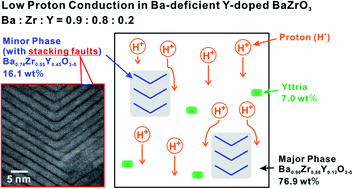
In the nonstoichiometric sample, besides the coexistence of yttria, the ratio was previously determined to be 76.9 wt% (76.5 vol%) and 16.1 wt% (15.5 vol%) for the phases of Ba0.90Zr0.88Y0.12O3−δ and Ba0.74Zr0.55Y0.45O3−δ, which were thereby named as major and minor phases, respectively.11 The minor phase is highly Y-rich and Ba-poor. Such minor phase is hardly to be found in the stoichiometric sample.11 We therefore consider that the minor phase is the region where stacking faults concentrate. It is also reasonable to believe that the formation of stacking faults should be promoted by insufficient amount of Ba in the whole composition.
Proton conductivity decreased when Ba-deficiency was introduced, which was also confirmed by Yamazaki et al. using the samples with the same composition as this study.9 Due to the lack of the information of the coexistence of two perovskite phases (namely the major and minor phases), they considered that Y was driven to the A-site with an increasing Ba-deficiency, resulting in a homogeneous decrease in proton conductivity.
But based on the observation in this study, we consider that the reason might be attributed to the very low conductivity in the Ba0.74Zr0.55Y0.45O3−δ minor phase. It is because that the conductivity and water content of the nonstoichiometric sample are both estimated to be about three times smaller than those of the stoichiometric one, implying that the difference in conductivity is mainly resulted from the difference in proton concentration. Since proton concentration decreases with the decreasing Y content,19 and the volume ratio of the major phase is 76.5 vol%, it is quite reasonable that the measured proton conductivity and water content of the nonstoichiometric sample attributed mainly to the Ba0.90Zr0.88Y0.12O3−δ phase (major phase), in which the Y content is 0.12, almost half of that of the stoichiometric sample (0.2). In addition, it is also quite possible that protons cannot move across the stacking faults smoothly to generate high conductivity. That is, we assume that proton conduction is almost negligible in the minor phase. In addition to the minor phase, yttria (7.0 wt%) is not a good conductive phase. Such much less conductive phases also decrease the conductivity by their existence ratio and topology.
Schematics of proton conduction are given in Fig. 7. Detailed analysis of these stacking faults, especially clarification of the relationship between the stacking faults and proton conduction, is no doubt highly valuable in future.
:
Zr
:
Y = 0.9
:
0.8
:
0.2). These stacking faults accommodated a higher content of Zr, Y or vacancies than Ba. We assume that the proton conduction is negligibly small in the minor phase.
| This journal is © The Royal Society of Chemistry 2014 |