Shuting Zhang‡
a,
Xiaohui Zhang‡a,
Xuege Linga,
Chao Hea,
Ruofeng Huanga,
Jing Pana,
Jiaqiang Lia and
Yan Xiong*ab
aSchool of Chemistry and Chemical Engineering, Chongqing University, Chongqing 400030, China. E-mail: xiong@cqu.edu.cn
bState Key Laboratory of Elemento-Organic Chemistry, Nankai University, Tianjin 300071, China
First published on 4th July 2014
A convenient procedure employing simple starting materials benzyl alcohols and acetates as the benzyl donors to assemble a series of diarylalkanes through benzylation of arenes using in situ prepared superacid BF3–H2O as an efficient promoter has been developed. The beneficial role of water in the reaction has been clarified with combination of control experiments and 11B NMR analysis. This reaction is a self-promoted model, which is triggered by the trace of water and continuously promoted by self released by-product water (or carboxylic acid). A wide range of substrates are investigated and the moderate to excellent yields and the good regioselectivities for secondary benzyl alcohols as well as arenes bearing electron-withdrawing groups have been achieved. As a result, moisture in the reaction system has been utilized as an efficient initiator in all benzylation cases.
BF3–OEt2 (or BF3) is usually utilized as a Lewis acid due to its empty p-orbital, and has shown strong interaction with numerous ligands due to the boron atom acting as an acceptor to form a large number of coordinate compounds containing carbon, nitrogen, oxygen, fluorine, phosphorus and sulfur.24 For instance, BF3–OEt2 is an adduct of BF3 and Et2O through a donor–acceptor bonding.25 Various synthetic procedures such as alkylation,22,26a cyclization,26b,e rearrangement26c and coupling reactions26d employing BF3–OEt2 have been reported. In the opposite way, the superacid boron trifluoride monohydrate (BF3–H2O) formed by mixing BF3 and water in equal amount has served as a highly effective acid catalyst for several Friedel–Craft reactions and become a very extensively studied area.27 Compared to Et2O, the interaction of H2O with BF3 is stronger, and ligand exchange has been observed between BF3–OEt2 and water to form superacid BF3–H2O.28
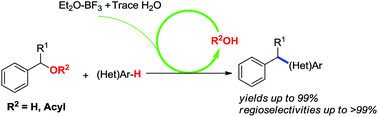
Direct nucleophilic substitution of an alcohol through OH activation is attractive as it yields water as the by-product, however hydroxide is a poor leaving group usually requiring activation. Based on an early report, BF3 gas has been utilized to promote the Friedel–Crafts alkylation of benzene with alcohols under open-flask conditions in up to gram scale, in which mono-/di-/polybenzylbezenes were obtained in yields of 23%, 15% and 34%, respectively.29 To the best of our knowledge, the true role of BF3 in this reaction has not been clarified and the substrate generality has not been investigated to date. Recently we have reported benzylation of arenes with benzyl ethers and illustrated the crucial role of moisture throughout the paper.30 Herein we are delighted to report an efficient self-promoted monobenzylation of arenes to assemble the structurally diverse diarylmethanes with benzyl alcohols and acetates triggered by the trace of water. The beneficial role of water has been investigated in detail, not the BF3–OEt2 but the in situ generated superacid BF3–H2O has proved to be the actual promoter in this transformation and the merit that the superacid BF3–H2O is formed with mainly by-product water has enhanced its synthetic appeal (Fig. 2).
| Entry | 1 | χ | T (°C) | Yieldb (%), ratio (o- : p- : m-)c |
|---|---|---|---|---|
| a Conditions: benzylic alcohols or acetates (1; 1.0 mmol), undistilled toluene (2; 2.0 mL), BF3–OEt2 (specified), temperature (specified), 2 h in air.b Yields of isolated products.c Isomer ratios determined by 13C NMR.d Yield determined by 1H NMR using 1,3,5-trimethylbenzene as an internal standard.e Toluene (2; 0.5 mL, 4.6 mmol), CHCl3 (1.5 mL).f No m-isomer was detected. | ||||
| 1 | 1a | 0.2 | 80 | 3 (−) |
| 2 | 1a | 1.0 | 80 | 82 (42 : 52 : 6) |
| 3 | 1a | 1.2 | 80 | 89 (42 : 53 : 5) |
| 4 | 1a | 1.5 | 80 | 91 (44 : 50 : 6) |
| 5 | 1a | 2.0 | 80 | 96 (41 : 53 : 6) |
| 6 | 1a | 2.5 | 80 | 93 (41 : 53 : 6) |
| 7 | 1a | 1.2 | Reflux | 81 (41 : 52 : 7) |
| 8d | 1a | 1.2 | 25 | 6 (−) |
| 9e | 1a | 1.2 | 80 | 58 (44 : 49 : 7) |
| 10 | 1a′ | 2.0 | 80 | 86 (42 : 51 : 7) |
| 11 | 1b | 2.0 | 80 | 91 (5 : 90 : 5) |
| 12f | 1b′ | 2.0 | 80 | 89 (12 : 88) |
11B NMR analysis was employed and the chemical shifts of the following signal peaks of H3BO3, BF3–OEt2, BF3–2H2O and HBF4–OEt2 were observed at 19.49 ppm, −0.04 ppm, −1.6 ppm and −3.50 ppm, respectively.31 When 1.0 equivalent of H2O was added into BF3–OEt2, the signal was firstly broadened and eventually shifted to −0.94 ppm, which suggested an exchange process (admittedly a slow process) and formation of superacid BF3–H2O occurs. Moreover, hydration experiments of BF3–OEt2 did not lead to HBF4 and H3BO3. Using Bode's reaction conditions, benzylations with benzyl alcohol and acetate resulted in low activities (≤5% yield).17c It should be noted that these experiments were carried out under an atmosphere of dry N2. We adapted the optimal conditions to the use of free benzyl alcohol and toluene (Table 1, entry 3), BF3–OEt2 was insoluble in toluene and two phases were observed before and after the reaction. At 80 °C the benzylation, carried out under an atmosphere of dry N2, only led to a yield of 31% with the regioselectivity of 44
:
48
:
8 (o-
:
p-
:
m-) after 2 h (Table 2, entry 1). We next tested the addition of 0.2 equivalent of water, which resulted in a significantly improved yield of 85% with a regioselectivity of 41
:
54
:
5 (o-
:
p-
:
m-) (Table 2, entry 2). With the amount of water increased to 1.2 eq., the yield dropped back to low yield of 43%, which indicated that excessive hydration of BF3–OEt2 is disfavorable to this transformation (Table 2, entry 3). Using undistilled toluene under an atmosphere of dry N2 (moisture content originates from toluene) and anhydrous toluene in air (moisture content originates from air) resulted in yields of 79% and 84% with regioselectivities of 41
:
53
:
6 and 42
:
51
:
7 (o-
:
p-
:
m-), respectively (Table 2, entries 4 and 5). Using open-flask conditions with undistilled toluene, benzyl alcohol gave rise to diphenylmethane in 89% with a regioselectivity of 42
:
53
:
5 (o-
:
p-
:
m-) (Table 2, entry 6). After the reaction the low layer was analyzed by 11B NMR spectroscopy and a signal at −0.97 ppm (vs. −0.94 ppm) was observed, which suggested the continuous formation of BF3–H2O during the benzylation reaction. Other boron compounds were tested as well. BF3–THF, BF3–2H2O and HBF4–OEt2 (ref. 32) provided yields of 82%, 9% and 87% (Table 2, entry 7–9), respectively, whereas H3BO3 led to no product formation (Table 2, entry 10). The inferior result of BF3–2H2O further showed that excessive hydration of BF3–OEt2 was detrimental to this benzylation.
| Entry | Boron sources | H2O | Atmosphere | Yieldb (%), ratio (o- : p- : m-)c |
|---|---|---|---|---|
| a Conditions: benzyl alcohol (1.0 mmol), undistilled toluene (2.0 mL), boron sources (1.2 eq.), 80 °C for 2 h.b Yields of isolated products after silica gel column chromatography.c Isomer ratios determined by 13C NMR.d The reaction was performed in anhydrous toluene. | ||||
| 1d | BF3–OEt2 (1.2 eq.) | — | N2 | 31 (44 : 48 : 8) |
| 2d | BF3–OEt2 (1.2 eq.) | 0.2 eq. | N2 | 85 (41 : 54 : 5) |
| 3d | BF3–OEt2 (1.2 eq.) | 1.2 eq. | N2 | 43 (46 : 49 : 5) |
| 4 | BF3–OEt2 (1.2 eq.) | — | N2 | 79 (41 : 53 : 6) |
| 5d | BF3–OEt2 (1.2 eq.) | — | Air | 84 (42 : 51 : 7) |
| 6 | BF3–OEt2 (1.2 eq.) | — | Air | 89 (42 : 53 : 5) |
| 7 | BF3-THF (1.2 eq.) | — | Air | 82 (40 : 54 : 6) |
| 8d | BF3–2H2O (1.2 eq.) | — | N2 | 9 (45 : 50 : 5) |
| 9d | HBF4–OEt2 (1.2 eq.) | — | N2 | 87 (39 : 54 : 7) |
| 10 | H3BO3 (1.2 eq.) | — | Air | 0 |
Having explored the reaction conditions, our interest then focused on the influence of the benzyl alcohols and acetate substitution in the Friedel–Crafts reaction with undistilled toluene (Table 3). Using the optimal reaction conditions described above (Table 1, entry 3), the generality of benzyl alcohols and acetates 1 has been investigated. A large variety of primary and secondary benzyl alcohols and acetates were greatly tolerated in this reaction. Throughout, the free alcohols and acetates resulted in very similar reactivity. Both the yields and the regioselectivities were not affected by the choice of precursor. We noted two exceptions: 3r and 3s. In the case of 3r, an increased yield was obtained when using the bis-acetate as a benzyl precursor whereas, in the case of 3s, this was the opposite way and the free alcohol performs much better. In the case of 3r this difference is readily explained by the poor solubility of the free benzyl alcohol compared to the bis-acetate under the reaction conditions. Furthermore, the yields of 3p and 3q possessing naphthyl groups are somewhat lower. To our delight this reaction gave excellent yields for a variety of halogenated benzyl donors (3g–o) which are amongst the more challenging substrates in benzylation reactions.17c The secondary alcohols and corresponding acetates employed predominantly give the expected para-substituted products (3b, 3d, 3e, 3f, 3j, 3k, 3l, 3m, 3n and 3q) (>78% regioselectivity). In addition, we do not observe elimination products when using secondary alcohols (1b, 1f, 1j, 1k, 1m, 1n and 1q) bearing β-H atoms which can potentially form in the presence of Bronsted and Lewis acids.
| a Conditions: benzylating agent (1.0 mmol), BF3–OEt2 (1.2 eq.), aromatic (2.0 mL), 80 °C for 2 h in air; yields of isolated products are given and only major products were presented; ratios of isomers are determined by 13C NMR.b BF3–OEt2 (2.0 eq.).c BF3–OEt2 (2.4 eq.).d BF3–OEt2 (4.0 eq.) and toluene (4.0 mL) at 100 °C for 9 h. |
|---|
![]() |
In a further effort we decided to rigorously investigate the effects of the acyl-moiety on the ability to serve as a benzyl donor (Table 4). Without any exception we observe very good reactivity and no significant effects on the regioselectivity. This demonstrates that a benzylic cation is formed which subsequently undergoes an electrophilic aromatic substitution (vide infra). In addition, it should be noted that the carboxylic acids tested possess a wide range of functional groups which are greatly tolerated under the reaction conditions. Therefore, one might consider application of this method as a mild deprotecting strategy. Benzyl esters are normally cleaved via Pd-based hydrogenolysis. In our deprotecting cases, all the benzyl esters were deprotected with a nice finding, and the substrates with nitro, cyano and thiophene groups (3g′–i′ and 3q') can be utilized to debenzylation directly as well.
The reactivity of a range of arenes was explored using ortho, para dichloro benzyl alcohol (1i) and diphenyl methanol (1d) (Table 5). Benzene gave rise to monobenzylation product 4a in excellent yield of 93%. Throughout we observe excellent reactivity for electron rich arenes possessing methyl substituents and regioselectivities which match the steric pattern of the starting materials (4b–4f and 5a–e). When using naphthalene CHCl3 was used as a (co)solvent using 4.0 equivalents of the arene obtaining 4g in 72% isolated yield. Thiophenes could also be employed in this reaction, albeit in a moderate yield (4i and 4j). Electron deficient trifluorotoluene also gave the desired product 4k in modest 42% yield favoring the meta-product as expected, which has the potential to be utilized in modern pharmaceuticals and specialty materials.33 In this case the reaction temperature had to be raised to 100 °C. Fortunately, dichloroarene gave tetrachloro-substituted diarylmethane (4m) in good yield with regioselectivity of above 87%, whereas using monochloroarene led to a closely quantitative transformation (4l) with regioselectivity of above 72%.
| a Conditions: benzylating agent (1d or 1i, 1.0 mmol), BF3–OEt2 (1.2 eq.), aromatics (2.0 mL), 80 °C for 2 h in air; yields of isolated products are provided and only major products were presented; ratios of isomers are determined by 13C NMR.b BF3–OEt2 (1.2 eq.), aromatics (4.0 eq.), CHCl3 (2.0 mL).c BF3–OEt2 (4.0 eq.), aromatic (4.0 mL), 100 °C, 2 h.d BF3–OEt2 (3.0 eq.), aromatic (2.0 mL). |
|---|
![]() |
As common Friedel–Crafts reaction of alcohol via an electrophilic substitution of carbonium intermediate in the presence of Lewis acid or Bronsted acid, benzylation reaction of benzyl alcohol initially gives rise to the carbonium intermediate in the presence of superacid BF3–H2O. The BF3–OEt2 has been found a highly-sensitive Lewis acid and hydration reaction might occurs even during the addition of the reagent. As a result, a low reactivity for benzylation was yet obtained in the absence of water under nitrogen atmosphere (Table 2, entry 1). When 0.2 equivalent of water is added, 0.2 equivalent of BF3–OEt2 is converted into an equal amount of superacid BF3–H2O to promote the benzylation and extra 0.2 equivalent of by-product water is released, which subsequently complexes with another 0.2 equivalent of BF3–OEt2 to generate an equal amount of superacid BF3–H2O. The by-product water goes and returns in following such a circle until the residual BF3–OEt2 is exhausted and the benzylation is complete. In the cases of carboxylic esters, the decomposed carboxylic acid undergoes the similar procedure.
Footnotes |
| † Electronic supplementary information (ESI) available: General information, experimental procedures, characterization data of products and the copies of NMR spectra. See DOI: 10.1039/c4ra04059g |
| ‡ These authors contributed equally. |
| This journal is © The Royal Society of Chemistry 2014 |