Crocrassins A and B: two novel sesquiterpenoids with an unprecedented carbon skeleton from Croton crassifolius

Zhan-Xin Zhang*a, Hui-Hong Lia, Feng-Ming Qib, Le-Le Donga, Yang Haia, Gai-Xia Fana and Dong-Qing Fei*a
aSchool of Pharmacy, Lanzhou University, Lanzhou 730000, People's Republic of China. E-mail: zhangzhx@lzu.edu.cn; feidq@lzu.edu.cn; Fax: +86 931 8915686; Tel: +86 931 8915686
bState Key Laboratory of Applied Organic Chemistry, College of Chemistry and Chemical Engineering, Lanzhou University, Lanzhou 730000, People's Republic of China

Received 25th April 2014 , Accepted 18th June 2014

First published on 18th June 2014


Abstract

Crocrassins A (1) and B (2), two novel sesquiterpenoids with a unique skeleton, were isolated from a Chinese medicinal plant Croton crassifolius. Their structures were assigned on the basis of detailed spectroscopic analyses (especially HRESIMS and 2D NMR), and their absolute configuration was established via single-crystal X-ray diffraction studies as well as chemical transformation.

The genus Croton (Euphorbiaceae), composed of more than 1300 species globally, mainly grows in tropical and subtropical regions1 with about 21 species distributed in the southern part of China.2 It grows in sandy and wet soil and on damp areas near river banks. Several species have long been used in Chinese folk medicine to alleviate dysmenorrhea as a purgative, and to treat dyspepsia and malaria.3 Phytochemical investigations on genus Croton have been carried out and several types of compounds were obtained, including diterpenes, sesquiterpenes, triterpenes, alkaloids, flavanones, lignans, polyphenolic compounds, phenylbutanoids, and peptides.1,3 Collectively, some compounds possess antimicrobial, anti-inflammatory, antibacterial, antimalarial, and cytotoxic activities.1

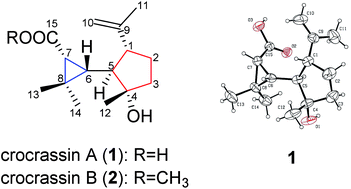
Croton crassifolius Geisel, an undershrub of up to 30–50 cm in height, is mainly found in the southern parts of China, and is also distributed in Vietnam, Laos, and Thailand.4 The roots of C. crassifolius, known as “Jiguxiang” in traditional Chinese medicine, have been used for the treatment of snake bites, stomach ache, sternalgia, joint pain, as well as pharyngitis, jaundice, and rheumatoid arthritis for a long time.5 In previous studies, numerous clerodane-type diterpenes and sesquiterpenes were reported from this species.6 As a part of our continuing work on searching structurally interesting bioactive compounds from traditional herbal medicines, further phytochemical investigations on this plant resulted in the isolation of two novel sesquiterpenoids with an unprecedented carbon skeleton via the connection of a single carbon–carbon bond to form a cyclopropylcyclopentane (Fig. 1). This paper describes the isolation and structural elucidation of compounds 1 and 2 by extensive spectroscopic and single-crystal X-ray crystallographic analyses, as well as chemical transformation.


image file: c4ra03798g-f1.tif
Fig. 1 Structures of crocrassin A (1) and crocrassin B (2).

The air-dried and powdered roots of C. crassifolius (9.5 kg) were exhaustively extracted with 95% EtOH at room temperature, and the residue (962 g) obtained by concentrating the EtOH extract in vacuo was suspended in water, which was then successively partitioned with EtOAc and n-BuOH. The EtOAc-soluble portion (731 g) was applied to silica gel CC eluted with the increasing polarities of petroleum ether–acetone mixtures (40[thin space (1/6-em)]:[thin space (1/6-em)]1 to 0[thin space (1/6-em)]:[thin space (1/6-em)]1) to afford combined fractions A–F. The fraction C was further separated by CC over silica gel and Sephadex LH-20 to yield 1 (4 mg) and 2 (2 mg).

Compound (1)§ was obtained as a colorless crystal, [α]25D + 60 (c 0.10, CHCl3). It exhibited a quasimolecular ion peak at m/z 275.1616 corresponding to [M + Na]+ in the HRESIMS analysis, which provided the molecular formula C15H24O3 (calcd for [M + Na]+ m/z 275.1618), indicating four degrees of unsaturation. The IR spectrum of 1 displayed characteristic absorption bands of a carboxylic acid group (1697 cm−1),7 double bond (3072, 1642 cm−1),8 and hydroxyl (3391 cm−1) functionalities.

The analysis of the 1H NMR data of 1 indicated the presence of two terminal olefinic protons at δH 4.64 (dd, J = 2.4, 1.8) and 4.79 (d, J = 2.4), an olefinic methyl at δH 1.67, three tertiary methyls at δH 1.20, 1.26, and 1.31, as well as signals with several complex multiplets from δH 1.20–2.5. The 13C NMR and DEPT spectra revealed 15 carbon resonances, which were determined to be four methyls, three methylenes (including one olefinic carbon), and four methines along with four quaternary carbons (including one carbonyl, one oxygenated sp3 carbon, and one olefinic carbon). From the number of carbon resonances in the 13C NMR, in combination with the molecular formula, it could be inferred that compound 1 could be a sesquiterpenoid. Moreover, deducting 2 degrees of unsaturation accounted for one carbonyl and one olefinic bond, and the remaining two degrees of unsaturation were indicative of the bicyclic ring system of 1.

The planar bicyclic carbon skeleton of 1 was established by the 2D NMR experiments, including 1H–1H COSY, HMQC and HMBC spectra. The proton and protonated carbon signals in the NMR spectra of 1 were unequivocally assigned by the HMQC experiment. In the 1H–1H COSY spectrum, homonuclear coupling correlations from H2-3 through H2-2, H-1, H-5 to H-6, and then to H-7, suggested the presence of one key fragment (C-3/C-2/C-1/C-5/C-6/C-7). This structural fragment along with other isolated groups was connected by quaternary carbons according to the further examination of HMBC data (Fig. 2), especially correlations arising from tertiary methyl protons. The protons of H2-3 (δH 1.68, 1.79) and H-5 (δH 2.34) showed significant HMBC correlations to C-4 (δC 81.6), which suggested that C-1, C-2, C-3, C-4, and C-5 constructed a five-membered carbon ring A. In the HMBC spectrum, two singlet methyls CH3-13 (δH 1.20) and CH3-14 (δH 1.31) together with the signals of two methines of C-6 (δH 0.97) and C-7 (δH 1.48) showed significant correlations to an sp3 quaternary carbon at δC 26.5 (C-8). These HMBC correlations established a cyclopropane ring B, as shown in Fig. 2. The connected position of the abovementioned two rings was established according to the following key correlations: in the 1H–1H COSY spectrum, H-5 correlated to H-6; and in the HMBC spectrum, H-1 correlated to C-6 and H-7 correlated to C-5. Thus, ring A and B were connected by a C–C σ-bond at C-5 and C-6. The C-4 position of 1 was substituted by a hydroxyl group based on the HMBC correlations of CH3-12 (δH 1.26), H2-3, and H-5 with the oxygenated quaternary carbon at δC 81.6. An isopropenyl group (δH 1.67, 4.64, and 4.79; δC 18.4, 111.8, and 147.0) was attached to the C-1 position (δC 55.4) because of the HMBC correlations of H-10a, H-10b, and CH3-11 with C-1. The carboxylic acid group was assigned to C-7 by the HMBC correlation of H-7 with C-15 (δC 178.2). Therefore, the planar structure of 1 was constructed, as shown in Fig. 1.


image file: c4ra03798g-f2.tif
Fig. 2 Key 1H–1H COSY and HMBC correlations for 1.

The relative stereochemistry of 1 was established by the interpretation of its NOESY spectrum (Fig. 3). In the NOESY spectrum, the cross peaks of H-6/H-7 and H-7/H3-13 demonstrated that H-6, H-7, and H3-13 were oriented on the same side of the cyclopropane ring B, while H3-14 and COOH were oriented on the opposite side. Consequently, the cross peaks of H-5/H3-11 and H-1/H3-12 confirmed that H-1 and H3-12 were on the same face of cyclopentane ring A, while H-5 was on the opposite face. The relative configuration between the conjoined bicyclic ring systems in 1 was defined by the observation of NOESY correlations between H-6 and H3-12 and between H-5 and H3-14, which could only be accommodated by the C-5R*/C-6S* relative configuration, as shown in Fig. 3.9


image file: c4ra03798g-f3.tif
Fig. 3 Key NOESY correlations for 1.

After repeated attempts, a suitable single crystal of 1 was obtained from petroleum ether–acetone solution. The X-ray crystallographic data (CuKα) (Fig. 4) corroborated the planar structure and relative configuration of 1, which was elucidated via NMR data, and further allowed the assignment of its absolute configuration as 1R, 4S, 5R, 6S, 7R [the refined Flack parameter is 0.07(14)].10 Thus, the structure of 1 was established and it was named as crocrassin A.


image file: c4ra03798g-f4.tif
Fig. 4 X-ray structure of compound 1.

Compound (2) was obtained as a colorless gum with [α]25D + 80 (c 0.10, CHCl3). Its molecular formula C16H26O3 was determined on the basis of the HRESIMS at m/z 289.1775 [M + Na]+ (calcd 289.1774), indicating four degrees of unsaturation. It was 14 mass units heavier than that of 1. The IR spectrum of 2 indicated the presence of a hydroxyl group (3439 cm−1) and a carbonyl group (1728 cm−1). The similar 1H and 13C NMR spectra revealed that 2 is an analogue of 1. A careful comparison of the NMR data for compounds 1 and 2 (Table 1) suggested that they had the same carbon skeleton including the cyclopropane and cyclopentane moieties, which were connected by a C–C σ-bond. The major difference between the 1H NMR spectra of 2 and 1 was the presence of an additional oxymethyl group in 2 with the spectral data at δH 3.55 (s, 3H), which was further corroborated by the 13C NMR spectrum as an additional signal compared to 1 detected at δC 51.2. In addition, the 13C NMR spectrum of 2 indicated that the carbonyl resonance was moved upfield from δC 178.2 in 1 to δC 172.1 in 2, which demonstrated that the carboxylic acid group in 1 was esterified in 2. Further examination of the 1H–1H COSY, HSQC, HMBC, and NOESY spectra confirmed the structural and relative configuration of 2, as shown in Fig. 1.

Table 1 1H (600 MHz) and 13C (150 MHz) NMR data for 1 and 2
no. 1a 2a
δH, mult, (J in Hz) δC δH, mult, (J in Hz) δC
a Measured in CDCl3.b Signal pattern unclear due to overlapping.
1 2.45 m 55.4 d 2.41 m 55.6 d
2a 1.81 mb 28.1 t 1.79 mb 28.3 t
2b 1.69 mb   1.68 mb  
3a 1.79 mb 41.8 t 1.78 mb 41.8 t
3b 1.68 mb   1.65 mb  
4   81.6 s   81.6 s
5 2.34 dd (10.8, 8.4) 48.0 d 2.27 dd (11.4, 8.4) 48.1 d
6 0.97 dd (10.8, 9.0) 39.4 d 0.90 dd (11.4, 9.6) 38.5 d
7 1.48 d (9.0) 28.3 d 1.48 d (9.6) 28.2 d
8   26.5 s   25.0 s
9   147.0 s   147.2 s
10a 4.79 d (2.4) 111.8 t 4.70 d (1.8) 111.0 t
10b 4.64 dd (2.4, 1.8)   4.58 d (1.8)  
11 1.67 brs 18.4 q 1.67 brs 18.5 q
12 1.26 s 25.1 q 1.27 s 25.1 q
13 1.20 s 29.1 q 1.16 s 29.1 q
14 1.31 s 16.3 q 1.33 s 16.2 q
15   178.2 s   172.1 s
OMe     3.55 s 51.2 q


Unfortunately, we failed to obtain a single crystal of 2 for determining its absolute configuration. To determine the absolute configuration of 2, compound 1 was methyl esterified using excess ethereal diazomethane in diethyl ether to give the compound 2. Thus, the absolute configuration of 2 was identical to that of 1 and was deduced as 1R, 4S, 5R, 6S, 7R. Finally, the structure of 2 was established, and it was named as crocrassin B.

To the best of our knowledge, crocrassins A (1) and B (2) are the first examples of a novel carbon skeleton via the connection of a single carbon–carbon bond to form a cyclopropylcyclopentane in the family of sesquiterpenoids.

Both 1 and 2 were evaluated for their cytotoxicity against four human cancer cell lines, HepG2, SGC-7901, K562, and K562/ADM, using the MTT method. Unfortunately, no significant activity was detected.

Acknowledgements

We are grateful to the National Natural Science Foundation of China (no. 21102065), the Natural Science Foundation of Gansu Province, China (no. 1208RJYA029) and the Foundational Research Funds for the Central Universities (no. lzujbky-2013-72 and no. lzujbky-2012-83) for the financial support of this research.

Notes and references

  1. A. Salatino, M. L. F. Salatino and G. Negri, J. Braz. Chem. Soc., 2007, 18, 11 CrossRef CAS PubMed.
  2. H. X. Qiu, in Flora Republicae Popularis Sinicae, ed. Z. Y. Wu, Science Press, Beijing, 1996, vol. 44, ch. 2, pp. 123–125 Search PubMed.
  3. X. D. Yang, W. Chen, J. F. Zhao, L. J. Yang, H. B. Zhang and L. Li, Biochem. Syst. Ecol., 2009, 37, 237 CrossRef CAS PubMed.
  4. H. X. Qiu, in Flora Republicae Popularis Sinicae, ed. Z. Y. Wu, Science Press, Beijing, 1996, vol. 44, ch. 2, p. 130 Search PubMed.
  5. J. Zhao, F. Fang, L. Z. Yu, G. Q. Wang and L. L. Yang, J. Ethnopharmacol., 2012, 142, 367 CrossRef PubMed.
  6. (a) L. Boonyarathanakornkit, C. T. Che, H. H. S. Fong and N. R. Farnsworth, Planta Med., 1988, 54, 61 CrossRef CAS PubMed; (b) S. Boonyaratavej, S. Roengsumran, R. B. Bates, R. B. Ortega and A. Petsom, J. Nat. Prod., 1988, 51, 769 CrossRef CAS PubMed; (c) X. H. Yang, S. W. Chen and S. M. Deng, ShizhenGuoyiGuoyao, 2009, 20, 515 CAS; (d) G. C. Wang, J. G. Li, G. Q. Li, J. J. Xu, X. Wu, W. C. Ye and Y. L. Li, J. Nat. Prod., 2012, 75, 2188 CrossRef CAS PubMed; (e) Y. Hu, L. Zhang, X. Q. Wen, X. J. Zeng, W. Rui and Y. Z. Cen, J. Asian Nat. Prod. Res., 2012, 14, 785 CrossRef CAS PubMed.
  7. J. Rodriguez, R. M. Nieto, M. Blanco, F. A. Valeriote, C. Jimenez and P. Crews, Org. Lett., 2014, 16, 464 CrossRef CAS PubMed.
  8. X. W. Yang, S. M. Li, L. Wu, Y. L. Li, L. Feng, Y. H. Shen, J. M. Tian, J. Tang, N. Wang, Y. H. Liu and W. D. Zhang, Org. Biomol. Chem., 2010, 8, 2609 CAS.
  9. X. F. Liu, Y. L. Song, H. J. Zhang, F. Yang, H. B. Yu, W. H. Jiao, S. J. Piao, W. S. Chen and W. H. Lin, Org. Lett., 2011, 13, 3154 CrossRef CAS PubMed.
  10. H. D. Flack, Acta Crystallogr., Sect. A: Found. Crystallogr., 1983, 39, 876 CrossRef.

Footnotes

Electronic supplementary information (ESI) available: Experimental procedures, NMR, HRESIMS, and IR spectra of compounds 1 and 2. Crystallographic data for the structure of 1, CCDC 995584. For ESI and crystallographic data in CIF or other electronic format see DOI: 10.1039/c4ra03798g
Crocrassin A (1): colorless crystals; mp 113–115 °C; [α]25D + 60 (c 0.10, CHCl3); IR (KBr) νmax 3391, 3072, 2953, 2926, 1696, 1453, 1438, 1376, 923, 739 cm−1; 1H (600 MHz) and 13C NMR (150 MHz) data, see Table 1; HRESIMS m/z 275.1616 [M + Na]+ (calcd for C15H24O3Na, 275.1618).
§ Crystal data for compound 1: C15H24O3, Mr = 252.34, orthorhombic, a = 111.2310(5) Å, b = 17.3234(7) Å, c = 31.7240(19) Å, α = 90.00°, β = 90.00°, γ = 90.00°, V = 6172.2(5) Å3, T = 293(2) K, space group P212121, Z = 16, μ (CuKα) = 0.590 mm−1, 39[thin space (1/6-em)]759 reflections measured, 11[thin space (1/6-em)]886 independent reflections (Rint = 0.0573). The final R1 value was 0.0702 (I > 2σ(I)). The final wR(F2) value was 0.1736 (I > 2σ(I)). The final R1 value was 0.0950 (all data). The final wR(F2) value was 0.2074 (all data). The goodness of fit on F2 was 1.020.
Crocrassin B (2): colorless gum; [α]25D + 80 (c 0.10, CHCl3); IR (KBr) νmax 3439, 2951, 1728, 1641, 1438, 1376, 928, 885 cm−1; 1H (600 MHz) and 13C NMR (150 MHz) data, see Table 1; HRESIMS m/z 289.1775 [M + Na]+ (calcd for C16H26O3Na, 289.1774).

This journal is © The Royal Society of Chemistry 2014
Click here to see how this site uses Cookies. View our privacy policy here.