Fabrication of a hybrid structure of diamond nanopits infilled with a gold nanoparticle

Jie Song, Hongdong Li*, Shaoheng Cheng and Qiliang Wang
State Key Laboratory of Superhard Materials, Jilin University, Changchun 130012, PR China. E-mail: hdli@jlu.edu.cn

Received 9th April 2014 , Accepted 19th June 2014

First published on 19th June 2014


Abstract

A hybrid structure of a gold-nanoparticle (Au-NP)/diamond-nanopit has been fabricated by using a simple procedure of oxygen plasma etching of a Au-coated single crystal diamond. The nanopit is of an inversely truncated pyramidal shaped, and is filled with a Au NP located at the bottom. The formation process is thoroughly investigated. It was found that the structure was induced by the interaction of oxygen plasma etching and the plasma enhancement effect of Au NP. Here, the Au NPs enhanced the etching process, which is completely different from the masking effect in the formation of diamond nanowires/rods. In addition, after the Au NPs were removed by soaking in aqua regia, the structure served as a structural template for fabricating pyramid-structured poly(dimethylsiloxane) sheets.

Introduction

Diamond has been thoroughly investigated and widely applied in numerous fields because of its unique properties of hardness, wide band gap, high thermal conductivity, good chemical stability, and high temperature stability, etc., which make it suitable for use in high performance optoelectronic and microelectromechanical devices.1 In addition to conventional bulk diamond crystals (e.g., large sized single crystal and polycrystalline films), the fabrication and properties of various diamond-related nanostructures (e.g., honeycomb,2 nanogrates,3 whiskers,4 ring-resonator structures,5,6 nanorods,7,8 nanotips,9,10 nanopillars11,12 and nanowires13–16) have attracted a significant amount of interest. Therefore, to design new nanostructures of diamond and exploit novel properties has become an important hot topic in current research. In general, the nanostructures are generated by: (i) molded growth (“bottom up” approach)7,15,16 or (ii) post growth etching (“top down” approach)2–6,8–14 on the surface of polycrystalline diamond films or single crystal diamonds (SCDs). Because of the advantages of the “top down” process, it has been widely utilized. In addition, numerous nanostructures were constructed by different “top down” methods such as radio frequency driven plasma etching,2,8 laser ablation,3 focused ion beam milling combined with galvanic etching,5 reactive ion etching (RIE),4,11,13 inductively coupled plasma RIE6,9,14 and electron cyclotron resonance etching.10,12

In this study, we propose a low cost and effective “top down” process to fabricate a new kind of nanostructure. By oxygen plasma etching of SCD covered with a thin gold (Au) layer, nanosized inversely truncated pyramidal shaped diamond pit infilled with Au nanoparticles (NPs) (we name the structure as a Au-NP/diamond-nanopit in the following text) were fabricated. Different from the fabrication of nanowires, where the NPs located at the top serve as a mask, the Au NPs here appear at the bottom of the diamond pits. The possible mechanism is discussed. In addition, poly(dimethylsiloxane) (PDMS) sheets with a pyramidal pattern have also been realized by employing the diamond pits as a template, which indicates the possibility of using diamond as a robust template in the future.

Experimental section

The SCDs used in this paper are commercial high-temperature and high-pressure (HTHP) Ib-type (100)-oriented SCDs (∼3 × 3 × 1 mm3, which were purchased from Element Six Ltd.) with highly polished smooth surfaces. The fabrication process of the Au-NP/diamond-nanopit is based on two fundamental procedures: (i) deposition of a thin Au layer on the surface of SCD, and (ii) subsequent etching of the Au-coated diamond in oxygen plasma. A thin Au layer with a thickness of about 20 nm was deposited onto the diamond by ion sputtering. Procedure (ii) was carried out using a quartz tube reactor equipped with a 1.5 kW ASTeX microwave generator. During the etching process, oxygen was used at a flow rate of 10 sccm (sccm denotes cubic centimeter per minute at STP). The input microwave power was 200 W, gas pressure was 3 kPa, and the etching duration was 40–80 s.

Results and discussion

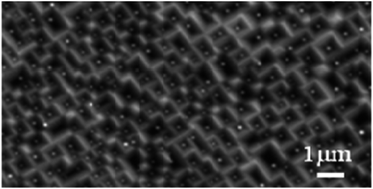
Fig. 1a shows a typical SEM micrograph of a Au-NP/diamond-nanopit structure obtained by etching for 60 s. Clearly, there are pits with an inverted pyramidal shape appearing on the surface of SCD with a density of 3 × 108 cm−2. The four edges of the pits are parallel to the 〈110〉 direction of the SCDs with their lengths in the scale of 500–600 nm. Meanwhile, the diameter of the NPs is about 30–100 nm. The analysis of XPS spectroscopy reveals that the NPs are pure Au particles (not shown). From the three-dimensional AFM image (Fig. 1b), it is clearly shown that almost all the NPs locate at the bottom of the diamond pits, and normally, one pit contains one NP. As observed from the section analysis of the AFM image (Fig. 1c), the depths of the pits are 100–300 nm and the angles between the sidewall and the (100) surface are ∼25.41°, which is close to the value of 25.24° between the (113) and (100) planes of the diamond, implying that the sidewalls of the pits prefer to be {113} facets. This result is consistent with the previous reports that the diamond (113) planes are easily etched in oxygen plasma rather than other planes.17 This NP-in-pit structure has potential applications in nanoelectronics, nanophotonics, nanoplasmonics, and lab-on-a-chip chemo- and bio-analyses.18–20 Researchers have previously utilized a spin coating method to implant Au NPs into the dislocation-corn-induced V-shaped pits of multiple InGaN/GaN quantum wells.20 Compared to this case, we offer a facile technique to fabricate the NP-in-pit structure.
image file: c4ra03196b-f1.tif
Fig. 1 (a) The typical SEM image and (b) three-dimensional AFM image (2 × 2 μm2) of the subwavelength-sized diamond pits infilled with Au NPs. (c) The corresponding cross-sectional profile for the feature as marked by the line in (b).

It is worth pointing out that the structural feature in this work is significantly different from the previous results of etching processes on polycrystalline diamond films by oxygen or hydrogen/Argon plasma.11,14 In those cases, the nanopillars and/or nanowires arrays were fabricated perpendicular to the surface of the diamond film, while no pyramid-shaped pits appeared, which can be attributed to the combined effects of abundant grain boundaries in the polycrystalline diamond films and the bias-assisted RIE. This structural difference between SCDs and polycrystalline diamond films results in the difference in the fabrication processes.

To thoroughly investigate the etching process, Au-coated SCDs were treated with plasma for different durations from 10–100 s, as shown in Fig. 2. Starting from an initial flat surface (Fig. 2a), the Au film melts and aggregates to form Au NPs of about 40 nm in size after 10 s (Fig. 2b). The Au NPs distribute uniformly on the diamond surface with a density of ∼5 × 109 cm−2. After 20 s, very shallow diamond pits appear surrounding the Au NPs (Fig. 2c), and the Au NPs exist on the diamond platform in the pits, as clearly observed in the inset of Fig. 2c. At the same time, the average size of the Au NPs is about 90 nm, and the density of the Au NPs decreases to 6 × 108 cm−2. When the etching time is prolonged to 60 s and 80 s (Fig. 1a and 2d), the size (depth) of pits is enlarged (deepened), and the pits become inversely pyramidal having Au NPs inside with an average size of about 80 and 75 nm, respectively. As the etching time is continuously increased to 100 s, the pits become significantly shallower and larger than those in Fig. 2d and the Au NPs are preserved with the average size of 60 nm (Fig. 2e).


image file: c4ra03196b-f2.tif
Fig. 2 SEM images showing the morphological and structural evolution of single crystal diamond coated with a Au thin film after oxygen plasma etching for (a) 0 s, (b) 10 s, (c) 20 s, (d) 80 s, and (e) 100 s, respectively.

To investigate the etching mechanism, Au-coated SCDs were etched in plasmas of different gases for 40 s. Fig. 3a shows the morphology of SCD after etching in hydrogen plasma; one can see that the surface was smooth, and no Au NPs appear. When etching in argon plasma (Fig. 3b), a lot of Au NPs appeared on the smooth SCD surface. Because a small amount of oxygen was introduced into the argon plasma (Fig. 3c), the inversely pyramidal shaped pits appeared. After etching in the pure oxygen plasma, uniform NPs were located in the inversely pyramidal shaped pits. Based on these observations, it is assumed that the temperature of hydrogen plasma was lower than the dewetting temperature of the Au film. Whereas, for the argon plasma, the temperature was high enough to make the film dewetting. However, because argon does not react with diamond, only NPs appeared on the surface, which can be confirmed by the pits appearing when the oxygen was added. Thus, it is concluded that the fabrication of this hybrid structure is by the process of “chemical reaction etching”, and only the strong chemical reaction etching of oxygen plasma is suitable for forming the hybrid structure in a short etching time.


image file: c4ra03196b-f3.tif
Fig. 3 SEM images of the single crystal diamonds after (a) hydrogen, (b) argon, (c) argon/oxygen and (d) oxygen plasma etching. The total flow rates are 10 sccm, and the gas ratio in (c) is 1[thin space (1/6-em)]:[thin space (1/6-em)]1. The etching time is 40 s.

For understanding the effects of the Au layer, we examined the oxygen etching process obtained on the surface of SCD deposited with a designed Au mask. The mask consists of Au disks with a diameter of 20 μm and center-to-center distances of 150 μm between the nearest neighbor disks. The etching time was 60 s. The morphology of the SCD surface after etching can be seen in Fig. 4a. There are several disks with light color on the surface, and the color is dark outside the disks. From the micrograph on the right displaying magnified views of the edge area of the disk (Fig. 4b), one can clearly see that cylindrical pits with depth of about 2 μm appear on the surface. This suggests that the etching of the Au-coated part is faster than that without the Au mask. Meanwhile, the morphologies of the two parts are different. In the Au-coated part, Au NPs are located in inversely pyramidal shaped pits, and in the uncoated part, only square pits with flat bottoms are presented, as reported in the literature.21 Based on the abovementioned discussions, it is concluded that Au is an essential factor for forming inversely pyramidal shaped pits.


image file: c4ra03196b-f4.tif
Fig. 4 The typical SEM image of oxygen plasma etching single crystal diamond (a) selectively coated with Au disks, and (b) enlargement of the blue box in (a).

Thus, it is demonstrated that the interaction of the chemical reaction etching of oxygen plasma and Au NPs assisting in the etching contribute to the formation of inversely pyramidal shaped diamond pits. Based on the above observations, the formation of the diamond pits infilled with Au NPs can be traced, as the schematic illustration shown in Fig. 5. In oxygen plasma, the temperature of Au film is increased quickly, and then the film tends to melt and forms self-organized NPs to minimize the surface energy by a dewetting process.22,23 Once the Au NPs are formed, the shallow pits first appear around the Au NPs because of the higher chemical inertness of Au than diamond in oxygen plasma. With further etching, the enhanced local microwave field around the Au NPs arising from the edge effect14 in the plasma causes an increase in the etching rate of the diamond surrounding the Au NPs. In addition, the diamond (113) planes are etched faster in oxygen plasma than the other planes.17 Therefore, inversely pyramidal shaped pits with (113) plane sidewalls are formed, and the Au NPs rest on the bottom of the as-formed pits. When the etching lasts for a longer time, the pits become larger with the adjacent pits connected together, and the NPs become smaller because of continuous thermal evaporation. Consequently, the enhanced etching effect around the NPs weakens, and the pits stop deepening, leading to shallower and larger pits with a low density. Therefore, the shape, size and density of the diamond nanopits can be controlled by etching time.


image file: c4ra03196b-f5.tif
Fig. 5 (a)–(f) Schematic diagram of the preparation process of the Au-NP/diamond-pit. The etching time of (f) is 60 s.

Diamond nanostructures can be applied in several fields; herein, we propose that the diamond pits can be used as a robust template for fabricating pyramid-patterned PDMS sheets. First, as shown in Fig. 6a–c, diamond pits with three sizes were fabricated by oxygen plasma etching as described above and the Au NPs in the pits were removed by soaking in aqua regia. Then, the template stripping method24,25 was employed to realize the PDMS sheets. The resulting PDMS pattern sheets were analysed by SEM and AFM, as shown in Fig. 6d–i. From the SEM and 3D AFM images, we can see that the patterns of the PDMS sheets are pyramids structures, which coincide with the diamond pits. This confirms that the structures are successfully peeled off from the diamond pits. It is known that the pyramid-patterned PDMS sheets have been applied in nanogenerators,26 solar cells27 and cell differentiation,28 etc. Compared with conventional template materials (AAO, Si, etc.), diamond has the unique advantages of chemical inertness, hardness, anti-abrasion, etc. Because of these advantages, they can be repeatedly used and easily cleaned. We expect that this will broaden the applications for diamond and provide an excellent alternate for template materials.


image file: c4ra03196b-f6.tif
Fig. 6 (a)–(c) SEM images of diamond pits of three sizes have been prepared by different etching times of (a) 40 s, (b) 60 s, and (c) 80 s. (d)–(f) SEM images of polymer nanopyramid sheets peeled off from (a)–(c), correspondingly. (g)–(i): corresponding 3D AFM images (8 × 8 μm2) of (d)–(f). The scale bars in (a)–(f) are 1 μm.

Conclusions

In summary, a simple and low-cost approach is proposed for fabricating a hybrid structure of a Au-NP/diamond-pit. This hybrid structure is marked by the Au-NP located at the bottom of the pit. The chemical etching reaction of oxygen plasma together with the Au NPs assisting the etching lead to the formation of the hybrid structure. It has been demonstrated here that the diamond pits can serve as a kind of robust template for fabricating pyramid-structured PDMS sheets, which generates the possibility for diamond application in the template.

Acknowledgements

This work was supported by National Natural Science Foundation of China (no. 51072066and 50772041), and Ph.D. Programs Foundation of Ministry of Education of China with no. 20100061110083.

Notes and references

  1. I. Aharonovich, A. D. Greentree and S. Prawer, Nat. Photonics, 2011, 5, 397 CrossRef CAS.
  2. H. Masuda, M. Watanabe, K. Yasui, D. Tryk, T. Rao and A. Fujishima, Adv. Mater., 2000, 12, 444 CrossRef CAS.
  3. M. P. Hiscocks, K. Ganesan, B. C. Gibson, S. T. Huntington, F. Ladouceur and S. Prawer, Opt. Express, 2008, 16, 19512 CrossRef CAS.
  4. C. Terashima, K. Arihara, S. Okazaki, T. Shichi, D. A. Tryk, T. Shirafuji, N. Saito, O. Takai and A. Fujishima, ACS Appl. Mater. Interfaces, 2011, 3, 177 CAS.
  5. B. A. Fairchild, P. Olivero, S. Rubanov, A. D. Greentree, F. Waldermann, R. A. Taylor, I. Walmsley, J. M. Smith, S. Huntington, B. C. Gibson, D. N. Jamieson and S. Prawer, Adv. Mater., 2008, 20, 4793 CrossRef CAS.
  6. B. J. M. Hausmann, B. Shields, Q. Quan, P. Maletinsky, M. McCutcheon, J. T. Choy, T. M. Babinec, A. Kubanek, A. Yacoby, M. D. Lukin and M. Lončar, Nano Lett., 2012, 12, 1578 CrossRef CAS PubMed.
  7. N. G. Shang, P. Papakonstantinou, P. Wang, A. Zakharov, U. Palnitkar, I. N. Lin, M. Chu and A. Stamboulis, ACS Nano, 2009, 3, 1032 CrossRef CAS PubMed.
  8. J. Y. Lin, Z. C. Li, C. Y. Chen, L. J. Chou, J. C. Hwang and C. S. Kou, Diamond Relat. Mater., 2011, 20, 922 CrossRef CAS PubMed.
  9. H. Uetsuka, T. Yamada and S. Shikata, Diamond Relat. Mater., 2008, 17, 728 CrossRef CAS PubMed.
  10. T. Nagase, J. Kawamura, S. A. Pahlovy and I. Miyamoto, Microelectron. Eng., 2010, 87, 1494 CrossRef CAS PubMed.
  11. Y. S. Zou, Y. Yang, W. J. Zhang, Y. M. Chong, B. He, I. Bello and S. T. Lee, Appl. Phys. Lett., 2008, 92, 053105 CrossRef PubMed.
  12. M. Bernard, A. Deneuville, L. Ortega, K. Ayadi and P. Muret, Diamond Relat. Mater., 2004, 13, 287 CrossRef CAS PubMed.
  13. N. J. Yang, H. Uetsuka, E. Osawa and C. E. Nebel, Nano Lett., 2008, 8, 3572 CrossRef CAS PubMed.
  14. W. Janssen and E. Gheeraert, Diamond Relat. Mater., 2011, 20, 389 CrossRef CAS PubMed.
  15. I. I. Vlasov, O. I. Lebedev, V. G. Ralchenko, E. Goovaerts, G. Bertoni, G. V. Tendeloo and V. I. Konov, Adv. Mater., 2007, 19, 4058 CrossRef CAS.
  16. C. H. Hsu, S. G. Cloutier, S. Palefsky and J. Xu, Nano Lett., 2010, 10, 3272 CrossRef CAS PubMed.
  17. J. Achard, F. Silva, O. Brinza, X. Bonnin, V. Mille, R. Issaoui, M. Kasu and A. Gicque, Phys. Status Solidi A, 2009, 206, 1949 CrossRef CAS.
  18. Y. J. Oh, C. A. Ross, Y. S. Jung, Y. Wang and C. V. Thompson, Small, 2009, 5, 860 CrossRef CAS PubMed.
  19. C. Y. Hsu, J. W. Huang, S. Gwo and K. J. Lin, Nanotechnology, 2010, 21, 035302 CrossRef PubMed.
  20. S. M. S. Pereira, M. A. Martins, T. Trindade, I. M. Watson, D. Zhu and C. J. Humphreys, Adv. Mater., 2008, 20, 1038 CrossRef CAS.
  21. N. Lee and A. Badzian, Appl. Phys. Lett., 1995, 66, 24 Search PubMed.
  22. S. Herminghaus, K. Jacobs, K. Mecke, J. Bischof, A. Fery, M. Ibn-Elhaj and S. Schlagowski, Science., 1998, 282, 916 CrossRef.
  23. S. H. Kwon, D. H. Han, H. J. Choe and J. J. Lee, Nanotechnology., 2011, 22, 245608 CrossRef PubMed.
  24. H. Y. Guo, D. Jiang, H. B. Li, S. P. Xu and W. Q. Xu, J. Phys. Chem. C, 2013, 117, 564 CAS.
  25. H. Wang and N. J. Halas, Nano Lett., 2006, 6, 2945 CrossRef CAS PubMed.
  26. F. R. Fan, L. Lin, G. Zhu, W. Z. Wu, R. Zhang and Z. L. Wang, Nano Lett., 2012, 12, 3109 CrossRef CAS PubMed.
  27. S. Wooh, H. Yoon, J. H. Jung, Y. G. Lee, J. H. Koh, B. Lee, Y. S. Kang and K. Char, Adv. Mater., 2013, 25, 3111 CrossRef CAS PubMed.
  28. H. H. Liao, A. S. Andersson, D. Sutherland, S. Petronis, B. Kasemo and P. Thomsen, Biomaterials, 2003, 24, 649 CrossRef CAS.

This journal is © The Royal Society of Chemistry 2014
Click here to see how this site uses Cookies. View our privacy policy here.