
Debin Kongabc,
Haiyong Heb,
Qi Songb,
Bin Wangb,
Quan-Hong Yang*ac and
Linjie Zhi*abc
aSchool of Chemical Engineering and Technology, Tianjin University, Tianjin, 300072 China. E-mail: zhilj@nanoctr.cn; qhyangcn@tju.edu.cn
bNational Center for Nanoscience and Technology, no. 11 Beiyitiao, Zhongguancun, Beijing, 100190 China
cThe Synergistic Innovation Center of Chemistry and Chemical Engineering of Tianjin, Tianjin, 300072 China
First published on 12th May 2014
A unique SnS2@graphene nanocable structure with a novel contact model between SnS2 nanosheets and graphene has been successfully fabricated, in which the graphene layers are rolled up to encapsulate the SnS2 nanosheets, forming a mechanically robust, free-standing SnS2@graphene nanocable network. This distinctive structure provides an effective architecture as an electrode in lithium ion batteries to effectively accommodate the volume change of SnS2 during the charge–discharge cycling, facilitates the easy access of electrolyte to the active electrode materials, and also offers a continuous conductive network for the whole electrode. Interestingly, this binder-free electrode not only shows high specific capacity and excellent cycling performance with a specific capacity of 720 mA h g−1 even after 350 cycles at a current density of 0.2 A g−1 and over 93.5% capacity retention, but exhibits a high-rate capability of 580 mA h g−1 at a current rate of 1 A g−1
Due to the attractive characteristics such as large specific surface area, superior electronic conductivity and excellent mechanical properties, graphene is considered as an ideal matrix to host various electrochemical active nanoparticles.24–30 Recent research has shown that the combination of graphene with metal oxides,31 Si (ref. 32) and Sn (ref. 33) can significantly enhance the electrochemical properties of these nanostructured anodes. Similar to those of SnO2,34 the electrochemical properties of SnS2 could also be obviously improved when forming SnS2/graphene nanohybrids.12,35,36 Particularly, detailed studies from our group demonstrate the interface effect or the contact model between graphene and SnS2 plays critically important role in improving the rate capability and the cycling stability of the elctrode.13
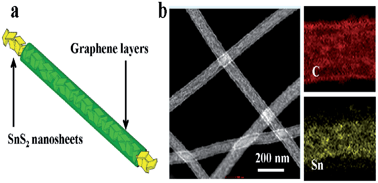
Herein, we develop a novel nanostructured hybrid composed of SnS2 nanosheets and graphene layers, as schematically shown in Fig. 1a. The graphene layers roll up into a hollow nanotube and SnS2 nanosheets are uniformly distributed in the graphene nanotube, thus forming mechanically robust, free-standing and interwoven SnS2@graphene nanocable (SnS2@GT). The as prepared SnS2@GT can not only effectively alleviate the volume change of SnS2 associated with the alloying/dealloying processes but also facilitate the easy access of electrolyte to the electrodes interior. Interestingly, this nanocable architecture enables a new contact model between graphene and SnS2, providing not only highly efficient interface interaction but a continuous conductive network for the whole electrode. Remarkably, this novel hybrid can be used as binder-free electrode in lithium ion batteries with high specific capacity and excellent cycling performance (720 mA h g−1 even after 350 cycles at a current density of 0.2 A g−1, with over 93.5% capacity retention) as well as high-rate capability of 580 mA h g−1 even at a current rate of 1 A g−1.
![]() | ||
| Fig. 1 (a) Electrode design and (b) dark field transmission electron microscopy image and mapping of SnS2@GT. | ||
![]() | ||
| Fig. 3 TEM and HRTEM images of SnS2@GT. (a) TEM images of SnS2@GT. Scale bar, 0.5 μm. (b) TEM images of SnS2@GT. Scale bar, 100 nm. (c and d) HRTEM images of SnS2@GT. Scale bar, 10 nm. | ||
The XRD pattern supports the assignment of a layered structure (JCPD card, no. 23-677) to the SnS2 nanoplates (Fig. 4a). No excrescent peak is observed, demonstrating the high purity of as formed SnS2 phase. Besides, the sharp diffraction peak of the (001) plane of SnS2 reveals the good crystallization of the as-synthesized SnS2 nanoparticles in the SnS2@GT. The thickness of the SnS2 nanoplates is estimated to be around 10 nm, using the Scherrer equation37 according to the (001) peak, which is complying with the estimated thickness from TEM. The presence of both SnS2 and graphene is further confirmed by Raman spectroscopy (Fig. 4b). The Raman spectrum of SnS2@GT exhibits an intense peak at about 311 cm−1, which is attributed to the A1g mode of SnS2 according to the group theory analysis conducted by previous studies.38 The peak at about 1585 cm−1 (G band), corresponding to an E2g mode of graphite, is related to the vibration of the sp2-bonded carbon atoms in a two dimensional hexagonal lattice, while the peak at about 1325 cm−1 (D band) is related to the defects and disorder in the hexagonal graphitic layers.39
Based on the unique nanocable architecture, the SnS2@GT hybrid has potential applications in the context of lithium ion storage. For comparison, bare SnS2 (SnS2-T) were prepared via a similar route as that of nanocable formation (see the Experimental section) and investigated under the same electrochemical conditions. The cyclic voltammetry (CV) behavior (Fig. S2†) of SnS2@GT is generally consistent with that of the SnS2 reported previously,40,41 indicating similar electrochemical reaction pathway of the two electrode materials. Fig. 5a and b compare the voltage profiles between SnS2@GT and SnS2-T charged–discharged at 0.2 A g−1 in the cutoff voltage of 0.01–3.0 V vs. Li/Li+. As shown in the Fig. 5a, SnS2@GT yields the first discharge and charge capacities of 1334 and 764 mA h g−1, respectively, with a coulomb efficiency of 58.3%, while the first charge and discharge capacities of bare SnS2-T are 1075 and 335 mA h g−1, respectively, with the Coulomb efficiency of only 31.2%.
![]() | ||
| Fig. 5 The charge–discharge curves of (a) SnS2@GT and (b) SnS2-T electrode at a current rate of 0.2 A g−1. | ||
As seen in Fig. 5b, most of the charge capacity of bare SnS2-T is obtained in the voltage range of 0.01–1.5 V, where lithiation and delithiation of Sn occur. The voltage increases rapidly to above 1.5 V, which indicates that voltage beyond 1.5 V only contributes a small proportion of the total capacity and that the lithium ions in Li2S is difficult to be extracted upon charging, similar to the case of SnO2, where the formation of Li2O during first discharge is also irreversible.42
For the SnS2@GT, the initial discharge capacity is slightly higher than the theoretical values reported previously. It is possible that the high surface area of the SnS2 nanoparticles, which may have promoted side-reactions with electrolyte and in the meantime intercalate the lithium ions into the SnS2 layers without phase decomposition at 1.8 V, is responsible for the high initial discharge capacity. Fig. 6a shows typical charge–discharge curves of the SnS2@GT and SnS2-T electrodes cycled between 3 V and 0.01 V. The SnS2@GT electrode clearly demonstrates its superior cycling performance and much better long-term stability than that of the SnS2-T electrode. The coulombic efficiency for SnS2@GT (the content of SnS2 is 71.6%, as confirmed by TGA in Fig. S3†) is 58% in the initial cycle, which rapidly reaches over 95% after the second cycle. Even after 350 cycles, both the discharge and charge capacities of this material are stable at about 720 mA h g−1, delivering nearly 92% capacity retention, whereas the SnS2-T electrode shows poor cycling performance with an initial reversible capacity of merely 335 mA h g−1, followed by a gradual reduction to 24 mA h g−1 after 170 cycles, which corresponds to merely 7.2% of the reversible capacity obtained in the first cycle. The results clearly demonstrate that the induced graphene nanotubes can effectively accommodate the volume change of SnS2, resulting in greatly enhanced cycling stability.
The rate capability of SnS2@GT and SnS2-T is evaluated to further investigate the effect of graphene incorporation on the electrochemical performance of SnS2 (Fig. 6b). The samples were charged at various current densities and discharged at 0.2 A g−1. It is obvious that the SnS2@GT hybrid displays a much better rate capability than SnS2-T. When the current density reaches 1 A g−1, the SnS2@GT electrode can still retain a charge capacity of 580 mA h g−1. Even at a current density as high as 5 A g−1, SnS2@GT still yields an attractive charge capacity of 247 mA h g−1. By contrast, the charge capacities of bare SnS2-T drop dramatically with increasing the current density.
To gain an insight view for the reason of such excellent performance of SnS2@GT architecture, we conducted electrochemical impedance measurements on SnS2@GT and SnS2-T to reveal their electrochemical reaction kinetics (Fig. S4†). Both plots are characteristic of one semicircle in the high frequency region and a straight sloping line in the low frequency region. In general, the semicircle is attributed to the summation of the contact resistance, the solid/electrolyte interphase resistance, and the charge-transfer resistance, while the slope of the line is closely related to the lithium-diffusion process within the electrodes. Apparently, compared to SnS2-T electrode, SnS2@GT electrodes hold much smaller semicircle diameter and almost a vertical line parallel to the Zireal as well. This is clear evidence that the SnS2@GT possesses a higher electrical conductivity and a faster charge-transfer reaction for lithium ion insertion and extraction.
Compared with other previously reported SnS2/graphene hybrids, the as prepared SnS2@GT sample exhibits an improved rate capability and good capacity retention under similar measurement conditions,10,13,22,41 which possibly could be attributed to its multi-scale structure and hierarchical features. Firstly, in such structure, the flexible film constructed by the interconnection of nanocables provides the most efficient electron transport pathways and forms a strong skeleton framework. Secondly, the induced graphene nanotubes with good mechanical properties can facile strain relaxation and accommodate the volume change of SnS2, which effectively mitigates the stress and protects active materials from pulverization during the charge–discharge process. Thirdly, the small size of SnS2 nanosheets decreases the over voltage of the Sn–Li alloying reaction, leading to a higher discharge capacity. At the beginning of the discharging process, it occurs mainly at the external surface of the electrode, which is favorable for the fast transport of lithium ions and electrons. However, during the subsequent cycles, the electrode reaction will move gradually into the interior of the electrode, leading to the increase of diffusion over potential. Obviously, the small size of SnS2 nanosheets is favorable for decreasing the over voltage of the Sn–Li alloying reaction, leading to a higher discharge capacity.
:
1 (v/v) ethylene carbonate/diethyl carbonate (EC/DEC) as the electrolyte. The cycle-life tests were performed using a CT2001A battery program controlling test system at different current rates within the 3–0.01 V voltage range. For achieving the capacity values of each electrode material, at least three cells were assembled and characterized under the same conditions. For each investigated electrode, the total electrode weight was used for calculating the specific capacities.
Footnote |
| † Electronic supplementary information (ESI) available. See DOI: 10.1039/c4ra03052d |
| This journal is © The Royal Society of Chemistry 2014 |