
Hui Wang,
Yu Pei,
Jie Bai,
Jinli Zhang,
Yangjie Wu* and
Xiuling Cui*
Department of Chemistry, Henan Key Laboratory of Chemical Biology and Organic Chemistry, Key Laboratory of Applied Chemistry of Henan Universities, Zhengzhou University, Zhengzhou, 450052, P.R. China. E-mail: cuixl@zzu.edu
First published on 6th June 2014
A novel procedure for the dimerization of heteroaromatic N-oxides under transition-metal-free conditions has been developed. The protocol is effective and convenient. The biheteroaromatic mono N-oxides products were obtained in up to 93% yield.
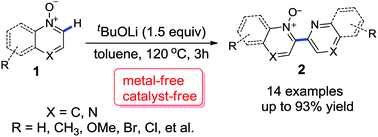
At the outset of the study, we chose quinoline N-oxide (1a) as a model substrate to screen the reaction parameters (Table 1). Firstly, the reaction was carried out in the presence of 10 mol% Pd(OAc)2 and 2.0 equiv. of tBuOLi in toluene at 120 °C for 20 h. The desired product 2a was isolated in 56% yield (entry 1). Encouraged by this result, we further optimized the reaction conditions. Surprisingly, 87% yield could be obtained in the absence of Pd(OAc)2 (entry 2). We found that reducing reaction time was beneficial for the reaction, as the yield of 2a was improved to 91% (entry 3). For this process, examination of the amount of tBuOLi indicated that 1.5 equiv. of tBuOLi was optimal (entries 3–6). Base screening disclosed that tBuOLi was superior to others (entries 4, 7–11). Investigation of different solvents showed that toluene was the best suitable solvent (entries 4, 12–17). Furthermore, decreasing the temperature of the reaction brought a significant decrease in the yields (entries 18–20). Finally, the optimal conditions for the dimerization were identified to be tBuOLi (1.5 equiv.) as the base and toluene as the solvent at 120 °C for 3 hours.
| Entry | Catalyst | Bases (equiv.) | Solvents | Yieldb (%) |
|---|---|---|---|---|
| a Reaction conditions: 1a (0.5 mmol), solvent (2.5 mL), 3 h at 120 °C.b Isolated yields.c 20 h.d nd is not detected.e 110 °C.f 100 °C.g 90 °C. | ||||
| 1c | Pd(OAc)2 (10%) | tBuOLi (2.0) | Toluene | 56 |
| 2c | — | tBuOLi (2.0) | Toluene | 87 |
| 3 | — | tBuOLi (2.0) | Toluene | 91 |
| 4 | — | tBuOLi (1.5) | Toluene | 93 |
| 5 | — | tBuOLi (2.5) | Toluene | 93 |
| 6 | — | tBuOLi (1.0) | Toluene | 81 |
| 7 | — | tBuONa (1.5) | Toluene | 58 |
| 8 | — | K2CO3 (1.5) | Toluene | 0 |
| 9 | — | K3PO4 (1.5) | Toluene | 0 |
| 10 | — | Cs2CO3 (1.5) | Toluene | 0 |
| 11 | — | DBU (1.5) | Toluene | 0 |
| 12 | — | tBuOLi (1.5) | DMSO | ndd |
| 13 | — | tBuOLi (1.5) | THF | 0 |
| 14 | — | tBuOLi (1.5) | DMF | 40 |
| 15 | — | tBuOLi (1.5) | CH3CN | 0 |
| 16 | — | tBuOLi (1.5) | Dioxane | 72 |
| 17 | — | tBuOLi (1.5) | DCE | Trace |
| 18e | — | tBuOLi (1.5) | Toluene | 81 |
| 19f | — | tBuOLi (1.5) | Toluene | 75 |
| 20g | — | tBuOLi (1.5) | Toluene | 72 |
Having established the optimal reaction conditions in hand, we investigated the generality and scope of substrates for this transition-metal-free transformation. The results in Table 2 demonstrated that this reaction had a good functional group tolerance. The reaction of quinoline N-oxide and its derivatives with moderate electron-withdrawing group, such as Br and Cl, readily proceeded smoothly and provided the desired products in 75–93% yields (2a–2e). When Br group at 3-position of quinoline N-oxide was also well tolerated and the product was obtained in 75% yield (2e), indicating that this reaction was not sensitive significantly to steric hindrance in the substrate. Electron-rich substrates, such as methyl, methoxyl groups substituted on the aromatic rings, provide the dimerization products in moderate yields (2f and 2g). However, when the pyridine rings were substituted by methyl or methoxyl groups, the dimerization products were obtained in 49%, 28% and 34% yields, respectively (2h–2j). Good yield was afforded when the reaction system was applied to quinoxaline N-oxide (2k). In addition, pyridine N-oxide derivatives were also shown to be possible substrates and gave the desired products in moderate to good yields (2l–2n).
The controlled experiment was carried out to see if the dimerization was achieved via a nucleophilic addition-elimination process5–7 (Scheme 2). When benzoxazole was employed in the reaction, the corresponding products 2a and 2o could be given in 40% and 41% (based on 1a) yields, respectively, which suggested that benzoxazole carbanion was generated by the aid of base and served as an external nucleophile.
A possible mechanism for this dimerization of quinoline N-oxide was proposed and described as follows (Scheme 3): (i) deprotonation of quinoline N-oxide in situ-generated carbanion A firstly by tBuOLi. (ii) Subsequently, the intermediate B was formed by attacking at the α-position of another quinoline N-oxide. (iii) The final product 2a was generated with concomitant release of the LiOH.
In conclusion, a mild and efficient method for the dimerization of heteroaromatic N-oxides under metal-free conditions has been developed. A broad range of 2,2′-biheteroaromatic mono N-oxides were obtained in up to 93% yield. Further efforts on the reaction mechanism will be studied in the future research.
Footnote |
| † Electronic supplementary information (ESI) available: Experimental procedures and spectral data for all products. See DOI: 10.1039/c4ra02820a |
| This journal is © The Royal Society of Chemistry 2014 |