
Ren-Jian Wei,
Ying-Ying Zhang,
Xing-Hong Zhang*,
Bin-Yang Du and
Zhi-Qiang Fan
MOE Key Laboratory of Macromolecular Synthesis and Functionalization, Department of Polymer Science and Engineering, Zhejiang University, Hangzhou, 310027, China. E-mail: xhzhang@zju.edu.cn; Fax: +86-571 87953732; Tel: +86-571 87953732
First published on 7th May 2014
A simple one-pot ring-opening polymerization (ROP) of epichlorohydrin (ECH) was successfully performed by a heterogeneous Zn–Co(III) double metal cyanide complex (Zn–Co(III) DMCC) catalyst, affording regio-regular poly(ECH) diol with a head-to-tail content of >99% in the absence of organic solvent and/or protic compound. No cyclic or oligomer by-product was observed, and the employed Zn–Co(III) DMCC catalyst was recyclable. ROP of (R)- or (S)-ECH led to the generation of semi-crystalline poly(ECH) diol with a melting point of 81 °C or 102 °C, respectively. These regio-regular poly(ECH)s with two end hydroxyl groups are versatile platforms for ECH-based functionalized polymers.
For most of the disclosed catalysts, like Lewis acids of BF3 etherate,3 SnCl4,4 or SbCl5,5 inorganic acid of sulfuric acid,6 trialkyl oxonium salt of triethyloxonium tetrafluoroborate,7 and super acid esters of CF3SO3R or FSO3R,8 generally, a protic compound co-initiator is essentially required. These co-initiators could be water, alcohol and organic carbonic acid, which were responsible for the generation of the end hydroxyl groups. Also, by adjusting the ratio of catalyst/co-initiator, the added protic compound could control the catalytic activity, molecular weight (MW) and microstructure of the product. Organometallic catalysts such as AlEt3 were also employed for the ECH ROP by a Vandenberg process, affording elastomeric poly(ECH) with high molecular weights.9 However, most of the produced poly(ECH) diols from the aforementioned catalysts had irregular-microstructure.
There are two ECH ROP mechanisms for the binary Lewis acids/protic compounds, as shown in Scheme 1.3b,c,10 One is the activated monomer (AM) mechanism, and the other is called the activated chain end (ACE) mechanism. Take Lewis acid BF3(OCH2CH3)/alcohol as an example, firstly, the alcohol combined with the Lewis acid catalyst to produce an oxonium salt, then reacted with ECH to generate activated monomer (AM). Herein, if AM reacted with the alcohol, a hydroxyl-terminated macro-monomer would be produced, and further reacted with AM to result in a higher molecular weight poly(ECH) diol (a and b in Scheme 1). On the other hand, since AM was a secondary oxonium ion, it also could react with the oxygen atom of neutral ECH monomer, and form an activated chain end (ACE, a′ in Scheme 1). The ACE could be terminated by reaction with protic compounds such as water and alcohol, to give poly(ECH) with end hydroxyl groups. However, if there were no adequate protic compounds, as an oxonium ion, the ACE could take intramolecular back biting reaction with any of the oxygen atom in the polymer chain, resulting in the generation of cyclic or oligomers by-product. Therefore, in order to improve the polyether diol selectivity, the instantaneous ratio of ECH monomer/alcohol was always kept very low, which favours the chain growth by AM mechanism.3g General method was that ECH was added drop by drop into the binary Lewis acid/alcohol system during ECH ROP.3a,b,7b Because of the acidity of the employed Lewis acid, the product was required post-treatment of neutralizing with weak base solution and pure water for several times. These operations made the polymerization complex.
![]() | ||
| Scheme 1 The typical ECH ROP mechanism for the binary Lewis acid/protic compound (BF3O(C2H5)/diol) catalyst system. | ||
In addition, these reported Lewis acid catalysts had to be performed at relatively low temperatures of <70 °C for improving poly(ECH) selectivity,3f which largely depressed the catalyst activity, because the ROP of epoxides was thermodynamically beneficial.11 So mostly, organic solvents such as toluene, dichloromethane were employed to reduce the reaction viscosity and improve the catalytic activity at low reaction temperatures. The recovery of the solvent is energy-consuming process and causes the release of the solvents. Importantly, under the binary Lewis acids/co-initiator system, the produced poly(ECH) diol only showed a head-to-tail content of up to 80% at the optimized conditions,3e,g,7b which is far from satisfaction.
Therefore, it is necessary to seek a simple catalytic way to circumvent the above problems and efficiently produce regio-regular poly(ECH) diol without using solvents. Zinc–cobalt(III) double metal cyanide complex (Zn–Co(III) DMCC), a typical heterogeneous catalyst, has been proved to be a highly efficient catalyst for the epoxide-involved polymerization, such as epoxides ROP11 and (regio-)selective epoxides/CO2 copolymerization,12 is expected to be a suitable catalyst for ECH ROP. This catalyst is traditionally prepared from the reaction of the excess ZnCl2 and K3Co(CN)6 in the presence of organic complexing agent tert-BuOH. The chemical formula of Zn–Co(III) DMCC catalyst could be noted as Zn3[Co(CN)6]2·xZnCl2·yt-BuOH·zH2O. In this work, the employed Zn–Co(III) DMCC catalyst was prepared at 75 °C, and had nanolamellar structure with a very high BET area of 653 m2 g−1, which enabled its better dispersion and exposure of active sites in the reaction systems.12a The initiating centre of this catalyst has been confirmed to be Zn–OH bond (Scheme 2), which triggers the polymerization and generates one terminated hydroxyl group for the resultant polymer.12a,13 Since there is trace water in the reaction system, the propagating polymer chain transfers to water and produces a dormant polymer chain with two terminal hydroxyl groups and a renewed Zn–OH initiating site.
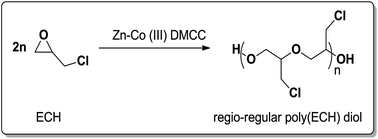
In the present work, we applied a nanolamellar Zn–Co(III) DMCC catalyst for efficiently producing regio-regular ECH ROP with a simple one-pot reaction process without using external organic solvent and protic compound co-initiators (Scheme 3). The effect of various reaction conditions such as temperatures, amounts of catalyst and reaction times on the polymerization was investigated. The two end hydroxyl groups were characterized by an electrospray ionization-tandem mass spectrometry (ESI-MS) test and the regio-regular chain structure was confirmed by the 13C NMR spectrum.
000 Da. Differential scanning calorimetric (DSC) tests were conducted on a TAQ200 instrument (New Castle, DE) with a heating rate of 10 °C min−1 under N2 atmosphere, and the data from the second heating curve were collected. Electrospray ionization-tandem mass spectrometry (ESI-MS) analysis was performed on an Esquire3000 plus mass spectrometer, using mixed methylene chloride/methanol as solvent for dissolving the copolymer.
| Entry | Catalyst (mg) | Temp. (°C) | Time (h) | Mnb (kg mol−1) | Mw/Mnb | Productivityc | Yield (%) |
|---|---|---|---|---|---|---|---|
| a Reaction condition: ECH 5.0 ml.b Determined by gel permeation chromatography in THF, 40 °C, calibrated with standard monodispersed polystyrene.c The productivity was defined as the g poly(ECH)/g catalyst.d Zn–Co(III) DMCC catalyst employed came from entry 13.e Zn–Co(III) DMCC catalyst employed came from entry 14.f Zn–Co(III) DMCC catalyst employed came from entry 15.g The ECH monomer employed was R-ECH.h The ECH monomer employed was S-ECH. | |||||||
| 1 | 3.0 | 40 | 7 | 0.9 | 1.42 | 550 | 30 |
| 2 | 3.0 | 60 | 7 | 1.9 | 1.56 | 743 | 38 |
| 3 | 3.0 | 80 | 7 | 2.5 | 1.62 | 1180 | 60 |
| 4 | 3.0 | 90 | 7 | 2.9 | 1.68 | 1265 | 64 |
| 5 | 3.0 | 100 | 7 | 3.1 | 1.70 | 1468 | 75 |
| 6 | 3.0 | 120 | 7 | 3.6 | 1.72 | 1653 | 84 |
| 7 | 3.0 | 80 | 3 | 1.3 | 1.52 | 526 | 27 |
| 8 | 3.0 | 80 | 5 | 2.0 | 1.55 | 945 | 48 |
| 9 | 3.0 | 80 | 10 | 3.4 | 1.63 | 1268 | 65 |
| 10 | 3.0 | 80 | 15 | 4.2 | 1.70 | 1427 | 73 |
| 11 | 1.0 | 80 | 7 | 0.9 | 1.43 | 534 | 9 |
| 12 | 5.0 | 80 | 7 | 2.7 | 1.62 | 845 | 72 |
| 13 | 7.0 | 80 | 7 | 2.9 | 1.65 | 710 | 84 |
| 14d | 7.0 | 80 | 7 | 2.8 | 1.66 | 695 | 83 |
| 15e | 7.0 | 80 | 7 | 2.7 | 1.64 | 690 | 82 |
| 16f | 7.0 | 80 | 7 | 2.7 | 1.64 | 683 | 81 |
| 17g | 3.0 | 80 | 7 | — | — | 900 | 46 |
| 18h | 3.0 | 80 | 7 | — | — | 825 | 42 |
![]() | ||
| Fig. 1 1H NMR spectrum of the crude poly(ECH)of entry 1 in Table 1 (CDCl3). | ||
![]() | ||
| Fig. 2 FT-IR spectrum of the crude poly(ECH) diol (entry 1, Table 1). | ||
Since ROP of the epoxide was considered to be a typical thermodynamically favourable polymerization,12a relatively high temperatures would result in enhanced poly(ECH) productivity. As shown in Table 1, when ECH ROP was carried out at 40 °C for 7.0 h using 3.0 mg Zn–Co(III) DMCC catalyst (entry 1), the productivity was 550 g polyether/g catalyst and the yield was only 30%. With elevating the reaction temperature up to 120 °C, the productivity was sharply improved to 1653 g polymer/g catalyst, and the yield increased to 84% (entry 6), which was about three times of that at 40 °C. The corresponding Mns of entries 1–6 increased from 0.9 to 3.6 kg mol−1 along with the temperatures from 40 to 120 °C, while the Mw/Mns of these samples kept relatively narrow and in a range of 1.42–1.72 despite of the heterogeneous catalysis and one-pot reaction mode. Fig. 3 showed GPC curves of these crude resultants under various reaction temperatures and displayed single elution peaks, which indicated that no cyclic or less-molecular-weight oligomer was produced even at a high temperature of 120 °C.3d,e
![]() | ||
| Fig. 3 GPC curves of the ECH ROP resultants at various temperatures (entries 1–6, Table 1). | ||
The effect of reaction time on the ECH ROP was also studied, as shown in Fig. 4 and 5. It is found that the yield increased from 27% to 73% with increasing reaction times from 3 to 15 h (entries 3 and 7–10 in Table 1, Fig. 4). Correspondingly, Mn increased from 1.3 to 4.2 kg mol−1 in an approximately linear fashion with increasing reaction time from 3 to 15 h, as shown in Fig. 4. The Mw/Mns kept at 1.52–1.70 and stable, this was caused by the fast chain transfer reaction.12a At the early polymerization stage, Mn was relatively low, as shown in Fig. 5. While that fast chain transfer reaction brought the dormant polyether with low molecular weight into propagating species, ensuring its continuous propagation, thus increased the Mn and eliminated low-molecular-weight oligomers that could be easily produced in a binary Lewis acids/protic compound system. Because Zn–Co(III) DMCC was acted as an effective initiator for ECH ROP, in which Zn–OH initiated the polymerization,12 the rate of ECH ROP was determined by the amounts of Zn–Co(III) DMCC. This was evident by the relationship of the amounts of the catalyst with ECH conversion under the same polymerization condition. When a low loading of 1.0 mg catalyst was employed, the yield and Mn were only 9% and 0.90 kg mol−1 respectively (entry 11). A higher loading of 5.0 mg catalyst was added, the yield was increased to 72%, while higher loading of 7.0 mg catalyst was used, 84% of ECH conversion was achieved (entries 12 and 13). However, the Mn and Mw/Mn kept nearly unchanged.
![]() | ||
| Fig. 4 Plots of Mn (black) and yield% (red) vs. time. Reaction conditions: 80 °C; catalyst, 3.0 mg; ECH, 5.0 ml. | ||
The recycle of Zn–Co(III) DMCC catalyst was tested as well, as shown in entries 14–16 in Table 1. After ECH ROP of the entry 13 in Table 1, the crude product was dissolved into dichloromethane, the dilute solution was then centrifuged at a rate of 15
000 rpm. At the bottom of the centrifuge tube, it was observed that Zn–Co(III) DMCC catalyst was deposited. After removal of the upper solution, Zn–Co(III) DMCC catalyst was washed and centrifuged several times. Afterwards, it was dried and applied to ECH ROP again. From entries 14–16 in Table 1, it is found that the Mns and Mw/Mns of the resultant poly(ECH)s were nearly unchanged, and the productivities kept almost the same. The recycle of this catalyst could be explained by the regeneration of Zn–OH of the catalyst via chain transfer reaction, through which the initiating structure and the catalytic performance of this catalyst could be preserved.
Since the chloromethyl of ECH is a strong electron-withdrawing group, we thought that chloromethyl could induce the sole attack of propagating species to the CH site of ECH and expected to produce regio-regular poly(ECH). In order to understand the chain microstructure of the resultant poly(ECH) via Zn–Co(III) DMCC catalysis, poly(R-ECH) and poly(S-ECH) were also synthesized as the controls under the same conditions as entry 3 in Table 1. These three poly(ECH)s were characterized by 13C NMR spectra, as shown in Fig. 6. The common chemical shifts at δ = 43.6, 69.5 and 79.0 ppm could be ascribed to the methylene carbon of pendant group –CH2Cl, the methylene and methine carbons in the polyether backbone, respectively, while the chemical shifts at δ = 51.2, 46.8 and 45.1 ppm were responsible for the methine and methylene carbons of the residual ECH. We observed that the 13C NMR spectroscopy of the poly(rac-ECH) presented two split symmetrical peaks at δ = 69.3 and 69.8 ppm, while poly(R-ECH) and poly(S-ECH) presented only one single peak at 69.7 ppm and 69.6 ppm respectively. These chemical shifts could be clearly ascribed to the carbon of –O–CH2– in the head-to-tail (H–T) diad.3b,d,g,10 No peaks at δ = 70.8–71.8 ppm were observed in these three spectra, which were attributed to the head-to-head (H–H) and tail-to-tail (T–T) diads of poly(ECH).3b,d,g,10 These results suggested that the resultant poly(ECH) exhibited a complete regio-regular structure as our expectation.
![]() | ||
| Fig. 6 13C NMR spectra of the resultant polyepichlorohydrins (lines 1–3 represented the samples of poly(ECH)s derived from rac-ECH, R-ECH and S-ECH, entries 3, 17–18, Table 1). | ||
Both poly(R-ECH) and poly(S-ECH) were solid powder (Fig. 7) and were not soluble in THF due to their enantiomorphous state, while poly(rac-ECH) was viscous liquid with a much low Tg of −38 °C (entry 10, Table 1). Moreover, both poly(R-ECH) and poly(S-ECH) were semi-crystalline, with melting points of 81 and 102 °C respectively, as shown in Fig. 8.
The two end hydroxyl groups of the resultant poly(ECH) were confirmed by the electrospray ionization-tandem mass spectrometry (ESI-MS) test with various positive ion sources such as H+, K+, as shown in Fig. 9. The polyether sample had low molecular weight of 1150 g mol−1 and PDI of 1.5 under Zn–Co(III) DMCC catalysis. All of m/z species in the spectrum were assigned and summarized in Table 2. Because of the two stable chlorine isotopes Cl35 and Cl37, the MS spectrum had two kinds of ether linkages of (ECH)92 and (ECH)94. Three kinds of species of (1) [(ECH)m94–(ECH)n92 + K+], (2) [HO–(ECH)m94–(ECH)n92–H + H+], and (3) [HO–(ECH)m94–(ECH)n92–H + K+] covered all m/z regions in the spectrum. It was found that all of the m/z species of (2) and (3) had two terminal hydroxyl groups. Species (1) was considered to be the species derived from (2) or (3) by a neutral loss of H2O during ESI-MS test condition. This is because the terminal secondary hydroxyl groups of poly(ECH) would be easily dissociated to form neutral H2O under the test environment due to the strong electron-withdrawing ability of –CH2Cl.12d Moreover, the probability of that species (1) was crown ethers could be minimized during the ROP,12a because such crown ethers with big rings (m + n = 6, 7,…, 17) was prohibited to form by backbiting mechanism.
| Species | m/z |
|---|---|
| (ECH)m94–(ECH)n92 + K+ | |
| (m = 0, 1, 2; n = 5) | (499, 593, 687) |
| (m = 2; n = 6, 7, 8, 9) | (779, 871, 963, 1055) |
| (m = 3; n = 9, 10, 11, 12, 13, 14) | (1149, 1241, 1333, 1425, 1517, 1609) |
| HO–(ECH)m94–(ECH)n92–H + H+ | |
| (m = 3; n = 3, 4, 5, 6, 7) | (577, 669, 761, 853, 945) |
| (m = 4, 5, 6, 7, 8, 9, 10, 11, 12; n = 5) | (855, 949, 1043, 1137, 1231, 1325, 141, 1513, 1607) |
| (m = 4, 5; n = 7) | (1039, 1133) |
| (m = 5; n = 8) | (1225) |
| (m = 6; n = 8, 9, 10, 11, 12) | (1319, 1411, 1503, 1595, 1687) |
| HO–(ECH)m94–(ECH)n92–H + K+ | |
| (m = 4; n = 2, 3, 4) | (617, 709, 801) |
| (m = 5; n = 4, 5, 6, 7, 8, 9, 10, 11, 12) | (895, 987, 1079, 1171, 1263, 1355, 1447, 1539, 1631) |
Based on the above results, a polymerization mechanism was proposed for the selective ECH ROP under Zn–Co(III) DMCC catalysis, as shown in Scheme 4. Due to the strong electron-withdrawing chloromethyl group, the methine carbon of ECH has more electron-positivity than the methylene carbon, and was predominantly attacked by propagating species (and the initiating species of –OH), realized regio-selective ring-opening reaction of ECH. Then followed by the continuous insertion of ECH, a regio-regular polyether chain with one terminal hydroxyl group of –CH(CH2Cl)OH was obtained. Afterward, the other end hydroxyl group of –CH(CH2Cl)CH2OH was generated by the chain transfer reaction of Zn-alkoxide intermediate to trace water during the polymerization. Finally, the poly(ECH) diol was achieved.
| This journal is © The Royal Society of Chemistry 2014 |