Ping Lia,
Fuqiang Zhaib,
Qi Wana,
Kuifei Zhaoa,
Ziliang Lia,
Alex A. Volinskyc and
Xuanhui Qu*a
aInstitute for Advanced Materials and Technology, University of Science and Technology Beijing, Beijing 100083, China. E-mail: quxh@ustb.edu.cn; Fax: +86-10-62334311; Tel: 86-10-8277286
bDepartament Física Aplicada, EETAC, Universitat Politècnica de Catalunya-BarcelonaTech, 08860 Castelldefels, Spain
cDepartment of Mechanical Engineering, University of South Florida, Tampa, FL 33620, USA
First published on 28th May 2014
To understand the fundamental reason leading to the poor stability of LaNi2.28 hydrogen storage alloy, the cycling behavior of LaNi2.28 alloy under hydrogen has been investigated. The present study describes the hydrogen-induced amorphization (HIA) of LaNi2.28 alloy. The phase composition, microstructure and morphology of the phases are observed and analyzed using X-ray diffraction and scanning electron microscopy. The crystal structure and chemical composition of the amorphized alloy show that HIA is found in the sample at different cycles of the hydrogenation process. During the first hydrogenation cycle, the degree of HIA is indeclinable with the increased cycle. In addition, the formation processes of amorphous alloys, the occurrence of HIA and the relationship between the structure of the hydrogen-induced amorphous alloy and the stability of LaNi2.28 are given. The conclusions can be summarized as follows: 2LaNi2.28 + H2 → LaNi2.28Hx (amorphous) + LaNi5Hy + LaH2, and amorphous LaNi2.28Hx and LaNi5Hy can desorb 50% hydrogen of the absorption capacity of LaNi2.28, and the absorption–desorption capacity is stable after the first cycle.
It has come to light that the deterioration of the hydrogen storage alloy capacity used as the negative electrode is mainly associated with pulverization, oxidation or corrosion of the alloy electrode during electrochemical charge–discharge cycling.13–15 Furthermore, it should be noted that the hydrogen-induced amorphization (HIA) also plays a crucial role in destroying the hydrogen storage capacity and cycle stability of AB3-type negative electrodes.16–19 Zhang et al.19 found that the AB3-type structure consists of one-third AB5 and two-third AB2 subunits, forming an alternating stacking structure. In the LaNi3 crystal structure, its LaNi2 subunits absorb hydrogen, resulting in the formation of an amorphous phase of LaNi2Hx, while its LaNi5 subunits transfer to the crystalline phase of LaNi5Hx, which leads to crack down of the LaNi3 crystal structure, and decreases the cycle stability of the corresponding alloy. The detailed reaction process may be described as: 3LaNi3 → LaNi2Hx (amorphous) + LaNi5Hy → 3/5LaH2 + 2/5LaNi5Hz. Similar to the structure of AB3-type alloy, A2B7-type alloy consists of both half AB5 and AB2 subunits, while A5B19-type alloy consists of three-fifth AB5 and two-fifth AB2 subunits. It was determined that the structural stability of the AB2 subunits determines the hydrogen storage properties of AB3-, A2B7- and A5B19-type alloys. With increase in the atomic proportion of the component element B among AB3, A2B7 and A5B19-type alloy, the content of AB2 subunits would decline resulting in improving in the cycle stability, but decrease in the theoretical hydrogen storage and electrochemical capacity. To date, HIA has been discovered in a large numbers of intermetallics, including A3B, A2B, AB, AB2, AB3, and A2B7-type alloy.16–23 LaNi2.28 (La7Ni16) alloy contains less Ni as compared with LaNi3 alloy, which indicates that LaNi2.28 alloy could be a promising candidate as the negative electrode of Ni–MH rechargeable batteries due to its high theoretical hydrogen storage capacity. Therefore, it is necessary to investigate the mechanism generating HIA in LaNi2.28 alloy during the absorption–desorption cycle process and the effects of HIA on the hydrogen storage capacity of LaNi2.28 alloy. Unfortunately, to date, the systematic investigation of HIA in LaNi2.28 alloy has not been conducted.24–27
In order to obtain a better understanding of the underlying mechanism of why and how to avoid or lessen the HIA in LaNi2.28 alloy to improve the cycling stability of hydrogen storage alloys as the negative electrode material, in this work the HIA process in LaNi2.28 alloy evolving during cycling under hydrogen, as well as the relationship between HIA and the microstructure of LaNi2.28 alloy, were investigated by X-ray diffraction (XRD), scanning electron microscopy (SEM) coupled with energy-dispersive spectroscopy (EDS), pressure-composition-temperature (PCT) measurement and transmission electron microscopy (TEM).
:
1 in a high-purity argon-filled glovebox (H2O: <10 ppm; O2: <10 ppm). Then, the alloy samples were mechanically ground into the powders with an average 35 μm diameter. Herein, it should be noted that the steel vial should rest for 5 min after every milling 10 min during the milling process in order to prevent increase in the temperature inside the steel vial.
X-ray diffraction (XRD) measurements were performed to characterize the amorphous nature and phase composition of the annealed LaNi2.28 alloys using a Rigaku D/Max diffractometer with Cu Kα radiation (λ = 1.5406 × 10⁻¹⁰ m). The morphologies of as annealed samples were observed using a Cambridge S360 model scanning electron microscope (SEM) coupled with energy-dispersive spectrometer (EDS). The hydriding/dehydriding properties of the LaNi2.28 alloy samples were measured using a pressure-composition-temperature (PCT) apparatus (Beijing Nonferrous Metal Research Institute, China). The details of the apparatus are given in previous reports.28,29 Typically, 0.5 g powder sample was loaded into the vessel, then the measuring system was pumped to a hard vacuum, and then the sample was heated up to 120 °C at a 6 °C min−1 heating rate under a pressure of 0.1 atm. After the completion of the first absorption process, the sample was subjected to re-hydrogenation at 120 °C under 3.5 MPa hydrogen pressure. Subsequently, the rehydrogenated sample was dehydrogenated at 120 °C under 0.1 MPa pressure to complete one cycle. The variation of phase composition with cycling process was examined by XRD and transmission electron microscopy (TEM).
:
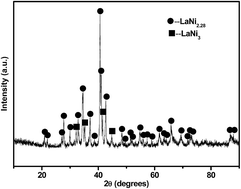
2, which is mainly because the atomic radius ratio between La and Ni (1.506) is relatively higher than the ideal atomic radius ratio of the Laves phase (1.225). Therefore, it is easier to form a LaNi2.28 phase when the atomic ratio between La and Ni is 1
:
2, which explains why more LaNi2.28 phases appear in Fig. 1.
![]() | ||
| Fig. 2 (a) Back-scattered SEM image of the annealed LaNi2.28 alloys annealed at 700 °C for 24 h; energy dispersive spectroscopy (EDS) results of the (b) grey region A and (c) black region B. | ||
![]() | ||
| Fig. 3 First hydrogen absorption–desorption curves of LaNi2.28 at 120 °C under a hydrogen pressure of 3.5 MPa: (a) hydrogen absorption and (b) hydrogen desorption. | ||
Fig. 4 shows the isothermal absorption–desorption curves of LaNi2.28 alloy from the first to fourth cycle at 120 °C. Before measuring the second cycle, the sample was dehydrogenated at 120 °C for 0.5 h. It should be noted that 1.6 wt% hydrogen remains inside the alloy sample after the first absorption process. The sloping plateau appears and the hydrogen absorption clearly decreases in the second absorption–desorption process, suggesting that the isothermal absorption–desorption curves of the second cycle is remarkably different from the first one. There is a distinct decrease in hydrogen absorption during the absorption–desorption cycle of LaNi2.28 alloy, indicating the formation of amorphous hydrides during the cycling process.
![]() | ||
| Fig. 4 The hydrogen capacity of pre-annealed LaNi2.28 alloy during four hydriding/dehydriding cycles at 120 °C. | ||
Fig. 6a shows the XRD pattern of as-annealed alloy after the first absorption. Compared with Fig. 1, the LaNi2.28 and LaNi3 phases disappear, and the main phases are LaNi5Hy and LaH2. Moreover, a small amount of LaNi5 can also be observed, and the diffraction peaks are broadened accordingly. Combined with the TEM analysis (Fig. 7), it can be observed that a few amorphous phases are formed. Moreover, the SAED diffraction rings can be indexed with crystal planes of (111) for LaNi5Hy, (111) for LaNi5 and (101) for LaH2, which is in good agreement with XRD analysis. Fig. 6b–d show the XRD patterns of the alloy after the first, fourth and tenth cycles, respectively. There are no diffraction peaks observed in Fig. 6b–d, indicating that the detected alloy exists in the form of amorphous state. Combined with the TEM analysis (Fig. 7b–d), it can be concluded that the major phases are amorphous states and that minor crystal phases, corresponding to LaNi5 and LaH2 can be seen, which can be verified by SAED analysis.
It can be seen from Fig. 6a and 7a that only partial amorphous phases can be found after absorption. A disproportionation reaction occurred between LaNi2.28 and LaNi3 after LaH2 and LaNi5 formation. The major phases exist in the form of amorphous states after the first absorption, while the minor phases are LaH2 and LaNi5 crystalline phases. To our best knowledge, the above mentioned results are not reported in the literature; moreover, this phenomenon is not consistent with the process of HIA, but it could be related to the process of sample preparation. The first absorption was conducted at 120 °C under 3.5 MPa hydrogen pressure, whereas the XRD and TEM measurements were performed after the sample was cooled in an electric furnace from 120 °C to room temperature; i.e., the sample was in amorphous state after the first absorption, but the crystallization process for the sample results from cooling in the electric furnace. For the samples after the first cycle, the XRD measurement was performed after the sample was cooled in air from 120 °C to room temperature. It can be seen from Fig. 4 and 5 that the absorption capacity is about 1.6 wt% for the first absorption, but the desorption capacity is only 0.8 wt% for the first desorption, which indicates that a disproportionation reaction occurs during the absorption process after LaH2 and LaNi5H6 formation, according to the reaction formula (1). As a support for above, the precipitation of LaH2 and LaNi5Hz from LaNi2Hx was also observed by Chung and Lee.34 According to Fig. 7, after the first, fourth and tenth cycles at 120 °C, the SADP of LaNi5 is pronounced. LaH2 is very stable and can not desorb hydrogen at 120 °C, resulting in a decreased desorption capacity. According to the reaction formula (1), if all La7Ni16 (LaNi2.28) participated in the disproportionation reaction, the desorption capacity of the formed LaNi5H6 would be 71.6% of the total absorption capacity; however, the actual desorption capacity is 50% of the total absorption capacity, which indicates that the disproportionation reaction is incomplete. After the absorption, amorphous LaNi2.28, LaNi5H6 and LaH2 are formed as shown in the reaction formula (2). The absorption and desorption capacities are 0.8 wt% from the second to fourth cycle, indicating that the amount of LaH2 is stable after the first cycle and the disproportionation reaction is completed during the first cycle.
![]() | (1) |
![]() | (2) |
The hydrogen-induced amorphization (HIA) is mainly responsible for the poor reversibility of the LaNi2.28 alloy, and it mainly occurs after the first cycle. With an increase in the number of cycles, the degree of HIA does not increase. For the LaNi2.28 alloy, the hydrogen absorption–desorption of its LaNi2.28 phase causes the local lattice to become a disordered one, leading to the amorphous phase formation. At the same time, the LaNi5Hx crystallites formed by the LaNi5 subunit start to precipitate. Combining the TEM measurements in Fig. 7 with the XRD results in Fig. 6 describes what occurred in the LaNi2.28 alloy: after the first absorption, amorphous LaNi2.28Hx formed, and it formed LaNi5Hy and LaH2 by the disproportionation reaction; amorphous LaNi2.28Hx and LaNi5Hy can desorb 50% hydrogen of the absorption capacity of LaNi2.28; and the absorption–desorption capacity is stable after the first cycle.
| This journal is © The Royal Society of Chemistry 2014 |