
Kamatchi Kamaraj Purushothaman*a,
Balakrishanan Saravanakumarb,
Inbamani Manohara Babuc,
Balasubramanian Sethuramana and
Gopalan Muralidharanc
aDepartment of Physics, TRP Engineering College (SRM group), Irungalur, Tamilnadu, India. E-mail: purushoth_gri@yahoo.co.in; Tel: +91 431 2908050
bFaculty of Physics, Mahalingam College of Engineering and Technology, Pollachi, Tamilnadu, India
cDepartment of Physics, Gandhigram Rural University, Gandhigram-624302, Tamilnadu, India
First published on 8th May 2014
To address the issues such as low ionic conductivity, poor electrode kinetics and cyclic stability, the strategy of combining carbon-based materials with transition metal oxide (TMO) is adopted. In this article, the preparation of CuO/reduced graphene oxide (RGO) nanocomposite electrodes by a simple, low cost hydrothermal method is described. This hybrid nanocomposite exhibits a high specific capacitance of 326 F g−1 at a current density of 0.5 A g−1. It shows a high energy density of 65.7 W h kg−1 at a power density of 302 W kg−1. Further, this material does not exhibit any measureable degradation in electrochemical performance, even after 1500 cycles. Symmetric hybrid capacitors exhibit a specific capacitance of 97 F g−1 at 0.2 A g−1 with a power density of 72 W kg−1. These superior electrochemical features demonstrate that the CuO/RGO hybrid nanocomposite is a promising material for next-generation supercapacitor systems.
Cupric oxide (CuO) is a well-known metal oxide due to its special features such as non-toxicity, abundance, low cost and ease of fabrication in the form of nano dimensions, which have led to its use in Li-ion batteries and supercapacitor electrodes.8–10 However, its low electrical conductivity and destruction of the structure during ion intercalation/deintercalation have hampered the electrochemical performance of CuO. These shortcomings are addressed by two strategies. First, the fabrication of CuO in the form of nanostructures is expected to provide facile pathways for electrolyte ion penetration. Second is blending carbon-based materials with CuO to make CuO hybrid composites. The presence of carbon-based materials (CNT, Graphene, mesoporous carbon etc.) in the composite greatly improves conductivity and electrochemical performance.
In this point of view, graphene has recently drawn great attention of researchers from many groups, since its discovery.11 Primarily, it possess tightly connected flat single layers of sp2-hybridized carbon atoms into a honeycomb lattice.12,13 Because of its hallmark features such as a 2D structure, ultra-high specific surface area, high mechanical strength and elevated conductivity have led to its application in bio- and chemical sensors,14,15 field-effect transistors,16 energy storage devices,17,18 and bio medicine,19 etc.
In this sense, the preparation of a composite containing CuO and carbon-based materials such as graphene is expected to yield SCs with an improved electrochemical nature. Earlier, the CuO/graphene nanocomposites were prepared and studied for Li-ion battery applications. Wang et al. fabricated graphene-enwrapped CuO with a high rate capacity and good cycling performance.20 Mai et al. reported the preparation of a CuO/graphene composite with improved efficiency as anode materials for Li-ion batteries.21 Rai et al. showed a microwave-assisted synthesis of a CuO/RGO nanocomposite to yield good electrochemical performance.22 However, the use of a CuO/RGO composite as a supercapacitor electrode is the least explored. This work is probably one of the few reports available on this composite or on the nature of CuO as an electrode material.
In this article, we reported the fabrication of a CuO/RGO hybrid nanocomposite by a low cost hydrothermal method and studied its electrochemical performance to explore its application as a supercapacitor electrode. We utilized RGO as a conductivity booster with CuO nanostructures. Structural and electrochemical investigations demonstrate the suitability and electrochemical features of the CuO/RGO hybrid nanocomposite as a better electrode material for a supercapacitor. The CuO/RGO is denoted as “CuG hybrid nanocomposite” in further discussions.
In order to confirm the structure, phase and purity of the materials, X-ray diffraction patterns (XRD) were recorded for the CuG hybrid nanocomposites (Fig. 4). The diffraction peaks coincide well with the standard pattern of CuO (JCPDS card no. 05-0661). Further, it shows monoclinic symmetry with a C2/C space group and possess lattice constant values of a = 0.4684 nm, b = 0.3425 nm and c = 0.5129 nm: β = 99.47°. No impurity peaks could be detected in the diffraction pattern; this is indicative of the phase purity of CuO.
![]() | ||
| Fig. 4 (a) XRD pattern of the CuG hybrid nanocomposite (b) FT Raman spectrum of the CuG hybrid nanocomposite. | ||
FT Raman spectroscopy is an effective analytical method to identify the structure and defects in composite materials. The FT Raman spectrum of the CuG hybrid nanocomposite (Fig. 4b) shows D and G bands at 1335 and 1593 cm−1, respectively. This band corresponds to the characteristic peaks of graphene. The G peak represents sp2 carbon vibrations, and the D band represents sp3 carbon in the graphitic lattice.23,24 The intensity of the D and G bands is less because of the low loading of graphene in CuO. CuO belongs to space group C62h with Raman active optical phonons (Ag + 2Bg). The well-resolved bands at 294, 615 and 1087 cm−1 confirm the presence of CuO.25,26
The electrochemical performance of the CuG hybrid nanocomposite is primarily investigated by cyclic voltammetry measurements (CV) at a scan rate of 1 mV s−1 within a potential range of −0.55 to 0.65 V (shown in Fig. 5a). The presence of anodic and cathodic peaks in the CV curve are proof of the fact that the origin of capacitance in the present nanocomposite is mainly from the surface redox reactions. The CuG hybrid nanocomposite exhibited a specific capacitance of 318 F g−1 at a scan rate of 1 mV s−1. Fig. 5b displays the CV profiles of the nanocomposite at different scan rates. It is indicative of good kinetic reversibility of the CuG hybrid nanocomposite as an electrode material. The variation of the specific capacitance with the scan rate is displayed in Fig. S1.† At higher scan rates, the electrolyte ions are not provided with enough time to access the interior parts of the electrode, and hence exhibit reduced charge storage characteristics, i.e., a lower specific capacitance. The electrolyte ion utilizes a maximum area of the electrode at lower scan rates and finds enough time to percolate into the material, resulting in superior values of specific capacitance.27
To understand the charge storage mechanism and rate capacity of the CuG hybrid nanocomposite, galvanostatic charge discharge (GCD) measurements were performed. A typical charge–discharge profile for the nanocomposite prepared in this work from −0.5 to 0.7 V at a constant current of 0.5 A g−1 is displayed in Fig. 5c. The near symmetric nature of the charge and discharge curve shows the improved capacitive nature and charge–discharge reversibility. Further, the specific capacitance value reaches up to 326 F g−1 at 0.5 A g−1. This capacitance is higher than the values reported by other researchers.23,28 To the best of our knowledge, this is one of the best capacitance values ever reported for a CuG hybrid nanocomposite. This superior enhancement in the specific capacitance is attributed to the presence of RGO with CuO. RGO acts as a conductivity enhancer and provides better pathways for ion intercalation. Fig. 5d shows the charge discharge profiles at different current densities. At higher current rates, electrolyte ion movement was not properly synchronized with the current rates.29 Because of this high current density, specific capacitance is significantly reduced. The variation of specific capacitance with current density is shown in Fig. S2.†
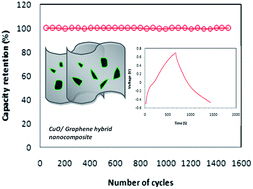
Energy density and power density are two of the most important parameters of an electrode material to decide its suitability for commercial usage. The Ragone plot for the electrodes prepared using the nanocomposite is shown in Fig. S3.† CuG hybrid nanocomposite electrodes exhibit a maximum energy density of 65.7 W h kg−1 and power density of 302 W kg−1 at 0.5 A g−1 and a maximum power density of 2.4 kW kg−1 and energy density of 20.8 W h kg−1 at 4 A g−1. The retention of capacity after long-term cycling of charge–discharge is one of the key factors to evaluate the supercapacitor electrodes for practical applications. Reduced graphene oxide (RGO) shows 100% stability, and copper oxide (CuO) exhibits 74% up to 1500 cycles at 5 A g−1 (Fig. S4†). The CuG hybrid nanocomposite does not show any measureable degradation after 1500 continuous cycles of charge–discharge at 5 A g−1 (Fig. 6a). The presence of RGO with CuO seems to greatly enhance the stability of the nanocomposite. The excellent cyclic stability exhibited by the CuO/RGO hybrid nanocomposite reveals that it is possible to use the nanocomposite in practical energy storage systems.
![]() | ||
| Fig. 6 (a) Cyclic stability of the CuG hybrid nanocomposite measured at 5 Ag−1. (b and c) The Nyquist plot of the CuG hybrid nanocomposite and equivalent circuit model. | ||
Better understanding of the fast ion diffusion in the CuG hybrid nanocomposite can be achieved by performing EIS measurements. They were made in the frequency range of 0.01 Hz to 100 kHz. The Nyquist profiles of the CuG hybrid nanocomposite is shown in Fig. 6b. The inset of Fig. 6b represents the high-frequency region of the Nyquist plot. Fig. 6c shows the equivalent circuit diagram to which the impedance data has been fitted to. It contains six components: solution resistance (Rs), charge transfer resistance (Rct), leakage resistance (RL), double layer capacitance (Cdl), mass capacitance (CL) and the Warburg element (W). These elements have their usual meaning. The semicircle intercept on the real axis (Z′) at higher frequencies represents the charge transfer resistance (Rct). The Rct value is observed to be 2.47 Ω for the CuG hybrid nanocomposite. This low value of charge transfer resistance helps in faster charge–discharge possibilities, which is an essential feature of an energy storage device where the generation of energy is fast and for a short period, and in some cases, the load may require instantaneous delivery of large power.
To analyze the capacitive features of the CuG hybrid nanocomposite electrode in a complete cell set up, a symmetric supercapacitor was fabricated. The schematic illustration of the fabrication process of the symmetric supercapacitor is shown in Fig. 7. This is composed of the CuG hybrid nanocomposite as the positive and negative electrodes, polypropylene (Celgard) as a separator and 0.5 M K2SO4 used as the electrolyte. Fig. 8 shows the CV curves of the CuG hybrid nanocomposite-based symmetric supercapacitor device at different scan rates (2 to 50 mV s−1) in a potential window of 1.2 V (0 to 1.2 V). The estimated specific capacitance from the CV measurements are 64, 58, 49, 39, 27 and 18 F g−1 at scan rates of 2, 3, 5, 10, 25 and 50 mV s−1, respectively. Further, the GCD curves with various current densities are shown in Fig. 9. The symmetric supercapacitor shows the triangular charge–discharge curves, confirming the linear relationship between potential and time. Further symmetric charge and discharge curves validate the fact that the material has superior electrochemical reversibility. Specific capacitance values derived from the GCD measurements are 97, 71, 55 and 36 F g−1 at current densities of 0.2, 0.5, 1 and 2 Ag−1, respectively, and the estimated energy density is 19 W h kg−1 at a power density of 72 W kg−1. The mixing of CuO and graphene has led to a new type of a hybrid nanocomposite as an electrode material for high-performance supercapacitors.
The specific capacitance (C, F g−1) values from CV measurements were obtained using the following equation,
Specific capacitance values were calculated from the galvanostatic discharge curves according to the following equation,
Energy and power densities were estimated from the following equations,
Footnote |
| † Electronic supplementary information (ESI) available: The variation of specific capacitance with various scan rates from the CV measurements (Fig. S1), the variation of specific capacitance with different current densities from the GCD measurements (Fig. S2) and the Ragone plot (Fig. S3). See DOI: 10.1039/c4ra02107j |
| This journal is © The Royal Society of Chemistry 2014 |