Guoyi
Bai
*,
Huixian
Dong
,
Zhen
Zhao
,
Hailong
Chu
,
Xin
Wen
,
Chen
Liu
and
Fei
Li
Key Laboratory of Chemical Biology of Hebei Province, College of Chemistry and Environmental Science, Hebei University, Baoding 071002, PR China. E-mail: baiguoyi@hotmail.com; Fax: +86-312-5937102; Tel: +86-312-5079359
First published on 16th April 2014
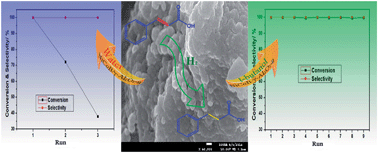
Selective hydrogenation of cinnamic acid was studied over different supported NiCoB amorphous alloys; a γ-Al2O3 supported NiCoB catalyst showed particularly good activity. The application of ultrasound during catalyst preparation was found to make the Ni active sites more dispersed, thus enhancing the catalyst activity. The NiCoB/γ-Al2O3-u catalyst so obtained could be recycled effectively for nine runs in tert-butanol, in contrast it deactivated after only three runs in water. XPS, SEM and XRD characterizations indicated that loss of Ni and hydration of the γ-Al2O3 support were the main reasons for catalyst deactivation in water. Thus, an efficient and stable catalytic system involving NiCoB/γ-Al2O3-u and tert-butanol was established for cinnamic acid hydrogenation in this study.
As is well known, stability is an important character for a good industrial catalyst and much effort has been devoted to achieve this.6–9 Specific to NiB amorphous alloy catalysts, loading the active species on a support is regarded as an effective method to improve their stability.10,11 For instance, Liu et al. have reported that a NiB amorphous alloy supported on boehmite exhibited superior activity and relatively good stability over four runs in the selective hydrogenation of p-nitrophenol and p-chloronitrobenzene.11 However, there is still a lack of NiB amorphous alloys with sufficient stability, which of course limits their applications in industry.
Very recently, we have prepared a Co-modified NiB amorphous alloy catalyst for the selective hydrogenation of cinnamic acid to hydrocinnamic acid,12 which is an important chemical intermediate.13,14 This catalyst showed excellent catalytic performance in this reaction, similar to that of Pd-based noble metal catalysts,15,16 but it also exhibited poor stability during recycling. Consequently, in an effort to find a suitably active and stable catalyst for this transformation, various solid supports were examined in combination with this type of NiCoB amorphous alloy catalyst. The effects of solvent on the stability of such supported NiCoB catalysts were also examined to search for optimal reaction conditions for this hydrogenation. This has resulted in the identification of a NiCoB/γ-Al2O3-u catalyst, which shows both suitable activity and stability, when used in tert-butanol, for the selective hydrogenation of cinnamic acid.
:
Co = 10
:
1). The resulting paste was then dried at 393 K for 2 h. The resulting precursor was reduced by adding 7 mL of 1.0 M aqueous KBH4 containing 0.2 M NaOH dropwise with vigorous stirring while cooling in an ice bath to furnish a black precipitate. This was filtered off and washed with deionized water several times, followed by absolute ethanol three times. The catalyst so obtained (denoted as NiCoB/S) was kept under absolute ethanol for future use. When ultrasound was applied during the preparation process, the catalyst thus obtained was denoted as NiCoB/S-u. NiCoB catalyst was prepared by a chemical reduction method as described previously.12
| Catalyst | Conversion of cinnamic acid (%) | Selectivity for hydrocinnamic acid (%) |
|---|---|---|
| a Reaction conditions: 3.0 g cinnamic acid, 0.2 g catalyst (10 wt% NiCoB), 60 mL water, temperature at 393 K, initial P(H2) = 2.0 MPa, and reaction time 30 min. b 0.02 g NiCoB. | ||
| NiCoB/TiO2 | 58.5 | 100.0 |
| NiCoB/AC | 31.7 | 100.0 |
| NiCoB/ZSM-5 | 51.6 | 100.0 |
| NiCoB/Hβ | 52.4 | 100.0 |
| NiCoB/γ-Al2O3 | 71.3 | 100.0 |
| NiCoB/γ-Al2O3-u | 83.5 | 100.0 |
| NiCoBb | 57.8 | 100.0 |
![]() | ||
| Fig. 1 XRD patterns of γ-Al2O3 and amorphous alloy catalysts. (a) NiCoB, (b) γ-Al2O3, (c) NiCoB/γ-Al2O3, (d) NiCoB/γ-Al2O3-u. | ||
The results of composition, Ni loading, BET surface area, pore volume and H2-chemisorption of the amorphous alloy catalysts, together with the structural properties of γ-Al2O3, are summarized in Table 2. From the ICP analysis, it was found that the Co and B ratio of the γ-Al2O3 supported catalysts markedly increased when compared to the unsupported NiCoB. The increase of the B content could increase the amorphous degree and the thermal stability of the as-prepared amorphous alloy catalysts, thereby enhancing their hydrogenation activity.20 The surface area and pore volume of the γ-Al2O3 supported catalysts decreased compared with γ-Al2O3 itself, probably due to the occupation of some pores of γ-Al2O3 by small amorphous alloy particles. Noticeably, the surface area of NiCoB/γ-Al2O3-u increased slightly when compared with NiCoB/γ-Al2O3. Furthermore, the ultrasound-assisted NiCoB/γ-Al2O3-u sample showed higher H2-chemisorption and Ni loading than the conventionally prepared material. Thus, the use of ultrasound appears to inhibit the agglomeration of NiCoB particles on γ-Al2O3, making the active Ni species more dispersed, hence accounting for the higher activity of NiCoB/γ-Al2O3-u.
| Sample | Compositiona (atomic ratio) | Ni loading (wt%) | Surface area (m2 g−1) | Pore volume (cm3 g−1) | H2-chemisorption (cm3 g−1) |
|---|---|---|---|---|---|
| a Based on ICP results. b Data from ref. 12. | |||||
| γ-Al2O3 | — | — | 200.2 | 0.339 | — |
| NiCoBb | Ni1.00Co0.080B0.52 | — | 28.3 | 0.062 | 0.22 |
| NiCoB/γ-Al2O3 | Ni1.00Co0.118B1.48 | 6.8 | 164.6 | 0.220 | 0.26 |
| NiCoB/γ-Al2O3-u | Ni1.00Co0.117B1.49 | 7.1 | 172.5 | 0.222 | 0.30 |
The morphologies of the supported NiCoB amorphous catalysts were recorded by both SEM and TEM (Fig. 2). As can be seen, the two fresh samples displayed cotton-like morphology (Fig. 2a and b), similar to other supported amorphous alloy catalysts.21 It was observed that the particles of NiCoB/γ-Al2O3-u became smaller and well dispersed when ultrasound was used, a finding also supported by TEM (Fig. 2c and d). The SAED patterns (Fig. 2 insets) of the samples showed successive diffraction halos rather than distinct dots, confirming the amorphous structure of the active component NiCoB, in good agreement with the XRD results.
Fig. 3 shows the H2-TPD profiles of NiCoB/γ-Al2O3 and NiCoB/γ-Al2O3-u. There is only one strong peak at about 628 K for these two supported catalysts, indicating the presence of one kind of adsorption site for each sample. Furthermore, it is apparent that the hydrogen desorption peak of NiCoB/γ-Al2O3-u is much larger than that of NiCoB/γ-Al2O3, in agreement with the H2-chemisorption results. This indicates that ultrasonic treatment favors the dispersion of NiCoB particles on γ-Al2O3, resulting in the formation of more active Ni centers and accounting for the higher activity of NiCoB/γ-Al2O3-u.
![]() | ||
| Fig. 4 Effect of reaction time (a), hydrogen pressure (b), and catalyst dosage (c) on cinnamic acid hydrogenation. | ||
| Solvents | Run 1 | Run 2 | ||
|---|---|---|---|---|
| Conversion (%) | Selectivity (%) | Conversion (%) | Selectivity (%) | |
| a Reaction conditions: 3.0 g cinnamic acid, 0.3 g catalyst, 60 mL solvent, temperature at 393 K, initial P(H2) = 3.0 MPa, and reaction time 60 min. | ||||
| Water | 100.0 | 100.0 | 72.2 | 100.0 |
| Dioxane | 100.0 | 100.0 | 43.3 | 100.0 |
| Ethanol | 98.3 | 87.3 | 98.1 | 85.4 |
| iso-propanol | 100.0 | 88.7 | 100.0 | 83.9 |
| tert-Butanol | 100.0 | 100.0 | 100.0 | 100.0 |
| Ethyl acetate | 98.5 | 100.0 | 96.1 | 100.0 |
In order to find the reason for the above results, the used NiCoB/γ-Al2O3-u samples were characterized by XPS and compared with the fresh sample (Fig. 6). As can be seen, the surface Ni atomic concentration decreased from 1.7% to 0.9% after three runs in water; whereas it remained in a high level (1.6%) even after being used nine times in tert-butanol. We can thus deduce that loss of active Ni is the main reason for catalyst deactivation in water. On the other hand, some bar-like material was observed on the NiCoB/γ-Al2O3-u catalyst surface that had been used in three runs in water (Fig. 2f), which was suspected to be the hydrated phase of the γ-Al2O3 support.23 Thus, the used NiCoB/γ-Al2O3-u catalysts were characterized by XRD and the results are shown in Fig. 7A. As anticipated, the X-ray diffraction pattern of the catalyst used three runs in water has markedly changed, with the appearance of new strong diffraction peaks at around 2θ = 15°, 17.5°, 24°, 31° and 38°, which can be assigned to γ-AlO(OH). Furthermore, the high-resolution XPS spectra of Al 2p (Fig. 6 insets) also shows that the binding energy of Al 2p has slightly decreased from 74.3 to 74.1 eV after the catalyst was used in water, suggesting the transformation from γ-Al2O3 to γ-AlO(OH),24 and in agreement with the above XRD results. Small peaks related to Al(OH)3 were also detected in this used catalyst. Thus, much of the γ-Al2O3 is transformed into hydrated phases during reactions in water, similar to what occurs in hydrothermal synthesis, as previously reported.25–28 In contrast, the X-ray diffraction pattern of the catalyst used nine runs in tert-butanol is similar to that of the fresh material, except for the weakness of the peak intensity, proving that the original γ-Al2O3 structure is maintained during the reaction in tert-butanol. Moreover, the surface area of the NiCoB/γ-Al2O3-u catalyst used three runs in water markedly decreased from 172.5 to 32.9 m2 g−1, which represents a loss of greater than 80% of its original surface area; while it was still 103.1 m2 g−1 after nine runs in tert-butanol. The different tendencies in the N2 adsorption–desorption isotherms of the NiCoB/γ-Al2O3-u catalyst used in water and tert-butanol (Fig. 7B) also supports this type of structural transformation of γ-Al2O3 during hydrogenation in water. Thus, the hydration of the γ-Al2O3 support, which accounting for the decrease of its surface area, is believed to be another reason for the deactivation of NiCoB/γ-Al2O3-u when used in water.
![]() | ||
| Fig. 6 XPS spectra of NiCoB/γ-Al2O3-u (a), NiCoB/γ-Al2O3-u used in tert-butanol (b) and in water (c), the insets are the high resolution spectra of Al 2p. | ||
![]() | ||
| Fig. 7 XRD patterns (A) and N2 adsorption–desorption isotherms (B) of the fresh NiCoB/γ-Al2O3-u (a) and the catalysts used in tert-butanol (b) and in water (c). | ||
| This journal is © The Royal Society of Chemistry 2014 |