Enantioselective synthesis of N-allylindoles via palladium-catalyzed allylic amination/oxidation of indolines

Qiang Zhao, Chun-Xiang Zhuo and Shu-Li You*
State Key Laboratory of Organometallic Chemistry, Shanghai Institute of Organic Chemistry, Chinese Academy of Sciences, 345 Lingling Lu, Shanghai 200032, China. E-mail: slyou@sioc.ac.cn

Received 6th January 2014 , Accepted 5th February 2014

First published on 5th February 2014


Abstract

A highly efficient synthesis of N-allylindoles was realized via palladium-catalyzed asymmetric allylic amination/oxidation sequential reaction of indolines. The N-alkylated indole derivatives were obtained with up to 91% yield and 97% ee.
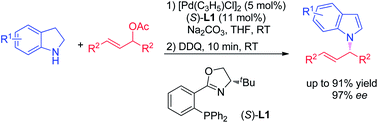

Chiral indole moieties are embedded extensively in numerous biologically active natural products and pharmaceuticals, therefore the enantioselective functionalization of indoles is now becoming one of the most important research areas.1 In this regard, enormous efforts have been made towards the synthesis of various functionalized chiral indole scaffolds in the past two decades.2 For the most studied Friedel–Crafts reaction, it is well developed for the C-3 alkylation of indole because C-3 is the innately most reactive site of the indole core.3 Recently, the enantioselective C-2 alkylation of indoles was also realized.4 While the methods for the asymmetric synthesis of 3-substituted and 2-substituted indoles are well established, the development of catalytically enantioselective synthesis of N-substituted indoles is relatively slow.5

Transition-metal-catalyzed allylic substitution reaction is one of the most powerful method for the construction of C–C and C–X bonds.6,7 During our efforts towards the asymmetric functionalization of indoles,8 recently, we reported the asymmetric synthesis of N-allylindoles via the iridium-catalyzed allylic alkylation/oxidation of indolines (eqn (1), Scheme 1).9 The method provided highly enantioenriched N-allylindoles bearing a terminal alkene, which could be utilized in the enantioselective synthesis of one diastereomer of natural product yuremamine. This two-step strategy has not been explored for other transition-metal-catalysis except for iridium. In addition, the substituted N-allylindoles are also popular structural motifs in natural alkaloids and biologically active compounds.10,11 Therefore, in this paper, we would like to report our results on Pd-catalyzed allylic amination of indolines/oxidation sequence, providing an efficient synthesis of enantioenriched 1,3-diarylallyl indoles (eqn (2), Scheme 1).


image file: c4ra00701h-s1.tif
Scheme 1 One-pot synthesis of substituted N-allylindoles via Pd-catalyzed allylic alkylation of indolines/oxidation sequence.

At the outset, indoline 1a and (E)-1,3-diphenylallyl acetate 2a were chosen as the model substrates, and the results are summarized in Table 1. In the presence of 5 mol% of [Pd(C3H5)Cl]2, 11 mol% of the Phox ligand L1, and 2.0 equiv. of Na2CO3, the reaction of 1a with 2a in THF for 12 h gave the (E)-1,3-diphenylallyl indoline 3aa in 99% yield and 95% ee (entry 1, Table 1). The effects of chiral ligands were examined next. Ligands L2 and L4–L7 were found to be suitable ligands to afford 3aa in moderate to good yields with moderate ee (entries 2 & 4–7, Table 1). However, the reaction with ligand L3 proceeded in low yield with moderate ee (entry 3, Table 1).

Table 1 Optimization of the reaction conditionsa

image file: c4ra00701h-u1.tif

Entry Ligand Solvent Base t/h Conv.b (%) Yieldc (%) eed (%)
a Reaction conditions: 0.24 mmol of 1a, 0.2 mmol of 2a, 0.4 mmol of base in solvent (2.0 mL) at room temperature.b Determined by 1H NMR of the crude reaction mixture.c Isolated yield of 3aa.d Determined by HPLC analysis.
1 L1 THF Na2CO3 12 100 99 95
2 L2 THF Na2CO3 12 100 94 47
3 L3 THF Na2CO3 12 90 28 50
4 L4 THF Na2CO3 12 96 90 43
5 L5 THF Na2CO3 12 72 70 14
6 L6 THF Na2CO3 12 72 71 47
7 L7 THF Na2CO3 12 100 97 86
8 L1 THF Li2CO3 33 73 71 69
9 L1 THF Cs2CO3 33 89 73 86
10 L1 THF K3PO4 15 100 96 75
11 L1 THF KOAc 15 100 90 67
12 L1 THF DBU 15 100 60 95
13 L1 THF Et3N 21 99 92 77
14 L1 THF NaOAc 21 60 60 58
15 L1 THF DABCO 21 20 30
16 L1 DCM Na2CO3 23 100 93 86
17 L1 Dioxane Na2CO3 23 100 75 91
18 L1 Toluene Na2CO3 23 100 94 71
19 L1 Et2O Na2CO3 23 100 93 83
20 L1 CH3CN Na2CO3 23 83 62


In addition, various bases such as Li2CO3, Cs2CO3, K3PO4, KOAc, DBU, Et3N, NaOAc and DABCO were also tested (entries 8–15, Table 1). The examination of bases led to the discovery of Na2CO3 as the optimal base. Meanwhile screening of various solvents (entries 16–20, Table 1) led to the identification of THF as the best solvent. After systematic optimization studies, the best reaction conditions are the following: 1a and 2a in THF with 5 mol% of [Pd(C3H5)Cl]2, 11 mol% L1, and 2.0 equiv. of Na2CO3 at room temperature. This process produces (E)-1,3-diphenylallyl indoline 3aa in 99% yield and 95% ee (entry 1, Table 1). Next, we investigated the one-pot allylic amination of indolines/oxidation sequence. To our great delight, with DDQ as an efficient oxidant, the oxidation reaction of 3aa to 4aa went smoothly in 10 min at room temperature without loss of the optical purity, affording (E)-1,3-diphenylallyl indole 4aa in 80% yield and 95% ee (Scheme 2).


image file: c4ra00701h-s2.tif
Scheme 2 One-pot synthesis of substituted N-allylindoles.

Under the above optimized reaction conditions, various substituted indolines and allylic acetates were explored to examine the generality of the process. The results are summarized in Table 2. The stereochemistry of the products was assigned as S based on an X-ray crystallographic analysis of enantiopure 4aa. The reaction of C-2 methyl substituted indoline 1b gave product 4ba in 81% yield and 96% ee (entry 2, Table 2). Notably, when indoline 1c bearing a phenyl group at the C-2 position, the reaction could also react smoothly, providing product 4ca in 53% yield and 96% ee (entry 3, Table 2). The substrates bearing either an electron-donating group (3-Me, 4-Me, 5-OMe, 7-Me) or an electron-withdrawing group (5-Cl, 6-Br) on the indoline core all reacted and gave the corresponding indole products in moderate to good yields with excellent ee (72–82% yields, 93–97% ee, entries 4–9, Table 2). When the electrophile was switched to (E)-1,3-di(para-chlorophenyl)-allylic acetate 2b, the reaction occurred smoothly to afford indole product 4ab in excellent yield and ee (91% yield, 97% ee, entry 10, Table 2). However, when (E)-1,3-dimethylallyl acetate 2c was utilized, the reaction took place with only moderate yield and ee (48% yield, 39% ee, entry 11, Table 2).

Table 2 The reaction substrate scope

image file: c4ra00701h-u2.tif

Entry 1, R1 2, R2 4, Yielda (%) eeb (%)
a Isolated yield of 4.b Determined by HPLC analysis.
1 1a, R1 = H 2a, R2 = Ph 4aa, 80 95
2 1b, R1 = 2-Me 2a, R2 = Ph 4ba, 81 96
3 1c, R1 = 2-Ph 2a, R2 = Ph 4ca, 53 96
4 1d, R1 = 3-Me 2a, R2 = Ph 4da, 72 97
5 1e, R1 = 4-Me 2a, R2 = Ph 4ea, 77 95
6 1f, R1 = 5-OMe 2a, R2 = Ph 4fa, 72 61
7 1g, R1 = 7-Me 2a, R2 = Ph 4ga, 82 93
8 1h, R1 = 5-Cl 2a, R2 = Ph 4ha, 75 97
9 1i, R1 = 6-Br 2a, R2 = Ph 4ia, 73 96
10 1a, R1 = H 2b, R2 = 4-ClC6H4 4ab, 91 97
11 1a, R1 = H 2c, R2 = Me 4ac, 48 39


The kinetic resolution reaction of C-2 methyl substituted indoline 1b has also been carried out. To our disappointment, under the optimized reaction conditions, indoline 1b was recovered in 31% yield with only 4% ee (Scheme 3).


image file: c4ra00701h-s3.tif
Scheme 3 The kinetic resolution reaction with substrate 1b.

In summary, we have developed a highly efficient synthesis of enantio-enriched N-1,3-diarylallyl indoles via palladium-catalyzed enantioselective allylic amination of indolines/oxidation sequence. The N-alkylated indole derivatives were obtained with up to 91% yield and 97% ee. Further studies on the substrate scope and applications of the enantioenriched N-allylindoles are currently underway in our laboratory.

Acknowledgements

We thank the National Basic Research Program of China (973 Program 2010CB833300) and the National Natural Science Foundation of China (21025209, 21121062, 21332009) for generous financial support.

Notes and references

  1. (a) J. Bosch and M.-L. Bennasar, Synlett, 1995, 587 CrossRef CAS PubMed; (b) J. A. Joule and K. Mills, Heterocyclic Chemistry, Blackwell Science, Oxford, 4th edn, 2000 Search PubMed; (c) D. J. Faulkner, Nat. Prod. Rep., 2002, 19, 1 CAS; (d) M. Somei and F. Yamada, Nat. Prod. Rep., 2004, 21, 278 RSC; (e) S. Agarwal, S. Cammerer, S. Filali, W. Frohner, J. Knoll, M. P. Krahl, K. R. Reddy and H.-J. Knolker, Curr. Org. Chem., 2005, 9, 1601 CrossRef CAS; (f) S. E. O'Connor and J. J. Maresh, Nat. Prod. Rep., 2006, 23, 532 RSC; (g) A. J. Kochanowska-Karamyan and M. T. Hamann, Chem. Rev., 2010, 110, 4489 CrossRef CAS PubMed.
  2. For reviews, see: (a) M. Bandini, A. Melloni and A. Umani-Ronchi, Angew. Chem., Int. Ed., 2004, 43, 550 CrossRef CAS PubMed; (b) T. B. Poulsen and K. A. Jørgensen, Chem. Rev., 2008, 108, 2903 CrossRef CAS PubMed; (c) S.-L. You, Q. Cai and M. Zeng, Chem. Soc. Rev., 2009, 38, 2190 RSC; (d) M. Bandini and A. Eichholzer, Angew. Chem., Int. Ed., 2009, 48, 9608 CrossRef CAS PubMed; (e) M. Zeng and S.-L. You, Synlett, 2010, 1289 CAS.
  3. For selected examples of asymmetric C-3 alkylation of indoles, see: (a) J. Zhou and Y. Tang, J. Am. Chem. Soc., 2002, 124, 9030 CrossRef CAS PubMed; (b) J. F. Austin and D. W. C. MacMillan, J. Am. Chem. Soc., 2002, 124, 1172 CrossRef CAS PubMed; (c) D. A. Evans, K. R. Fandrick and H.-J. Song, J. Am. Chem. Soc., 2005, 127, 8942 CrossRef CAS PubMed; (d) Y.-Q. Wang, J. Song, R. Hong, H. Li and L. Deng, J. Am. Chem. Soc., 2006, 128, 8156 CrossRef CAS PubMed; (e) Y.-X. Jia, J. Zhong, S.-F. Zhu, C.-M. Zhang and Q.-L. Zhou, Angew. Chem., Int. Ed., 2007, 46, 5565 CrossRef CAS PubMed; (f) M. Rueping, B. J. Nachtsheim, S. A. Moreth and M. Bolte, Angew. Chem., Int. Ed., 2008, 47, 593 CrossRef CAS PubMed; (g) J. Itoh, K. Fuchibe and T. Akiyama, Angew. Chem., Int. Ed., 2008, 47, 4016 CrossRef CAS PubMed; (h) P. Bachu and T. Akiyama, Chem. Commun., 2010, 46, 4112 RSC; (i) G. Cera, M. Chiarucci, A. Mazzanti, M. Mancinelli and M. Bandini, Org. Lett., 2012, 14, 1350 CrossRef CAS PubMed; (j) S. Zhu and D. W. C. MacMillan, J. Am. Chem. Soc., 2012, 134, 10815 CrossRef CAS PubMed; (k) Y.-M. Wang, J. Wu, C. Hoong, V. Rauniyar and F. D. Toste, J. Am. Chem. Soc., 2012, 134, 12928 CrossRef CAS PubMed; (l) J.-R. Gao, H. Wu, B. Xiang, W.-B. Yu, L. Han and Y.-X. Jia, J. Am. Chem. Soc., 2013, 135, 2983 CrossRef CAS PubMed; (m) J. E. Spangler and H. M. L. Davies, J. Am. Chem. Soc., 2013, 135, 6802 CrossRef CAS PubMed; (n) H. Xiong, H. Xu, S. Liao, Z. Xie and Y. Tang, J. Am. Chem. Soc., 2013, 135, 7851 CrossRef CAS PubMed.
  4. Selected recent examples: (a) M. S. Taylor and E. N. Jacobsen, J. Am. Chem. Soc., 2004, 126, 10558 CrossRef CAS PubMed; (b) J. Seayad, A. M. Seayad and B. List, J. Am. Chem. Soc., 2006, 128, 1086 CrossRef CAS PubMed; (c) M. J. Wanner, R. N. S. van der Haas, K. R. de Cuba, J. H. van Maarseveen and H. Hiemstra, Angew. Chem., Int. Ed., 2007, 46, 7485 CrossRef CAS PubMed; (d) D. A. Evans, K. R. Fandrick, H.-J. Song, K. A. Scheidt and R. Xu, J. Am. Chem. Soc., 2007, 129, 10029 CrossRef CAS PubMed; (e) I. T. Raheem, P. S. Thiara, E. A. Peterson and E. N. Jacobsen, J. Am. Chem. Soc., 2007, 129, 13404 CrossRef CAS PubMed; (f) S. Lee and D. W. C. MacMillan, J. Am. Chem. Soc., 2007, 129, 15438 CrossRef CAS PubMed; (g) Q. Kang, X.-J. Zheng and S.-L. You, Chem.–Eur. J., 2008, 14, 3539 CrossRef CAS PubMed; (h) M. Zeng, Q. Kang, Q.-L. He and S.-L. You, Adv. Synth. Catal., 2008, 350, 2169 CrossRef CAS; (i) D. J. Mergott, S. J. Zuend and E. N. Jacobsen, Org. Lett., 2008, 10, 745 CrossRef CAS PubMed; (j) I. T. Raheem, P. S. Thiara and E. N. Jacobsen, Org. Lett., 2008, 10, 1577 CrossRef CAS PubMed; (k) N. V. Sewgobind, M. J. Wanner, S. Ingemann, R. de Gelder, J. H. van Maarseveen and H. Hiemstra, J. Org. Chem., 2008, 73, 6405 CrossRef CAS PubMed; (l) Y.-F. Sheng, G.-Q. Li, Q. Kang, A.-J. Zhang and S.-L. You, Chem.–Eur. J., 2009, 15, 3351 CrossRef CAS PubMed; (m) L. Hong, C. Liu, W. Sun, L. Wang, K. Wong and R. Wang, Org. Lett., 2009, 11, 2177 CrossRef CAS PubMed; (n) L. Hong, W. Sun, C. Liu, L. Wang, K. Wong and R. Wang, Chem.–Eur. J., 2009, 15, 11105 CrossRef CAS PubMed; (o) D. Huang, F. Xu, X. Lin and Y. Wang, Chem.–Eur. J., 2012, 18, 3148 CrossRef CAS PubMed; (p) M. Zeng, W. Zhang and S. You, Chin. J. Chem., 2012, 30, 2615 CrossRef CAS; (q) H.-G. Cheng, L.-Q. Lu, T. Wang, Q.-Q. Yang, X.-P. Liu, Y. Li, Q.-H. Deng, J.-R. Chen and W.-J. Xiao, Angew. Chem., Int. Ed., 2013, 52, 3250 CrossRef CAS PubMed; (r) Y. Zhang, X. Liu, X. Zhao, J. Zhang, L. Zhou, L. Lin and X. Feng, Chem. Commun., 2013, 49, 11311 RSC.
  5. (a) B. M. Trost, M. J. Krische, V. Berl and E. M. Grenzer, Org. Lett., 2002, 4, 2005 CrossRef CAS PubMed; (b) M. Bandini, A. Eichholzer, M. Tragni and A. Umani-Ronchi, Angew. Chem., Int. Ed., 2008, 47, 3238 CrossRef CAS PubMed; (c) H.-L. Cui, X. Feng, J. Peng, J. Lei, K. Jiang and Y.-C. Chen, Angew. Chem., Int. Ed., 2009, 48, 5737 CrossRef CAS PubMed; (d) L. M. Stanley and J. F. Hartwig, Angew. Chem., Int. Ed., 2009, 48, 7841 CrossRef CAS PubMed; (e) D. Enders, C. Wang and G. Raabe, Synthesis, 2009, 4119 CAS; (f) L. Hong, W. Sun, C. Liu, L. Wang and R. Wang, Chem.–Eur. J., 2010, 16, 440 CrossRef CAS PubMed; (g) B. M. Trost, M. Osipov and G. Dong, J. Am. Chem. Soc., 2010, 132, 15800 CrossRef CAS PubMed; (h) Q. Cai, C. Zheng and S.-L. You, Angew. Chem., Int. Ed., 2010, 49, 8666 CrossRef CAS PubMed; (i) M. Bandini, A. Bottoni, A. Eichholzer, G. P. Miscione and M. Stenta, Chem.–Eur. J., 2010, 16, 12462 CrossRef CAS PubMed; (j) Y. Xie, Y. Zhao, B. Qian, L. Yang, C. Xia and H. Huang, Angew. Chem., Int. Ed., 2011, 50, 5682 CrossRef CAS PubMed; (k) Y.-C. Shi, S.-G. Wang, Q. Yin and S.-L. You, Org. Chem. Front., 2014, 1 10.1039/c3qo00008g.
  6. For reviews: (a) B. M. Trost and D. L. Van Vranken, Chem. Rev., 1996, 96, 395 CrossRef CAS PubMed; (b) B. M. Trost and M. L. Crawley, Chem. Rev., 2003, 103, 2921 CrossRef CAS PubMed; (c) Z. Lu and S. Ma, Angew. Chem., Int. Ed., 2008, 47, 258 CrossRef CAS PubMed; (d) B. M. Trost, T. Zhang and J. D. Sieber, Chem. Sci., 2010, 1, 427 RSC.
  7. Selected examples for transition-metal-catalyzed allylic substitution reactions with indoles: (a) M. Bandini, A. Melloni and A. Umani-Ronchi, Org. Lett., 2004, 6, 3199 CrossRef CAS PubMed; (b) M. Kimura, M. Futamata, R. Mukai and Y. Tamaru, J. Am. Chem. Soc., 2005, 127, 4592 CrossRef CAS PubMed; (c) N. Kagawa, J. P. Malerich and V. H. Rawal, Org. Lett., 2008, 10, 2381 CrossRef CAS PubMed; (d) M. Bandini and A. Eichholzer, Angew. Chem., Int. Ed., 2009, 48, 9533 CrossRef CAS PubMed; (e) B. Sundararaju, M. Achard, B. Demerseman, L. Toupet, G. V. M. Sharma and C. Bruneau, Angew. Chem., Int. Ed., 2010, 49, 2782 CrossRef CAS PubMed; (f) M. Bandini, A. Bottoni, M. Chiarucci, G. Cera and G. P. Miscione, J. Am. Chem. Soc., 2012, 134, 20690 CrossRef CAS PubMed; (g) Y. Liu and H. Du, Org. Lett., 2013, 15, 740 CrossRef CAS PubMed; (h) T. D. Montgomery, Y. Zhu, N. Kagawa and V. H. Rawal, Org. Lett., 2013, 15, 1140 CrossRef CAS PubMed; (i) Q.-L. Xu, C.-X. Zhuo, L.-X. Dai and S.-L. You, Org. Lett., 2013, 15, 5909 CrossRef CAS PubMed.
  8. Selected examples from our group: (a) Q. Kang, Z.-A. Zhao and S.-L. You, J. Am. Chem. Soc., 2007, 129, 1484 CrossRef CAS PubMed; (b) Q. Cai, Z.-A. Zhao and S.-L. You, Angew. Chem., Int. Ed., 2009, 48, 7428 CrossRef CAS PubMed; (c) Q.-F. Wu, H. He, W.-B. Liu and S.-L. You, J. Am. Chem. Soc., 2010, 132, 11418 CrossRef CAS PubMed; (d) Q. Cai, C. Zheng, J.-W. Zhang and S.-L. You, Angew. Chem., Int. Ed., 2011, 50, 8665 CrossRef CAS PubMed; (e) Q. Yin and S.-L. You, Chem. Sci., 2011, 2, 1344 RSC; (f) Q. Cai, C. Liu, X.-W. Liang and S.-L. You, Org. Lett., 2012, 14, 4588 CrossRef CAS PubMed; (g) Q.-F. Wu, C. Zheng and S.-L. You, Angew. Chem., Int. Ed., 2012, 51, 1680 CrossRef CAS PubMed; (h) C.-X. Zhuo, Q.-F. Wu, Q. Zhao, Q.-L. Xu and S.-L. You, J. Am. Chem. Soc., 2013, 135, 8169 CrossRef CAS PubMed; (i) Q.-L. Xu, L.-X. Dai and S.-L. You, Chem. Sci., 2013, 4, 97 RSC; (j) X. Zhang, L. Han and S.-L. You, Chem. Sci., 2014, 5, 1059 RSC.
  9. (a) W.-B. Liu, X. Zhang, L.-X. Dai and S.-L. You, Angew. Chem., Int. Ed., 2012, 51, 5183 CrossRef CAS PubMed; (b) For pioneering studies on synthesis of N-alkylated indoles via alkylation/oxidation of indolines, see: S. Bayindir, E. Erdogan, H. Kilic and N. Saracoglu, Synlett, 2010, 1455 CAS; (c) H. Kilic, S. Bayindir, E. Erdogan and N. Saracoglu, Tetrahedron, 2012, 68, 5619 CrossRef CAS PubMed; (d) For a recent asymmetric study: A. K. Ghosh and B. Zhu, Tetrahedron Lett., 2013, 54, 3500 CrossRef CAS PubMed.
  10. For a review, see: U. Galm, M. H. Hager, S. G. van Lanen, J. Ju, J. S. Thorson and B. Shen, Chem. Rev., 2005, 105, 739 CrossRef CAS PubMed.
  11. Selected examples: (a) F. Tillequin, M. Koch, M. Bert and T. Sevenet, J. Nat. Prod., 1979, 42, 92 CrossRef CAS; (b) E. O. M. Orlemans, W. Verboom, M. W. Scheltinga, D. N. Reinhoudt, P. Lelieveld, H. H. Fiebig, B. R. Winterhalter, J. A. Double and M. C. Bibby, J. Med. Chem., 1989, 32, 1612 CrossRef CAS; (c) D. Paris, M. Cottin, P. Demonchaux, G. Augert, P. Dupassieux, P. Lenoir, M. J. Peck and D. Jasserand, J. Med. Chem., 1995, 38, 669 CrossRef CAS; (d) P. E. Mahaney, A. T. Vu, C. C. McComas, P. Zhang, L. M. Nogle, W. L. Watts, A. Sarkahian, L. Leventhal, N. R. Sullivan, A. J. Uveges and E. J. Trybulski, Bioorg. Med. Chem., 2006, 14, 8455 CrossRef CAS PubMed; (e) L. S. Fernandez, M. S. Buchanan, A. R. Carroll, Y. J. Feng, R. J. Quinn and V. M. Avery, Org. Lett., 2009, 11, 329 CrossRef CAS PubMed.

Footnote

Electronic supplementary information (ESI) available. CCDC 979724. For ESI and crystallographic data in CIF or other electronic format see DOI: 10.1039/c4ra00701h

This journal is © The Royal Society of Chemistry 2014
Click here to see how this site uses Cookies. View our privacy policy here.