
Green Baek‡
a,
Prabhu Pandurangan‡a,
Eunsol Koa,
Yirong Mo*b and
Dongil Lee*a
aDepartment of Chemistry, Yonsei University, Seoul 120-749, Korea. E-mail: dongil@yonsei.ac.kr
bDepartment of Chemistry, Western Michigan University, Kalamazoo, Michigan 49008, USA. E-mail: yirong.mo@wmich.edu
First published on 6th February 2014
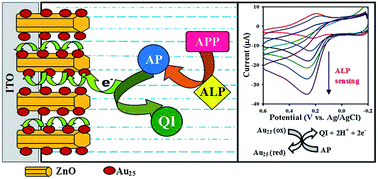
Well-defined composite electrodes were fabricated by combining redox-active Au25 nanoclusters with highly oriented ZnO nanorods. The structure and electrocatalytic activity of the composite electrodes were examined for the development of an amperometric sensor for alkaline phosphatase.
Recently, ZnO nanostructures have attracted much interest in electrochemical biosensors due to their biocompatibility, chemical stability, and electron communicating ability.5a Their desired orientations with a high isoelectric point (∼9.5) allow facile and strong binding of various biomolecules on their surfaces, making them an attractive matrix for biosensor applications.5b ZnO nanostructures formed on various substrate electrodes have been used for the detection of biomolecules such as glucose, α-fetoprotein and rheumatoid arthritis.6 Hybrid nanocomposites of ZnO have also been explored for biosensors. ZnO films modified with a redox-active mediator such as toluidine blue were employed for the detection of NADH.7 Whereas ZnO matrix provides biocompatible environment, the redox-active molecule immobilized on the ZnO surface acts as a mediator, allowing sensitive detection of NADH at a low overpotential. In these nanocomposites, however, the intrinsically toxic nature of such mediator appears to limit their wide use in biosensors.8
Gold nanoparticles have been widely employed in electrochemical biosensors due to their biocompatibility, high conductivity, and electrocatalytic activity.9a Gold nanoparticles dispersed in various substrates such as self-assembled monolayer, carbon paste and polymer matrices have been used for chemical and biological sensing.9b Gold nanoparticles grown on ZnO nanostructures also showed enhanced electrocatalytic activity towards the detection of glucose and hydrazine.10 However, gold nanoparticles employed in these composites have been limitedly used to enhance the electrocatalytic activity of the composites and their redox mediating ability remains largely unexplored. In this work, we explore the possibility of utilizing a redox-active Au25 cluster as a mediator by immobilizing it on ZnO nanorods (NRs) for the determination of alkaline phosphatase (ALP), a common enzyme label in immunoassays.11a The quantitative determination of ALP is also of interest in the field of routine clinical analysis. The diseases of liver and bone such as Paget's disease, osteomalacia and hepatitis are known to be related with high levels of serum ALP.11b Thus, the rapid and sensitive determination of ALP is of high significance.
Highly oriented ZnO nanorods with average diameter of 150 nm and length of 1.5 μm were grown on indium tin oxide (ITO) electrode via a two-step solution process (ESI†).12 Glutathione-stabilized Au25 clusters were synthesized according to a procedure4b,13 described in ESI.† They display the characteristic UV-vis absorption profile of Au25 clusters1 as shown in Fig. S1 (ESI†) and have a composition of Au25(glutathione)18 as confirmed by the negative-ion electrospray ionization (ESI) mass spectrum in Fig. S2 (ESI†). Four sets of peaks observed with m/z 1500–3000 represent 7-, 6-, 5-, and 4-anions of Au25(glutathione)18. The prepared ZnO/ITO electrode was then modified with glutathione-stabilized Au25 clusters by dropcasting an aqueous Au25 solution on the surface of ZnO nanorods and dried at 50 °C (Scheme 1). The glutathione ligand possesses two negatively charged carboxylate groups at a neutral pH (see Fig. S1 inset, ESI†). It is thus expected that glutathione-stabilized Au25 clusters electrostatically bind to the positively charged ZnO surface at a neutral pH. The fabrication procedure of Au25/ZnO/ITO electrodes is described in ESI.†
![]() | ||
| Scheme 1 Schematic of Au25/ZnO/ITO electrode for the sensing of ALP by Au25-mediated oxidation of AP to QI. | ||
As shown in Fig. 1A, the image taken using a field-emission scanning electron microscope (SEM) shows that the entire ITO electrode is densely coated with highly uniform ZnO nanorods. In addition, the transmission electron microscopy (TEM) image in Fig. 1A inset shows that the ZnO surface is uniformly coated with Au25 clusters. The SEM energy dispersive spectrum (Fig. S3, ESI†) of the nanocomposite shows the presence of Au along with Zn, confirming stable immobilization of Au25 on ZnO nanorods.
In Fig. 1B, cyclic voltammograms (CVs) of bare ITO (black line) and ZnO/ITO electrode (blue line) in 0.1 M KCl show no distinct peak but only capacitive charging current. When ZnO/ITO electrode is modified with Au25 clusters, reversible anodic and cathodic peaks of Au25 are found at 0.23 and 0.17 V (vs. Ag/AgCl), respectively, that can be assigned to the redox peaks of Au25. As observed before,4a the redox peaks of Au25+/0 and Au250/− couples are not well resolved in aqueous media presumably due to the high dielectric constant of the surrounding media. At any rate, the characteristic redox peaks of Au25 confirm that Au25 clusters are stably immobilized on ZnO nanorods and retain their redox activity. The effect of scan rate on the voltammetric response of the Au25/ZnO/ITO electrode was examined in the range of 5–200 mV s−1 (Fig. 1C). The linear correlation of the peak currents (Ip) with square root of scan rates (ν1/2) suggests the voltammetric current response is controlled by the diffusion-like electron hopping process between Au25 clusters on ZnO surface.4a
The facile anchoring process of Au25 on ZnO enabled the control of Au25 loading by varying the amount of Au25 dropcast on ZnO surface. The Au25 loading on ZnO can be estimated by the integrated charge of the corresponding voltammetric peak. As can be seen in Fig. 1D, the Au25 loading increases with Au25 addition and levels off at around (∼330 μg cm−2). Beyond this concentration, Au25 clusters appear to be physically adsorbed but electrically unconnected to the ZnO/ITO electrode. The maximum Au25 loading was found to be ca. 8 × 10¹³ clusters per cm2, which corresponds to ∼8 full monolayers of Au25 on ITO substrate, showing that highly dense packing of Au25 can be achieved using ZnO nanorods.
ALP is known to hydrolyze a variety of orthophosphoric monoesters into the corresponding detectable phenol derivatives.11a We first examined the voltammetric response of the Au25/ZnO/ITO electrode towards oxidation of p-aminophenol (AP), the end product of the enzymatic hydrolysis of p-aminophenylphosphate (APP) by ALP (Scheme 1). Fig. 2A shows CVs of Au25/ZnO/ITO in the presence of 0, 0.05, 0.11, 0.17 and 0.23 mM of AP. The anodic peak currents significantly increase upon the addition of AP, indicating the mediated electrocatalytic activity of Au25. As the potential is swept to the positive direction, Au25 is first oxidized. In the presence of AP the oxidized Au25 electrocatalytically oxidizes AP to quinoneimine (QI) while it is reduced, as illustrated in Scheme 1. This process leads to enhancement of the anodic current of Au25. The generated QI is rapidly hydrolyzed to p-benzoquinone and therefore only the increase in the anodic current is observed. For ZnO/ITO electrode (Fig. 2B), the oxidation of AP only occurs at a higher overpotential and the increment of current is much lesser than that observed for the Au25/ZnO/ITO electrode.
The calibration graph shown in Fig. 2C shows the current response linearly increases with AP concentration in the range from 0.62 μM to 0.8 mM. The detection limit (S/N = 3) and the sensitivity were found to be 0.21 μM and 193.5 μA mM−1, respectively. These values are comparable or better than those of recently reported electrochemical sensors for the determination of AP.14 Evidently, the sensitivity increases with Au25 loading as can be seen in Fig. 2D. The sensitivity (determined in the range of 0.62–100 μM) for the composite electrode with Au25 loading of 0.05 × 10¹³ clusters per cm2 was found to be 50.1 μA mM−1. It increases linearly with Au25 loading and reaches to 203.4 μA mM−1 when the loading is increased to 8.3 × 10¹³ clusters per cm2, confirming the role of Au25 in the detection of AP. The selectivity of the Au25/ZnO/ITO electrode for the detection of AP was also investigated. The Au25/ZnO/ITO electrode was found to exhibit some voltammetric response in the presence of potential interferents such as ascorbic acid and uric acid. To reduce the interference effect of these anions, the Au25/ZnO/ITO electrode was coated with Nafion (1 vol% ethanol solution) and examined for the detection of AP in the presence of ascorbic acid and uric acid. As can be seen in Fig. S4 (ESI†) the Nafion coated electrode shows similar voltammetric oxidation and reduction peaks, but it shows much higher resistance to the addition of interferents; up to 240 μM and 150 μM for ascorbic acid and uric acid, respectively.
The detection of AP under dynamic condition was also examined by monitoring the chronoamperometric (CA) response of Au25/ZnO/ITO electrode under stirring for the successive additions of AP with 60 s intervals at a fixed potential of 0.25 V as shown in Fig. S5 (ESI†). It was found from the amperogram and the calibration plot that this composite electrode exhibits an excellent linearity with enhanced sensitivity (247.8 μA mM−1) for the determination of AP.
The successful determination of AP with the Au25/ZnO/ITO electrodes prompted us to directly determine the ALP activity as it rapidly hydrolyses APP to AP (Scheme 1). ALP is known to exhibit maximum activity at 37 °C in the presence of Mg2+ that serves as an activator in basic media.15 However, the electrostatic interaction between Au25 and ZnO becomes noticeably weakened above pH 9 and thus the determination of the ALP activity was conducted at pH 8 in the presence of 0.5 mM APP and 1 mM MgCl2 at 37 °C. The change in CV upon the addition of ALP is shown in Fig. 3. The anodic current of Au25 increases linearly with ALP and the sensitivity for the determination of ALP was found to be 90.7 nA U−1 L. It is noteworthy that the detection potential of 0.25 V (vs. Ag/AgCl) with the composite electrode is much lower than those reported with screen printed graphite and micropatterned ITO electrodes for the determination of ALP.11a,16
The time-dependent current response of the Au25/ZnO/ITO composite electrode towards the detection of the ALP activity was also tested using CA in the range up to 300 U L−1 at 0.25 V. As shown in Fig. S6A (ESI†), the current response increases with ALP and the sensitivity determined from the initial slopes of the amperometric response curves was found to be 0.4925 nA s−1 U−1 L with a detection limit of 1.77 U L−1 (see Fig. S6B, ESI†). This sensitivity is more than 100 times higher than that reported for ALP sensing,11a enabled presumably by high electrocatalytic activity and dense packing of Au25 on ZnO nanorods. The current responses in Fig. S6A† were found to be curved due to the depletion of AP during the amperometric measurement.
In summary, we have developed a highly sensitive electrochemical sensor by immobilizing redox-active Au25 clusters on ZnO nanorods. The high sensitivity could be realized by the excellent mediated electrocatalytic activity and dense loading of Au25 clusters on ZnO nanorods. With the unique size-dependent redox potentials, electrocatalytic activity and facile ligand engineering, the ultrasmall gold clusters immobilized on biocompatible ZnO nanostructures may prove useful in the development of biosensors and immunosensors.
Footnotes |
| † Electronic supplementary information (ESI) available: Experimental, characterization and amperometric studies of Au25/ZnO/ITO electrodes. See DOI: 10.1039/c4ra00256c |
| ‡ These authors contributed equally to this work. |
| This journal is © The Royal Society of Chemistry 2014 |