Fe3+ facilitating the response of NiO towards H2S

Fang Li, Yuejiao Chen and Jianmin Ma*
Key Laboratory for Micro-Nano Optoelectronic Devices of Ministry of Education, State Key Laboratory for Chemo/Biosensing and Chemometrics, Hunan University, Changsha, P. R. China. E-mail: nanoelechem@hnu.edu.cn

Received 8th January 2014 , Accepted 27th February 2014

First published on 28th February 2014


Abstract

Fe2O3-loaded NiO nanoplates have been successfully prepared by a facile method by immersing NiO nanoplates in aqueous Fe(NO3)3 solution and annealing the corresponding as-immersed NiO nanoplates. When studied as sensing materials, the as-fabricated Fe2O3-loaded NiO nanoplates display enhanced response towards H2S in comparison with pure NiO nanoplates.

Gas sensing has been widely studied owing to its important applications in environmental monitoring. Gas-sensing performance usually depends on the as-employed sensing materials. So far, many semiconductors have been explored as important sensing materials, such as Fe2O3,1,2 ZnO,3,4 WO3,5,6 SnO2,7,8 CuO,9,10 TiO2,11,12 NiO13,14 and Co3O4,15,16 etc. Moreover, other strategies have also been employed to improve the sensing performance, such as noble metal doping oxides,17–19 heterogeneous oxides,20–22 and carbon or polymer/oxides,23–26 etc.

As one of most important p-type sensing semiconductors, various NiO materials have been studied.13,14,27–30 However, pure NiO usually has relatively poor sensing properties. Much effort has been made to modify NiO nanostructures to achieve excellent gas-sensing properties.31–35 For example, NiO@ZnO heterostructured nanotubes fabricated by the coelectrospinning method improved H2S-sensing properties owing to the change of nanostructure and activity of ZnO and NiO nanocrystals as well as combination of homo- and heterointerfaces.31 Nguyen et al. reported that the response of the NiO-decorated SnO2 nanowire sensor to 10 ppm H2S at 300 °C reached as high as 1372 owing to the catalytic effect of NiO and the formation of a continuous chain of n–p–n–p junctions.32 Inspired by these examples, exploring an alternative, facile decorating method is highly desirable.

Fe2O3 is a well-known H2S-sensing material.1,2,36–38 Thus, it is expected that loading Fe2O3 on NiO nanoplates could exhibit high response towards H2S gas. In this communication, we have prepared the Fe2O3-loaded NiO nanoplates through immersing hydrothermally proceeded NiO nanoplates with aqueous Fe(NO3)3 solution and annealing the corresponding as-immersed NiO nanoplates. The as-fabricated Fe2O3-loaded NiO nanoplates have largely enhanced the response towards H2S in comparison with pure NiO nanoplates.

The Fe2O3-loaded NiO nanoplates were prepared by two steps: (1) NiO nanoplates were obtained through annealing hydrothermally proceeded Ni(OH)2 nanoplates with the assistance of n-butylamine;38 (2) Fe2O3-loaded NiO nanoplates were produced through annealing immersed NiO nanoplates with aqueous Fe(NO3)3 solution. The phase of NiO and Fe2O3-loaded NiO was analyzed by X-ray diffraction (XRD). In Fig. 1, one could find that all the peaks in patterns could be attributed to these of the standard card (PDF: 47-1049).39 There is no diffraction peak of Fe2O3 observed for the XRD pattern of Fe2O3-loaded NiO nanoplates, which indicate that the content of Fe2O3 is extremely low. The content of Fe2O3-loaded NiO nanocomponents is about 3.9% by weight, as supported by EDX (Fig. S1).


image file: c4ra00182f-f1.tif
Fig. 1 XRD pattern for NiO nanoplates and Fe2O3-loaded NiO nanoplates.

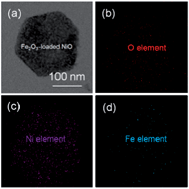
The morphology, composition and elemental distribution of the as-fabricated Fe2O3-loaded NiO nanoplates were further mapped through TEM and EDS by displaying the integrated intensity of oxygen, nickel and iron signals as a function of the beam position when operating the TEM in scanning mode (STEM). The SEM image of NiO without Fe2O3 loading (Fig. 2a) shows the hexagonal nanoplates, similar to our previous report.39 The as-fabricated Fe2O3-loaded NiO sample (Fig. 2b) is composed of hexagonal nanoplates, which is similar to the unloaded NiO nanoplates. Fig. 2c shows an HAADF-STEM image of the Fe2O3-loaded NiO nanoplate. The results shown in Fig. 2d–f reveal that the three elements of O, Ni, and Fe are distributed very homogeneously in the nanoplate. Moreover, the Fe/Ni ratio measured from the nanoplates with EDS analysis show an average ratio of 72.03[thin space (1/6-em)]:[thin space (1/6-em)]2.63. The mapping data indicates that our as-employed method is effective for us to prepare Fe2O3-loaded NiO nanoplates.


image file: c4ra00182f-f2.tif
Fig. 2 (a and b) SEM images of NiO nanoplates and Fe2O3-loaded NiO nanoplates, respectively; STEM-EDS elemental maps of as-fabricated Fe2O3-loaded NiO nanoplates: (c) HAADF-STEM image, (d) O elemental map, (e) Ni elemental map, and (f) Fe elemental map.

To understand the gas-sensing properties of Fe2O3-loaded NiO nanoplates, we compared the response characteristics of NiO nanoplates and Fe2O3-loaded NiO nanoplates-based gas sensor, respectively. Fig. 3a and b display that the typical response and recovery time of two sensors to 10 ppm H2S at different temperature. From Fig. 3a, it could be found that the response of the two sensors have the same change trend, the response increases with the increase of operating temperature at the beginning, and approaches a maximum value at 200 °C (named as the optimum operating temperature), however, gradually decreases with further increasing operating temperature. The response of Fe2O3-loaded NiO nanoplates is constantly higher than that of NiO nanoplates at different temperatures. Moreover, the recovery time of NiO nanoplates and Fe2O3-loaded NiO nanoplates were also studied, as shown in Fig. 3b. The recovery time vary from 27 to 13 s (from 25 to 350 °C) for Fe2O3-loaded NiO nanoplates, which did not change much when changing the operating temperature. However, the recovery time of NiO nanoplates dropped dramatically with the temperature increasing from 25 to 250 °C. Analyzed from the data of their response and recovery time, we chose 200 °C as the working temperature.


image file: c4ra00182f-f3.tif
Fig. 3 (a) Response and (b) recovery time of NiO nanoplate and Fe2O3-loaded NiO nanoplate sensors to 10 ppm H2S gas at different working temperature.

To understand the sensing characteristics of two sensors, the real-time response curves of Fe2O3-loaded NiO sensor and NiO sensor to H2S gas with increased concentration ranging from 1 to 100 ppm at a working temperature of 200 °C were investigated, as shown in Fig. 4a and b, respectively. In Fig. 4a and b, one could find that gas responses increase with the increase of H2S concentration. As shown in Fig. 4c, the Fe2O3-loaded NiO nanoplate sensor shows the response of approximately 2.89, 3.8, 7.35, 13.8, 26.48, and 109.4 for the corresponding 1, 5, 10, 20, 50, and 100 ppm H2S gas, respectively. In comparison, the NiO nanoplates based sensor shows response of approximately 1.64, 1.82, 2.94, 3.95, 3.83, and 10.19 for the corresponding 1, 5, 10, 20, 50, and 100 ppm H2S gas, respectively. It is clearly found that the response of NiO nanoplates towards H2S gas after loading Fe2O3 is improved dramatically. The response is compared with those results reported by some literatures.1,2 However, the sensing mechanism of NiO and Fe2O3-loaded NiO sensor towards H2S gas is different from those reported literatures involved Fe2O3.1,2 The gas-sensing behavior of the p-type NiO semiconductor towards H2S gas can be explained by the decrease in the hole concentration due to the increased formation of negatively charged oxygen upon exposure to the oxidizing gas (H2S). After injection of H2S gas, H2S molecules were adsorbed on the surface, providing electrons to the surface of NiO nanoplates. During this process the potential barrier increased and hence the resistance of the oxide was enhanced. Moreover, owing to extrahigh molar ratio of NiO to Fe2O3, the Fe2O3-loaded NiO nanoplates show the gas-sensing behavior of p-type semiconductors towards H2S gas. The NO2-sensing performance of Fe2O3-loaded NiO nanoplates are largely improved owing to the change of nanostructure and activity of NiO and Fe2O3 as well as combination of homo- and heterointerfaces.31


image file: c4ra00182f-f4.tif
Fig. 4 (a and b) The real-time response curve of the Fe2O3-loaded NiO nanoplate and NiO nanoplate sensors to H2S gas with increased concentration at a working temperature of 200 °C, respectively; (c) the relationship between the response and H2S concentration.

To further confirm the versatility of as-fabricated Fe2O3-loaded NiO nanoplate sensors, the selective test towards to 50 ppm CO, CH4, SO2 and H2S was conducted at 200 °C, respectively. Fig. 5 indicates that both of NiO nanoplate and Fe2O3-loaded NiO nanoplate sensors show excellent selectivity to H2S gas. This indicates that the Fe2O3-loaded NiO nanoplate sensor has a quite wonderful selectivity to H2S gas.


image file: c4ra00182f-f5.tif
Fig. 5 Sensor response to various gases with 50 ppm at 200 °C.

In Fig. 6a and b, the reproducibility and stability of the NiO nanoplate and Fe2O3-loaded NiO nanoplate sensors were also investigated. The results indicate that the Fe2O3-loaded NiO nanoplate sensor maintains 82.7% of its initial response amplitude after ten successive sensing tests to 50 ppm H2S gas at 200 °C, which is better than that the NiO nanoplates (74.4%). These results demonstrate that the Fe2O3-loaded NiO nanoplate sensor has better reproducibility and stability to H2S gas than the NiO nanoplates sensor.


image file: c4ra00182f-f6.tif
Fig. 6 (a and b) The reproducibility and stability of the Fe2O3-loaded NiO nanoplates and NiO nanoplates sensors to 50 ppm H2S gas at 200 °C.

In summary, we have developed a synthetic route to prepare Fe2O3-loaded NiO nanoplates with high response, excellent selectivity towards H2S gas. Our as-employed method to immerse NiO nanoplates with aqueous Fe(NO3)3 solution and anneal the corresponding as-immersed NiO nanoplates is proven to be effective to synthesize Fe2O3-loaded NiO nanoplates. The as-fabricated Fe2O3-loaded NiO nanoplates are promising H2S-sensing materials due to its response as high as 26.48 and excellent selectivity towards 50 ppm H2S gas.

Acknowledgements

This work was supported by the National Natural Science Foundation of China (Grant no. 51302079) and the Young Teachers' Growth Plan of Hunan University (Grant no. 2012-118).

Notes and references

  1. J. M. Ma, L. Mei, Y. J. Chen, Q. H. Li, T. H. Wang, X. C. Duan and W. J. Zheng, Nanoscale, 2013, 5, 895–898 RSC.
  2. J. W. Deng, J. M. Ma, L. Mei, Y. J. Tang, Y. J. Chen, T. Lv, Z. Xu and T. H. Wang, J. Mater. Chem. A, 2013, 1, 12400–12403 CAS.
  3. S. Q. Tian, F. Yang, D. W. Zeng and C. S. Xie, J. Phys. Chem. C, 2012, 116, 10586–10591 CAS.
  4. J. Zhang, S. R. Wang, M. J. Xu, Y. Wang, B. L. Zhu, S. M. Zhang, W. P. Huang and S. H. Wu, Cryst. Growth Des., 2009, 9, 3532–3537 CAS.
  5. J. M. Ma, J. Zhang, S. R. Wang, T. H. Wang, J. B. Lian, X. C. Duan and W. J. Zheng, J. Phys. Chem. C, 2011, 115, 18157–18163 CAS.
  6. D. L. Chen, X. X. Hou, H. J. Wen, Y. Wang, H. L. Wang, X. J. Li, R. Zhang, H. X. Lu, H. L. Xu, S. K. Guan, J. Sun and L. Gao, Nanotechnology, 2010, 21, 035501 CrossRef PubMed.
  7. J. M. Ma, J. Zhang, S. R. Wang, Q. H. Wang, L. F. Jiao, J. Q. Yang, X. C. Duan, Z. F. Liu, J. B. Lian and W. J. Zheng, CrystEngComm, 2011, 13, 6077–6081 RSC.
  8. R. Li, J. M. Du, Y. X. Luan, H. Zou, G. S. Zhuang and Z. H. Li, CrystEngComm, 2012, 14, 3404–3410 RSC.
  9. F. Zhang, A. W. Zhu, Y. P. Luo, Y. Tian, J. H. Yang and Y. Qin, J. Phys. Chem. C, 2010, 114, 19214–19219 CAS.
  10. D. P. Singh, A. K. Ojha and O. N. Srivastava, J. Phys. Chem. C, 2009, 113, 3409–3418 CAS.
  11. C. X. Wang, L. W. Yin, L. Y. Zhang, Y. X. Qi, N. Lun and N. N. Liu, Langmuir, 2010, 26, 12841–12848 CrossRef CAS PubMed.
  12. M. H. Seo, M. Yuasa, T. Kida, J. S. Huh, K. Shimanoe and N. Yamazoe, Sens. Actuators, B, 2009, 137, 513–520 CrossRef CAS PubMed.
  13. B. Liu, H. Q. Yang, H. Zhao, L. J. An, L. H. Zhang, R. Y. Shi, L. Wang, L. Bao and Y. Chen, Sens. Actuators, B, 2011, 156, 251–262 CrossRef CAS PubMed.
  14. N. G. Cho, I. S. Hwang, H. G. Kim, J. H. Lee and I. D. Kim, Sens. Actuators, B, 2011, 156, 366–371 CrossRef PubMed.
  15. C. C. Li, X. M. Yin, T. H. Wang and H. C. Zeng, Chem. Mater., 2009, 21, 4984–4992 CrossRef CAS.
  16. C. W. Sun, S. Rajasekhara, Y. J. Chen and J. B. Goodenough, Chem. Commun., 2011, 47, 12852–12854 RSC.
  17. X. Y. Xue, Z. H. Chen, C. H. Ma, L. L. Xing, Y. J. Chen, Y. G. Wang and T. H. Wang, J. Phys. Chem. C, 2010, 114, 3968–3972 CAS.
  18. X. H. Liu, J. Zhang, L. W. Wang, T. L. Yang, X. Z. Guo, S. H. Wu and S. R. Wang, J. Mater. Chem., 2011, 21, 349–356 RSC.
  19. H. Kim, C. Jin, S. Park, S. Kim and C. Lee, Sens. Actuators, B, 2012, 161, 594–599 CrossRef CAS PubMed.
  20. M. R. Yu, R. J. Wu and M. Chavali, Sens. Actuators, B, 2011, 153, 321–328 CrossRef CAS PubMed.
  21. J. Kim, W. Kim and K. Yong, J. Phys. Chem. C, 2012, 116, 15682–15691 CAS.
  22. E. D. Gaspera, M. Guglielmi, S. Agnoli, G. Granozzi, M. L. Post, V. Bello, G. Mattei and A. Martucci, Chem. Mater., 2010, 22, 3407–3417 CrossRef.
  23. G. Singh, A. Choudhary, D. Haranath, A. G. Joshi, N. Singh, S. Singh and R. Pasrich, Carbon, 2012, 50, 385–394 CrossRef CAS PubMed.
  24. C. H. Zhan, Y. Z. Pan, Z. Wang, Y. F. Wang, H. F. He and Z. Y. Hou, Sens. Actuators, B, 2013, 183, 81–86 CrossRef CAS PubMed.
  25. Y. Wang, W. Z. Jia, T. Strout, A. Schempf, H. Zhang, B. Li, J. H. Cui and Y. Lei, Electroanalysis, 2009, 21, 1432–1438 CrossRef CAS.
  26. R. N. Bulakhe, S. V. Patil, P. R. Deshmukh, N. M. Shinde and C. D. Lokhande, Sens. Actuators, B, 2013, 181, 417–423 CrossRef CAS PubMed.
  27. H. Steinebach, S. Kannan, L. Rieth and F. Solzbacher, Sens. Actuators, B, 2010, 151, 162–168 CrossRef CAS PubMed.
  28. X. F. Song, L. Gao and S. Mathur, J. Phys. Chem. C, 2011, 115, 21730–21735 CAS.
  29. C. Y. Lee, C. M. Chiang, Y. H. Wang and R. H. Ma, Sens. Actuators, B, 2007, 122, 503–510 CrossRef CAS PubMed.
  30. A. Aslani, V. Oroojpour and M. Fallahi, Appl. Surf. Sci., 2011, 257, 4056–4061 CrossRef CAS PubMed.
  31. L. Xu, R. F. Zheng, S. H. Liu, J. Song, J. S. Chen, B. Dong and H. W. Song, Inorg. Chem., 2012, 51, 7733–7740 CrossRef CAS PubMed.
  32. N. V. Hieu, P. T. H. Van, L. T. Nhan, N. V. Duy and N. D. Hoa, Appl. Phys. Lett., 2012, 101, 253106 CrossRef PubMed.
  33. Z. J. Wang, Z. Y. Li, J. H. Sun, H. N. Zhang, W. Wang, W. Zheng and C. Wang, J. Phys. Chem. C, 2010, 114, 6100–6105 CAS.
  34. P. Lv, Z. A. Tang, J. Yu, F. T. Zhang, G. F. Zhang, Z. X. Huang and Y. Hu, Sens. Actuators, B, 2008, 132, 74–80 CrossRef CAS PubMed.
  35. M. Bao, Y. J. Chen, J. M. Ma, F. Li, T. Lv, Y. J. Tang, L. B. Chen, Z. Xu and T. H. Wang, Nanoscale, 2014 10.1039/c3nr05268k.
  36. J. M. Ma, J. Teo, L. Mei, Z. Y. Zhong, Q. H. Li, T. H. Wang, X. C. Duan, J. B. Lian and W. J. Zheng, J. Mater. Chem., 2012, 22, 11694–11700 RSC.
  37. B. Sun, J. Horvat, H. S. Kim, W. S. Kim, J. H. Ahn and G. X. Wang, J. Phys. Chem. C, 2010, 114, 18753–18761 CAS.
  38. P. Sun, Z. Zhu, P. L. Zhao, X. S. Liang, Y. F. Sun, F. M. Liu and G. Y. Lu, CrystEngComm, 2012, 14, 8335–8337 RSC.
  39. J. M. Ma, J. Q. Yang, L. F. Jiao, Y. H. Mao, T. H. Wang, X. C. Duan, J. B. Lian and W. J. Zheng, CrystEngComm, 2012, 14, 453–459 RSC.

Footnote

Electronic supplementary information (ESI) available. See DOI: 10.1039/c4ra00182f

This journal is © The Royal Society of Chemistry 2014
Click here to see how this site uses Cookies. View our privacy policy here.