
DOI:
10.1039/C3RA48075E
(Communication)
RSC Adv., 2014,
4, 13405-13408
Copper catalyzed nitrile synthesis from aryl halides using formamide as a nitrile source†
Received
31st December 2013
, Accepted 27th February 2014
First published on 3rd March 2014
Abstract
A copper iodide/triphenyl phosphine catalyzed simple and efficient protocol has been developed for cyanide free cyanation of aryl halide using formamide as a cyanide source. The reaction works well to furnish aryl nitriles using an inexpensive and easily available copper catalyst with triphenyl phosphine and phosphorus oxychloride. Under the optimized reaction conditions, a variety of electron-donating and electron-withdrawing aryl halides were efficiently converted into the respective nitriles in moderate to excellent yields.
Introduction
The aryl nitriles are important building blocks in pharmaceuticals, agrochemicals, heterocycles, natural products, therapeutic drugs, pigments etc.1 In addition, nitriles are easily transformed into variety of functional groups like amines, aldehydes, amides, ketones, tetrazoles, carboxylic acids and amidines.2 The well known method for nitrile synthesis is the transition metal catalysed cyanation of aryl halide. Conventionally, nitriles were synthesized by Sandmeyer and Rosenmund-von Braun reactions using stoichiometric amount of CuCN at 150–250 °C.3 Whereas, industrially more preferred method for the nitrile synthesis involves the reaction of toluene derivatives with oxygen and ammonia at 300–550 °C using fixed-bed heterogeneous catalyst i.e. ammoxidation.4 Subsequently, the cyanation of aryl halides were also carried out by using different cyanation reagent such as KCN,5 Zn(CN)2,6 CuCN,7 NaCN8 and acetone cyanohydrins.9 Furthermore, some groups have reported the formation of nitriles by using nickel, copper and palladium catalyst.10 Although, these protocols have various applications, they suffer from one or more drawbacks such as limited substrate scope, harsh reaction conditions, metal cyanides as cyanide source and liberation of hazardous gases limiting their applications. Next, the non toxic trimethylsilyl cyanide was also explored as a cyanide source for the cyanation reaction.11 However; the trimethylsilyl cyanide was prepared by using metal cyanide source. In addition, it is highly moisture sensitive and produces hydrogen cyanide by-product which limits its application for the nitrile synthesis.
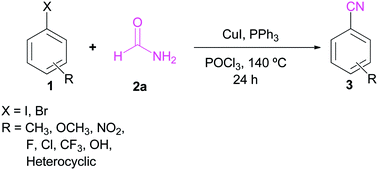
Recently, the cyanation of various organic moieties were also carried out by C–H activation using metal cyanide source, but the formation of cyano complex causes metal poisoning which is undesirable.12 Hence, a simple and efficient protocol for the transformation of aryl halides into the corresponding nitriles is highly desirable. The progress towards more sustainable protocol for nitrile synthesis had been made from aryl halides.13 Subsequently, some groups have developed a metal cyanide free cyanation for nitrile synthesis.14 In this context, we have recently reported the nitrile synthesis from aryl halides using palladium and rhodium catalyst along with xantphos ligand.15 In continuation of our interest, herein we report an cost efficient and attractive protocol for the synthesis of nitriles from aryl halides using inexpensive and easily available copper catalyst along with triphenyl phosphine ligand (Scheme 1). The protocol sounds to be more economical as it circumvents the use of expensive noble metal catalyst and phosphine ligands like xantphos.
Results and discussion
The reaction of 4-iodotoluene (1a) with formamide (2a) using copper catalyst and phosphine ligand was chosen as a model reaction for the optimization study. The results are summarized in Table 1. Initially, we have screened various copper precursors such as CuI, CuBr, CuCl, CuO, CuBr2, Cu(OAc)2·H2O and CuSO4·5H2O for cyanation of 1a (Table 1, entries 1–7), in which CuI was found to be the best catalyst providing an excellent yield of the desired product p-tolunitrile (3a) (Table 1, entry 1). The reaction selectively provided the desired nitrile product and aldehyde formation was not observed. However, the catalysts like CuBr, CuCl, CuO, CuBr2 furnished the p-tolunitrile (3a) in moderate to good yield (Table 1, entries 2–5). Whereas, Cu(OAc)2·H2O and CuSO4·5H2O were ineffective (Table 1, entries 6–7). The product formation was not observed in the absence of catalyst (Table 1, entry 8).
Table 1 Optimisation of reaction conditions for nitrile synthesisa

|
| Entry |
Catalyst (mol%) |
Ligand (mol%) |
Yieldb (%) |
| Reaction conditions: 4-iodotoluene (1 mmol), formamide (10 mL mmol−1), catalyst (20 mol%), ligand (20 mol%), POCl3 (2 mmol), 24 h, 140 °C, N2 atmosphere. GC yield. Aldehyde product. 120 °C. 30 h. 18 h. PPh3 = triphenyl phosphine, xantphos = 4,5-bis(diphenylphosphino)-9,9-dimethylxanthene, DPPF = 1,1′-bis(diphenylphosphanyl)ferrocene, DPPM = 1,1-bis(diphenylphosphino)methane, DPPE = 1,2-bis(diphenylphosphino)ethane, DPPP = 1,3-bis(diphenylphosphino)propane, DPPB = 1,4-bis(diphenylphosphino)butane. |
| 1 |
CuI |
PPh3 |
85 (00)c |
| 2 |
CuBr |
PPh3 |
69 |
| 3 |
CuCl |
PPh3 |
74 |
| 4 |
CuO |
PPh3 |
42 |
| 5 |
CuBr2 |
PPh3 |
35 |
| 6 |
Cu(OAc)2·H2O |
PPh3 |
N.R. |
| 7 |
CuSO4·5H2O |
PPh3 |
N.R. |
| 8 |
— |
PPh3 |
N.R. |
| 9 |
CuI |
Xantphos |
52 |
| 10 |
CuI |
DPPF |
35 |
| 11 |
CuI |
DPPM |
N.R. |
| 12 |
CuI |
DPPE |
N.R. |
| 13 |
CuI |
DPPP |
N.R. |
| 14 |
CuI |
DPPB |
N.R. |
| 15 |
CuI |
P(t-Bu)3 |
10 |
| 16 |
CuI |
— |
N.R. |
| 17d |
CuI |
PPh3 |
48 |
| 18e |
CuI |
PPh3 |
87 |
| 19f |
CuI |
PPh3 |
69 |
 |
| | Scheme 1 Copper catalyzed cyanation of aryl halide. | |
We further studied the effect of various phosphine ligands like P(t-Bu)3, xantphos, DPPF, DPPM, DPPE, DPPP and DPPB on reaction outcome (Table 1, entries 9–15). Among the various screened ligands, PPh3 was found to be the best ligand (Table 1, entry 1). However, reaction did not proceed in the absence of ligand (Table 1, entry 16). Next, we have investigated the effect of reaction temperature and time for the effective progress of the reaction. It was observed that the yield of the desired product decreased with decreasing the reaction temperature from 140 to 120 °C (Table 1, entry 17). Hence, the optimum temperature for the nitrile synthesis was found to be 140 °C. Whereas, no significant change in the yield of desired product was observed with increasing the reaction time upto 30 h (Table 1, entry 18). While, decreasing the reaction time from 24 to 18 h resulted in low yield of 3a (Table 1, entry 19). It shows that 24 h was an optimum time required for the completion of cyanation reaction. Subsequently, the reactions were carried out to study the effect of ligand and catalyst loading, it was found that 20 mol% catalyst along with 20 mol% ligand provided maximum yield of 3a (Table 1, entry 1).
Thus, the optimized reaction parameters for nitrile synthesis were aryl halide (1a, 1 mmol), formamide (10 mL mmol−1), copper catalyst (20 mol%), ligand (20 mol%), 140 °C, 24 h.
In order to broaden the scope of the developed protocol, a wide range of aryl halides were examined for the synthesis of nitrile derivatives (Table 2). The aryl halides containing the electron donating as well as electron withdrawing substituents were compatible under the optimized reaction condition and provided good to excellent yield of the corresponding nitriles. It was observed that iodobenzene reacts with formamide and provided desired product benzonitrile (3c) in 77% yield (Table 2, entry 3). When the reaction was performed by using 1-iodonaphthalene (1f) excellent yield of the desired product 1-naphthonitrile (3f) was obtained (Table 2, entry 6). The aryl halides with ortho substituents furnished the good yield as compared to para substituted aryl halides under the present reaction condition (Table 2, entries 1, 2, 4, 5 and 7–8). The less reactive aryl halides with electron withdrawing substituents 1g, 1h, 1i also provided the corresponding products 3g, 3h, 3i in good to moderate yield (Table 2, entries 7–9). The halo substituted aryl halides 1j, 1k, 1l furnished the respective products 3j, 3k, 3l in a moderate yield (Table 2, entries 10–12). The p-hydroxy iodobenzene (1m) also gave 39% yield of p-hydroxy benzonitrile (3m) (Table 2, entry 13). Next, the heteroaromatic halide 5-iodo-1H-indole (1n) provided the desired nitrile product 1H-indole-5-carbonitrile (3n) in good yield (Table 2, entry 14). Furthermore, the developed catalytic system was also applied to less reactive aryl bromide derivatives (Table 2). Interestingly, the various aryl bromide derivatives furnished the corresponding nitriles in moderate yield (Table 2, entries 15–18). However, aryl chloride does not work under the optimised reaction conditions (Table 2, entry 19).
Table 2 Substrate study for nitrile synthesisa
Conclusion
A simple and efficient catalytic system has been developed for the selective cyanation of aryl halides. The present protocol requires inexpensive and easily available copper iodide catalyst along with triphenyl phosphine ligand for the nitrile synthesis. The developed methodology tolerates wide range of electron donating as well as electron withdrawing functional groups and provides the respective nitrile products in moderate to excellent yield under the optimized reaction conditions.
Acknowledgements
The author A. B. Khemnar is greatly thankful to the Council of Scientific and Industrial Research (CSIR), India for providing senior research fellowship (SRF).
Notes and references
-
(a) D. E. Uehling, S. S. Nanthakumar, D. Croom, D. L. Emerson, P. P. Leitner, M. J. Luzzio, G. McIntyre, B. Morton, S. Profeta, J. Sisco, D. D. Sternbach, W.-Q. Tong, A. Vuong and J. M. Besterman, J. Med. Chem., 1995, 38, 1106–1118 CrossRef CAS;
(b) V. C. O. Njar and A. M. H. Brodie, Drugs, 1999, 58, 233–255 CrossRef CAS PubMed;
(c) J. S. Miller and J. L. Manson, Acc. Chem. Res., 2001, 34, 563–570 CrossRef CAS PubMed;
(d) D. Sriram and P. Yogeeswari, Medicinal Chemistry, Pearson Education, Munchen, 2007, p. 35 Search PubMed;
(e) M. B. Smith and J. March, March's Advanced Organic Chemistry, Reactions, Mechanisms, and Structure, Wiley, Hoboken, NJ, 6th edn, 2007 Search PubMed.
-
(a) Z. Rappoport, The Chemistry of the Cyano Group, Interscience Publishers, New York, 1970 Search PubMed;
(b) H. Ohno, A. Mori and S. Inoue, Chem. Lett., 1993, 375–378 CrossRef CAS;
(c) F. F. Fleming and Q. Wang, Chem. Rev., 2003, 103, 2035–2077 CrossRef CAS PubMed;
(d) P. Anbarasan, T. Schareina and M. Beller, Chem. Soc. Rev., 2011, 40, 5049–5067 RSC.
-
(a) K. W. Rosenmund and E. Struck, Ber. Dtsch. Chem. Ges., 1919, 2, 1749–1756 CrossRef;
(b) T. Sandmeyer, Chem. Ber., 1884, 17, 2650–2653 CrossRef;
(c) T. Sandmeyer, Chem. Ber., 1885, 18, 1492–1496 CrossRef.
-
(a) A. C. Stevenson, Ind. Eng. Chem., 1949, 41, 1846–1851 CrossRef CAS;
(b) W. I. Denton, R. B. Bishop, H. P. Caldwell and H. D. Chapman, Ind. Eng. Chem., 1950, 42, 796–800 CrossRef CAS.
-
(a) B. A. Anderson, E. C. Bell, F. O. Ginah, N. K. Harn, L. M. Pagh and J. P. Wepsiec, J. Org. Chem., 1998, 63, 8224–8228 CrossRef CAS;
(b) C. Yang and J. M. Williams, Org. Lett., 2004, 6, 2837–2840 CrossRef CAS PubMed;
(c) H.-J. Cristau, A. Ouali, J.-F. Spindler and M. Taillefer, Chem.–Eur. J., 2005, 11, 2483–2492 CrossRef CAS PubMed.
-
(a) M. Alterman and A. Hallberg, J. Org. Chem., 2000, 65, 7984–7989 CrossRef CAS PubMed;
(b) R. Chidambaram, Tetrahedron Lett., 2004, 45, 1441–1444 CrossRef CAS PubMed;
(c) F. G. Buono, R. Chidambaram, R. H. Mueller and R. E. Waltermire, Org. Lett., 2008, 10, 5325–5328 CrossRef CAS PubMed.
-
(a) T. Sakamoto and K. Ohsawa, J. Chem. Soc., Perkin Trans. 1, 1999, 2323–2326 RSC;
(b) A. J. Allentoff, B. Markus, T. Duelfer, A. Wu, L. Jones, G. Ciszewska and T. Ray, J. Labelled Compd. Radiopharm., 2000, 43, 1075–1085 CrossRef CAS.
-
(a) J. Zanon, A. Klapars and S. L. Buchwald, J. Am. Chem. Soc., 2003, 125, 2890–2891 CrossRef CAS PubMed;
(b) A. V. Ushkov and V. V. Grushin, J. Am. Chem. Soc., 2011, 133, 10999–11005 CrossRef CAS PubMed.
-
(a) M. Sundermeier, A. Zapf and M. Beller, Angew. Chem., Int. Ed., 2003, 42, 1661–1664 CrossRef CAS PubMed;
(b) T. Schareina, A. Zapf, A. Cotte, M. Gotta and M. Beller, Adv. Synth. Catal., 2011, 353, 777–780 CrossRef CAS.
-
(a) M. Sundermeier, A. Zapf and M. Beller, Eur. J. Inorg. Chem., 2003, 3513–3526 CrossRef CAS;
(b) R. K. Arvela and N. E. Leadbeater, J. Org. Chem., 2003, 68, 9122–9125 CrossRef CAS PubMed;
(c) L. Cassar, S. Ferrara and M. Foa, Adv. Chem. Ser., 1974, 132, 252–273 CrossRef CAS PubMed;
(d) J. Kim, J. Choi, K. Shin and S. Chang, J. Am. Chem. Soc., 2012, 134, 2528–2531 CrossRef CAS PubMed.
- Y. Ren, C. Dong, S. Zhao, Y. Sun, J. Wang, J. Ma and C. Hou, Tetrahedron Lett., 2012, 53, 2825–2827 CrossRef CAS PubMed.
-
(a) T. Dohi, K. Morimoto, Y. Kiyono, H. Tohma and Y. Kita, Org. Lett., 2005, 7, 537–540 CrossRef CAS PubMed;
(b) M. Sundermeier, A. Zapf, S. Mutyala, W. Baumann, J. Sans, S. Weiss and M. Beller, Chem.–Eur. J., 2003, 9, 1828–1836 CrossRef CAS PubMed;
(c) X. Jia, D. Yang, W. Wang, F. Luo and J. Cheng, J. Org. Chem., 2009, 74, 9470–9474 CrossRef CAS PubMed;
(d) X. Jia, D. Yang, S. Zhang and J. Cheng, Org. Lett., 2009, 11, 4716–4719 CrossRef CAS PubMed.
-
(a) Q. Wen, J. Jin, Y. Mei, P. Lu and Y. Wang, Eur. J. Org. Chem., 2013, 4032–4036 CrossRef CAS;
(b) Z. Shu, Y. Ye, Y. Deng, Y. Zhang and J. Wang, Angew. Chem., Int. Ed., 2013, 52, 10573–10576 CrossRef CAS PubMed.
-
(a) J. Kim and S. Chang, J. Am. Chem. Soc., 2010, 132, 10272–10274 CrossRef CAS PubMed;
(b) G. Zhang, X. Ren, J. Chen, M. Hu and J. Cheng, Org. Lett., 2011, 13, 5004–5007 CrossRef CAS PubMed;
(c) J. Kim, H. Kim and S. Chang, Org. Lett., 2012, 14, 3924–3927 CrossRef CAS PubMed;
(d) C. Pan, H. Jin, P. Xu, X. Liu, Y. Cheng and C. Zhu, J. Org. Chem., 2013, 78, 9494–9498 CrossRef CAS PubMed;
(e) D. K. T. Yadav and B. M. Bhanage, Eur. J. Org. Chem., 2013, 5106–5110 CrossRef CAS.
-
(a) D. N. Sawant, Y. S. Wagh, P. J. Tambade, K. D. Bhatte and B. M. Bhanage, Adv. Synth. Catal., 2011, 353, 781–787 CrossRef CAS;
(b) A. B. Khemnar, D. N. Sawant and B. M. Bhanage, Tetrahedron Lett., 2013, 54, 2682–2684 CrossRef CAS PubMed.
Footnote |
| † Electronic supplementary information (ESI) available. See DOI: 10.1039/c3ra48075e |
|
| This journal is © The Royal Society of Chemistry 2014 |
Click here to see how this site uses Cookies. View our privacy policy here.